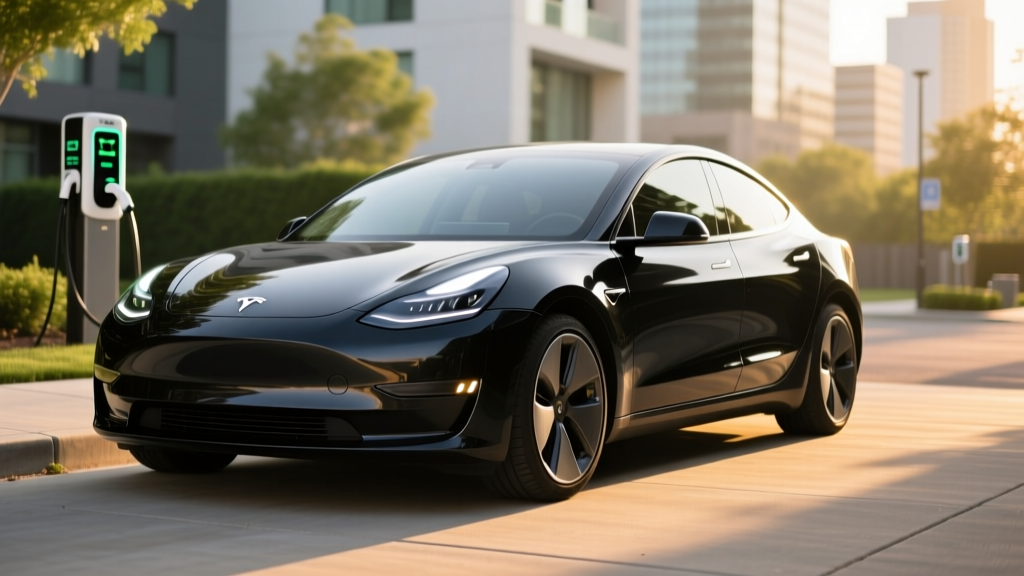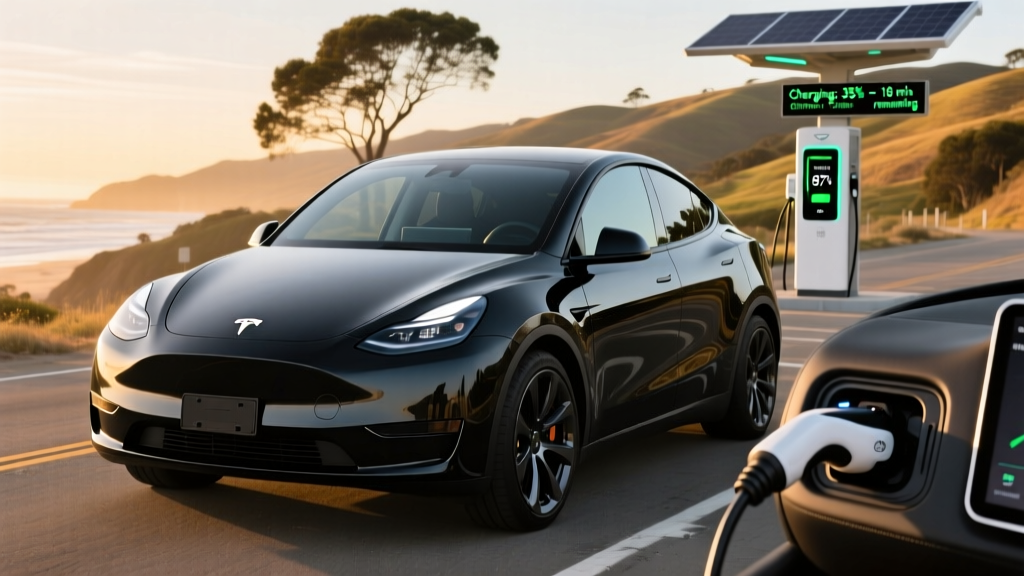
California remains the largest EV market in the United States, and the Tesla Model Y Performance continues to anchor Tesla's sales volume in the state. For 2026, the refreshed "Juniper" Model Y Performance brings a redesigned interior, improved ride quality, and updated battery management — but does it still deserve its spot on shortlists from San Jose to San Diego? We break down the exact range, charging speeds, pricing, and California-specific incentives buyers need before signing a purchase agreement.
2026 Model Y Performance: Core Specifications
| Specification | Value |
|---|---|
| EPA Estimated Range | 277 miles |
| Battery Capacity (Usable) | ~75 kWh, NMC (Nickel Manganese Cobalt) |
| Drivetrain | Dual Motor All-Wheel Drive |
| Horsepower | ~456 hp (combined) |
| 0–60 mph | 3.5 seconds |
| Top Speed | 155 mph |
| Max DC Fast Charge Rate | 250 kW (peak) |
| 10–80% DC Charge Time | ~25 minutes |
| Level 2 Home Charging | 11.5 kW (~44 mi/hr) |
| Efficiency | 111 MPGe combined / 30 kWh/100 mi |
| Cargo Volume (rear seats up / down) | 30.2 / 72.0 cu ft |
| Base MSRP | $51,490 (before incentives) |
| Battery & Drive Unit Warranty | 8 years / 120,000 miles |
Real-World Range: What California Drivers Actually Get
Real-World Expectation (California conditions): 240–265 miles in mixed driving; 220–240 miles sustained highway at 75+ mph. Cold-weather mountain trips (e.g., Tahoe in winter) can drop range to 190–210 miles due to temperature and elevation.
Why the gap? The EPA test cycle favors low-speed urban driving with climate off. Highway speeds above 65 mph increase aerodynamic drag exponentially, and battery thermal management consumes energy in cold ambient temperatures.
For most California commuters — think the 405, I-5, or US-101 corridors — the Model Y Performance delivers enough range to comfortably cover a 120-mile round-trip commute for two days before needing a charge. Where range anxiety surfaces is the drive to Lake Tahoe or Big Bear in January: expect to arrive at your destination needing a charge, and plan your Supercharger stop accordingly.
Tesla's trip planner in the navigation system is one of the most accurate in the industry, factoring in elevation, temperature, and driving speed. Trust it — it has saved more than a few drivers from a low-battery limp into Truckee.
Charging Speeds: Supercharger Network Advantage
Charging remains Tesla's strongest competitive moat. The 2026 Model Y Performance supports a peak DC fast-charge rate of 250 kW at V3 and V4 Supercharger stalls. Here is what that translates to in practice:
| Charging Level | Power (kW) | Miles Added per Hour | Typical Use Case |
|---|---|---|---|
| Level 1 (120V outlet) | ~1.4 kW | ~3–4 mi/hr | Emergency / trickle top-off |
| Level 2 (240V, 48A Wall Connector) | 11.5 kW | ~44 mi/hr | Overnight home charging |
| DC Fast Charge (V3 Supercharger) | Up to 250 kW (peak) | ~1,000+ mi/hr (at peak) | Road trips; 10–80% in ~25 min |
The charge-curve reality: Peak 250 kW is achieved only between roughly 10% and 30% state of charge. By 60%, the rate tapers to approximately 100 kW, and above 80% it drops further to protect battery longevity. This means a 10–80% session takes about 25 minutes, but 10–100% stretches closer to 45 minutes. For road trips, plan 80% stops and skip the final 20% unless you need the buffer for your destination.
California has the densest Supercharger network in the country, with over 700 stations and 7,000+ stalls statewide as of early 2026. Tesla has also opened portions of the Supercharger network to non-Tesla EVs via the built-in Magic Dock adapter, but Model Y owners still benefit from native plug-and-charge integration — no adapter needed, no app handshake delays.
Performance and Driving Dynamics
The Model Y Performance earns its badge. Dual electric motors produce approximately 456 combined horsepower, launching the crossover from 0–60 mph in 3.5 seconds. That puts it in sports-car territory — faster than a Porsche Cayenne S, for context, at a fraction of the price.
The 2026 Juniper refresh brought meaningful improvements to ride quality. Tesla retuned the suspension with frequency-selective damping and added acoustic glass, reducing cabin noise on rough California freeway surfaces (looking at you, I-710). The Performance trim retains adaptive dampers that firm up in Sport mode for canyon carving along Mulholland Drive or Highway 1, while remaining compliant enough for daily commuting.
Regenerative braking remains single-mode in 2026 (Tesla removed the adjustable regen setting several years ago). Lift off the accelerator and the car decelerates firmly, enabling one-pedal driving in most traffic scenarios. New EV drivers typically adapt within a week, and the reduced brake-pad wear is a tangible long-term savings.
Interior, Cargo, and Technology
The 2026 Juniper interior is a significant step up from the pre-refresh Model Y. New materials, ventilated front seats, ambient lighting, and a rear-seat touchscreen for climate and entertainment bring the cabin closer to luxury-compact territory. The 15.4-inch center touchscreen handles all infotainment, navigation, and vehicle settings — there are still no physical buttons for climate or volume, which remains polarizing.
Cargo space: 30.2 cubic feet behind the second row, expanding to 72.0 cubic feet with the 60/40 split rear seats folded. The front trunk (frunk) adds useful space for a charging cable bag or groceries. For a compact luxury crossover, these figures are class-competitive — the BMW iX offers similar volume, while the Ford Mustang Mach-E trails slightly at 29.7 / 59.7 cu ft.
Tech highlights:
- Tesla navigation with real-time Supercharger routing and battery preconditioning
- Over-the-air software updates adding features post-purchase
- Sentry Mode dashcam recording when parked
- Phone-as-key via Bluetooth (no fob needed)
- HEPA air filtration with Bioweapon Defense Mode
Notable drawbacks: No Apple CarPlay or Android Auto — Tesla's proprietary system is the only option. No heads-up display. The reliance on touchscreen controls for basic functions like mirror adjustment and glovebox release continues to frustrate some buyers. Turn-signal buttons on the steering wheel (rather than a stalk) remain a 2025/2026 change that divides opinion.
Pricing, Tax Credits, and California Incentives
| Item | Amount |
|---|---|
| Base MSRP (Performance AWD) | $51,490 |
| Destination Fee | $1,390 |
| Typical As-Tested (w/ FSD, Red Paint) | ~$61,490 |
| Federal §30D Tax Credit (if eligible) | Up to $7,500 |
| California CVRP Rebate (income-dependent) | Up to $2,000 |
| Effective Price After Max Incentives | From ~$41,990 |
Federal tax credit (IRS §30D) eligibility: The Model Y qualifies for up to $7,500 in federal tax credits, but eligibility depends on several factors that change periodically. As of 2026, the key requirements include:
- MSRP cap: SUVs/crossovers must be priced at or below $80,000 — the Model Y Performance clears this at $51,490 base.
- Buyer income cap: Modified adjusted gross income must not exceed $150,000 (single), $225,000 (head of household), or $300,000 (joint filers).
- Battery sourcing: Critical minerals and battery components must meet phased-in domestic-content and free-trade-agreement thresholds. Tesla's Fremont-built Model Y has historically qualified, but sourcing requirements tighten annually. Verify current eligibility at IRS.gov §30D page or via the Tesla checkout page, which displays credit eligibility in real time.
- Point-of-sale transfer: Since 2024, buyers can transfer the credit to the dealer (Tesla) at purchase, reducing the purchase price directly rather than waiting for a tax refund.
California-specific incentives: The Clean Vehicle Rebate Project (CVRP) offers up to $2,000 for income-eligible buyers. Additionally, many California utilities (PG&E, SCE, SDG&E) offer time-of-use electricity rates that make home charging significantly cheaper than gasoline — typically $0.12–$0.18/kWh off-peak, equating to roughly $0.04–$0.05 per mile versus $0.15+ per mile for a comparable gas crossover at $4.50/gallon. California also offers HOV lane access stickers for qualifying EVs, though the program has waitlists and phase-out timelines — check the California Air Resources Board for current status.
Efficiency and Operating Costs
The EPA rates the 2026 Model Y Performance at 111 MPGe combined, consuming approximately 30 kWh per 100 miles. This is excellent efficiency for a dual-motor performance crossover — the Jaguar I-PACE achieves 76 MPGe, and the BMW iX xDrive50 sits at 86 MPGe, for comparison.
For a California driver covering 12,000 miles annually at $0.15/kWh (blended home rate), annual electricity cost is approximately $540. A comparable gasoline crossover averaging 25 MPG at $4.80/gallon (California average) would cost $2,304 per year — a savings of roughly $1,760 annually, or $8,800 over five years, before accounting for reduced maintenance (no oil changes, fewer brake replacements).
Warranty and Long-Term Ownership
Tesla provides an 8-year/120,000-mile warranty on the battery and drive units, with a guaranteed minimum 70% capacity retention over that period. The basic vehicle limited warranty covers 4 years / 50,000 miles.
Battery chemistry context: The Model Y Performance uses NMC (nickel manganese cobalt) cells, which offer higher energy density than LFP (lithium iron phosphate) chemistry. This enables the Performance trim's range and power figures, but NMC batteries benefit from daily charging limits of 80–90% for longevity. Tesla's battery management system handles this automatically when you set a daily charge limit in the app. For road trips, charging to 100% is fine — just don't let the car sit at 100% for extended periods.
Long-term degradation data from Tesla's fleet indicates approximately 12% capacity loss at 150,000 miles for NMC packs — well within the warranty threshold. Out-of-warranty battery replacement remains expensive ($12,000–$16,000), but the failure rate is low based on current fleet data.
Autopilot and FSD: What You Need to Know
Every Model Y ships with Basic Autopilot (adaptive cruise control and lane centering on marked highways). The optional FSD (Supervised) package, priced at $8,000 or $99/month in 2026, adds automatic lane changes, traffic light and stop sign recognition, and navigation-guided on-ramp-to-off-ramp driving. FSD continues to improve via over-the-air updates but remains a supervised system requiring constant driver attention.
For California commuters on well-marked freeways, Autopilot significantly reduces fatigue. For complex urban environments, it remains imperfect — expect occasional phantom braking and lane-change hesitation. Evaluate whether the subscription model ($99/month) makes more sense than a lump-sum purchase based on your expected ownership duration.
Who Should Buy the Model Y Performance?
- You want sports-car acceleration (3.5s 0–60) in a practical family crossover
- You have access to home Level 2 charging (garage or driveway with 240V circuit)
- You take regular road trips and value the Supercharger network
- You commute on California freeways and want HOV lane access
- You prioritize over-the-air software updates and tech-forward ownership
- You need a third row (look at the Model X, Kia EV9, or Rivian R1S)
- You prefer Apple CarPlay/Android Auto integration
- You want a more traditional luxury interior with physical controls (BMW iX, Genesis GV60)
- You lack reliable home charging access and public infrastructure in your area is sparse
Model Y Performance vs. Key Competitors
| Spec | Tesla Model Y Perf. | BMW iX M60 | Ford Mustang Mach-E GT | Porsche Macan EV Turbo |
|---|---|---|---|---|
| EPA Range | 277 mi | 289 mi | 263 mi | 288 mi |
| 0–60 mph | 3.5 sec | 3.6 sec | 3.5 sec | 3.1 sec |
| Peak DC Charge | 250 kW | 200 kW | 150 kW | 270 kW |
| Base MSRP | $51,490 | $111,500 | $59,995 | $98,300 |
| Federal Credit Eligible | Yes (up to $7,500) | No (MSRP > $80K) | Yes (up to $7,500) | No (MSRP > $80K) |
| Cargo (rear up) | 30.2 cu ft | 35.5 cu ft | 29.7 cu ft | 26.4 cu ft |
The Model Y Performance's value proposition is difficult to beat: nothing else delivers sub-4-second acceleration, 277 miles of range, and Supercharger access below $55,000. The Mach-E GT is a credible alternative with more conventional controls and a slightly softer ride, but its 150 kW peak charging rate is a meaningful disadvantage on road trips. The BMW iX and Porsche Macan EV are superior in luxury and refinement but cost nearly double and, in the iX's case, exceed the federal tax credit MSRP cap.
Pros and Cons
- Class-leading acceleration (3.5s 0–60) at a mainstream price
- Supercharger network: the most reliable DC fast-charging ecosystem in the US
- 250 kW peak charging keeps road-trip stops under 30 minutes
- Strong efficiency (111 MPGe) reduces operating costs
- Continuous OTA updates add features post-purchase
- Excellent cargo versatility with frunk + 72 cu ft max
- No Apple CarPlay or Android Auto
- Touchscreen-only controls for mirrors, glovebox, and climate frustrate some users
- FSD (Supervised) remains Level 2 despite the "Full Self-Driving" name
- NMC battery prefers 80% daily charge limit — full charges reserved for trips
- Turn-signal buttons on steering wheel take adjustment
- No heads-up display available
Frequently Asked Questions
What is the real-world range of the 2026 Tesla Model Y Performance?
Expect 240–265 miles in mixed California driving conditions. Sustained highway driving at 75+ mph reduces range to approximately 220–240 miles. Winter mountain trips with cold temperatures and elevation gains can drop range to 190–210 miles. Always use Tesla's trip planner for route-specific estimates.
How fast does the Model Y Performance charge at home and on the road?
On a Level 2 home charger (Tesla Wall Connector at 48 amps / 11.5 kW), you'll add roughly 44 miles of range per hour — a full overnight charge easily replenishes a day's driving. On a V3 Supercharger, peak rate is 250 kW, delivering a 10–80% charge in approximately 25 minutes.
How much does the 2026 Model Y Performance cost after tax credits?
The base MSRP is $51,490 plus $1,390 destination. If you qualify for the full $7,500 federal §30D credit and the $2,000 California CVRP rebate, the effective price drops to approximately $41,990. Eligibility depends on income limits, battery sourcing requirements, and MSRP caps — verify at IRS.gov before purchasing.
Does the Model Y Performance qualify for the federal EV tax credit?
As of early 2026, yes — the Model Y Performance qualifies for up to $7,500 under IRS §30D, provided the buyer meets income caps ($150K single / $300K joint) and the vehicle's battery sourcing meets current critical-mineral and component thresholds. The credit can be transferred at point of sale, reducing your purchase price directly. Always confirm current eligibility, as sourcing rules tighten annually.
Is the Model Y Performance worth buying over the Long Range trim?
The Performance trim costs roughly $4,000 more than the Long Range AWD and sacrifices approximately 20 miles of EPA range (277 vs. ~297 mi) in exchange for 3.5-second 0–60 acceleration, adaptive dampers, performance brakes, and 21-inch wheels. If you value acceleration and sportier handling, the upgrade is worthwhile. If maximum range is your priority, the Long Range is the better choice.
Is Tesla's FSD actually self-driving?
No. Full Self-Driving (Supervised) is an SAE Level 2 driver-assistance system. You must keep your hands on the steering wheel and eyes on the road at all times. It handles highway lane changes, navigation-guided exits, and some city-street scenarios, but it is not autonomous. Only Level 4 robotaxi services like Waymo operate without driver supervision.
How does the Supercharger network compare to other charging networks in California?
Tesla's Supercharger network remains the most reliable public DC fast-charging ecosystem in the US, with 99.9% uptime and seamless plug-and-charge billing. Third-party networks (Electrify America, EVgo, ChargePoint) have improved but still report higher downtime rates and connector compatibility issues. Model Y owners benefit from native Supercharger access without adapters.
Sources: EPA range and efficiency data from fueleconomy.gov. Federal tax credit rules from IRS.gov §30D. Vehicle specifications from Tesla's official product pages. Safety ratings from NHTSA and IIHS.