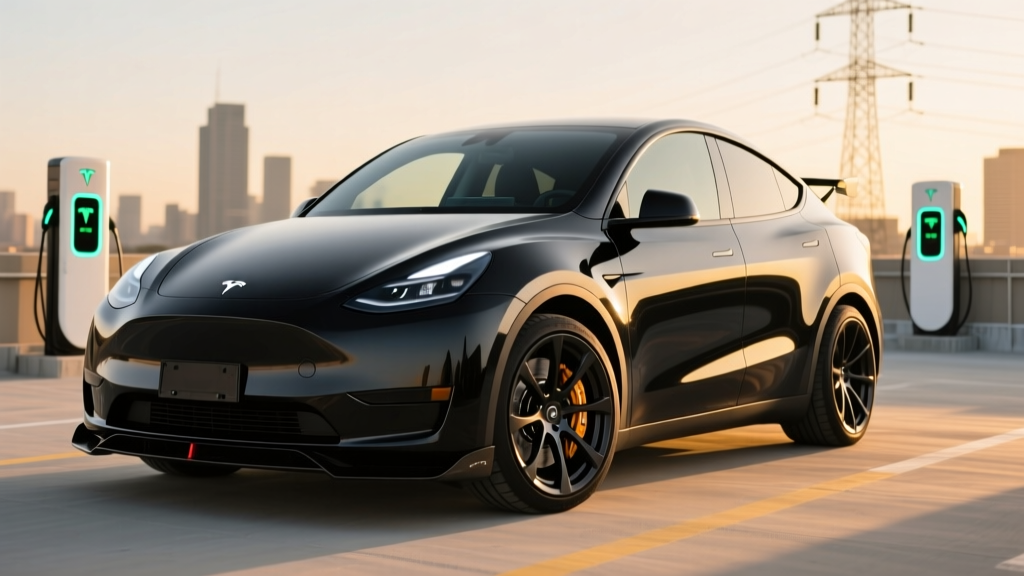
Tesla has officially teased an August 29th reveal of what appears to be a refreshed, high-output variant of its best-selling crossover — widely reported as a 510-horsepower Model Y Performance. The teaser, surfaced through Tesla's social channels and owner-community forums, has reignited speculation about a Juniper-refreshed performance trim that could slot above the current Long Range AWD and replace the outgoing Performance model's powertrain calibration.
As of this writing, Tesla has not published official specs, pricing, or delivery timelines for this variant. Everything below is based on the teaser details, current 2026 Model Y architecture, historical Performance trim data, and industry reporting. We will update this profile with confirmed figures the moment Tesla publishes them.
| Spec | Projected / Current Long Range AWD Baseline |
|---|---|
| Powertrain | Dual-motor AWD |
| Horsepower | 510 hp (teased) |
| 0-60 mph | ~3.5 sec (est. based on prior Performance) |
| Battery (usable) | ~75 kWh NMC (est.) |
| EPA Range | ~285-300 mi (est.; LR AWD = 320 mi) |
| DC Fast Charge Peak | 250 kW (V3 Supercharger) |
| 10-80% DC Time | ~25-27 min (est.) |
| Level 2 Home Charge | 11.5 kW / ~44 mi/hr |
| Base MSRP | TBD (LR AWD = $44,990) |
| Battery Warranty | 8 yr / 120,000 mi |
Range and Efficiency: Real-World Expectations
If the 510HP variant follows the pattern of Tesla's prior Performance trims, expect a modest EPA range penalty versus the Long Range AWD. The outgoing Model Y Performance was rated at 285 miles EPA versus 330 for the Long Range — a ~45-mile gap driven by stickier tires, stiffer suspension tuning, and more aggressive inverter mapping.
Real-World Highway (70-80 mph): Expect 240-260 miles in moderate temperatures.
Cold-Weather (sub-32°F): Plan for 190-220 miles without preconditioning; ~230-250 miles with battery preconditioning active. NMC chemistry loses roughly 20-30% range in deep cold.
Efficiency Target: ~105-110 MPGe combined / 28-30 kWh/100 mi (est.)
Tesla's heat pump (standard on Juniper-refreshed vehicles) mitigates cold-weather cabin-heating losses, but battery chemistry itself is the primary range limiter in winter. On a 300-mile road trip at highway speeds in 75°F weather, we'd expect this car to deliver approximately 250 usable miles between charges — enough for most intercity routes with a single Supercharger stop.
For the most accurate, updated EPA figures once published, check fueleconomy.gov.
Charging Speed: DC Fast, Level 2, and the Charge Curve
Tesla's Supercharger network remains the benchmark for public DC fast charging reliability. The current Model Y architecture supports a peak of 250 kW on V3 Superchargers. Unless Tesla introduces a 400V-to-800V inverter upgrade (unlikely for a mid-cycle refresh), the 510HP variant will likely share this ceiling.
| Level | Power | Miles Added per Hour | Notes |
|---|---|---|---|
| Level 1 (120V) | ~1.4 kW | ~5-6 mi/hr | Emergency/trickle only |
| Level 2 (240V, 48A) | 11.5 kW | ~44 mi/hr | Full overnight charge in ~7-8 hrs |
| DC Fast (V3 Supercharger) | Peak 250 kW | ~1,000 mi/hr (peak) | 10-80% in ~25-27 min |
| DC Fast (V4 Supercharger) | Up to 250 kW | ~1,000 mi/hr (peak) | Newer stalls; CCS adapter not needed for Tesla |
Charge curve reality: The 250 kW peak is sustained only between roughly 10-30% State of Charge. Above 50%, the curve tapers to ~100-120 kW; above 80%, it drops below 50 kW to protect cell longevity. Plan your road-trip stops around 10-80% windows for the fastest throughput. Preconditioning the battery via the car's navigation-routed Supercharger preconditioning is essential — arriving at a Supercharger without it can cut peak power to 100-150 kW in cold weather.
Performance: What 510 Horsepower Means in Practice
The teased 510HP figure represents a modest bump over the outgoing Model Y Performance's 456 hp. Dual-motor AWD is a given, with Tesla's permanent-magnet rear motor and induction front motor (for efficiency coasting and torque-vectoring).
Based on Tesla's historical power-to-weight scaling and the Juniper platform's weight (~4,400 lbs), a 0-60 mph time of approximately 3.5 seconds is a reasonable projection — roughly 0.2 seconds quicker than the outgoing Performance and competitive with the Porsche Macan 4 Electric and BMW iX M60.
Tesla's Performance trims historically include:
- Lowered sport suspension (~10mm drop)
- Performance brake package (larger front rotors, red calipers)
- 21-inch Überturbine wheels with Pirelli P Zero or Michelin Pilot Sport EV tires
- Track Mode (adjustable torque balance and regen tuning)
- Carbon fiber interior trim and aluminum alloy pedals
Pricing, Trims, and Federal Tax Credit Eligibility
Tesla has not published pricing for the 510HP variant. Using the current 2026 Model Y lineup as a baseline:
| Trim | Base MSRP | §30D Federal Credit | Effective Price (if eligible) |
|---|---|---|---|
| Long Range RWD | $42,990 | Up to $7,500 | ~$35,490 |
| Long Range AWD | $44,990 | Up to $7,500 | ~$37,490 |
| Performance (510HP, projected) | $48,990-$52,990 (est.) | Up to $7,500 | ~$41,490-$45,490 |
IRS §30D tax credit rules (2026): Eligibility is not automatic. Per IRS guidelines, buyers must meet all of the following:
- MSRP cap: SUVs/vans/pickups must have an MSRP at or below $80,000 (the Model Y qualifies)
- Income cap: Modified AGI must not exceed $150,000 (single), $225,000 (head of household), or $300,000 (joint)
- Battery sourcing: A percentage of critical minerals and battery components must be sourced from the US or FTA-partner nations — this requirement tightens annually and has disqualified some trims in prior years
- Point-of-sale transfer: Buyers can transfer the credit to the dealer at purchase for an immediate price reduction, or claim it on their tax return
Tesla's US-built vehicles have historically qualified for the full $7,500 credit, but battery-sourcing rules change annually. Confirm eligibility on the IRS clean vehicle credit page or with a tax professional before purchasing.
Interior, Cargo, and Technology
The Juniper refresh brought meaningful interior improvements to the Model Y: ventilated front seats, ambient lighting, a rear-seat touchscreen, power-folding second row, and improved NVH (noise/vibration/harshness) insulation. The 510HP Performance variant will likely add Alcantara-style headliner, carbon fiber trim, and Performance-specific badging.
Cargo volume:
- Behind second row: ~30.2 cu ft
- Second row folded: ~72.1 cu ft
- Front trunk (frunk): ~4.1 cu ft
Passenger space:
- Front legroom: 41.8 in
- Rear legroom: 41.6 in (Juniper improved this significantly over pre-refresh)
- Seating: 5-passenger standard; 7-seat option unlikely on Performance trim due to sport suspension
Infotainment and driver assist: The 15.4-inch center touchscreen runs Tesla's proprietary OS with native navigation, streaming, and gaming. Autopilot (SAE Level 2) is standard; Full Self-Driving (Supervised) is a $8,000 option. Neither system is self-driving — the driver must remain engaged and hands on the wheel at all times. Only Level 4 robotaxi services (Waymo, Zoox) operate without a driver.
Warranty, Ownership Costs, and Long-Term Battery Outlook
Tesla's battery and drive unit warranty for the Model Y is 8 years or 120,000 miles, whichever comes first, with a minimum 70% capacity retention threshold. This is competitive with Hyundai/Kia (10yr/100,000mi) and slightly above the industry average for NMC packs.
NMC (nickel-manganese-cobalt) chemistry offers higher energy density than LFP (lithium iron phosphate), which is why Tesla reserves it for Long Range and Performance trims. The trade-off: NMC degrades slightly faster than LFP over time and is more sensitive to sustained 100% State of Charge. Tesla recommends daily charging to 80-90% for NMC vehicles and 100% only before long trips.
Insurance: Model Y Performance trims typically carry higher premiums than Long Range variants due to higher repair costs and acceleration-related risk. Expect $1,800-$2,800/year depending on your profile (data from industry averages; get a personalized quote before purchasing).
Maintenance: No oil changes, no spark plugs, no transmission fluid. Cabin air filter replacement every 2 years, tire rotation every 6,250 miles, brake fluid check every 2 years, and tire replacement every 25,000-40,000 miles (Performance tires wear faster due to compound and weight).
How It Compares: Key Competitors
- 510 hp and ~3.5-sec 0-60 in a practical crossover
- Access to Tesla's Supercharger network (17,000+ US stalls)
- Best-in-class software, OTA updates, and app integration
- Strong cargo/passenger utility in Juniper refresh
- Likely qualifies for full $7,500 federal credit
- Range penalty vs Long Range (~35-45 mi less)
- Performance tires wear quickly and cost $300+ each
- No Apple CarPlay / Android Auto
- FSD (Supervised) remains Level 2 — not autonomous
- Minimal physical controls; all functions via touchscreen
Competitive landscape:
- Porsche Macan 4 Electric: More refined ride, 800V architecture (faster charging), but starts ~$20K higher
- BMW iX xDrive50: Larger, more luxurious, but heavier and less efficient
- Ford Mustang Mach-E GT: 480 hp, comparable price, but less range and weaker charging network access
- Genesis GV60 Performance: 483 hp, premium interior, but limited DCFC network and lower range
Who Should Wait for This Model?
The 510HP Model Y Performance targets a specific buyer: someone who wants sports-sedan acceleration in a family-capable crossover, values the Supercharger network for road trips, and doesn't mind a 35-mile range trade-off for the performance hardware. If your priority is maximum range or lowest cost, the Long Range RWD at ~$42,990 (before credit) is the smarter buy. If you want the quickest, most engaging Model Y and can absorb higher tire and insurance costs, this Performance variant — once officially revealed and priced — will likely be the segment benchmark.
What is the real-world range of the 510HP Model Y Performance?
Projected at ~285-300 miles EPA. In real-world highway driving at 75 mph in moderate temperatures, expect 240-260 miles. In sub-freezing weather without preconditioning, plan for 190-220 miles.
How fast does it charge at home and on the road?
At home on a 240V/48A Level 2 charger: 11.5 kW, adding ~44 miles per hour (full charge in ~7-8 hours). On a V3 Supercharger: peak 250 kW, 10-80% in approximately 25-27 minutes, with significant taper above 80%.
How much will it cost after the federal tax credit?
Projected MSRP of $48,990-$52,990 minus up to $7,500 in §30D credit yields an effective price of ~$41,490-$45,490 — assuming you meet income caps, the vehicle meets battery-sourcing requirements, and the MSRP stays under $80,000.
Does the 510HP Model Y Performance qualify for the federal EV tax credit?
Likely yes, based on Tesla's US manufacturing and prior-year eligibility. However, §30D rules tighten annually on battery sourcing. Confirm on irs.gov at time of purchase.
Is it worth waiting for vs buying a Long Range AWD now?
If you want maximum acceleration, Track Mode, and Performance brakes, wait. If you prioritize range (320 mi EPA), lower insurance, and immediate delivery, the Long Range AWD at $44,990 is available now and qualifies for the credit.
Is Full Self-Driving included?
No. FSD (Supervised) is an $8,000 option and remains SAE Level 2 — the driver must remain fully engaged. It is not autonomous driving.