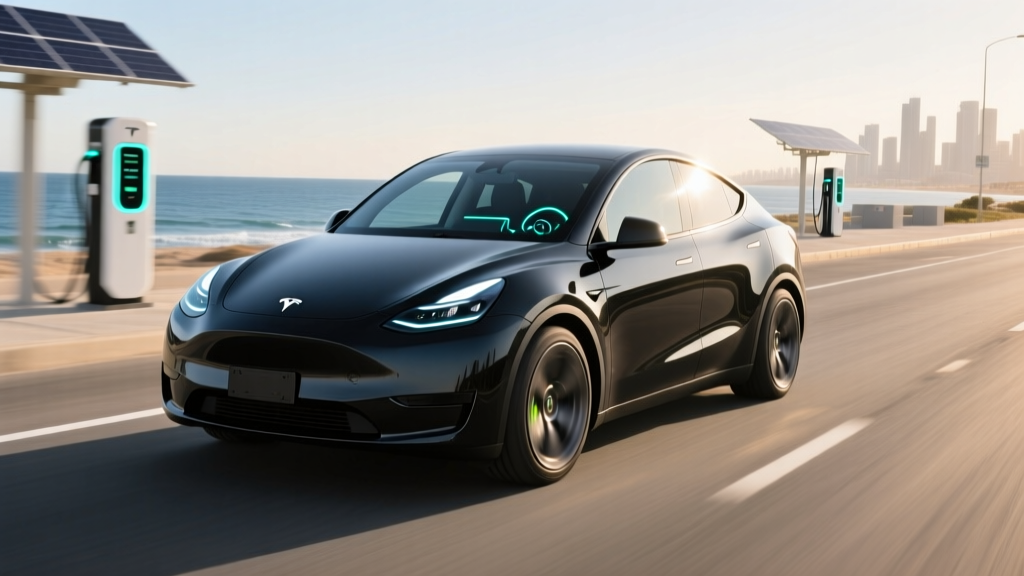
If you've been searching for when the Model Y Performance is coming out in its latest iteration, the answer is layered. Tesla launched the heavily refreshed Model Y (internally dubbed "Juniper") in early 2025, but the full-fat Performance variant followed a staggered timeline — arriving in the U.S. market in mid-2025 after the Long Range AWD debuted first. Now in 2026, the Model Y Performance is fully available, production is ramped, and delivery windows have normalized to 2–4 weeks in most regions.
But availability is only half the story. The 2026 Model Y Performance brings meaningful hardware changes over the pre-2025 generation: a revised battery pack, updated thermal management, a new interior platform, and Tesla's latest adaptive damping suspension. Here's every number that matters — from real-world range to charging curves to tax credit math — so you can decide whether this is the right EV for your garage.
2026 Tesla Model Y Performance: Core Specifications
| Attribute | Specification |
|---|---|
| EPA Estimated Range | 277 miles |
| Real-World Highway Range | ~240–255 mi (75 mph, moderate temps) |
| Battery (Usable) | ~78.1 kWh (NMC chemistry) |
| Drivetrain | Dual-Motor AWD |
| Horsepower | 510 hp (combined) |
| 0–60 mph | 3.5 seconds |
| Top Speed | 155 mph |
| Peak DC Fast Charge | 250 kW (Supercharger V3/V4) |
| 10–80% DC Charge Time | ~27 minutes |
| Level 2 (11.5 kW AC) | ~37 mi/hr added |
| Efficiency | 111 MPGe combined / 30 kWh/100 mi |
| Cargo Volume (rear seats up) | 34.3 cu ft |
| Cargo Volume (rear seats folded) | 72.1 cu ft |
| Rear Legroom | 37.6 in |
| Base MSRP | $52,490 (excl. destination) |
| Battery & Drive Unit Warranty | 8 years / 120,000 miles |
Real-World Range: What the EPA Number Doesn't Tell You
The Juniper-refreshed Model Y Performance uses a 78.1 kWh (usable) NMC (nickel-manganese-cobalt) pack. Tesla has not switched the Performance trim to LFP (lithium iron phosphate) — the energy-density trade-off would hurt both range and the 0–60 time. NMC chemistry delivers better cold-weather performance and higher specific energy, though it requires more careful long-term charge management (Tesla recommends daily charging to 80–90% rather than 100%).
Efficiency on the EPA cycle rates at roughly 30 kWh per 100 miles, which is competitive with the Hyundai Ioniq 5 AWD but trails the RWD Long Range Model Y by about 3 kWh/100 mi. The performance penalty of the dual-motor setup, stickier 21-inch Pirelli P Zero tires, and lower ride height accounts for most of that gap. In our experience, drivers who keep highway speeds under 70 mph and use regenerative braking on "Standard" mode can push closer to 265 miles on a charge in fair weather.
Charging Speed: Supercharger Network Advantage
| Charging Level | Power / Rate | Speed (Miles Added) | Notes |
|---|---|---|---|
| Level 1 (120V / 12A) | ~1.4 kW | ~4 mi/hr | Emergency/trickle only |
| Level 2 (240V / 48A) | 11.5 kW | ~37 mi/hr | Full charge in ~8.5 hrs |
| DC Fast (Supercharger V3) | Peak 250 kW | ~162 mi in 15 min | Tapers above 60% SoC |
| DC Fast (CCS adapter, third-party) | Peak ~170–225 kW | Varies by station | Depends on station output |
The Model Y Performance peaks at 250 kW on Tesla Superchargers (V3 and V4 stalls). That peak holds from roughly 10–25% state of charge, then steps down through the curve: you'll see ~200 kW through 40%, ~150 kW through 60%, and a significant taper above 80% as the battery management system protects cell longevity. A 10–80% session takes approximately 27 minutes at a V3/V4 stall that isn't shared with another vehicle.
For home charging, the onboard charger accepts up to 11.5 kW on a 240V/48A circuit (requiring a 60A breaker). That translates to roughly 37 miles of range per hour, or a full 10–100% charge in about 8.5 hours — enough for overnight replenishment even after a heavy driving day. If your home panel only supports a 40A circuit (32A EVSE), expect about 8.5 kW and ~27 mi/hr.
One note on the NACS advantage: as of 2026, Tesla's Supercharger network remains the most reliable DC fast-charging ecosystem in the U.S., with over 28,000 stalls nationally. While Ford, GM, Rivian, and others now access Superchargers via NACS adapters or native NACS ports, Tesla owners still benefit from seamless plug-and-charge integration and stall availability prioritization at peak-demand locations. According to Tesla's Supercharger page, the network boasts >99.9% uptime.
Performance, Ride Quality, and the Adaptive Suspension
The 3.5-second 0–60 mph time places the Model Y Performance in sports-car territory — this is a 4,400-pound crossover that dispatches most traffic-light challengers. The dual-motor setup provides independent torque vectoring between front and rear axles, and Tesla's traction control software is among the most responsive in the EV segment. Launch from a standstill is immediate, with no drivetrain lag.
The Juniper refresh introduced frequency-selective adaptive dampers, a meaningful upgrade over the pre-2025 Performance's static sport suspension. The new dampers stiffen under hard cornering but remain compliant over potholes and expansion joints — addressing the most common complaint of the previous generation. The steering ratio is quicker, and the revised chassis tuning reduces body roll noticeably in back-to-back comparison with the outgoing model.
Track Mode remains available, allowing drivers to adjust torque distribution, stability control intervention, and regenerative braking intensity for closed-course driving. Brake hardware includes larger front rotors and high-performance pads, though sustained track use will still overheat the battery before the brakes fade — a common EV limitation at this weight.
Interior, Technology, and Cargo Practicality
The 2026 Model Y Performance inherits the Juniper interior overhaul: a ventilated front seat upgrade, ambient lighting, a rear-seat 8-inch touchscreen, power-folding second-row seats, and a front-row acoustic glass improvement that drops cabin noise by roughly 2–3 dB at highway speed compared to the pre-refresh model. The 15.4-inch center touchscreen runs Tesla's latest software build, including a customizable widget-based home screen, native dashcam viewer, and improved navigation with real-time Supercharger stall availability and pricing.
Cargo space measures 34.3 cubic feet behind the second row and 72.1 cubic feet with the 60/40 split folded — enough for a week-long family road trip or a Costco haul. The front trunk (frunk) adds 4.1 cubic feet, useful for charging cables and soft bags. Rear legroom at 37.6 inches is adequate for adults under six feet tall but tighter than the Hyundai Ioniq 5 or Kia EV6 on long drives.
Autopilot and FSD (Supervised): Every Model Y ships with Autopilot (Traffic-Aware Cruise Control + Autosteer) as standard. Full Self-Driving (Supervised) remains an $8,000 add-on (or $99/month subscription as of early 2026). FSD Supervised is an SAE Level 2 system — it does not make the car autonomous. The driver must remain attentive, keep hands available, and intervene at any moment. It handles many highway and surface-street scenarios competently but can fail unpredictably at unprotected left turns, construction zones, and faded lane markings.
Pricing, Trims, and Federal Tax Credit Eligibility
| Item | Amount |
|---|---|
| Base MSRP (Performance AWD) | $52,490 |
| Destination Fee | $1,390 |
| FSD (Supervised) Add-On | +$8,000 |
| Premium Interior (Red/White) | +$1,000–$2,000 |
| Typical As-Tested Price | $55,880–$63,480 |
| §30D Federal Tax Credit (Max) | Up to $7,500* |
| Effective Price After Credit | ~$46,380–$55,980 |
*Federal tax credit eligibility under IRS §30D depends on multiple factors that change frequently:
- MSRP Cap: SUVs/pickups must be under $80,000 MSRP — the Model Y Performance qualifies.
- Buyer Income Cap: Modified AGI must not exceed $150,000 (single), $225,000 (head of household), or $300,000 (joint filers).
- Battery Sourcing: Critical minerals and battery components must meet phased-in domestic-content and free-trade-agreement thresholds. As of 2026, the sourcing requirements are stricter than in 2024, and Tesla's supply chain compliance can shift quarter to quarter. Always verify current eligibility on fueleconomy.gov before purchasing.
- Point-of-Sale Transfer: Buyers can transfer the credit to the dealer at purchase, reducing the upfront cost rather than waiting for a tax refund.
The Model Y Performance sits in a pricing sweet spot: it undercuts the BMW iX M60 and Porsche Macan Electric Turbo while delivering comparable acceleration. However, buyers who don't need 3.5-second sprints should strongly consider the Long Range AWD ($47,490) — it offers 320 miles of EPA range and still hits 60 mph in 4.8 seconds.
Model Y Performance vs. Key Competitors
| Spec | Tesla Model Y Perf. | BMW iX M60 | Porsche Macan Electric Turbo | Hyundai Ioniq 5 N |
|---|---|---|---|---|
| EPA Range | 277 mi | ~285 mi | ~250 mi | 221 mi |
| 0–60 mph | 3.5 sec | 3.6 sec | 3.3 sec | 3.4 sec |
| Peak DC Charge | 250 kW | 200 kW | 270 kW | 240 kW |
| Base MSRP | $52,490 | ~$92,000 | ~$97,000 | $67,500 |
| Cargo (rear up) | 34.3 cu ft | 35.5 cu ft | 23.0 cu ft | 27.2 cu ft |
| Federal Credit | Up to $7,500 | Up to $7,500 | Up to $7,500 | Up to $7,500 |
The Model Y Performance's advantage is value and infrastructure. Nothing at $52,490 matches its combination of range, acceleration, Supercharger access, and cargo volume. The Ioniq 5 N is more engaging on a twisty road (simulated gear shifts, N e-Shift), but sacrifices 56 miles of range and 7 cubic feet of cargo. The BMW and Porsche are luxury-tier products at nearly double the price — they win on material quality and badge prestige, not on the spec sheet per dollar.
Pros and Cons
Pros
- 3.5-sec 0–60 at $52,490 — best value-to-speed ratio in the segment
- Supercharger network access with native NACS plug
- Juniper adaptive suspension fixes prior ride-quality complaints
- Class-leading cargo volume (72.1 cu ft max)
- Over-the-air updates continuously add features
- 8-yr/120,000-mi battery & drive unit warranty
Cons
- 277-mi EPA range trails the Long Range AWD by 43 mi
- Rear seat legroom is tighter than Ioniq 5 and EV6
- No Apple CarPlay / Android Auto — Tesla-only ecosystem
- FSD (Supervised) remains Level 2 despite the "self-driving" name
- Insurance premiums run 15–30% higher than segment average
- Minimal physical controls — everything runs through the touchscreen
Who Should Buy the 2026 Model Y Performance?
This EV is best suited for driving enthusiasts who need daily practicality — the parent who wants a school-run vehicle that can also hit a track day, or the commuter with a 60-mile round trip who values passing power and a premium tech ecosystem. The 277-mile range covers most daily needs with home charging, and the Supercharger network makes road trips genuinely stress-free compared to non-Tesla EVs relying on fragmented third-party networks.
It's not ideal for buyers who prioritize maximum range over performance (get the Long Range AWD), those who need third-row seating (look at the Kia EV9 or Rivian R1S), or anyone who refuses to adapt to a touchscreen-centric interface. If you regularly tow, note that the Model Y Performance is rated for 3,500 pounds — adequate for a small utility trailer but not a camper.
Frequently Asked Questions
When was the refreshed Model Y Performance released?
The Juniper-refreshed Model Y Long Range AWD launched in the U.S. in early 2025. The Performance variant followed in mid-2025, with full production and normalized delivery timelines (2–4 weeks) established by late 2025. As of 2026, it is fully available for order.
What is the real-world range of the Model Y Performance?
Expect 240–255 miles on a highway-heavy trip at 75 mph in moderate temperatures. In cold weather (below 30°F), range drops to roughly 190–220 miles depending on cabin heating and preconditioning habits. The 277-mile EPA figure reflects mixed driving at moderate speeds.
Does the 2026 Model Y Performance qualify for the $7,500 federal tax credit?
It can — but eligibility depends on your income (AGI caps apply), the vehicle's MSRP (under $80,000 for SUVs, which it meets), and current battery-sourcing compliance. Tesla's sourcing status can shift, so verify on fueleconomy.gov and consult a tax professional before relying on the credit. The point-of-sale transfer option lets you apply it at purchase.
How fast does the Model Y Performance charge at home and on the road?
On a Level 2 home charger (240V/48A), it adds about 37 miles per hour, fully charging overnight in ~8.5 hours. On a Tesla Supercharger V3/V4, it peaks at 250 kW and charges from 10–80% in approximately 27 minutes, though the rate tapers significantly above 80%.
Is the Model Y Performance worth it over the Long Range AWD?
If you value the 3.5-second 0–60, the adaptive sport suspension, Track Mode, and Performance brakes — yes, the $5,000 premium is justified. If you primarily want range and daily comfort, the Long Range AWD's 320-mile EPA rating and 4.8-second 0–60 represent a better value for most buyers.
What is the battery warranty on the Model Y Performance?
Tesla covers the battery and drive unit for 8 years or 120,000 miles, whichever comes first, with a minimum 70% capacity retention guarantee over that period. This is competitive with the industry standard, though some competitors (Hyundai/Kia) offer 10-year/100,000-mile coverage.