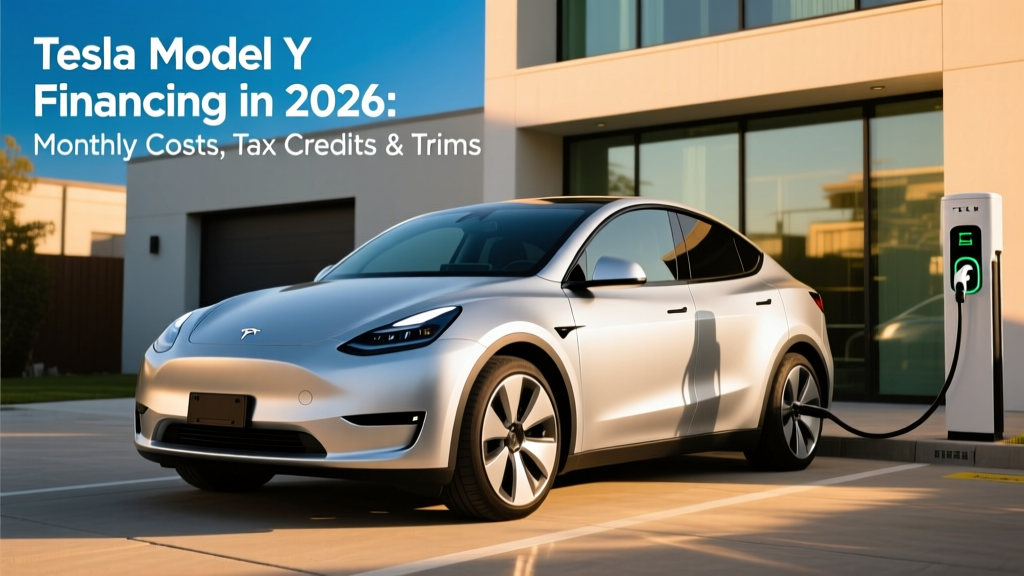
The Tesla Model Y Performance remains one of the quickest, most efficient, and most accessible electric SUVs on the market. For 2026, Tesla continues to refine the Juniper-refreshed Model Y with updated aerodynamics, a revised interior, and improved ride quality — while keeping the dual-motor Performance variant at the top of the lineup for buyers who want sports-car acceleration in a practical crossover package. If you've been searching for Tesla Model Y Performance 0-60 times, real-world range data, and whether it still qualifies for the federal tax credit, this review covers every number that matters.
Quick Verdict: Who Should Buy the Model Y Performance?
The 2026 Tesla Model Y Performance is built for buyers who refuse to choose between a sub-4-second 0-60 time and 70+ cubic feet of cargo space. It works as a daily commuter, a family hauler, and a road-trip EV thanks to Tesla's Supercharger network. The trade-off is a firm ride, a minimalist interior that not everyone loves, and a price that crests $50,000 before options. If outright acceleration matters less to you, the Long Range AWD trim delivers nearly identical utility at a lower price and slightly more range.
Tesla Model Y Performance: Core Specs at a Glance
| Spec | 2026 Model Y Performance |
|---|---|
| EPA Range | 277 miles |
| Battery (usable) | ~75 kWh, NMC (nickel manganese cobalt) |
| Drivetrain | Dual-motor AWD |
| Horsepower | ~456 hp (combined) |
| 0-60 mph | 3.5 seconds (manufacturer, with rollout) |
| Top Speed | 155 mph |
| Max DC Fast Charge | 250 kW (peak) |
| 10-80% DC Charge Time | ~27 minutes |
| Level 2 Charge Rate | 11.5 kW (~44 mi/hr) |
| Efficiency | 122 MPGe combined / 28 kWh/100 mi |
| Cargo (rear seats up / folded) | 30.2 / 72.0 cu ft |
| Front Trunk (Frunk) | 4.1 cu ft |
| Base MSRP | $51,490 (excl. destination) |
| Battery Warranty | 8 years / 120,000 miles |
Source: fueleconomy.gov and Tesla specifications.
Real-World Range: What to Actually Expect
Real-World Highway (70 mph, mild weather): ~240-255 miles
Real-World City / Mixed: ~260-275 miles
Cold Weather (below 30°F): ~200-225 miles (20-30% reduction)
The 277-mile EPA figure for the Performance trim is lower than the Long Range AWD's 300+ mile rating because of the Performance model's larger 21-inch wheels, stickier tires, and slightly more aggressive powertrain calibration. In real-world highway driving at sustained speeds above 70 mph, expect to see roughly 240-255 miles before needing to stop — typical for any performance-oriented EV.
Cold weather hits all EVs hard, and the Model Y is no exception. Without preconditioning, winter range can drop 20-30%. Tesla's heat pump (standard on all 2026 trims) mitigates cabin-heating energy draw, but battery chemistry itself is less efficient in the cold. If you live in a northern climate and commute more than 80 miles round-trip, plan your charging around a 200-220 mile winter buffer.
One advantage the Juniper generation holds over the pre-2025 Model Y is improved aerodynamics and thermal management, which help sustain efficiency at highway speeds. Owners reporting on long-distance routes consistently log 3.8-4.2 miles per kWh in mixed driving, which aligns with the 28 kWh/100 mi EPA rating.
Charging Speed: DC Fast, Level 2, and the Charge Curve
| Charging Level | Power | Speed (approx.) | Notes |
|---|---|---|---|
| Level 1 (120V outlet) | ~1.4 kW | ~5 mi/hr | Emergency/trickle only |
| Level 2 (240V home) | 11.5 kW | ~44 mi/hr | Full charge in ~7-8 hours |
| DC Fast (Tesla Supercharger V3/V4) | 250 kW peak | ~175 mi in 15 min | 10-80% in ~27 min |
| DC Fast (CCS adapter, non-Tesla) | ~150-250 kW | Varies by station | CCS adapter may be required |
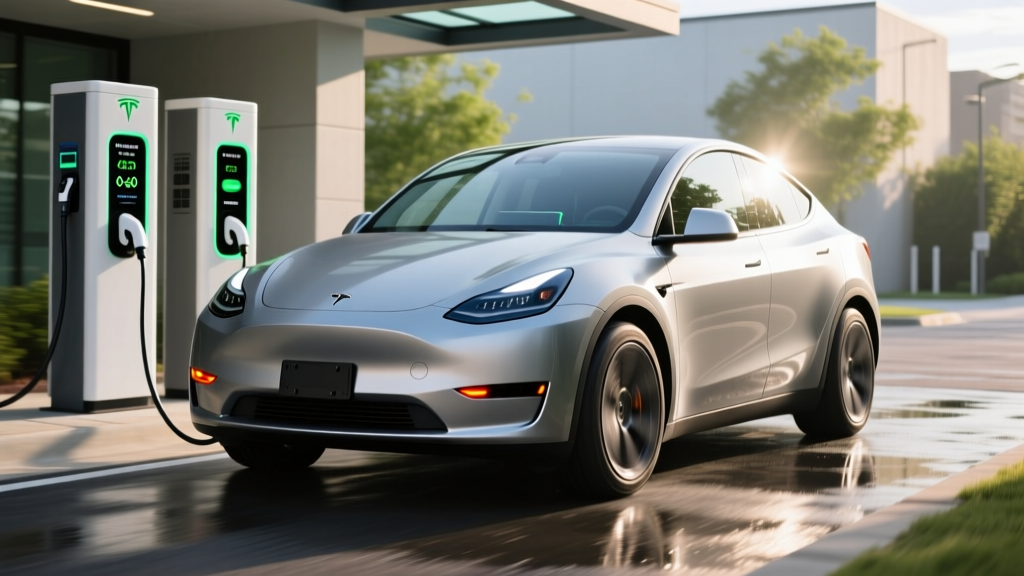
Tesla's 250 kW peak charge rate on V3 and V4 Superchargers is well-established, but the sustained curve matters more than the peak number. The Model Y Performance holds near-peak power from roughly 10-40% state of charge, then tapers progressively. From 50-80%, expect speeds closer to 80-120 kW. This is why the 10-80% time of ~27 minutes is the more honest metric than the "175 miles in 15 minutes" marketing claim, which applies to the best-case low-SoC window.
Preconditioning is critical. Navigate to a Supercharger using the built-in nav, and the car will warm the battery en route to accept maximum charge rates upon arrival. Skip preconditioning — especially in cold weather — and your peak charge rate may be cut in half for the first several minutes.
At home on a 48-amp Level 2 circuit (60-amp breaker), the onboard 11.5 kW charger adds roughly 44 miles of range per hour. A full overnight charge from 20-100% takes about 7-8 hours. Installation of a Tesla Wall Connector or equivalent NEMA 14-50 outlet typically runs $500-$2,000 depending on your electrical panel's capacity and the distance from panel to garage. Homes with older 100-amp panels may need a $1,500-$3,000 panel upgrade to support a 48-amp EV circuit.
With the 2024-2026 transition to the NACS (North American Charging Standard) connector, the Model Y ships natively with the Tesla plug. Non-Tesla DC networks like Electrify America and EVgo are accessible via a CCS-to-NACS adapter, though Tesla's own Supercharger network — now exceeding 25,000 stalls in North America — remains the most reliable option for road trips.
Performance: 0-60, Handling, and Drivetrain
The headline number: 3.5 seconds from 0-60 mph (with 1-foot rollout, as Tesla reports). Independent testing by outlets like Motor Trend and Car and Driver has confirmed times in the 3.5-3.8 second range depending on surface, temperature, and tire condition. That puts the Model Y Performance in the territory of a Porsche Macan GTS or BMW X3 M — at roughly half the price.
The dual-motor AWD system uses a permanent-magnet synchronous motor on the rear axle and an induction motor up front. This setup provides instant torque from standstill, precise torque vectoring between axles, and the ability to decouple the front motor for efficiency during light-load cruising. Combined output sits around 456 horsepower and an estimated 460 lb-ft of torque.
Ride quality on the 2026 Juniper Model Y is noticeably improved over the pre-refresh cars. Tesla retuned the dampers and added acoustic glass, reducing cabin noise and harshness over rough pavement. The Performance trim's 21-inch Überturbine wheels and low-profile tires still transmit more road texture than the Long Range's 19- or 20-inch setups, but the gap has narrowed. Steering is quick and well-weighted, though feedback remains somewhat artificial — a common trait in electric power steering systems.
Braking deserves a note: regenerative braking handles most deceleration in daily driving, but the friction brakes can feel grabby when regen tapers off near a full stop. One-pedal driving is achievable but not as seamless as in some competitors that allow a full stop without touching the brake pedal.
Interior, Cargo, and Technology
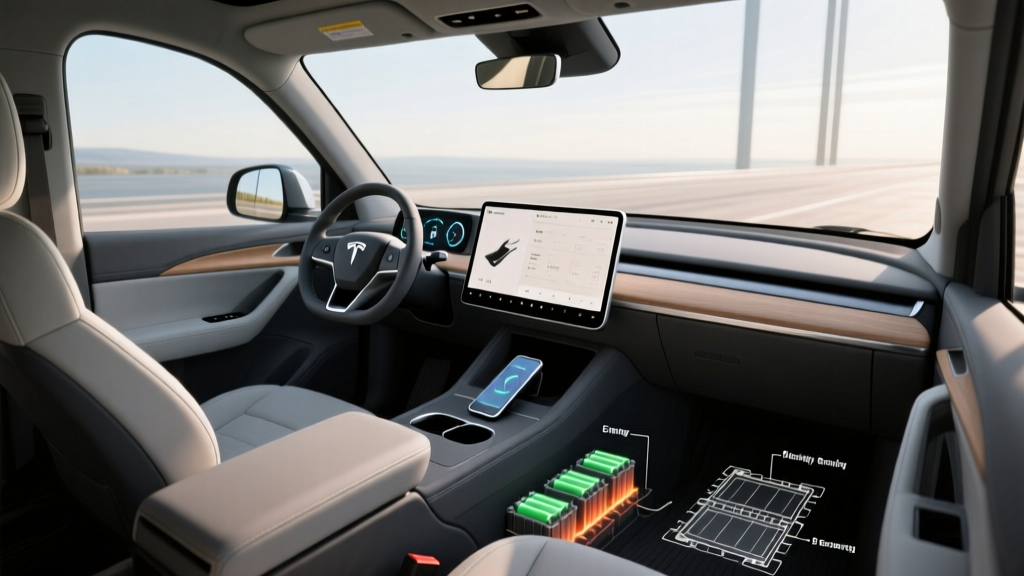
The 2026 Model Y interior follows Tesla's minimalist philosophy: a single 15.4-inch touchscreen dominates the dashboard, with nearly all vehicle controls routed through it. The Juniper refresh brought a rear-seat touchscreen (8-inch), ventilated front seats, ambient lighting, and improved material quality across soft-touch surfaces. A power-folding second row and a flat load floor make cargo loading straightforward.
Cargo volume: 30.2 cubic feet behind the second row, expanding to 72.0 cubic feet with the 60/40 split rear seats folded. The front trunk (frunk) adds 4.1 cubic feet — useful for charging cables, groceries, or a small carry-on. Rear legroom measures 41.6 inches, sufficient for adults on longer trips, though the sloping roofline cuts into headroom for passengers over 6 feet tall.
Infotainment and tech highlights:
- 15.4-inch primary touchscreen with navigation, streaming (Netflix, YouTube, Spotify), and gaming
- Tesla app with remote climate control, charge monitoring, and vehicle location
- Over-the-air (OTA) software updates that add features post-purchase
- Sentry Mode (360° camera recording when parked)
- Dashcam with front, rear, and side camera recording
- Phone-as-key via Bluetooth
Driver assistance: Tesla's Basic Autopilot (lane centering + adaptive cruise) is standard. Enhanced Autopilot ($6,000) adds auto lane change, autosteer on navigation, and smart summon. Full Self-Driving (Supervised) at $8,000 adds traffic light/stop sign recognition and city street autosteer. Important: All current Tesla driver-assist features are SAE Level 2 — the driver must remain fully engaged, hands on the wheel, and eyes on the road at all times. This is not autonomous driving.
Pricing, Trims, and Federal Tax Credit Eligibility
| Trim | Base MSRP | Est. After Federal Credit* |
|---|---|---|
| Model Y Long Range AWD | $46,630 | ~$39,130 (if eligible) |
| Model Y Performance | $51,490 | ~$43,990 (if eligible) |
*Destination fee ($1,390) not included. Tax credit availability depends on IRS §30D eligibility — see below.
The 2026 Model Y Performance starts at $51,490 before the $1,390 destination charge. Common add-ons include FSD (Supervised) at $8,000, Enhanced Autopilot at $6,000, and premium paint colors ranging from $1,000 to $2,500. A fully loaded Performance model can approach $62,000-$64,000.
Does the Model Y Performance Qualify for the $7,500 Federal Tax Credit?
Under the IRS §30D New Clean Vehicle Credit, the Model Y is eligible for up to $7,500 — but only if you meet all of the following criteria:
- MSRP Cap: SUVs/vans/pickups must have an MSRP at or below $80,000. The Model Y Performance at ~$52,880 (with destination) clears this easily.
- Buyer Income Limits: Modified adjusted gross income (MAGI) must not exceed $150,000 (single), $225,000 (head of household), or $300,000 (joint filers).
- Battery Sourcing: The $7,500 credit is split into two halves — $3,750 for critical minerals and $3,750 for battery component sourcing. As of 2026, vehicles with battery components from a "foreign entity of concern" (FEOC) may lose one or both halves. Tesla has shifted significant battery supply chain to North America, but verify current-year eligibility at fueleconomy.gov before purchasing.
- Point-of-Sale Transfer: As of 2024, you can transfer the credit to the dealer at purchase, reducing your out-of-pocket cost immediately rather than waiting to claim it on your tax return.
Bottom line: Most Model Y Performance buyers who meet the income thresholds should expect the full or partial credit, but battery-sourcing rules tighten annually. Confirm your specific eligibility with a tax professional and check the latest IRS guidance before finalizing your purchase.
Model Y Performance vs. Key Competitors
| Spec | Tesla Model Y Perf. | Ford Mustang Mach-E GT | Hyundai Ioniq 5 N | BMW iX M60 |
|---|---|---|---|---|
| 0-60 mph | 3.5 sec | 3.5 sec | 3.4 sec | 3.6 sec |
| EPA Range | 277 mi | 280 mi | 221 mi | 296 mi |
| Max DC Charge | 250 kW | 150 kW | 240 kW | 200 kW |
| Cargo (cu ft) | 72.0 | 59.7 | 59.3 | 77.9 |
| Base MSRP | $51,490 | $59,995 | $66,100 | $87,250 |
| Charging Network | Supercharger (native) | CCS / NACS adapter | CCS / NACS adapter | CCS / NACS adapter |
The Model Y Performance's advantage is clear: it matches or beats competitors on acceleration while undercutting them on price by $8,000-$35,000. Its cargo volume is second only to the larger, far more expensive BMW iX. The Mach-E GT and Ioniq 5 N offer more engaging steering feel and traditional interior layouts, but neither can match Tesla's Supercharger infrastructure or the Model Y's efficiency. For pure value-per-horsepower, the Model Y Performance is difficult to beat.
Pros and Cons
Pros
- 3.5-second 0-60 at a sub-$52K starting price
- Access to Tesla Supercharger network (most reliable in the US)
- Class-leading cargo capacity for a performance SUV
- Continuous OTA updates add features over time
- Strong efficiency at 122 MPGe / 28 kWh/100mi
- 8-year/120,000-mile battery warranty
Cons
- Firm ride on 21-inch wheels over rough pavement
- Minimalist interior lacks physical controls (climate, mirrors)
- FSD (Supervised) is expensive and still requires full driver attention
- No Apple CarPlay or Android Auto
- Range drops to ~200-225 mi in cold weather
- Tesla service center availability varies by region
Frequently Asked Questions
What is the real-world range of the Tesla Model Y Performance?
The EPA rates the 2026 Model Y Performance at 277 miles. In real-world mixed driving, expect 240-275 miles depending on speed, temperature, and terrain. Highway driving at 75+ mph and cold weather below freezing will push range toward 200-240 miles.
How fast does the Model Y Performance charge on DC and at home?
On a Tesla V3/V4 Supercharger, it peaks at 250 kW and charges from 10-80% in approximately 27 minutes. At home on a 48-amp Level 2 charger (240V), the 11.5 kW onboard charger adds about 44 miles of range per hour, with a full charge taking 7-8 hours.
How much does the Model Y Performance cost after the federal tax credit?
The base MSRP is $51,490 plus $1,390 destination. If you qualify for the full $7,500 §30D credit (meeting income, MSRP, and battery-sourcing requirements), your effective cost drops to approximately $45,380. Use the IRS point-of-sale transfer to apply the credit at purchase.
Is the Model Y Performance worth buying over the Long Range AWD?
If you value the 3.5-second 0-60 time, track-capable brakes, and 21-inch wheels, the $4,860 premium over the Long Range AWD is justified. If you prioritize maximum range (300+ miles) and a softer ride, the Long Range is the better choice. Both share the same battery, interior, and tech.
Does the Model Y Performance qualify for the full $7,500 federal EV tax credit?
It is eligible, but qualification depends on your income (under $150K single / $300K joint), the MSRP cap (under $80K for SUVs — the Model Y clears this), and current battery-sourcing rules under IRS §30D. Battery component and critical mineral requirements tighten each year, so verify at fueleconomy.gov and consult a tax professional before purchasing.
What is the battery warranty on the 2026 Model Y Performance?
Tesla covers the battery and drive unit for 8 years or 120,000 miles (whichever comes first), with a guaranteed minimum 70% capacity retention over that period. This is competitive with the industry standard, though some competitors offer 10-year/100,000-mile battery coverage.
Can I tow with the Model Y Performance?
The 2026 Model Y is rated to tow up to 3,500 pounds when equipped with the factory tow hitch. Keep in mind that towing significantly reduces range — expect a 30-50% reduction depending on trailer weight and aerodynamics.