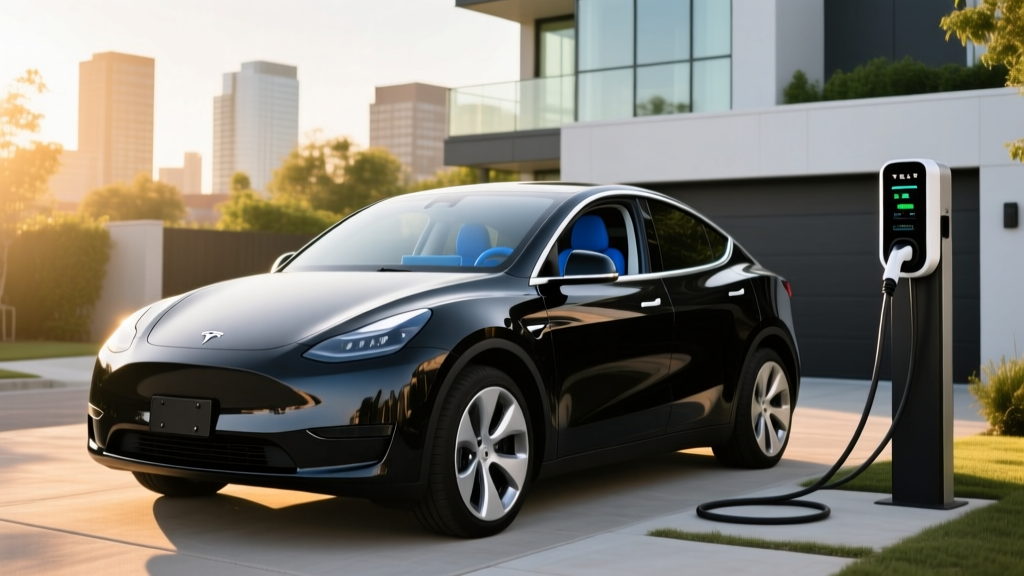
If you have been searching for a reliable Tesla payment calculator to figure out what a Model Y actually costs per month, you have likely noticed that most online tools stop at the sticker price. They ignore the federal tax credit, electricity costs, insurance premiums, and depreciation — the four variables that determine whether an EV saves you money or quietly drains your wallet. This review does the math that generic calculators miss, using the refreshed 2026 Tesla Model Y as our test case.
The Model Y remains Tesla's volume leader and one of the best-selling vehicles in the United States, period. But with the Hyundai Ioniq 5, Ford Mustang Mach-E, and Chevrolet Equinox EV all aggressively priced, the question is no longer "Is the Model Y a good EV?" — it is "Does the Model Y still make financial sense in 2026?" Let's build the full picture from the ground up.
2026 Model Y at a Glance: The Specs That Matter
| Spec | Value |
|---|---|
| EPA Range | 320 miles |
| Battery Capacity | 78.1 kWh usable (NMC chemistry) |
| Efficiency | 122 MPGe combined / 27 kWh/100 mi |
| Max DC Fast Charge | 250 kW peak (V3 Supercharger) |
| 10–80% DC Charge Time | ~22 minutes |
| Level 2 Home Charging | 11.5 kW (~44 mi/hr) |
| Drivetrain | Dual-motor AWD |
| Horsepower | 384 hp combined |
| 0–60 mph | 4.8 seconds |
| Cargo Volume | 30.2 cu ft (rear seats up) / 72.0 cu ft (folded) |
| Frunk | 4.1 cu ft |
| Rear Legroom | 39.4 inches |
| Battery Warranty | 8 years / 120,000 miles (70% capacity retention) |
| Base MSRP | $44,990 (Long Range AWD) |
Real-World Range: What the EPA Sticker Doesn't Tell You
The EPA rates the 2026 Model Y Long Range AWD at 320 miles. That number is achievable under ideal conditions: moderate temperatures, mixed city/highway driving at or below 65 mph, and minimal climate-control draw. In practice, your mileage will vary — sometimes significantly.
EPA estimate: 320 miles
Highway (70–75 mph, summer): ~275–290 miles
Highway (70–75 mph, winter 30°F): ~230–255 miles
City/suburban mixed: ~300–315 miles
Tesla's heat pump helps mitigate cold-weather loss compared to older EVs, but expect a 15–25% range reduction in sustained sub-freezing highway driving. Preconditioning the battery while plugged in recovers some of this loss.
Efficiency on the combined cycle lands at roughly 27 kWh per 100 miles, which translates to 122 MPGe per EPA data on fueleconomy.gov. That efficiency figure is critical for the payment calculator below — it determines your per-mile electricity cost.
Charging Speed: DC Fast, Level 2, and the Curve Reality
The Model Y Long Range AWD peaks at 250 kW on a Tesla V3 Supercharger. However, that peak only sustains roughly from 10% to 35% state of charge. Above 50%, the charge curve tapers significantly — by 80% you are pulling closer to 60–80 kW. This is normal lithium-ion behavior, not a defect, but it matters for road-trip planning.
| Charging Level | Power | Speed (Miles Added) | Typical Use Case |
|---|---|---|---|
| Level 1 (120V household) | ~1.2 kW | ~4–5 mi/hr | Emergency / overnight trickle |
| Level 2 (240V home, 48A) | 11.5 kW | ~44 mi/hr | Daily home charging |
| DC Fast (V3 Supercharger) | 250 kW peak | ~162 mi in 15 min | Road trips |
| DC Fast (CCS adapter, 350 kW station) | ~170 kW actual | ~110 mi in 15 min | Non-Tesla networks |
A full 10–80% session takes approximately 22 minutes on a V3 Supercharger. On a non-Tesla 350 kW CCS station using Tesla's CCS adapter, expect closer to 28–30 minutes because the car's onboard charging limit caps the draw well below the station's maximum.
For home charging, a Wall Connector on a 60-amp circuit delivers the full 11.5 kW, adding about 44 miles per hour. Most owners who drive 30–40 miles daily will replenish their commute in under an hour of plug-in time. If your electrical panel requires an upgrade to support a 60-amp dedicated circuit, budget $800–$2,000 for the electrician work on top of the $475 Wall Connector unit.
Running the Tesla Payment Calculator: True Monthly Cost
Here is where the Tesla payment calculator exercise gets useful. Most buyers fixate on the monthly loan payment and ignore the four other cost pillars: energy, insurance, maintenance, and depreciation. Let's break down a realistic 60-month ownership scenario for the Model Y Long Range AWD.
Assumptions: 12,000 miles/year, home charging at $0.14/kWh national average, 70% home / 30% Supercharger mix, average insurance quote, no state incentives applied.
| Cost Category | Monthly | 5-Year Total |
|---|---|---|
| Loan payment ($44,990, 10% down, 6.5% APR, 60 mo) | $784 | $47,040 |
| Federal tax credit (§30D, applied at point of sale) | –$125/mo equiv. | –$7,500 |
| Electricity (12k mi/yr, 27 kWh/100mi, blended rate ~$0.18/kWh) | $58 | $3,480 |
| Insurance (national EV average) | $195 | $11,700 |
| Maintenance (tires, cabin filter, wiper fluid) | $35 | $2,100 |
| Estimated depreciation (5-yr, ~45%) | — | $20,250 |
| Net 5-Year Cost (after credit) | ~$947/mo effective | $57,070 |
For comparison, a similarly equipped gas-powered compact SUV averaging 28 MPG at $3.40/gallon would cost roughly $121/month in fuel alone — more than double the Model Y's electricity cost. The EV's maintenance savings (no oil changes, no transmission fluid, far less brake wear due to regenerative braking) add another $3,000–$4,000 in savings over five years.
Federal Tax Credit Eligibility: The §30D Checklist
The 2026 Model Y Long Range AWD qualifies for the full $7,500 federal tax credit under IRS §30D rules, but only if you meet all of the following criteria. The credit is available as a point-of-sale transfer to the dealer, effectively reducing your purchase price at signing.
- MSRP cap: Vehicle base price must be ≤$80,000 for SUVs (Model Y qualifies at $44,990)
- Buyer income cap: Modified AGI ≤$300,000 (joint filers), ≤$225,000 (head of household), ≤$150,000 (single)
- Battery sourcing: Critical minerals and battery components must meet phased-in domestic/free-trade-partner thresholds (Tesla's supply chain currently meets 2026 requirements for the Long Range variant)
- Final assembly: Must occur in North America (Fremont, CA and Austin, TX plants qualify)
- Vehicle classification: Must be titled as new, for personal use, primarily in the U.S.
Important: Tax credit rules are subject to legislative change. Always verify current eligibility on IRS.gov or consult a tax professional before finalizing your purchase. The point-of-sale transfer option means you do not need to wait until tax filing — the $7,500 comes off at the dealership.
Performance, Tech, and Daily Livability
The dual-motor AWD powertrain produces 384 horsepower and launches the Model Y to 60 mph in 4.8 seconds. That is genuinely quick for a family crossover, and the instant torque delivery makes highway merging effortless. The Performance trim (if available in your market) drops that to 3.5 seconds, but at a $5,000+ premium and a slight range penalty.
Inside, the minimalist cabin centers on a 15.4-inch touchscreen that handles everything from navigation to glove-box release. The 2026 refresh added ventilated front seats, a rear-seat touchscreen for passengers, ambient lighting, and improved sound insulation. Cargo space is generous: 30.2 cubic feet behind the second row, expanding to 72.0 with seats folded. The 4.1-cubic-foot frunk handles charging cables or a small grocery run.
Driver Assistance: Autopilot and FSD Supervised
Tesla Autopilot (included) and Full Self-Driving Supervised ($8,000 option or $99/month) are Level 2 driver-assistance systems. The driver must remain fully engaged, hands on or near the wheel, eyes on the road, at all times. These systems do not make the vehicle autonomous. Only Level 4 services like Waymo operate without a human driver in geofenced areas.
Autopilot provides competent adaptive cruise control and lane-centering on highways. FSD Supervised adds automated lane changes, traffic-light recognition, and city-street navigation, but its performance varies by route complexity and weather. For most buyers, the included Autopilot is sufficient; FSD remains a premium option best evaluated through Tesla's trial period before committing.
Model Y vs. the Competition: Is It Still Worth It?
The electric crossover segment has matured considerably. Here is how the Model Y stacks up against its three closest rivals on the metrics that matter for a payment-calculator comparison:
| Spec | Tesla Model Y LR AWD | Hyundai Ioniq 5 Limited | Ford Mustang Mach-E Premium | Chevy Equinox EV RS |
|---|---|---|---|---|
| EPA Range | 320 mi | 305 mi | 300 mi | 319 mi |
| Battery (kWh) | 78.1 (NMC) | 77.4 (NMC) | 75.7 (NMC) | 85.0 (NMC) |
| Peak DC Charge | 250 kW | 240 kW | 150 kW | 190 kW |
| 10–80% Time | ~22 min | ~18 min | ~34 min | ~28 min |
| 0–60 mph | 4.8 sec | 5.1 sec | 5.2 sec | 5.8 sec |
| Base MSRP | $44,990 | $48,500 | $44,895 | $43,400 |
| Federal Credit | $7,500 | $7,500 | $7,500 | $7,500 |
| Efficiency (kWh/100mi) | 27 | 28 | 30 | 29 |
The Model Y's edge is its combination of Supercharger network access, best-in-class efficiency, and strong resale value. The Ioniq 5 charges faster on compatible 800V stations. The Mach-E offers a more traditional interior layout. The Equinox EV undercuts on price. But when you run the full payment calculator — factoring in efficiency, charging infrastructure reliability, and depreciation — the Model Y's total cost of ownership remains among the lowest in this segment.
Who Should Buy the Model Y (and Who Shouldn't)
Choose the Model Y if:
- You want the most reliable public charging network (Supercharger) for road trips
- Efficiency (low kWh/mi) is a priority for keeping electricity costs down
- You value strong cargo space and the frunk for family gear
- You want over-the-air updates that add features post-purchase
- You need a physical instrument cluster or traditional button layout (try Ioniq 5 or Mach-E)
- You want the fastest DC charging available (Ioniq 5's 800V architecture is quicker)
- You need third-row seating (consider the Kia EV9 or Rivian R1S)
- Your budget is strictly under $38,000 (Chevy Equinox EV or Bolt EUV territory)
Biggest Pros and Cons
- Best-in-class efficiency (27 kWh/100mi) lowers running costs
- Supercharger network remains the most reliable DC fast-charging option
- Strong cargo capacity with frunk (34.3 cu ft total)
- Over-the-air software updates add features over time
- $7,500 federal tax credit eligible (point-of-sale transfer)
- Minimal maintenance costs vs. ICE equivalents
- Minimalist interior polarizes — no physical buttons or instrument cluster
- Insurance premiums run 15–25% higher than gas equivalents
- FSD Supervised is expensive and still requires full driver attention
- 250 kW peak charge rate trails 800V competitors on compatible stations
- Ride quality can be firm on broken pavement
- Service center wait times remain long in some metro areas
Frequently Asked Questions
What is the real-world range of the 2026 Tesla Model Y?
The EPA rates it at 320 miles, but expect roughly 275–290 miles on summer highway trips and 230–255 miles in freezing winter highway conditions. City and suburban driving at moderate speeds gets you closest to the sticker number.
How fast does the Model Y charge at home and on the road?
On a Level 2 home charger (11.5 kW), it adds about 44 miles per hour — enough to fully replenish overnight. On a V3 Supercharger at 250 kW peak, a 10–80% session takes approximately 22 minutes, though the charge curve tapers above 50% SoC.
How much does the Model Y actually cost after tax credits?
The Long Range AWD starts at $44,990. With the $7,500 federal credit applied at point of sale, the effective price drops to $37,490 before destination fees, state registration, and any optional packages. State incentives may reduce the cost further — check your local energy provider and DMV.
Does the 2026 Model Y qualify for the federal EV tax credit?
Yes, the Model Y Long Range AWD currently qualifies for the full $7,500 under IRS §30D, provided the buyer meets income caps ($300K joint / $150K single) and the vehicle's battery sourcing meets 2026 thresholds. The credit can be transferred to the dealer at point of sale.
Is the Model Y worth buying over the Hyundai Ioniq 5 or Ford Mach-E?
If Supercharger reliability and per-mile efficiency are your top priorities, yes — the Model Y's total cost of ownership remains hard to beat. If you prefer faster DC charging on non-Tesla networks and a more conventional interior, the Ioniq 5 is a strong alternative. The Mach-E appeals to buyers who want a traditional crossover feel. Run your own payment calculator with local electricity rates and insurance quotes to decide.
What does the Model Y's battery warranty cover?
Tesla covers the battery and drive unit for 8 years or 120,000 miles, whichever comes first, with a guaranteed minimum 70% capacity retention. If degradation drops below that threshold within the warranty period, Tesla will repair or replace the battery at no cost. Real-world data from high-mileage owners suggests typical degradation of 8–12% over the first 100,000 miles.
Editorial note: Pricing, tax credit eligibility, and specifications are based on 2026 model-year data available at time of publication. Always verify current figures on Tesla.com and IRS.gov before purchasing.