If you've ever typed "Tesla nav" into a search bar, you're likely trying to understand how Tesla's built-in navigation system actually works in daily driving — or you're shopping for a Tesla and want to know whether its route planning, Supercharger integration, and real-time traffic features justify the purchase. This review centers on the 2026 Tesla Model Y Long Range AWD, the best-selling EV in America, and evaluates it through the lens of what matters most to EV buyers: real-world range, charging speed, the navigation and tech stack, total cost after tax credits, and whether it still holds the crown against a growing field of competitors.
EPA Estimated Range: 320 miles (Long Range AWD)
Real-World Highway (70-75 mph, moderate temps): ~270–290 miles
Real-World Cold Weather (below 32°F, highway): ~230–255 miles
Source: fueleconomy.gov
Spec Table: 2026 Tesla Model Y Long Range AWD at a Glance
| Specification | Value |
|---|---|
| EPA Range | 320 miles |
| Battery (usable) | ~78 kWh (NMC chemistry) |
| Efficiency | 119 MPGe combined / 28 kWh/100 mi |
| Max DC Fast Charge | 250 kW (V3 Supercharger) |
| 10–80% DC Fast Charge | ~27 minutes |
| Level 2 Home Charge Rate | 11.5 kW (~44 mi/hr) |
| 0–60 mph | 4.8 seconds |
| Horsepower | 384 hp (dual motor) |
| Drivetrain | Dual Motor AWD |
| Cargo Volume (rear seats up) | 30.2 cu ft |
| Cargo Volume (rear seats folded) | 72.1 cu ft |
| Rear Legroom | 41.6 inches |
| Battery & Drive Unit Warranty | 8 years / 120,000 miles |
| Base MSRP | $44,990 (before incentives) |
How Tesla's Navigation System Actually Works in 2026
Tesla's navigation is not a standalone app — it's the backbone of the entire driving experience. When you enter a destination, the system doesn't just plot a route. It calculates whether your current state of charge (SoC) is sufficient, automatically adds Supercharger stops if needed, and preconditions the battery as you approach a fast-charger so you arrive at optimal temperature for maximum charge rate. This battery preconditioning is a feature many EV buyers overlook, but it can shave 5–10 minutes off a charging stop in cold weather.
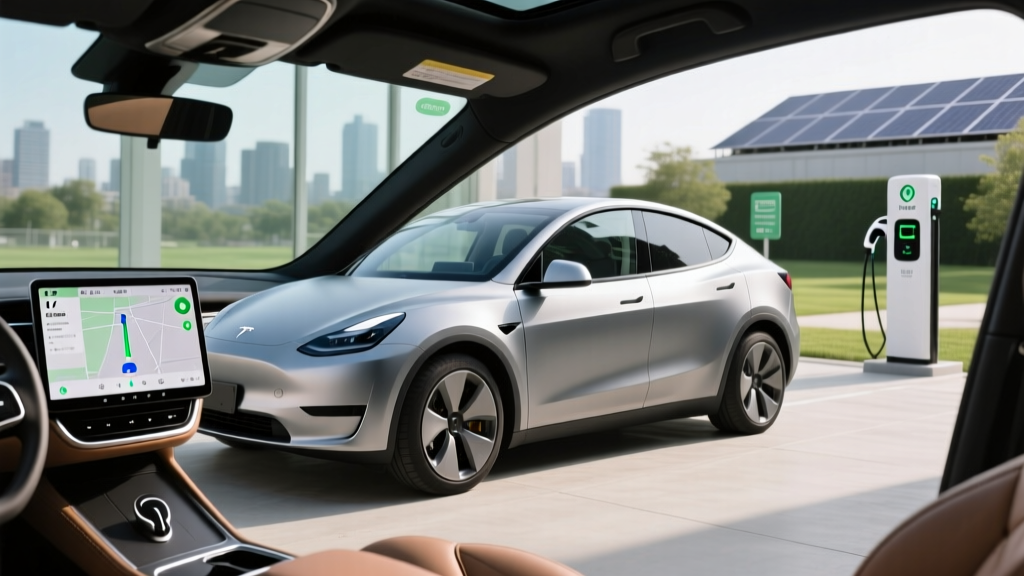
The 2026 Model Y's 15.4-inch center touchscreen handles all nav functions with minimal lag. Real-time traffic data reroutes you around congestion, and the trip planner displays predicted SoC at each waypoint and at your destination — a critical feature for road-trip confidence. The navigation also integrates with Tesla's Supercharger network, showing real-time stall availability, pricing per kWh, and whether a station has V3 (250 kW) or older V2 (150 kW) hardware.
One limitation: Tesla's nav does not support Apple CarPlay or Android Auto. If you rely on Waze or Google Maps on your phone, you'll need a phone mount and must accept that the car's native route planning won't incorporate your preferred app's traffic data. For most Tesla owners, the native system is sufficient, but this remains a polarizing omission.
Charging Speed: DC Fast, Level 2, and the Charge Curve Reality
The 2026 Model Y Long Range AWD supports a peak DC fast-charge rate of 250 kW on Tesla V3 Superchargers. In practice, you'll see that peak rate only briefly — typically between 10% and 30% SoC. The charge curve tapers significantly above 50%, and especially above 80%, which is why Tesla (and most EV manufacturers) quote 10–80% times rather than 0–100%.
| Charging Level | Power | Speed (approx.) | Use Case |
|---|---|---|---|
| Level 1 (120V household) | ~1.4 kW | ~5 mi/hr | Emergency / overnight trickle |
| Level 2 (240V home Wall Connector) | 11.5 kW | ~44 mi/hr | Daily home charging |
| DC Fast (V3 Supercharger) | Up to 250 kW | 10–80% in ~27 min | Road trips, quick top-ups |
| DC Fast (CCS adapter, Electrify America) | Up to ~150 kW | 10–80% in ~38 min | Non-Tesla networks |
Key charging insight: The Model Y's NMC battery chemistry delivers strong charge speeds but benefits from not sitting at 100% SoC for extended periods. Tesla recommends daily charging to 80–90% for NMC packs and saving 100% for road trips. If you want a battery you can routinely charge to 100% without degradation concern, the base Model Y RWD (which uses LFP chemistry) is worth considering — though you sacrifice roughly 50 miles of range.
Home charging with the Tesla Wall Connector on a 60-amp circuit delivers the full 11.5 kW (48 amps continuous), adding about 44 miles of range per hour. A full charge from 10% to 90% takes roughly 7 hours overnight — more than adequate for daily use. Installation typically runs $800–$2,000 depending on panel proximity and whether a 200-amp service upgrade is needed. Consult a licensed electrician for a site-specific quote.
Real-World Range, Efficiency, and What the EPA Number Doesn't Tell You
The EPA rates the 2026 Model Y Long Range AWD at 320 miles with a combined efficiency of 119 MPGe (28 kWh per 100 miles). That's among the most efficient vehicles in its class, a testament to Tesla's thermal management system and aerodynamic refinement in the refreshed "Juniper" body.
But EPA estimates assume a mix of city and highway driving at moderate temperatures. Here's what to expect in specific scenarios:
- City driving, 60–80°F: You may exceed the EPA estimate, hitting 330–340 miles thanks to regenerative braking recovering energy at low speeds.
- Highway driving, 70–75 mph, 60–80°F: Expect 270–290 miles. Aerodynamic drag scales with the square of speed, and sustained highway speeds are an EV's least efficient mode.
- Cold weather highway (below 32°F): Plan for 230–255 miles. Battery internal resistance increases, cabin heating draws energy (the Model Y uses a heat pump, which helps, but doesn't eliminate the penalty), and regenerative braking is reduced at low battery temperatures.
- Towing (up to 3,500 lbs rated capacity): Range drops roughly 40–50%, yielding approximately 160–190 miles per charge.
For most commuters driving 30–60 miles round trip, even cold-weather range is a non-issue with nightly home charging. Road-trippers should plan Supercharger stops every 200–240 miles in winter to maintain a comfort buffer.
Pricing, Trims, and Federal Tax Credit Eligibility
The 2026 Tesla Model Y is offered in three configurations:
| Trim | MSRP | Drivetrain | EPA Range | §30D Credit Eligibility |
|---|---|---|---|---|
| Long Range RWD (LFP) | $39,990 | RWD | ~290 mi | Eligible (up to $7,500) |
| Long Range AWD (NMC) | $44,990 | Dual Motor AWD | 320 mi | Eligible (up to $7,500) |
| Performance AWD | $48,990 | Dual Motor AWD | ~295 mi | Eligible (up to $7,500) |
Federal tax credit rules (§30D) for 2026: The IRS allows up to $7,500 in federal tax credits for new EVs, but eligibility depends on several factors that change annually. Here's the checklist:
- MSRP cap: SUVs and trucks must be under $80,000. All Model Y trims qualify.
- Buyer income cap: Modified AGI must not exceed $150,000 (single), $225,000 (head of household), or $300,000 (joint). Check IRS.gov §30D guidelines for current-year thresholds.
- Battery sourcing: A percentage of critical minerals and battery components must be sourced from the U.S. or free-trade-agreement countries. Tesla's North American supply chain has improved compliance, but the specific credit amount ($3,750 vs. $7,500) depends on the current year's sourcing thresholds.
- Point-of-sale transfer: As of 2024, buyers can transfer the credit to the dealer at purchase, reducing the out-of-pocket price immediately rather than waiting for a tax refund.
Important: Tax credit eligibility is complex and subject to change. Consult a tax professional and verify current rules at IRS.gov before purchasing.
Tech, Driver Assistance, and What Tesla Gets Right (and Wrong)
The Model Y's tech stack remains one of the most integrated in the industry. Everything runs through the 15.4-inch touchscreen: navigation, climate, media, vehicle settings, and driver-assistance controls. Over-the-air (OTA) updates regularly add features — Tesla pushed a major UI refresh and improved trip-planner algorithms in late 2025.
Standard driver assistance (Autopilot): Includes adaptive cruise control, lane centering, automatic emergency braking, and blind-spot monitoring. This is SAE Level 2 automation — you must keep your hands on the wheel and eyes on the road at all times.
Tesla Autopilot and Full Self-Driving (Supervised) are Level 2 driver-assistance systems. The driver must remain fully engaged and responsible for the vehicle at all times. These are not self-driving systems. Only Level 4 services like Waymo operate without a human driver in geofenced areas.
Full Self-Driving (Supervised) — $8,000 option or $99/month: Adds automatic lane changes, navigation-guided on/off-ramp transitions, traffic light and stop sign recognition, and enhanced parking features. Despite the name, FSD (Supervised) still requires active driver supervision. It performs well on highways but can be unpredictable in complex urban scenarios, construction zones, and adverse weather. The system continues to improve via OTA updates, but buyers should test it thoroughly during the return window before committing.
Notable drawbacks:
- No Apple CarPlay or Android Auto — a dealbreaker for some buyers
- No physical buttons for climate or audio — everything is touchscreen-driven
- No traditional instrument cluster — speed and nav directions appear on the center screen only (a minimal driver-facing display exists but is limited)
- Rear-seat visibility is compromised by the sloping roofline
- Ride quality on 20-inch wheels can be firm on rough pavement
Pros and Cons: The Honest Scorecard
Pros
- Class-leading efficiency (119 MPGe combined)
- Extensive Supercharger network with reliable plug-and-charge
- Battery preconditioning optimizes DC charge speed
- Over-the-air updates add features post-purchase
- Strong cargo capacity (72.1 cu ft with seats folded)
- Competitive 0–60 time (4.8s) for the class
- Heat pump standard — better cold-weather efficiency
Cons
- No Apple CarPlay / Android Auto
- Touchscreen-only controls frustrate some drivers
- FSD (Supervised) is expensive and still Level 2
- NMC battery requires charge-limit discipline for longevity
- Insurance premiums run 15–30% higher than comparable ICE SUVs
- Rear visibility limited by coupe-like roofline
Model Y vs. Key Competitors: Is It Still the One to Beat?
The 2026 Model Y faces stiffer competition than ever. Here's how it stacks up against the Hyundai Ioniq 5, Ford Mustang Mach-E, and Chevrolet Equinox EV:
| Attribute | Tesla Model Y LR AWD | Hyundai Ioniq 5 LR AWD | Ford Mach-E ER AWD | Chevy Equinox EV RS AWD |
|---|---|---|---|---|
| EPA Range | 320 mi | 290 mi | 305 mi | 307 mi |
| Max DC Charge | 250 kW | 238 kW | 150 kW | 190 kW |
| 10–80% Time | ~27 min | ~18 min | ~38 min | ~30 min |
| 0–60 mph | 4.8s | 5.1s | 5.6s | 6.3s |
| Base MSRP (AWD) | $44,990 | $48,500 | $48,995 | $43,900 |
| Charging Network | Supercharger (native NACS) | NACS (Supercharger access) | NACS (Supercharger access) | NACS (Supercharger access) |
The Ioniq 5 charges faster (its 800V architecture sustains higher peak rates), but the Model Y wins on range and Supercharger-native convenience. The Mach-E's charging speed remains a weak point. The Equinox EV undercuts on price but trails in performance. With Ford, Hyundai, and GM now using NACS connectors and gaining Supercharger access, Tesla's network moat is narrowing — but native integration (no adapter, automatic stall recognition, seamless billing) still gives Tesla owners a frictionless charging experience.
Who Should Buy the 2026 Tesla Model Y?
- You want the longest real-world range in the compact EV SUV segment
- You road-trip frequently and value Supercharger network reliability
- You prefer OTA-updated software that improves over time
- You're comfortable with touchscreen-only vehicle controls
- You need Apple CarPlay or Android Auto (Ioniq 5, Mach-E)
- You want the fastest possible DC charging (Ioniq 5 with 800V)
- You prefer physical buttons and a traditional instrument cluster (Mach-E, Equinox EV)
- Upfront budget is tight and you want the lowest MSRP in the segment (Equinox EV)
For daily commuters with home charging, the Model Y Long Range AWD is nearly bulletproof: plug in each evening, wake up to 250+ miles, and rarely think about range. For families, the 30.2 cu ft of rear cargo (expandable to 72.1) handles strollers, groceries, and luggage with room to spare. For road-trippers, the Supercharger network and integrated trip planner remove most of the planning anxiety that still plagues other EVs on long drives.
Frequently Asked Questions
What is the real-world range of the 2026 Tesla Model Y?
The EPA rates it at 320 miles, but expect 270–290 miles on the highway in moderate weather, and 230–255 miles in cold winter conditions. City driving with regenerative braking can push range above the EPA estimate.
How fast does the Model Y charge at home and on the road?
On a 240V Level 2 home charger (Tesla Wall Connector at 11.5 kW), you'll add about 44 miles of range per hour — a full overnight charge is routine. On a V3 Supercharger (250 kW DC), 10–80% takes approximately 27 minutes. Using a CCS adapter on non-Tesla networks, expect 10–80% in roughly 38 minutes at ~150 kW.
Does the 2026 Model Y qualify for the $7,500 federal EV tax credit?
The Model Y qualifies for up to $7,500 under IRS §30D, subject to buyer income caps ($300,000 joint / $150,000 single), the $80,000 SUV MSRP cap (all trims clear this), and battery-sourcing requirements that determine whether you receive $3,750 or the full $7,500. The credit can be transferred at point of sale. Verify current-year rules at IRS.gov and consult a tax professional.
Is Tesla's navigation system better than using Google Maps on my phone?
Tesla's native navigation is tightly integrated with the vehicle's battery management, Supercharger network, and trip planner. It automatically routes through Superchargers, predicts arrival SoC, and preconditions the battery for fast charging. However, it lacks CarPlay/Android Auto, so you can't use Waze or Google Maps natively on the car's screen. Most Tesla owners adapt to the native system, but phone-mount users are common.
Is the Model Y worth buying over the Hyundai Ioniq 5 or Ford Mach-E?
The Model Y wins on range (320 vs. 290–305 mi), Supercharger integration, and efficiency. The Ioniq 5 charges faster (10–80% in ~18 min) and offers CarPlay. The Mach-E has a more traditional interior layout but slower DC charging. If Supercharger convenience and max range are your priorities, the Model Y remains the segment benchmark. If you value faster charging or CarPlay, the Ioniq 5 is a strong alternative.
What is the battery warranty on the 2026 Model Y?
Tesla covers the battery and drive units for 8 years or 120,000 miles (whichever comes first) on the Long Range AWD, with a minimum 70% capacity retention threshold. This is competitive with the industry standard. Real-world degradation data from Tesla's fleet suggests most packs retain 90%+ capacity at 100,000 miles with proper charging habits (avoiding prolonged 100% SoC on NMC chemistry).
How much cargo space does the Model Y offer?
With rear seats up: 30.2 cubic feet. With rear seats folded: 72.1 cubic feet. There is also a small front trunk (frunk) suitable for a charging cable bag or small grocery bag. Rear legroom is 41.6 inches, adequate for adults on longer trips.