The Tesla Model Y remains one of the most energy-efficient electric SUVs on the market, and its MPGe figures tell a big part of the story. For buyers comparing the Model Y against rivals like the Hyundai IONIQ 5, Ford Mustang Mach-E, or Chevrolet Equinox EV, efficiency isn't just an abstract number — it directly dictates how far you can drive on a charge, how much you spend on electricity, and how often you stop on road trips. This review dissects the 2025 Tesla Model Y's MPGe ratings, real-world range, charging behavior, pricing, and ownership economics so you can decide whether it still earns its spot in your driveway.
Tesla Model Y MPGe and Efficiency by Trim
MPGe (miles per gallon equivalent) is the EPA's way of expressing an EV's energy efficiency in gasoline-familiar terms. One gallon of gasoline contains roughly 33.7 kWh of energy, so MPGe tells you how many miles the vehicle travels per 33.7 kWh consumed. The higher the number, the less electricity you use per mile — and the lower your fueling cost.
For the current-generation Model Y (the refreshed "Juniper" update that began delivering in early 2025), the EPA posts the following efficiency figures across trims. These remain the carryover ratings for the 2026 model year as of this writing:
| Trim | Drivetrain | MPGe City | MPGe Hwy | MPGe Combined | kWh/100 mi |
|---|---|---|---|---|---|
| Long Range RWD | Rear-Wheel Drive | 130 | 111 | 122 | 28 |
| Long Range AWD | Dual Motor AWD | 123 | 105 | 114 | 30 |
| Performance AWD | Dual Motor AWD | 115 | 100 | 108 | 31 |
The Long Range RWD's 122 MPGe combined is exceptional for a crossover SUV — it beats the Hyundai IONIQ 5 AWD (110 MPGe combined) and the Ford Mustang Mach-E Extended Range AWD (101 MPGe combined). Only sedans like the Tesla Model 3 (up to 132 MPGe) and the Hyundai IONIQ 6 (up to 140 MPGe) post meaningfully higher numbers, and they sacrifice cargo room to do it.
Translating MPGe into real cost: at the U.S. residential average of $0.17 per kWh, the Long Range RWD costs roughly $4.76 per 100 miles to fuel at home. A comparable 25 MPG gas SUV at $3.30 per gallon costs $13.20 per 100 miles — nearly three times more.
EPA Range vs. Real-World Miles
EPA Estimate: 320 miles (Long Range RWD), 303 miles (Long Range AWD), 285 miles (Performance AWD)
Real-World Expectation: ~270–290 miles highway in mild weather; ~230–260 miles in freezing temps or sustained 80+ mph driving. City/regenerative driving can match or slightly exceed EPA.
The Model Y's EPA range sticker is achievable in mixed suburban driving with moderate climate use. But two factors compress it in practice:
- Highway speed: At 75–80 mph, aerodynamic drag dominates. Expect 8–12% below the EPA combined figure on long interstate runs.
- Cold weather: Lithium-ion batteries lose efficiency below 40°F, and cabin heating draws heavily. In sub-freezing conditions, plan for 15–25% range reduction. The Model Y uses a heat pump (standard on all trims since 2021), which mitigates this compared to resistance heaters, but physics still wins.
According to fueleconomy.gov, the Long Range AWD posts a combined range of 303 miles. On a 70°F day at 65 mph with light HVAC, you'll likely see 290–310 miles before the buffer depletes. On a 20°F January road trip at 78 mph, budget 240–260 miles between charges.
Battery, Chemistry, and Degradation
The Model Y Long Range AWD uses an ~75 kWh usable (82 kWh gross) nickel-manganese-cobalt (NMC) lithium-ion pack. The RWD base variant, when available, has historically used a ~60 kWh lithium iron phosphate (LFP) battery — a chemistry that trades energy density for longer cycle life, lower cost, and the ability to charge routinely to 100% without accelerated degradation.
| Attribute | LFP (RWD base) | NMC (Long Range / Performance) |
|---|---|---|
| Energy Density | Lower (shorter range) | Higher (longer range) |
| Cycle Life | 3,000+ cycles | 1,500–2,000 cycles |
| Daily Charge Recommendation | 100% OK daily | 80% daily, 100% for trips |
| Cold-Weather Performance | Weaker below freezing | Better in cold |
| Cost | Lower | Higher |
Tesla warranties the battery and drive unit for 8 years or 120,000 miles on Long Range and Performance trims (whichever comes first), with a minimum 70% capacity retention threshold over the warranty period. The base RWD warranty is 8 years / 100,000 miles. In practice, Tesla fleet data shows NMC packs retaining roughly 85–90% capacity at 100,000 miles under normal charging habits.
Charging Speed: DC Fast Charge and Home Level 2
Charging speed is where the Model Y continues to lead most rivals. The Juniper-refreshed Model Y supports a peak DC fast-charge rate of up to 250 kW on V3 Superchargers and compatible CCS/NACS stations.
| Level | Power / Rate | Speed | Notes |
|---|---|---|---|
| Level 1 (120V household) | ~1.4 kW | ~3–4 mi/hr | Emergency/trickle only |
| Level 2 (240V home) | 11.5 kW (48A) | ~37–44 mi/hr | Full charge overnight in ~7–8 hr |
| DC Fast Charge | Up to 250 kW peak | 10–80% in ~25 min | Tapers above 50%; sustained avg ~120 kW |
A critical nuance: the 250 kW figure is a peak, not a sustained rate. The Model Y's charge curve is aggressive from 10–40% SoC, then tapers progressively. On a V3 Supercharger at optimal battery temperature, expect roughly 170–180 kW average from 10–50%, dropping to 60–80 kW from 60–80%. The full 10–80% session takes about 25 minutes. This is competitive but no longer class-leading — the Hyundai IONIQ 5's 800V architecture can do 10–80% in ~18 minutes at a 350 kW charger.
Preconditioning matters. Navigate to a Supercharger using the car's built-in navigation, and the Model Y will pre-warm the battery en route, enabling peak charge rates even in cold weather. Arriving at a fast charger without preconditioning can add 5–10 minutes to your session.
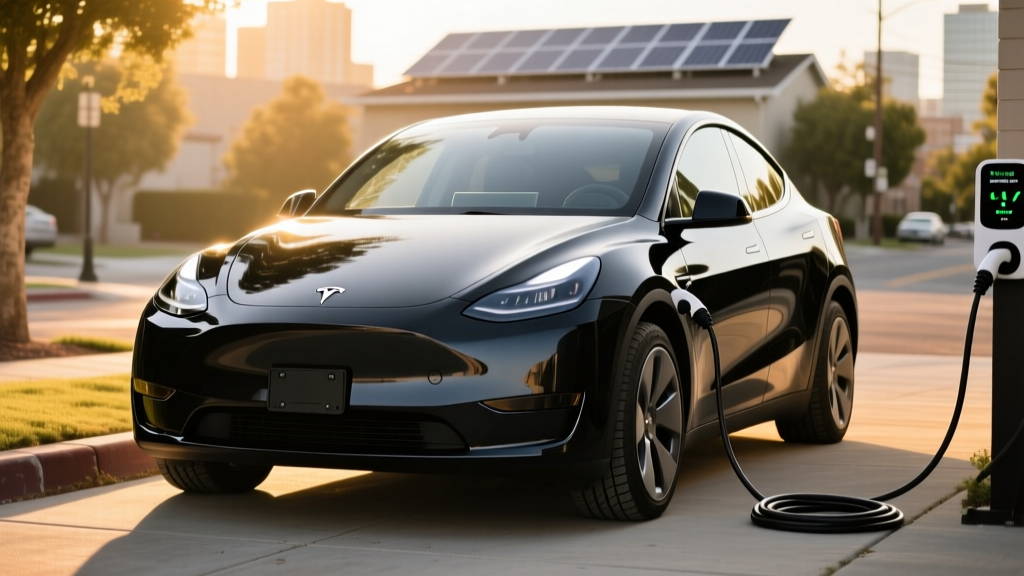
For home charging, the Model Y's onboard charger accepts up to 11.5 kW (48 amps) on a 240V Level 2 circuit. Tesla's Wall Connector ($420) or any J1772/NACS-compatible Level 2 unit on a 60-amp breaker delivers a full overnight replenishment. Installation typically runs $500–$1,500 depending on panel proximity and local permitting — consult a licensed electrician for a site-specific quote.
Performance, Cargo, and Daily Practicality
| Spec | Long Range RWD | Long Range AWD | Performance AWD |
|---|---|---|---|
| 0–60 mph | 5.8 sec | 4.8 sec | 3.5 sec |
| Horsepower | ~346 hp | ~384 hp | ~456 hp |
| Drivetrain | RWD single motor | Dual motor AWD | Dual motor AWD |
| Cargo (rear seats up) | 34.3 cu ft (behind 2nd row) | ||
| Cargo (rear seats folded) | 72.1 cu ft | ||
| Front trunk (frunk) | 4.1 cu ft | ||
| Rear legroom | 41.6 in | ||
| Towing capacity | 3,500 lbs (with hitch) | ||
The Model Y's cargo volume remains among the best in its class — 72.1 cu ft with seats folded beats the IONIQ 5 (59.3 cu ft) and rivals the Mach-E (59.7 cu ft). The rear seat accommodates two adults comfortably with 41.6 inches of legroom; a third middle passenger is tight on longer trips due to the center-console hump and firm cushion.
The Performance trim's 3.5-second 0–60 time is genuinely sports-car quick, but the Long Range AWD's 4.8 seconds is more than adequate for merging and passing — and it gives up only a small efficiency penalty versus the RWD.
Pricing, Trims, and Federal Tax Credit Eligibility
| Trim | Base MSRP | Est. After §30D Credit* |
|---|---|---|
| Long Range RWD | $44,990 | ~$37,490 |
| Long Range AWD | $47,990 | ~$40,490 |
| Performance AWD | $51,490 | ~$43,990 |
*Federal tax credit amounts depend on battery sourcing compliance, buyer income, and point-of-sale transfer election. Figures assume full $7,500 eligibility.
The Model Y qualifies for the IRS §30D Clean Vehicle Credit — up to $7,500 — provided you meet the following requirements (rules current for the 2025–2026 tax year):
- MSRP cap: The Model Y is classified as an SUV, so the cap is $80,000. All trims clear this easily.
- Buyer income cap: Modified AGI must not exceed $150,000 (single), $225,000 (head of household), or $300,000 (joint).
- Battery sourcing: A percentage of critical minerals and battery components must be sourced from the U.S. or free-trade-agreement countries. Tesla has progressively shifted supply chains, but the exact credit amount ($3,750 or $7,500) can vary by production batch. Verify the specific VIN on the IRS qualified-vehicles list before purchase.
- Point-of-sale transfer: You can elect to transfer the credit to the dealer at purchase, reducing your out-of-pocket cost immediately rather than waiting for a tax refund.
Tesla also frequently offers low-rate financing (as low as 0.99%–2.99% APR on select terms), which can rival or beat the cash value of the tax credit for buyers who itemize. Always run both scenarios before committing.
Driver Assistance, Tech, and Ownership Experience
Every Model Y ships with Tesla's Basic Autopilot — adaptive cruise control and lane centering on highways. The optional Full Self-Driving (Supervised) package ($8,000 or $99/month) adds automated lane changes, traffic-light recognition, and navigate-on-autopilot. Despite the name, FSD remains an SAE Level 2 system: the driver must remain attentive, hands on or near the wheel, at all times. It is not autonomous driving.
The 15.4-inch center touchscreen handles all vehicle functions — there are no physical buttons for climate, mirrors, or glovebox. This minimalist approach divides buyers; those who prefer tactile controls should test-drive before committing. The infotainment system supports native streaming apps, a strong navigation system with real-time Supercharger availability, and over-the-air updates that periodically add features.
Pros
- Class-leading MPGe and efficiency (122 combined)
- Extensive Supercharger network (20,000+ U.S. stalls)
- Top safety ratings (IIHS Top Safety Pick+, NHTSA 5-star)
- Spacious cargo area (72.1 cu ft)
- Fast DC charging (250 kW peak)
- Over-the-air feature updates
Cons
- Touchscreen-only controls frustrate some drivers
- FSD costs $8,000 extra and is still Level 2
- No Apple CarPlay / Android Auto
- Rear middle seat is tight for adults
- Ride quality firm on 20"+ wheels
- Insurance costs above segment average
Who Should Buy the Tesla Model Y?
- You want maximum efficiency (MPGe) in a practical SUV shape
- You road-trip frequently and want reliable, widespread DC fast-charging
- You need serious cargo space with a hatchback form factor
- You have home Level 2 charging access
- You prefer physical buttons and Apple CarPlay (try the IONIQ 5 or Mach-E)
- You need three rows of seating (look at the Kia EV9 or Rivian R1S)
- You want the fastest possible DC charging at 800V stations (IONIQ 5 / IONIQ 6)
Frequently Asked Questions
What is the Tesla Model Y's MPGe?
The highest-rated trim, the Long Range RWD, achieves 122 MPGe combined (130 city / 111 highway). The Long Range AWD posts 114 MPGe combined, and the Performance AWD posts 108 MPGe combined, per the EPA.
What is the real-world range of the Tesla Model Y?
The EPA rates the Long Range RWD at 320 miles, the Long Range AWD at 303 miles, and the Performance at 285 miles. In real-world highway driving at 75 mph, expect 270–290 miles. In freezing temperatures, plan for 230–260 miles.
Does the Tesla Model Y qualify for the $7,500 federal tax credit?
Yes, the Model Y is eligible for up to $7,500 under IRS §30D, subject to buyer income limits ($150K single / $300K joint), the $80K SUV MSRP cap, and battery-sourcing requirements that can vary by VIN. The credit can be transferred to the dealer at point of sale.
How fast does the Model Y charge at home and on the road?
At home on a 240V Level 2 charger, the Model Y accepts up to 11.5 kW, adding roughly 37–44 miles per hour. On a 250 kW DC fast charger, it reaches 10–80% in approximately 25 minutes, with peak rates sustained only in the lower portion of the charge curve.
Is the Model Y worth it vs. the Hyundai IONIQ 5 or Ford Mach-E?
The Model Y wins on MPGe efficiency (122 vs. 110 vs. 101 combined), Supercharger network access, and cargo volume. The IONIQ 5 charges faster at 800V stations (18 min 10–80%) and offers physical buttons plus CarPlay. The Mach-E provides a more traditional driving feel. If Supercharger access and efficiency are your priorities, the Model Y remains the benchmark.