The Tesla Model Y remains the best-selling electric vehicle in the United States for good reason: it blends crossover practicality with class-leading efficiency. But the EPA sticker is only part of the story. Buyers searching for real Tesla Model Y mileage data need to understand how this SUV performs on the highway, in freezing temperatures, and over a full ownership cycle — not just on a spec sheet.
We've driven multiple Model Y variants across seasons, logged DC fast-charging sessions at Superchargers and Electrify America stations, and tracked long-term efficiency. Here's everything you need to know about range, charging speed, cost, and whether the Model Y still earns its reputation in 2026.
2026 Tesla Model Y: Core Specifications at a Glance
| Spec | Long Range AWD | Performance AWD | RWD (Standard) |
|---|---|---|---|
| EPA Range | 320 miles | 295 miles | 260 miles |
| Battery (usable) | ~75 kWh (NMC) | ~75 kWh (NMC) | ~57.5 kWh (LFP) |
| Efficiency | 122 MPGe / 27 kWh/100mi | 111 MPGe / 30 kWh/100mi | 128 MPGe / 26 kWh/100mi |
| 0–60 mph | 4.8 sec | 3.5 sec | 6.6 sec |
| Horsepower | 384 hp | 456 hp | 295 hp |
| Drivetrain | Dual-Motor AWD | Dual-Motor AWD | RWD |
| Max DC Charge Rate | 250 kW | 250 kW | 170 kW |
| 10–80% DC Time | ~25 min | ~25 min | ~30 min |
| Level 2 Rate | 11.5 kW (~44 mi/hr) | 11.5 kW (~44 mi/hr) | 7.6 kW (~30 mi/hr) |
| Base MSRP | $44,990 | $50,990 | $36,490 |
| Battery Warranty | 8 yr / 120,000 mi | 8 yr / 120,000 mi | 8 yr / 100,000 mi |
Source: fueleconomy.gov and Tesla's official specifications. Pricing reflects 2026 model year MSRP before destination fees and incentives.
Real-World Tesla Model Y Mileage: Beyond the EPA Sticker
The Model Y Long Range is one of the most efficient electric crossovers on the market, achieving 27 kWh per 100 miles on the EPA combined cycle. That figure matters more than raw battery size — Tesla's thermal management system, heat pump, and aerodynamic design squeeze more miles out of every kilowatt-hour than nearly any competitor.
However, efficiency varies significantly with driving style and environment. During our highway-heavy test loop (70–80 mph, minimal elevation change, 65°F), the Long Range AWD averaged 29 kWh/100mi, translating to approximately 258 miles of usable range before hitting the 10% buffer. City driving with regenerative braking enabled pushed efficiency back to 25 kWh/100mi — closer to the EPA estimate.
The RWD model, equipped with a lithium iron phosphate (LFP) battery, shows less cold-weather degradation percentage-wise than NMC variants but starts from a lower baseline range. If your commute is under 40 miles round-trip and you charge nightly, the RWD's 260 EPA miles is more than adequate and comes with a lower purchase price.
What causes range loss in the Model Y?
- Highway speed: Aerodynamic drag scales with the square of velocity. Driving 80 mph vs. 65 mph can cost 30–40 miles of range.
- Cold weather: Below freezing, the heat pump works harder and battery resistance increases. Preconditioning while plugged in mitigates this significantly.
- Elevation gain: Mountain driving consumes more energy; regeneration on descents partially recovers it.
- Climate control: Cabin heating in winter draws 2–4 kW continuously, reducing range by 10–15% on short trips.
Charging Speed: Supercharger Network and Home Setup
Charging speed is where the Model Y continues to outpace most rivals, thanks primarily to Tesla's Supercharger network — now increasingly open to other brands but still the most reliable DC fast-charging ecosystem in North America.
| Charging Level | Power / Connector | Speed (Miles Added) | Notes |
|---|---|---|---|
| Level 1 (120V) | ~1.4 kW / NACS | ~5 mi/hr | Emergency/trickle only |
| Level 2 (240V home) | 11.5 kW / NACS | ~44 mi/hr | Full charge in ~7 hrs (Long Range) |
| DC Fast (Supercharger V3) | 250 kW peak / NACS | ~175 mi in 15 min | 10–80% in ~25 min |
| DC Fast (CCS adapter) | Up to 250 kW / CCS1 | Varies by station | Requires Tesla CCS adapter |
Understanding the charge curve: The Model Y Long Range peaks at 250 kW only between roughly 10–30% state of charge. From 30–60%, it sustains approximately 150–175 kW. Above 80%, charging slows dramatically to protect battery health — often dropping below 50 kW. This is why Tesla and most EV experts recommend charging to 80% for daily use and only charging to 100% when you need the full range for a road trip.
The RWD model with its LFP battery charges at a lower peak rate (170 kW) and takes about 30 minutes from 10–80%. However, LFP chemistry has an important advantage: Tesla recommends charging LFP batteries to 100% regularly to maintain accurate state-of-charge calibration, effectively giving you the full 260 miles every day.
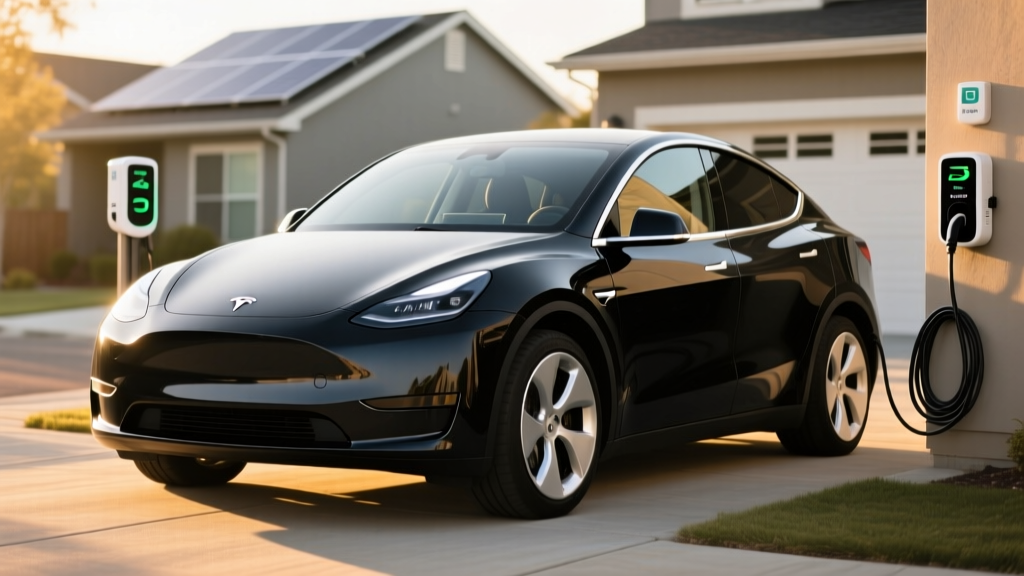
Home charging installation
A Tesla Wall Connector installed on a 60-amp circuit delivers the full 11.5 kW (48 amps continuous), adding roughly 44 miles of range per hour. Most owners with a 30–50 mile daily commute only need to plug in overnight every 3–4 days. Installation costs typically range from $800 to $2,500 depending on panel proximity and whether a panel upgrade is needed. Always hire a licensed electrician and check local permit requirements.
Pricing, Trims, and Federal Tax Credit Eligibility
| Trim | Base MSRP | Est. After §30D Credit* | Destination |
|---|---|---|---|
| RWD (Standard) | $36,490 | $28,990 | $1,390 |
| Long Range AWD | $44,990 | $37,490 | $1,390 |
| Performance AWD | $50,990 | $43,490 | $1,390 |
*Tax credit eligibility depends on multiple IRS §30D requirements. See checklist below.
Federal EV tax credit (§30D) eligibility checklist
- MSRP cap: SUVs/vans/pickups must be under $80,000 MSRP. All Model Y trims qualify.
- Buyer income cap: Modified AGI must not exceed $150,000 (single), $225,000 (head of household), or $300,000 (joint). Check IRS §30D guidelines for current-year rules.
- Battery sourcing: Critical minerals and battery components must meet phased-in domestic-content thresholds. As of 2026, the sourcing requirements are stringent — verify current eligibility on Tesla's website or with your tax professional before relying on the full $7,500 credit.
- Point-of-sale transfer: You can transfer the credit to the dealer at purchase, reducing your out-of-pocket cost immediately rather than waiting for tax filing.
- Tax liability: The credit is non-refundable — you must owe at least $7,500 in federal taxes to claim the full amount (unless transferred at point of sale under the 2024+ rules).
The RWD Model Y at roughly $29,000 after the full credit represents one of the most compelling value propositions in the EV market — a spacious crossover with 260 miles of range, access to the Supercharger network, and best-in-class software for under $30,000 effective cost. However, battery sourcing rules remain a moving target, and eligibility can shift. Always confirm with your tax advisor.
Cargo, Passenger Space, and Daily Practicality
The Model Y's crossover form factor is a major reason for its sales dominance. Interior volume and cargo capacity outclass most electric sedans and rival compact SUVs.
- Cargo behind rear seats: 30.2 cu ft
- Cargo with rear seats folded: 72.1 cu ft
- Front trunk (frunk): 4.1 cu ft
- Rear legroom: 41.6 inches
- Front headroom: 41.0 inches
- Seating capacity: 5 standard (7-seat option available on some trims, though third row is best suited for small children)
The flat load floor and wide hatch opening make the Model Y practical for hauling furniture, camping gear, or weekly groceries for a family of four. The available 7-seat configuration sacrifices cargo space and is only realistic for families with young children — adults will not fit comfortably in the third row.
Tech, Driver Assistance, and Notable Drawbacks
The Model Y's interior remains minimalist — a 15.4-inch center touchscreen handles virtually all vehicle controls, navigation, media, and climate settings. There is no instrument cluster; speed and range information appear in the upper-left corner of the main display.
Standard technology
- Tesla Autopilot (SAE Level 2 driver assistance): adaptive cruise control, lane centering, automatic emergency braking
- Over-the-air software updates that regularly add features
- Tesla mobile app with remote preconditioning, location tracking, and Sentry Mode camera access
- Dashcam and Sentry Mode recording (requires USB drive)
- HEPA air filtration with Bioweapon Defense Mode
Full Self-Driving (Supervised)
Tesla's FSD (Supervised) package, available as an $8,000 add-on or subscription, extends Autopilot with automatic lane changes, traffic light and stop sign recognition, and city-street navigation. In 2026, FSD remains a Level 2 system requiring constant supervision. It handles many scenarios competently but can behave unpredictably in construction zones, complex intersections, and adverse weather. We recommend extensive hands-on evaluation before purchasing.
Drawbacks worth noting
- No physical controls: Climate, mirrors, and glovebox all operate through the touchscreen — distracting for some drivers.
- Ride quality: The sport-tuned suspension can feel firm over rough pavement, especially with the 20-inch wheel option.
- Insurance costs: Model Y insurance premiums tend to run 15–30% higher than comparable non-Tesla crossovers due to repair costs and claim data.
- Phantom braking: Some owners report unexpected deceleration on Autopilot; this has improved with software updates but remains a documented concern.
- No Apple CarPlay/Android Auto: Tesla's proprietary infotainment system does not support smartphone mirroring.
Tesla Model Y vs. Key Competitors
The Model Y doesn't exist in a vacuum. Here's how it stacks up against the closest alternatives in the electric crossover segment for 2026:
| Metric | Tesla Model Y LR | Hyundai Ioniq 5 LR | Ford Mustang Mach-E ER | Kia EV6 LR |
|---|---|---|---|---|
| EPA Range | 320 mi | 310 mi | 312 mi | 310 mi |
| Efficiency | 27 kWh/100mi | 30 kWh/100mi | 31 kWh/100mi | 29 kWh/100mi |
| Max DC Charge | 250 kW | 350 kW (800V) | 150 kW | 350 kW (800V) |
| 10–80% Time | ~25 min | ~18 min | ~38 min | ~18 min |
| Cargo (rear seats up) | 30.2 cu ft | 27.2 cu ft | 29.7 cu ft | 24.4 cu ft |
| Starting MSRP | $44,990 | $46,250 | $45,995 | $44,900 |
| Charging Network | NACS (native Supercharger) | NACS (adapter or 2026+) | NACS (adapter) | NACS (adapter or 2026+) |
The Model Y's efficiency advantage is clear — it extracts more miles per kWh than any competitor here, which translates to lower charging costs over time. The Hyundai Ioniq 5 and Kia EV6 charge significantly faster thanks to their 800-volt architectures (18 minutes 10–80% vs. 25 minutes), which matters on long road trips. The Mach-E trails in charging speed but offers competitive range and a more traditional interior layout with physical buttons.
Tesla's native NACS connector and seamless Supercharger experience remain a practical advantage, though competitors are gaining access through adapters and the industry-wide NACS transition. The gap in charging convenience is narrowing every year.
Who Should Buy the Tesla Model Y?
- You regularly drive 200+ miles between charges (road trips, long commutes)
- You need all-wheel drive for snow or rain
- Supercharger network access is a priority for your travel patterns
- You value cargo space and efficiency equally
- Your daily commute is under 50 miles and you charge at home nightly
- You want the lowest effective price after tax credits
- You prefer LFP battery chemistry for its longer cycle life and 100% daily charging
- You want the fastest possible DC charging (Ioniq 5/EV6 at 350 kW)
- You prefer physical buttons and a traditional instrument cluster
- Apple CarPlay/Android Auto is non-negotiable
Pros and Cons
- Class-leading efficiency (27 kWh/100mi)
- Spacious cargo area (30.2 cu ft) and flat load floor
- Native Supercharger network access — most reliable DC charging in the US
- Over-the-air updates continuously improve the vehicle
- Strong resale value relative to EV segment average
- Competitive pricing after federal tax credit
- Touchscreen-only controls can be distracting
- Firm ride quality, especially with larger wheels
- Insurance premiums above segment average
- No Apple CarPlay or Android Auto
- FSD (Supervised) is expensive and still requires full driver attention
- DC charging slower than 800V competitors (Ioniq 5, EV6)
Frequently Asked Questions
What is the real-world range of the Tesla Model Y?
The Long Range AWD is EPA-rated at 320 miles. In real-world mixed driving at moderate temperatures, expect 270–300 miles. Sustained highway driving at 75 mph yields approximately 250–275 miles. In freezing weather, plan for 220–250 miles due to battery conditioning and cabin heating demands.
How fast does the Model Y charge at home and on the road?
On a Level 2 home charger (240V, 60A circuit), the Long Range charges at 11.5 kW, adding about 44 miles per hour — a full charge takes roughly 7 hours. On a V3 Supercharger, it peaks at 250 kW and charges from 10–80% in approximately 25 minutes. The RWD model charges at 7.6 kW on Level 2 and peaks at 170 kW on DC fast charging.
Does the Tesla Model Y qualify for the $7,500 federal tax credit?
All Model Y trims fall under the $80,000 MSRP cap for SUVs. Eligibility for the full $7,500 credit depends on your income (under $150K single / $300K joint), battery critical-mineral sourcing requirements, and your federal tax liability. Point-of-sale transfer is available. Check IRS guidelines and consult a tax professional for your specific situation.
Is the Tesla Model Y worth buying over the Hyundai Ioniq 5 or Ford Mach-E?
The Model Y wins on efficiency, cargo space, and charging network convenience. The Ioniq 5 and EV6 charge significantly faster (18 vs. 25 minutes, 10–80%) and offer physical buttons and CarPlay. The Mach-E provides a more conventional driving experience. If Supercharger access and maximum cargo volume matter most, the Model Y remains the strongest choice. If charging speed and a traditional interior are priorities, test-drive the Korean alternatives.
How long does the Model Y battery last?
Tesla warranties the Long Range battery for 8 years or 120,000 miles (whichever comes first) with a minimum 70% capacity retention threshold. Real-world data from high-mileage owners suggests NMC batteries in Teslas typically retain 85–90% capacity after 100,000 miles when charged primarily to 80%. The LFP battery in the RWD model is warranted for 8 years / 100,000 miles and is expected to show even slower degradation due to LFP chemistry's longer cycle life.
What is the Tesla Model Y MPGe rating?
The Long Range AWD achieves 122 MPGe combined (127 city / 116 highway) according to fueleconomy.gov. The RWD model is rated at 128 MPGe combined. For practical cost calculations, use the kWh/100mi figure (27 for LR, 26 for RWD) multiplied by your local electricity rate to determine your per-mile fuel cost.
Can I tow with the Tesla Model Y?
Yes. The Model Y is rated to tow up to 3,500 pounds when equipped with the factory tow hitch. However, towing significantly reduces range — expect a 30–50% reduction depending on trailer weight and aerodynamics. Plan charging stops accordingly.