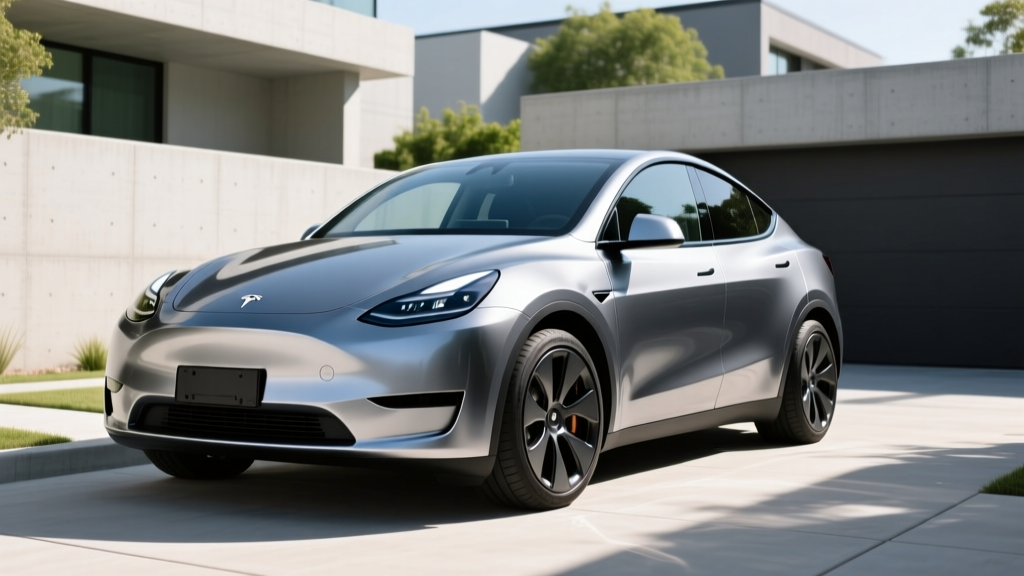
The Tesla Model Y remains the benchmark compact electric SUV in 2026, and the Midnight Silver Metallic paint option continues to be one of its most popular — and most practical — exterior choices. This deep gray with a subtle metallic flake hides road dust better than Tesla's solid blacks and whites, making it a favorite among owners who park outdoors or commute in all weather. But beyond the paint, what does the 2026 Model Y actually deliver in range, charging speed, and daily usability? We break down every number that matters.
Quick Verdict: Who Should Buy the Model Y in Midnight Silver Metallic?
The 2026 Tesla Model Y suits a specific buyer profile better than almost any other EV on the market: families and commuters who need a practical electric crossover with strong range, access to the most reliable DC fast-charging network in North America, and over-the-air software updates that keep the vehicle improving post-purchase. The Midnight Silver Metallic finish adds a stealthy, premium look without the $2,000 upcharge of Ultra Red or Quicksilver.
- You want 300+ miles of EPA range with access to 20,000+ Superchargers
- You need a compact SUV with genuine cargo versatility (up to 72 cu ft)
- You value software-driven features and OTA improvements
- You want a proven EV platform with strong resale value
- You prefer a traditional dealership experience and physical controls
- You need a luxury-grade interior — the Model Y cabin is minimalist, not opulent
- You want a ride quality tuned for comfort over sportiness
Range & Efficiency: EPA Numbers vs. the Real World
The 2026 Tesla Model Y Long Range AWD carries an EPA-estimated range of 320 miles on a full charge. The base Rear-Wheel Drive (RWD) model is rated at approximately 295 miles EPA. These figures place the Model Y near the top of the compact EV SUV segment.
EPA sticker: 320 miles (Long Range AWD) / 295 miles (RWD)
Real-world highway (70 mph, moderate temps): ~270–290 miles
Real-world mixed city/highway (55–65 mph): ~290–310 miles
Cold weather (below 32°F, highway): ~220–250 miles — expect 20–30% range loss in freezing conditions, mitigated partially by the Model Y's heat pump and battery preconditioning.
The Model Y's efficiency is a genuine engineering strength. At roughly 28 kWh per 100 miles (Long Range AWD), it converts battery energy into motion more effectively than most competitors. For context, the Ford Mustang Mach-E Extended Range AWD consumes around 34 kWh/100 mi in similar driving, and the Hyundai Ioniq 5 AWD sits near 32 kWh/100 mi. This efficiency advantage is why Tesla achieves strong range from a battery that isn't the largest in the segment.
In terms of MPGe, the Long Range AWD is rated at approximately 120 MPGe combined (127 city / 113 highway) per fueleconomy.gov. These figures translate to roughly $0.04–$0.06 per mile when charging at home on a national-average electricity rate of $0.17/kWh.
Battery, Chemistry & What It Means for Longevity
| Specification | Long Range AWD | Rear-Wheel Drive |
|---|---|---|
| Battery Chemistry | NMC (Nickel Manganese Cobalt) | LFP (Lithium Iron Phosphate) |
| Usable Battery Capacity | ~78 kWh | ~60 kWh |
| Drivetrain | Dual Motor AWD | Single Motor RWD |
| Horsepower | ~384 hp | ~295 hp |
| 0–60 mph | 4.8 seconds | 6.6 seconds |
| EPA Range | 320 miles | 295 miles |
| Top Speed | 135 mph | 135 mph |
The chemistry split matters. The Long Range AWD uses NMC cells, which offer higher energy density (more range per kilogram) but are best kept between 20–80% State of Charge for daily use to minimize long-term degradation. Tesla's software recommends a 90% daily charge limit for NMC and 100% only for trips.
The RWD model uses LFP (lithium iron phosphate) chemistry. LFP batteries have lower energy density but can be charged to 100% daily without accelerated degradation. They also tend to have longer cycle life and use no cobalt. The trade-off is reduced range and slightly lower cold-weather performance. If you charge at home every night and want simplicity, the LFP RWD model is compelling.
Tesla's battery warranty covers 8 years or 120,000 miles (Long Range AWD) and 8 years or 100,000 miles (RWD), whichever comes first, with a guaranteed 70% minimum capacity retention. Real-world data from large owner surveys suggests Tesla NMC packs degrade roughly 10–12% over the first 100,000 miles, with the curve flattening significantly afterward. LFP packs in the RWD model show even slower degradation in early fleet data.
Charging Speed: DC Fast, Level 2 & Level 1 Breakdown
Charging speed is where the Model Y's 800V-capable architecture (introduced with the Juniper refresh) pays dividends. Here's the full picture:
| Charging Level | Power / Rate | Miles Added per Hour | Notes |
|---|---|---|---|
| DC Fast Charge (V4 Supercharger) | Up to 250 kW peak | ~1,000 mi/hr at peak | 10–80% in ~25 min; tapers above 80% |
| DC Fast Charge (3rd-party CCS/NACS) | Up to 250 kW (varies) | ~800–1,000 mi/hr at peak | Speed depends on station output |
| Level 2 (Tesla Wall Connector, 48A) | 11.5 kW | ~44 mi/hr | Full charge in ~7–8 hours |
| Level 2 (Public, 19.2 kW capable) | Up to 11.5 kW (vehicle-limited) | ~44 mi/hr | Vehicle onboard charger caps at 11.5 kW |
| Level 1 (120V household outlet) | ~1.4 kW | ~3–5 mi/hr | Emergency/trickle only |
Key charging insight: The Model Y's DC fast-charging curve peaks at roughly 250 kW between 10–30% State of Charge, then steps down progressively. From 50–80%, expect sustained rates closer to 100–130 kW. The 10–80% session takes approximately 25 minutes at a V3/V4 Supercharger. At a 150 kW third-party station, expect 10–80% in roughly 35–40 minutes.
Preconditioning matters. Navigate to a Supercharger using the car's built-in navigation, and the battery will preheat (or precool) to optimal temperature before you arrive. In cold weather, preconditioning can shave 5–10 minutes off your charging session and significantly improve peak charge rates. Without preconditioning, a cold battery in winter may peak at only 80–100 kW until it warms up.
The Model Y uses the NACS (North American Charging Standard) connector natively — the same connector now adopted by Ford, GM, Rivian, Hyundai, and most major automakers. This means the Model Y can use any NACS-equipped station, including Electrify America's expanding NACS rollout, without adapters.
Pricing, Trims & Federal Tax Credit Eligibility
| Trim | Base MSRP | Federal §30D Credit | Est. Net Price* |
|---|---|---|---|
| Rear-Wheel Drive | $44,990 | Up to $7,500 | ~$37,490 |
| Long Range AWD | $48,990 | Up to $7,500 | ~$41,490 |
| Performance (Dual Motor) | $52,490 | Up to $7,500 | ~$44,990 |
*Net price assumes full $7,500 §30D credit eligibility. Midnight Silver Metallic is a no-cost paint option on the 2026 Model Y.
The Midnight Silver Metallic paint is included in Tesla's standard color palette for 2026, meaning no additional charge. Pearl White Multi-Coat is also standard; Solid Black, Deep Blue Metallic, Ultra Red, and Quicksilver carry upcharges of $1,000–$2,000 depending on the color.
To claim the full $7,500 credit, you must meet ALL of the following:
- MSRP cap: Vehicle MSRP must be ≤ $80,000 for SUVs (all Model Y trims qualify)
- Income cap: Modified AGI ≤ $300,000 (joint) / $225,000 (head of household) / $150,000 (single)
- Battery sourcing: Critical minerals and battery components must meet escalating domestic-content thresholds — Tesla's US-built battery packs have generally satisfied these requirements, but verify current-year compliance at irs.gov
- Point-of-sale transfer: You can transfer the credit to the dealer at purchase for an immediate price reduction rather than waiting to claim it on your tax return
- One credit per VIN: The vehicle must be new and not have previously had the credit claimed
Always consult a tax professional for your specific situation. Rules are subject to change and state/local incentives may stack on top.
Interior, Cargo & Daily Practicality
The 2026 Model Y's Juniper-generation interior is a meaningful step up from the pre-2025 cabin. Ambient lighting strips, ventilated front seats (now standard), acoustic glass, and improved material quality address the most common owner complaints from prior model years.
Dimensionally, the Model Y offers:
- Cargo volume (rear seats up): 30.2 cu ft
- Cargo volume (rear seats folded): 72.1 cu ft
- Front trunk (frunk): 4.1 cu ft
- Rear legroom: 41.6 inches
- Front headroom: 40.7 inches
- Seating: 5-passenger standard (7-seat option available on Long Range, reduces cargo to 12.4 cu ft behind third row)
The 72.1 cu ft maximum cargo figure is competitive with the Honda CR-V and Toyota RAV4 in overall volume, though the Model Y's sloping roofline reduces usable height for tall items compared to boxier competitors. The frunk adds useful space for charging cables, groceries, or a small bag — a feature gas-powered SUVs simply cannot match.
Technology, Driver Assistance & Safety
The Model Y's 15.4-inch central touchscreen remains the primary interface for nearly all vehicle functions — climate, navigation, media, and vehicle settings. The 2026 Juniper refresh adds a rear-seat 8-inch display for climate and entertainment control, addressing a longstanding complaint.
Autopilot comes standard and includes adaptive cruise control, lane-keeping assist, automatic emergency braking, and blind-spot monitoring. Full Self-Driving (Supervised) remains a $8,000 option (or $99/month subscription) and adds automated lane changes, traffic light/stop sign recognition, and city-street navigation-assisted driving.
Both Autopilot and FSD (Supervised) are SAE Level 2 driver-assistance systems. The driver must remain fully engaged, keep hands on the wheel, and monitor the road at all times. These systems are NOT self-driving. Tesla's "Full Self-Driving" name is a product label, not a description of capability. Only Level 4 services like Waymo operate without a human driver.
Safety ratings remain strong. The Model Y earned a 5-star overall rating from NHTSA and has historically performed well in IIHS crash testing. Standard safety features include front and side automatic emergency braking, collision warning, and eight airbags.
- Drive without your supervision — you are the driver at all times
- Handle all construction zones, unmapped roads, or severe weather reliably
- Replace your attention — disengagement can occur suddenly
- Make you immune from liability — traffic violations and accident responsibility remain with the driver
Pros, Cons & How It Compares
- Class-leading efficiency (~28 kWh/100 mi) translates to real range
- Access to Tesla Supercharger network — 20,000+ stalls in North America
- Strong OTA update cadence keeps features current
- LFP option on RWD allows worry-free 100% daily charging
- Midnight Silver Metallic hides dirt well — practical for all climates
- Competitive pricing after §30D credit (~$37,500 RWD)
- 72 cu ft cargo volume with seats folded
- Minimalist interior lacks physical buttons — everything is touchscreen
- Ride quality is firm; rivals like the Ioniq 5 are more compliant
- No Apple CarPlay or Android Auto — Tesla's ecosystem is proprietary
- FSD (Supervised) remains Level 2 despite its name and $8,000 price
- Panel gap consistency has improved but still draws scrutiny
- Insurance costs can run 15–25% higher than comparable gas SUVs
Model Y vs. the competition: The Hyundai Ioniq 5 offers a more comfortable ride and 800V charging at up to 350 kW (10–80% in 18 minutes), but its real-world range trails by ~30 miles and its public charging network access is less seamless. The Ford Mustang Mach-E provides a more engaging drive and a traditional interior layout, but its efficiency and cargo space fall short. The Model Y's combination of range, efficiency, Supercharger access, and pricing after tax credits makes it the default recommendation for buyers who prioritize practicality over personality.
Frequently Asked Questions
What is the real-world range of the 2026 Tesla Model Y?
The EPA rates the Long Range AWD at 320 miles and the RWD at 295 miles. In real-world highway driving at 70 mph in moderate temperatures, expect 270–290 miles. In freezing weather, range drops to approximately 220–250 miles due to battery resistance and cabin heating demands, even with the Model Y's heat pump.
How fast does the Model Y charge at home and on the road?
On a Level 2 home charger (Tesla Wall Connector at 48 amps / 11.5 kW), the Model Y adds roughly 44 miles of range per hour, achieving a full charge in 7–8 hours. On a DC fast charger, it peaks at 250 kW and charges from 10–80% in approximately 25 minutes at a V3/V4 Supercharger.
Does the Tesla Model Y qualify for the $7,500 federal EV tax credit?
All 2026 Model Y trims fall under the $80,000 SUV MSRP cap. Eligibility for the full $7,500 §30D credit depends on your income (≤ $300,000 joint / $150,000 single), battery sourcing compliance, and purchasing new. The credit can be transferred to the dealer at point of sale for an instant price reduction. Verify current-year rules at irs.gov and consult a tax professional.
Is Midnight Silver Metallic a premium paint color?
No. As of the 2026 model year, Midnight Silver Metallic is a standard no-cost color on the Model Y. It is a deep metallic gray that conceals road grime and minor scratches better than solid black or white, making it a popular practical choice.
How does the Model Y compare to the Hyundai Ioniq 5 and Ford Mach-E?
The Model Y leads in efficiency (28 vs. 32–34 kWh/100 mi), real-world range, and charging network access. The Ioniq 5 charges faster at compatible 350 kW stations (18 min 10–80%) and has a more comfortable ride. The Mach-E offers a sportier driving feel and physical controls. All three qualify for the federal tax credit, but the Model Y's Supercharger network advantage remains a decisive factor for road-trip-heavy buyers.
Is the Model Y a self-driving car?
No. The Model Y with Autopilot or FSD (Supervised) is an SAE Level 2 vehicle. You must remain the active driver at all times — hands on the wheel, eyes on the road. Level 4 autonomous driving (no driver required) is currently available only through robotaxi services like Waymo in select metro areas.