The Tesla Model Y remains one of the best-selling electric vehicles in the United States for good reason: strong range, access to the Supercharger network, and a practical crossover footprint. But a recurring question among new owners and prospective buyers centers on a feature buried deep in the owner's manual — the Tesla manual door release on the Model Y. Understanding how it works isn't just trivia; it's a critical safety function that every driver and passenger should know before they ever need it.
This review covers the 2026 Tesla Model Y comprehensively — range, charging, performance, pricing, tax credits, and interior practicality — while giving the manual door release system the detailed attention it deserves. Whether you're researching a purchase or just took delivery, here's everything you need to know.
Why the Tesla Manual Door Release on the Model Y Matters
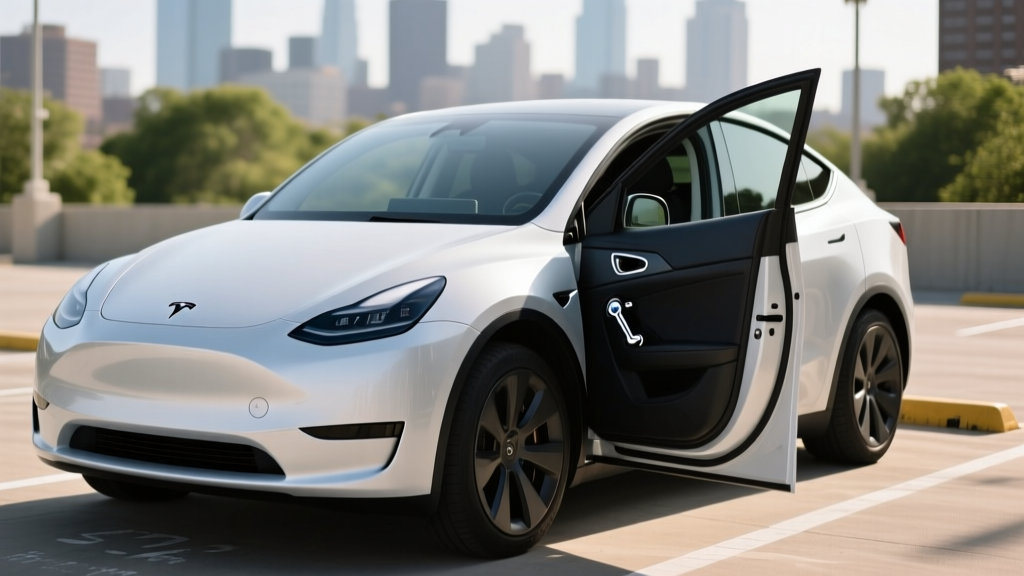
The Model Y uses electronic push-button door handles. There is no traditional mechanical pull handle on the inside of the doors for normal operation. You press a button at the top of the interior door panel, and the electronic latch releases. This design is clean and minimalist, but it raises a legitimate question: what happens if the 12V electrical system fails, the car loses power, or you're in an emergency?
The answer is the manual door release — a mechanical override built into each door. Here's how it works on the current-generation Model Y:
- Front doors: Pull upward on the manual release lever located near the window switches on the interior door panel. This mechanically disengages the latch and allows you to push the door open.
- Rear doors: The manual release is accessed by pulling up the bottom edge of the rear door pocket liner (the trim panel at the base of the door card). Underneath, you'll find a mechanical release cable that you pull to open the door.
Tesla updated the rear-door manual release mechanism on the refreshed Model Y (introduced for the 2025 model year and carried into 2026) to be more accessible and clearly labeled compared to earlier production years, where the cable was tucked behind trim and difficult for rear-seat passengers to locate under stress. The current design includes a visible pull-tab and improved instructions in the owner's manual.
2026 Tesla Model Y: Specs at a Glance
| Attribute | Long Range AWD | Performance |
|---|---|---|
| EPA Range | 320 miles | 295 miles |
| Battery Capacity | ~75 kWh usable (NMC) | ~75 kWh usable (NMC) |
| Drivetrain | Dual-Motor AWD | Dual-Motor AWD |
| Horsepower | 384 hp | 456 hp |
| 0–60 mph | 4.8 seconds | 3.5 seconds |
| Max DC Fast Charge | 250 kW | 250 kW |
| 10–80% DC Charge | ~25 minutes | ~25 minutes |
| Level 2 Charge Rate | 11.5 kW (~44 mi/hr) | 11.5 kW (~44 mi/hr) |
| Efficiency (MPGe) | 122 MPGe combined | 111 MPGe combined |
| Cargo Volume | 72 cu ft (rear seats folded) | 72 cu ft (rear seats folded) |
| Base MSRP | $44,990 | $48,990 |
Source: fueleconomy.gov and Tesla's official specifications. Prices reflect 2026 model year MSRP before destination fees and incentives.
Real-World Range: What the EPA Number Doesn't Tell You
The Model Y's NMC (nickel manganese cobalt) battery chemistry offers higher energy density than LFP (lithium iron phosphate), which is why the Long Range variant achieves its 320-mile rating from a ~75 kWh usable pack. Tesla's battery management system includes a buffer that protects against deep discharge, so the usable capacity is slightly less than the gross pack size.
For comparison, the base RWD Model Y (where available) uses an LFP battery with a lower EPA range but allows regular 100% charging without degradation concerns — a trade-off worth understanding depending on your driving pattern.
Charging Speed and Infrastructure
| Charging Level | Power (kW) | Miles of Range Added | Notes |
|---|---|---|---|
| Level 1 (120V) | ~1.4 kW | ~3–5 mi/hr | Emergency/trickle only |
| Level 2 (240V Home) | 11.5 kW | ~44 mi/hr | Full charge in ~7 hours |
| DC Fast (Supercharger V3) | Peak 250 kW | ~200 mi in 15 min | Tapers above 80% SoC |
| DC Fast (CCS Adapter) | Up to 250 kW | Varies by station | Requires Tesla CCS adapter |
The Model Y uses the North American Charging Standard (NACS) connector natively — Tesla's proprietary plug that has now been adopted by Ford, GM, Rivian, and most major automakers. This means the Model Y connects directly to the Supercharger network without adapters, and as of 2026, the Supercharger network includes over 25,000 stalls across North America, widely regarded as the most reliable public charging infrastructure available.
On a V3 Supercharger, the Model Y peaks at 250 kW but doesn't sustain that rate for the full session. The charging curve is aggressive from 10–50% State of Charge (SoC), then tapers progressively. Expect a 10–80% session in roughly 25 minutes under ideal conditions (battery preconditioned via navigation to a Supercharger). Without preconditioning — for instance, if you pull into a charger without routing through the nav system — peak rates may be lower, especially in cold weather, adding 5–10 minutes to your session.
At home on a Wall Connector with a 60-amp circuit (48 amps continuous), the onboard charger accepts up to 11.5 kW, adding approximately 44 miles of range per hour. An overnight session from 20% to 80% takes roughly 4–5 hours, which is more than adequate for daily use. If your home electrical panel supports only a 40-amp circuit, expect about 9.6 kW and roughly 37 miles per hour — still practical for most commuters.
Performance, Efficiency, and Daily Drivability
The Long Range AWD Model Y delivers 384 horsepower from its dual-motor setup, hitting 60 mph in 4.8 seconds. That's brisk for a family crossover and more than sufficient for highway merging and passing. The Performance trim bumps output to 456 hp with a 3.5-second 0–60 time, putting it in sports-sedan territory despite its crossover ride height.
Efficiency is where the Model Y continues to shine. At 122 MPGe combined (Long Range AWD), it consumes approximately 28 kWh per 100 miles — one of the most efficient vehicles in its class. This efficiency directly translates to lower charging costs and more miles per session. For context, the Ford Mustang Mach-E Extended Range AWD achieves 101 MPGe combined, and the Hyundai Ioniq 5 AWD sits at 110 MPGe combined per fueleconomy.gov.
Regenerative braking in the Model Y is strong and consistent. Tesla removed the user-adjustable regen setting several years ago, defaulting to a strong one-pedal-driving experience. Most owners adapt quickly and appreciate the reduced brake wear — the friction brakes are rarely engaged in normal driving.
Interior Space, Tech, and the Minimalist Cabin
The refreshed Model Y interior has improved materially over earlier production years. The cabin now features ventilated front seats, ambient lighting, a rear-seat touchscreen for passengers, power-folding second-row seats, and improved sound-deadening materials. The 15.4-inch center touchscreen remains the command center for virtually all vehicle functions — climate, navigation, media, vehicle settings, and even the glovebox release.
Cargo and passenger dimensions:
- Cargo volume behind second row: 30.2 cu ft
- Cargo volume with rear seats folded: 72 cu ft
- Front trunk (frunk): 4.1 cu ft
- Rear legroom: 41.6 inches
- Front headroom: 41.0 inches
The 72 cu ft maximum cargo figure is competitive with midsize crossovers generally, and the flat load floor with no transmission tunnel makes it practical for bulky items. The frunk adds useful space for charging cables, groceries, or a small bag.
Notable drawbacks: The reliance on the touchscreen for nearly all controls (there are no physical buttons for climate or wiper settings) remains polarizing. Turn signals are on a stalk in the 2026 model year (Tesla reversed the yoke-only experiment for the refresh), which most buyers will appreciate. The absence of Apple CarPlay and Android Auto continues to frustrate some shoppers, though Tesla's native infotainment is responsive and feature-rich.
Pricing, Trim Levels, and Federal Tax Credit Eligibility
| Trim | Base MSRP | Est. After §30D Credit | §30D Eligible? |
|---|---|---|---|
| Long Range AWD | $44,990 | ~$37,490* | Yes (if sourcing rules met) |
| Performance | $48,990 | ~$41,490* | Yes (if sourcing rules met) |
*Effective price assumes full $7,500 federal tax credit under IRS §30D. Eligibility depends on buyer income limits, battery component and critical mineral sourcing requirements, and MSRP caps. As of 2026, the MSRP cap for SUVs/crossovers is $80,000. Income caps are $300,000 (married filing jointly), $225,000 (head of household), and $150,000 (single). The credit can be transferred to the dealer at point of sale for an immediate price reduction. Always verify current eligibility at IRS.gov before purchasing.
The Model Y's pricing places it in the premium compact crossover segment, but after the federal credit, the Long Range AWD becomes highly competitive with internal-combustion alternatives like the Toyota RAV4 Hybrid (which starts around $33,000 but doesn't qualify for the §30D new-vehicle credit). When you factor in fuel savings, lower maintenance costs, and available state incentives, the total cost of ownership over five years can be favorable — though insurance premiums for the Model Y tend to run higher than average.
Battery Warranty, Longevity, and Degradation
Tesla covers the Model Y's battery and drive unit with an 8-year/120,000-mile warranty (whichever comes first) for the Long Range and Performance trims. The warranty guarantees a minimum of 70% battery capacity retention over that period. If the battery falls below 70% State of Health (SoH) within the warranty window, Tesla will repair or replace it.
Real-world degradation data from fleet studies and owner reports suggests the NMC packs in the Model Y lose approximately 8–12% capacity over the first 100,000 miles, with the steepest drop occurring in the first 20,000 miles before leveling off. This is consistent with industry norms for NMC chemistry. Best practices for longevity include:
- Charge to 80% for daily use; reserve 100% charges for road trips
- Avoid regularly draining below 10% SoC
- Use preconditioning when navigating to DC fast chargers
- In extreme heat, park in shade or a garage when possible
Autopilot, FSD, and Driver-Assistance Features
The Model Y comes standard with Tesla's basic Autopilot, which includes Traffic-Aware Cruise Control and Autosteer (lane-centering on marked highways). The optional FSD (Supervised) package adds automatic lane changes, navigation-guided on-ramp-to-off-ramp driving, traffic light and stop sign recognition, and enhanced summon features. As of 2026, FSD is a $8,000 one-time purchase or $99/month subscription.
The system's real-world performance is capable but imperfect. It handles well-marked highways confidently, but urban environments with construction zones, faded lane markings, or erratic traffic still require frequent driver intervention. Owners should view it as an advanced cruise control system, not a replacement for active driving.
Who the Model Y Suits Best
Look elsewhere if: You need three rows of seating, you want physical buttons and knobs, you require Apple CarPlay/Android Auto, you frequently tow heavy loads (the Model Y is rated for 3,500 lbs but towing significantly reduces range), or you live in an area with limited charging infrastructure and cannot install a Level 2 charger at home.
Frequently Asked Questions
Where is the manual door release on a Tesla Model Y?
For the front doors, the manual release is a pull-up lever located on the interior door panel near the window switches. For the rear doors on the 2026 Model Y, the manual release cable is accessed by pulling up the bottom edge of the rear door pocket liner. Both releases mechanically disengage the door latch independent of the vehicle's electrical system.
What happens if the Tesla Model Y loses all power — can I still get out?
Yes. The manual door releases are purely mechanical and do not require electrical power to function. Even if the 12V auxiliary battery and the high-voltage traction battery are both depleted, the manual releases will allow you to open each door from the inside. This is why Tesla includes them and why every occupant should know their location.
Does the 2026 Tesla Model Y qualify for the $7,500 federal tax credit?
The Model Y qualifies for the full $7,500 credit under IRS §30D provided that the buyer meets income limits ($150,000 single / $300,000 married filing jointly), the vehicle MSRP is under the $80,000 SUV cap, and the battery meets critical mineral and component sourcing requirements for the current tax year. The credit can be applied as a point-of-sale reduction at Tesla. Always verify current eligibility rules on IRS.gov as sourcing requirements have tightened annually.
How much does it cost to charge a Model Y at home vs. a Supercharger?
At the US average residential electricity rate of ~$0.17/kWh, a full charge of the Model Y's ~75 kWh battery costs approximately $12.75, yielding roughly 320 miles of range — about $0.04 per mile. Supercharger pricing varies by location but averages $0.30–$0.35/kWh, making a full charge roughly $22–$26, or about $0.07–$0.08 per mile. Both are significantly cheaper than gasoline at $3.50/gallon in a comparable 25 MPG crossover ($0.14 per mile).
Is the Tesla Model Y worth buying over the Ford Mach-E or Hyundai Ioniq 5?
The Model Y's strongest advantages are the Supercharger network, best-in-class efficiency (122 MPGe), strong cargo capacity, and over-the-air software updates that add features post-purchase. The Ford Mustang Mach-E offers a more traditional interior layout and CarPlay support. The Hyundai Ioniq 5 charges faster on 800V architecture (10–80% in ~18 minutes on a 350 kW charger). If charging network reliability and efficiency are your top priorities, the Model Y remains the benchmark. If interior ergonomics and ultra-fast DC charging matter more, the competitors deserve a close look.
What is the real-world range of the 2026 Model Y Long Range?
The EPA rates the Long Range AWD at 320 miles. Real-world mixed driving typically yields 280–300 miles. Sustained highway speeds above 70 mph reduce that to 250–270 miles. Cold weather below 30°F can drop range to 220–250 miles. These figures assume normal driving habits without aggressive acceleration or extreme climate-control usage.