Tesla's grip on the EV market has loosened. Search interest in tesla owner brand loyalty decline has surged as competitors from Hyundai, Ford, and legacy luxury brands close the gap on range, charging, and build quality. The 2026 Model Y remains the best-selling EV in America, but does it still deserve that title — or are owners right to look elsewhere? We put the current Model Y Long Range AWD through a full spec, charging, and ownership analysis to find out.
2026 Tesla Model Y: Quick Verdict
The 2026 Model Y Long Range AWD delivers 320 miles of EPA range, a refined Juniper-design interior, and access to the industry's most reliable DC fast-charging network. Its efficiency and software remain best-in-class, but build-quality inconsistency, panel-gap variance, and the absence of Apple CarPlay/Android Auto continue to push loyal owners toward rivals like the Hyundai Ioniq 5 and Ford Mustang Mach-E. If you already live in the Tesla ecosystem (Superchargers, Powerwall, Solar Roof), the switching cost is real. If you don't, the competitive field has never been stronger.
EPA Estimated: 320 miles (Long Range AWD, 19" wheels)
Real-World Highway (70 mph, moderate climate): ~270–285 miles
Real-World Cold Weather (below 32°F, mixed driving): ~230–255 miles
The Model Y's heat pump helps mitigate winter losses better than many competitors, but any EV loses 15–30% range in sustained freezing temperatures. Highway driving at 75+ mph also reduces efficiency noticeably versus the EPA combined cycle.
Spec Table: 2026 Tesla Model Y Long Range AWD
| Spec | Value |
|---|---|
| EPA Range | 320 miles (19" wheels) |
| Battery Capacity | ~78 kWh usable (NMC chemistry) |
| Drivetrain | Dual-Motor AWD |
| Horsepower | 384 hp (combined) |
| 0–60 mph | 4.8 seconds |
| Top Speed | 125 mph |
| Efficiency (EPA) | 122 MPGe combined / 27 kWh/100mi |
| Max DC Fast Charge | 250 kW (peak) |
| 10–80% DCFC Time | ~25 minutes |
| Level 2 Home Charge Rate | 11.5 kW (44 mi/hr) |
| Cargo Volume (rear seats up) | 30.2 cu ft |
| Cargo Volume (rear seats folded) | 72.1 cu ft |
| Rear Legroom | 41.6 inches |
| Base MSRP (Long Range AWD) | $48,990 |
| Battery Warranty | 8 years / 120,000 miles (70% retention) |
| Basic Vehicle Warranty | 4 years / 50,000 miles |
Source: fueleconomy.gov, Tesla specifications. Performance trim (0–60 in 3.5s, 303-mi range) starts at $52,490.
Charging Speed & Network Reality
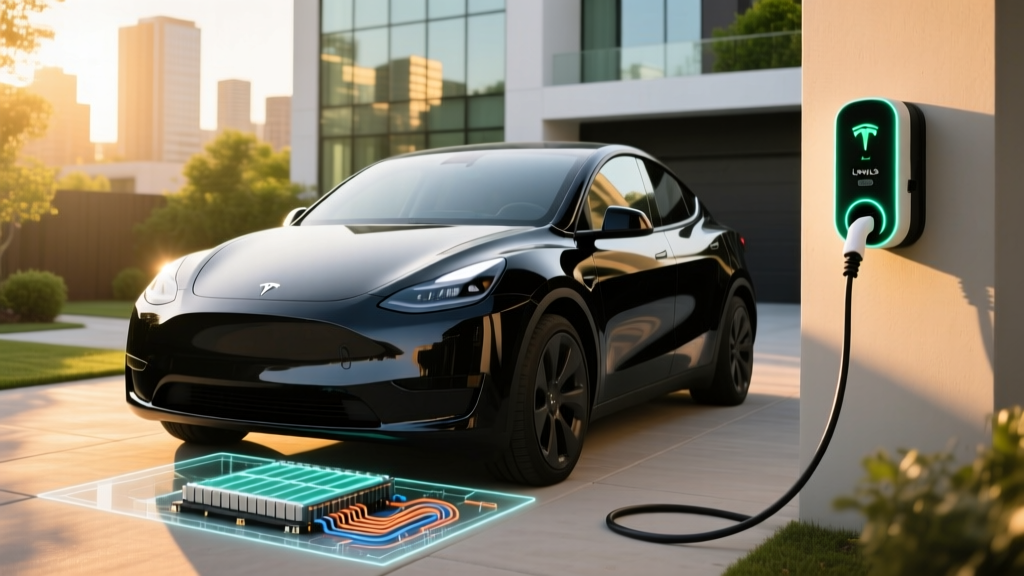
Charging remains Tesla's strongest competitive moat — and a primary reason many owners hesitate to leave. The Model Y Long Range supports up to 250 kW peak DC fast charging at V3 Superchargers, adding roughly 200 miles in 15 minutes under optimal conditions. However, the charge curve tapers significantly above 60% state of charge (SoC); the full 10–80% session averages closer to ~150 kW sustained, which is why the 10–80% time lands at approximately 25 minutes rather than the theoretical minimum.
| Charging Level | Power | Miles Added Per Hour | Typical Use Case |
|---|---|---|---|
| Level 1 (120V) | ~1.4 kW | ~5 mi/hr | Emergency / overnight trickle |
| Level 2 (240V, 48A) | 11.5 kW | ~44 mi/hr | Home Wall Connector, full overnight charge |
| DC Fast (V3 Supercharger) | 250 kW peak | ~200 mi in 15 min | Road trips, highway corridor charging |
| DC Fast (V4 Supercharger) | Up to 325 kW | Faster taper profile | Next-gen sites; Model Y may not reach full peak |
Home charging on a Tesla Wall Connector at 48 amps delivers a full charge in approximately 8 hours — adequate for any daily commute. The Model Y now ships with the NACS (North American Charging Standard) port natively, which has become the industry standard adopted by Ford, GM, Rivian, and others. This means Tesla's Supercharger advantage is eroding as competitors gain access, though Tesla still controls network density, uptime, and pricing.
Interior, Tech & the Juniper Refresh
The 2026 Model Y received the Juniper design overhaul, addressing long-standing complaints about minimalist austerity. The cabin now features ventilated front seats, ambient lighting, a rear-seat touchscreen for climate and entertainment, improved sound insulation, and a power-folding second row. Build quality has improved measurably at the Austin and Shanghai factories, though panel-gap consistency still trails Hyundai/Kia and German competitors in third-party surveys.
The 15.4-inch center touchscreen runs Tesla's proprietary software — fast, responsive, and deeply integrated with navigation, Supercharger routing, and over-the-air updates. However, Apple CarPlay and Android Auto remain absent, a dealbreaker for a growing segment of buyers who expect phone-mirroring as standard. Tesla's navigation and trip planner are excellent, but the walled-garden approach frustrates users accustomed to ecosystem flexibility.
On the driver-assistance front, Autopilot (standard) provides competent lane-centering and adaptive cruise. Full Self-Driving (Supervised), a $8,000 add-on or $99/month subscription, adds automated lane changes, traffic-light recognition, and city-street navigation. Critically, this is SAE Level 2 — the driver must remain fully engaged, hands on the wheel, eyes on the road. It is not autonomous driving, and NHTSA continues to investigate Tesla's Autopilot/FSD incident data.
Tesla Autopilot and FSD (Supervised) require continuous driver supervision. The vehicle can steer, accelerate, and brake under certain conditions, but the driver is legally and practically responsible at all times. This is fundamentally different from Level 4 robotaxi services like Waymo, which operate without a human driver in geofenced areas.
Pricing, Tax Credit & Total Cost
The 2026 Model Y Long Range AWD starts at $48,990 before destination. The Performance trim is $52,490. Both fall under the IRS §30D MSRP cap of $80,000 for SUVs, but tax credit eligibility depends on multiple factors that change frequently.
- MSRP Cap: Vehicle must be under $80,000 (SUVs/trucks) — Model Y qualifies ✓
- Buyer Income Cap: AGI ≤ $150,000 (single), $225,000 (head of household), $300,000 (joint) — verify your situation
- Battery Sourcing: Critical minerals and battery components must meet escalating domestic-content thresholds; Tesla has largely shifted to LFP for Standard Range (CATL-sourced) and NMC from varied suppliers for Long Range — check current-year IRS guidance
- Point-of-Sale Transfer: Eligible buyers can apply the credit as an instant dealer discount rather than waiting for tax filing
- Final Assembly: Must be in North America — Austin-built Model Y qualifies ✓
| Trim | Base MSRP | Est. After $7,500 Credit | Notes |
|---|---|---|---|
| Long Range AWD | $48,990 | ~$41,490 | If buyer meets all §30D criteria |
| Performance AWD | $52,490 | ~$44,990 | If buyer meets all §30D criteria |
Insurance costs for the Model Y remain above segment average — expect $1,800–$2,600 annually depending on location and driving record, per industry data. This partially offsets fuel savings versus some competitors.
Pros and Cons: The Honest Assessment
- Best-in-class Supercharger network (17,000+ NA stalls, highest uptime)
- Excellent efficiency: 27 kWh/100mi beats most dual-motor AWD crossovers
- Spacious cargo area (72.1 cu ft) rivals midsize SUVs
- OTA updates continuously add features post-purchase
- Strong resale value relative to non-Tesla EVs
- Heat pump standard — better cold-weather range retention
- No Apple CarPlay or Android Auto — a major omission in 2026
- Build quality still inconsistent; panel gaps and paint defects reported
- FSD (Supervised) is expensive ($8K) and remains Level 2 only
- Supercharger network now open to competitors — moat narrowing
- Ride quality firm on 20" wheels; road noise present at highway speeds
- Service center wait times remain long in many metro areas
Why Tesla Owner Brand Loyalty Is Declining
Multiple data points and owner surveys point to converging factors behind the loyalty shift:
- Competitive convergence: The Hyundai Ioniq 5 (318-mi range, 800V architecture, 10–80% in 18 min), Ford Mustang Mach-E (320-mi range, CarPlay standard), and Kia EV6 now match or exceed the Model Y on key metrics while offering features Tesla refuses to add.
- Brand perception: CEO Elon Musk's polarizing public statements and political activities have alienated a segment of Tesla's core buyer demographic, particularly in coastal metro markets where EV adoption is highest.
- Service frustrations: Tesla's mobile-ranger and service-center model struggles with scale. Owners report multi-week waits for body repair and parts, a pain point traditional dealers handle more predictably.
- Feature stagnation: The refusal to add CarPlay, the slow rollout of genuine FSD capability, and the removal of ultrasonic sensors (replaced by Tesla Vision, which has drawn NHTSA scrutiny for parking-assist reliability) have eroded the "tech-leader" perception.
- Network exclusivity loss: As Ford, GM, and Rivian drivers access Superchargers via NACS adapters, the Tesla-only charging advantage that anchored loyalty is diminishing.
That said, Tesla still leads in charging infrastructure density, software integration, and manufacturing cost efficiency. The loyalty decline is real but not a collapse — it's a normalization as the market matures.
Who Should Buy the 2026 Model Y
- You road-trip frequently and want the most reliable DC fast-charging network
- You value OTA updates and software-first vehicle architecture
- You already own Tesla products (Powerwall, Solar Roof) and prefer ecosystem integration
- Cargo space is a priority (72.1 cu ft with seats folded is class-leading)
- You require Apple CarPlay/Android Auto for daily use
- Build-quality consistency and dealership service matter to you (consider Hyundai Ioniq 5, Genesis GV60)
- You want a traditional luxury interior (BMW iX, Genesis Electrified GV70)
- You need a third row (Kia EV9, Rivian R1S)
Frequently Asked Questions
What is the real-world range of the 2026 Tesla Model Y?
The EPA rates the Long Range AWD at 320 miles. In real-world highway driving at 70 mph in moderate temperatures, expect 270–285 miles. In sustained cold weather (below 32°F), plan for 230–255 miles. The heat pump helps, but physics dictates energy loss in freezing temperatures.
How fast does the Model Y charge at home and on the road?
On a Level 2 Tesla Wall Connector (11.5 kW), the Model Y adds approximately 44 miles per hour, achieving a full charge in about 8 hours. On a V3 Supercharger (250 kW peak), it charges from 10–80% in roughly 25 minutes, though the charge curve tapers significantly above 60% SoC.
Does the 2026 Model Y qualify for the $7,500 federal tax credit?
The Model Y is assembled in Austin, Texas, and falls under the $80,000 SUV MSRP cap, so it meets vehicle-level requirements. However, buyer eligibility depends on your adjusted gross income (≤$150K single, ≤$300K joint) and the battery-sourcing rules in effect at time of purchase. Check IRS §30D guidelines and consult a tax professional.
Is the Model Y worth buying over the Hyundai Ioniq 5 or Ford Mach-E?
If Supercharger network access and software integration are your top priorities, yes. If you want faster peak charging (Ioniq 5's 800V system hits 10–80% in ~18 min at 350 kW chargers), CarPlay support, or more consistent build quality, the Ioniq 5 and Mach-E are compelling alternatives at similar price points.
What are the biggest complaints from current Tesla owners?
Service-center wait times, panel-gap and paint inconsistencies, the absence of CarPlay/Android Auto, and FSD's failure to deliver full autonomy despite its name and price. These are the most-cited factors in owner surveys exploring brand-switching intent.
How long will the Model Y battery last?
Tesla warranties the Long Range battery for 8 years or 120,000 miles, whichever comes first, with a minimum 70% capacity retention threshold. Independent data from Tesla's own impact reports and third-party fleet analyses show NMC batteries typically retain 85–90% capacity at 100,000 miles under normal use. Replacement cost, if needed out of warranty, ranges from $12,000 to $16,000.