Quick Verdict: The Lowered Tesla Model Y in 2026
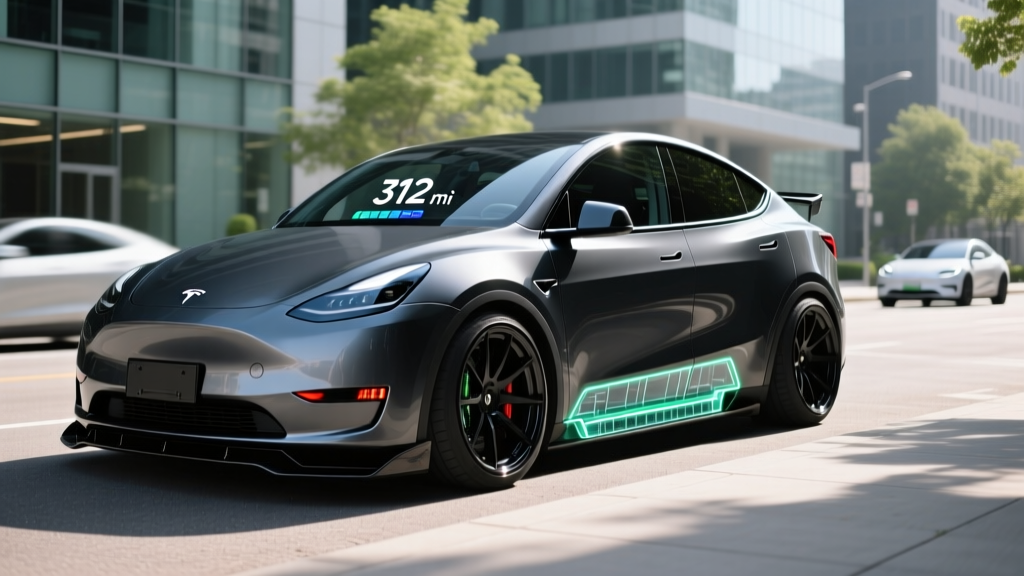
The 2026 Tesla Model Y—refreshed with the "Juniper" update that debuted in late 2025—remains the best-selling electric vehicle in the United States and one of the most efficient electric crossovers on the market. For buyers searching for a Tesla Model Y lowered setup, whether for aesthetic stance, reduced drag, or aftermarket suspension tuning, understanding how ride-height changes interact with the Juniper platform's revised geometry, battery, and efficiency profile is essential before making modifications.
Out of the box, the 2026 Model Y Long Range AWD delivers an EPA-estimated 320 miles of range, a usable battery of approximately 75 kWh (NMC chemistry in the Long Range; LFP in the base RWD), and DC fast-charging capability peaking at 250 kW on V3 Superchargers. The refreshed Model Y also brings a quieter cabin, ventilated front seats, ambient lighting, a rear touchscreen, and a power-folding second row—all standard.
This review covers the stock 2026 Model Y in full detail and dedicates a section to what lowering the suspension actually means for range, ride quality, warranty, and daily usability.
2026 Tesla Model Y Specifications at a Glance
| Spec | Long Range AWD | Performance AWD | RWD (Base) |
|---|---|---|---|
| EPA Range | 320 mi | 295 mi | 300 mi |
| Battery (usable) | ~75 kWh (NMC) | ~75 kWh (NMC) | ~60 kWh (LFP) |
| Drivetrain | Dual-Motor AWD | Dual-Motor AWD | Single-Motor RWD |
| Horsepower | ~384 hp | ~456 hp | ~295 hp |
| 0–60 mph | 4.8 sec | 3.5 sec | 6.6 sec |
| Max DC Charge Rate | 250 kW | 250 kW | 170 kW |
| 10–80% DC Time | ~25 min | ~25 min | ~30 min |
| Level 2 Rate (11.5 kW) | ~44 mi/hr | ~44 mi/hr | ~44 mi/hr |
| MPGe (combined) | 122 MPGe | 111 MPGe | 128 MPGe |
| Efficiency (kWh/100 mi) | 28 kWh | 30 kWh | 26 kWh |
| Base MSRP | $47,990 | $52,490 | $44,990 |
| Cargo (rear seats up) | 30.2 cu ft | 30.2 cu ft | 30.2 cu ft |
| Cargo (rear seats folded) | 72.0 cu ft | 72.0 cu ft | 72.0 cu ft |
| Battery Warranty | 8 yr / 120,000 mi | 8 yr / 120,000 mi | 8 yr / 100,000 mi |
Source: fueleconomy.gov (EPA) and Tesla.com specifications. Pricing reflects 2026 model year MSRP before destination fees and incentives.
Real-World Range: What the EPA Number Doesn't Tell You
Real-World Expectation:
• Highway (70–80 mph, moderate climate): ~260–285 miles
• Mixed city/highway (55–65 mph): ~290–310 miles
• Cold weather (below 32°F, highway): ~210–250 miles
• With lowering springs (aero benefit): potential +3–5% highway range
The 2026 Model Y Long Range AWD's EPA sticker of 320 miles is among the best in the electric crossover segment, trailing only the Hyundai Ioniq 5 Long Range (325 mi) and rivaling the Ford Mustang Mach-E Extended Range (312 mi). But EPA testing uses a blended cycle that favors lower-speed urban driving with generous regenerative braking recovery.
In sustained highway driving at 75 mph in 65–80°F conditions, expect roughly 260–285 miles before needing to charge. The Model Y's heat pump—standard on all 2026 trims—mitigates cold-weather range loss compared to resistance-heated competitors, but sub-freezing temperatures still reduce usable range by 15–25% depending on cabin heat demand and battery preconditioning behavior.
For buyers considering a lowered Tesla Model Y, aftermarket lowering springs (typically 1.0–1.5 inches of drop) can marginally improve the coefficient of drag, potentially recovering 3–5% of highway range at sustained speeds above 65 mph. However, this gain is small and can be offset by increased rolling resistance if wider aftermarket wheels are fitted simultaneously.
Charging Speed: Supercharger Network and Home Level 2
| Charging Level | Max Power (kW) | Miles Added per Hour | Notes |
|---|---|---|---|
| Level 1 (120V / 12A) | ~1.4 kW | ~3–4 mi/hr | Emergency/trickle only |
| Level 2 (240V / 48A) | 11.5 kW | ~44 mi/hr | Full charge overnight (~7–8 hrs) |
| DC Fast (V3 Supercharger) | 250 kW peak | ~1,000 mi/hr (peak) | 10–80% in ~25 min |
| DC Fast (V4 Supercharger) | 250 kW (current Y limit) | ~1,000 mi/hr (peak) | CCS-compatible via NACS adapter |
| Non-Tesla DC (CCS station w/ adapter) | Up to 250 kW | Varies | Requires NACS-to-CCS adapter (included) |
The 2026 Model Y Long Range and Performance trims peak at 250 kW on Tesla V3 and V4 Superchargers. The real-world charging curve matters more than the peak number: the battery sustains above 200 kW from roughly 10% to 35% State of Charge (SoC), then tapers progressively. From 50% to 80%, expect charge rates between 80–120 kW. The total 10–80% session takes approximately 25 minutes in warm conditions with battery preconditioning active.
The base RWD Model Y, equipped with an LFP (lithium iron phosphate) battery, peaks at a lower 170 kW. LFP cells charge more slowly but tolerate regular 100% charging without degradation concerns—a significant advantage for daily commuters who can charge fully each night at home.
Home Level 2 charging: The onboard charger accepts up to 11.5 kW (48 amps at 240V). Using a Tesla Wall Connector on a dedicated 60-amp circuit, you'll add roughly 44 miles of range per hour, meaning a depleted Long Range battery reaches full in about 7–8 hours. Installation typically costs $800–$2,000 depending on panel capacity and conduit run length. Homes with older 100-amp electrical panels may require a $2,000–$4,000 panel upgrade.
The 2026 Model Y ships with a NACS (North American Charging Standard) port natively. Tesla now includes a NACS-to-CCS adapter, granting access to Electrify America, EVgo, and other non-Tesla DC networks—critical for road trips through areas where Supercharger coverage is sparse.
Performance, Efficiency, and Drivetrain
The Long Range AWD pairs a permanent-magnet rear motor with an induction front motor, producing a combined ~384 horsepower. The 0–60 mph sprint takes 4.8 seconds—quick enough for confident highway merging and passing. The Performance trim bumps output to ~456 hp and drops the 0–60 to 3.5 seconds, with Track Mode and a lowered factory suspension (0.5 inches lower than Long Range) included.
Efficiency is where the Model Y continues to lead. At 28 kWh per 100 miles (Long Range AWD), it consumes less energy per mile than nearly every competing electric SUV. The Ford Mustang Mach-E Extended Range AWD returns 31 kWh/100mi; the Hyundai Ioniq 5 AWD sits at 30 kWh/100mi. This efficiency advantage translates directly to lower electricity costs and more miles per charging session.
The regenerative braking system is aggressive enough to enable one-pedal driving in most scenarios, though Tesla removed the user-adjustable regen strength toggle several years ago. The 2026 Juniper refresh adds a slightly more progressive brake-blending feel, reducing the "lurch" some drivers experienced with earlier models at low-speed stops.
Pricing, Trims, and Federal Tax Credit Eligibility
| Trim | Base MSRP | MSRP Cap (§30D) | Eligible for $7,500 Credit? | Effective Price (with credit) |
|---|---|---|---|---|
| RWD (Base) | $44,990 | $80,000 (SUV) | Yes (if income + sourcing qualify) | ~$37,490 |
| Long Range AWD | $47,990 | $80,000 (SUV) | Yes (if income + sourcing qualify) | ~$40,490 |
| Performance AWD | $52,490 | $80,000 (SUV) | Yes (if income + sourcing qualify) | ~$44,990 |
All 2026 Model Y trims fall well under the IRS §30D MSRP cap of $80,000 for SUVs and vans. However, eligibility for the full $7,500 federal tax credit depends on three additional criteria per current IRS rules:
- Buyer income caps: Modified adjusted gross income (MAGI) must not exceed $150,000 (single), $225,000 (head of household), or $300,000 (joint filers).
- Battery component sourcing: A percentage of battery components must be manufactured or assembled in North America, and critical minerals must meet sourcing thresholds. These thresholds increase annually. Tesla has historically met these requirements for US-built Model Y vehicles, but confirm your specific VIN's eligibility at purchase.
- Point-of-sale transfer: As of 2024, buyers can transfer the credit to the dealer at point of sale, reducing the purchase price directly rather than waiting for a tax refund. Tesla participates in this program.
Important: Tax credit rules are subject to change. Always verify eligibility with a tax professional and consult the IRS Clean Vehicle credit page before finalizing your purchase. State and local incentives (e.g., California CVRP, Colorado state credit) may stack on top of the federal credit but vary by jurisdiction.
Lowering the Tesla Model Y: What Owners Need to Know
The search term "Tesla Model Y lowered" reflects a genuine and growing aftermarket community. Owners pursue lowering for three primary reasons: improved aesthetics (reduced wheel gap, more aggressive stance), marginal aerodynamic gains, and lowered center of gravity for handling feel.
Common lowering methods:
- Lowering springs (e.g., Eibach, H&R, Unplugged Performance): 1.0–1.5" drop, $300–$600, retains factory dampers. This is the most popular route.
- Coilover kits (e.g., Mountain Pass Performance, Unplugged Performance): 1.0–2.0" adjustable drop with matched dampers, $1,500–$3,500. Better ride quality control.
- Air suspension (aftermarket): Rare for the Model Y, $4,000–$8,000+. Adjustable ride height on the fly. Not common in the Model Y aftermarket.
Real-world trade-offs of lowering:
- 3–5% highway range gain (reduced drag, 70+ mph)
- Lower center of gravity; sharper turn-in
- Reduced wheel gap; more aggressive look
- Slightly improved high-speed stability
- Harsher ride on rough roads and speed bumps
- Reduced ground clearance (scrape risk on driveways)
- Potential warranty issues (suspension-related claims)
- Accelerated tire wear if alignment is not corrected
- May interfere with factory ADAS calibration
Warranty implications: Tesla's New Vehicle Limited Warranty (4 years / 50,000 miles) covers suspension components. If a lowering spring or coilover causes premature wear on a control arm, bushing, or CV joint, Tesla may deny the claim under the Magnuson-Moss Warranty Act framework—meaning the aftermarket part must be shown to have caused the failure, but in practice, disputes can be time-consuming. The battery and drive unit warranty (8 years / 120,000 miles for Long Range/Performance) is unaffected by suspension modifications.
ADAS considerations: The Model Y's Autopilot and available FSD (Supervised) rely on camera-based perception calibrated to the factory ride height. Lowering the vehicle by more than ~1 inch can shift the camera sightlines enough to affect lane-keeping accuracy and following-distance calculations. Tesla Service Centers generally will not recalibrate for aftermarket suspension changes. If you lower your Model Y, consider third-party alignment shops experienced with EV camera recalibration.
Bottom line on lowering: If your priority is aesthetics and you accept a firmer ride, quality lowering springs from a reputable brand are the lowest-risk option. If you want handling improvement without ride degradation, invest in matched coilovers. Always get a professional alignment immediately after installation, and document everything for potential warranty discussions.
Interior, Cargo, and Technology
The 2026 Juniper refresh significantly improved the Model Y's interior quality. Acoustic glass on all windows reduces cabin noise by a measurable margin over the 2024 model. Ventilated front seats are now standard across all trims—a welcome addition for warm-climate buyers. The 15.4-inch center touchscreen runs Tesla's latest software, and a new 8-inch rear touchscreen allows second-row passengers to control climate, media, and entertainment independently.
Cargo dimensions:
- Behind second row: 30.2 cu ft
- Rear seats folded (60/40 split): 72.0 cu ft
- Front trunk (frunk): 4.1 cu ft
- Rear legroom: 41.6 inches
- Front headroom: 41.0 inches
The power-folding second row—new for the Juniper generation—folds flat via a button in the cargo area or through the touchscreen, making it easier to load large items without reaching across the seatbacks.
Driver assistance: The 2026 Model Y ships with Tesla's HW4 (Hardware 4) computer and the standard Autopilot suite (Traffic-Aware Cruise Control, Autosteer lane-keeping, automatic emergency braking). Full Self-Driving (Supervised) remains a $8,000 add-on or $99/month subscription. FSD (Supervised) is an SAE Level 2 system—meaning the driver must remain fully engaged, with hands on the wheel and eyes on the road at all times. It is not autonomous driving.
Ownership Costs and Who the Model Y Suits Best
The 2026 Model Y's total cost of ownership (TCO) remains competitive with internal-combustion compact SUVs when factoring in fuel savings, reduced maintenance (no oil changes, minimal brake wear from regen), and the federal tax credit. However, insurance premiums for the Model Y tend to run 15–30% higher than comparable gas-powered SUVs due to repair costs and claims data. Average annual insurance for a Model Y ranges from $2,200–$3,400 depending on state, age, and driving record.
Charging cost estimate: At the US average residential electricity rate of ~$0.16/kWh, fully charging the Long Range's 75 kWh battery costs approximately $12.00, yielding a cost per mile of roughly $0.038. Compare this to a 25 MPG gas SUV at $3.30/gallon: $0.132 per mile. Over 15,000 miles per year, that's a fuel savings of approximately $1,410 annually.
Who should buy the 2026 Model Y:
- Families: 72 cu ft of cargo space, standard AWD (Long Range/Performance), excellent safety ratings (IIHS Top Safety Pick+), and rear-seat entertainment make it a top family EV.
- Commuters: 320 miles of range covers most weekly commutes on a single charge. The RWD/LFP trim at $44,990 before credits is a value standout for daily drivers who can charge to 100% nightly.
- Road trippers: Tesla's Supercharger network—now the largest and most reliable in North America—remains the Model Y's strongest advantage for long-distance travel. Plan for one 25-minute charge stop every 250–280 highway miles.
- Enthusiasts considering lowering: The aftermarket support for the Model Y is extensive. If you want a lowered stance, the platform is well-supported, but understand the ride-quality and warranty trade-offs outlined above.
Who should look elsewhere:
- Buyers who prioritize ride comfort over sportiness (the Hyundai Ioniq 5 and Kia EV6 offer softer suspensions).
- Those who want Apple CarPlay or Android Auto (Tesla does not support either).
- Buyers in rural areas with limited home-charging options and distant Superchargers.
- Towers: the Model Y is not rated for towing in the US market.
Frequently Asked Questions
What is the real-world range of the 2026 Tesla Model Y?
The EPA estimates 320 miles for the Long Range AWD. In real-world highway driving at 75 mph in moderate temperatures, expect 260–285 miles. In cold weather below freezing, plan for 210–250 miles. The base RWD with LFP battery is rated at 300 miles EPA with similar real-world reductions.
How fast does the Model Y charge at home and on the road?
At home on a Level 2 (240V, 48A) charger, the Model Y adds about 44 miles of range per hour, reaching a full charge in 7–8 hours. On a Tesla V3 Supercharger, it peaks at 250 kW and charges from 10% to 80% in approximately 25 minutes. The RWD trim with LFP battery peaks at 170 kW and takes about 30 minutes for 10–80%.
Does the 2026 Tesla Model Y qualify for the $7,500 federal tax credit?
All trims fall under the $80,000 MSRP cap for SUVs under IRS §30D rules. However, full eligibility also depends on buyer income limits ($150K single / $300K joint), battery component sourcing requirements, and critical mineral thresholds. Tesla's US-built Model Y has historically qualified, but verify your VIN's eligibility at the time of purchase. The credit can be transferred at point of sale to reduce your purchase price directly. Consult IRS.gov and a tax professional for your specific situation.
Is it worth buying the Tesla Model Y vs competitors like the Ioniq 5 or Mach-E?
The Model Y leads in efficiency (28 kWh/100mi vs 30–31 for competitors), Supercharger network access, cargo volume (72 cu ft), and software integration. The Hyundai Ioniq 5 offers faster 800V charging architecture (10–80% in ~18 min on 350 kW chargers), a more comfortable ride, and Apple CarPlay. The Ford Mach-E offers a more traditional driving feel and BlueCruise hands-free driving on approved highways. Choose the Model Y if Supercharger access and cargo space are priorities; choose the Ioniq 5 if charging speed and ride comfort matter more.
What are the biggest pros and cons of the 2026 Model Y?
Pros: Class-leading efficiency, 320-mile range, Supercharger network, spacious cargo area, strong acceleration, OTA software updates, heat pump standard, competitive pricing after tax credit.
Cons: No Apple CarPlay/Android Auto, firm ride quality, insurance costs above segment average, FSD (Supervised) is expensive and still Level 2, limited service center availability in some regions, no towing capacity in the US.
Will lowering my Tesla Model Y void the warranty?
Lowering springs alone do not automatically void the entire vehicle warranty. Under the Magnuson-Moss Warranty Act, Tesla must demonstrate that an aftermarket part caused a specific failure to deny a claim. However, suspension-related warranty claims (control arms, bushings, CV joints) may face scrutiny after a lowering modification. The battery and drive unit warranty is unaffected. Document your installation and get a professional alignment immediately.
Does the Model Y have a frunk?
Yes. The 2026 Model Y includes a front trunk (frunk) with 4.1 cu ft of storage—enough for a charging cable kit, a small bag, or emergency supplies. It opens via the touchscreen or the Tesla app.
For the latest safety ratings, see NHTSA.gov and IIHS.org. Always verify specifications with Tesla directly, as mid-year changes can affect pricing and eligibility.