The Tesla 'Loot Box' Problem: What You Actually Get for Your Money
Search forums and owner threads for "loot box Tesla" and you'll find a recurring frustration: buyers feel like they're gambling on build quality, feature availability, and software promises that may or may not materialize. Unlike a traditional automaker where trim levels lock in specific equipment, Tesla's approach — frequent mid-year production changes, beta software features, and a minimalist option sheet — can make the purchase feel like opening a randomized crate.
But strip away the meme, and the 2026 Tesla Model Y remains one of the most data-rich, spec-transparent EVs on the market. You just need to know exactly what the numbers say before you configure one. This review cuts through the hype and the anxiety with hard EPA figures, real-world charging data, and a clear-eyed look at whether the Model Y earns your money in 2026.
2026 Tesla Model Y: Core Specifications at a Glance
| Spec | Value |
|---|---|
| EPA Range | 320 miles (Long Range AWD) |
| Battery Capacity | ~75 kWh usable (NMC chemistry, 2170 cells) |
| Drivetrain | Dual-Motor AWD |
| Horsepower | 384 hp (combined) |
| 0–60 mph | 4.8 seconds |
| Max DC Fast Charge | 250 kW peak |
| 10–80% DC Charge Time | ~27 minutes |
| Level 2 Home Charge Rate | 11.5 kW (~44 mi/hr) |
| MPGe (Combined) | 117 MPGe |
| Efficiency | 28 kWh/100 mi |
| Cargo Volume (rear seats up) | 30.2 cu ft |
| Cargo Volume (rear seats folded) | 72.0 cu ft |
| Base MSRP (Long Range AWD) | $44,990 |
| Battery Warranty | 8 years / 120,000 miles (min 70% retention) |
Real-World Range: What the EPA Sticker Doesn't Tell You
EPA Estimated Range: 320 miles (Long Range AWD)
Real-World Expectation: Plan for 260–285 miles on sustained highway driving at 70–80 mph. In cold weather (below 32°F), expect a 20–30% reduction, dropping effective range to roughly 220–255 miles. City driving with regenerative braking recaptures energy and can push closer to or slightly above the EPA figure.
The Model Y Long Range's 320-mile EPA rating is competitive for a dual-motor crossover, but efficiency in the real world depends heavily on driving style, ambient temperature, and terrain. Tesla's heat pump — standard on all current Model Y variants — significantly reduces cold-weather cabin-heating energy draw compared to resistive heaters, but battery chemistry itself loses efficiency in the cold. On a 75°F day at mixed speeds, owners consistently report 290–310 miles of usable range before needing to charge. Push it to 80 mph on I-70 in January, and you'll be looking for a Supercharger around mile 220.
The EPA's fueleconomy.gov listing confirms the combined 117 MPGe rating, which translates to roughly 28 kWh consumed per 100 miles driven — a strong efficiency figure for a 4,400-lb AWD crossover.
Charging Speed: Supercharger Network vs. Home Level 2
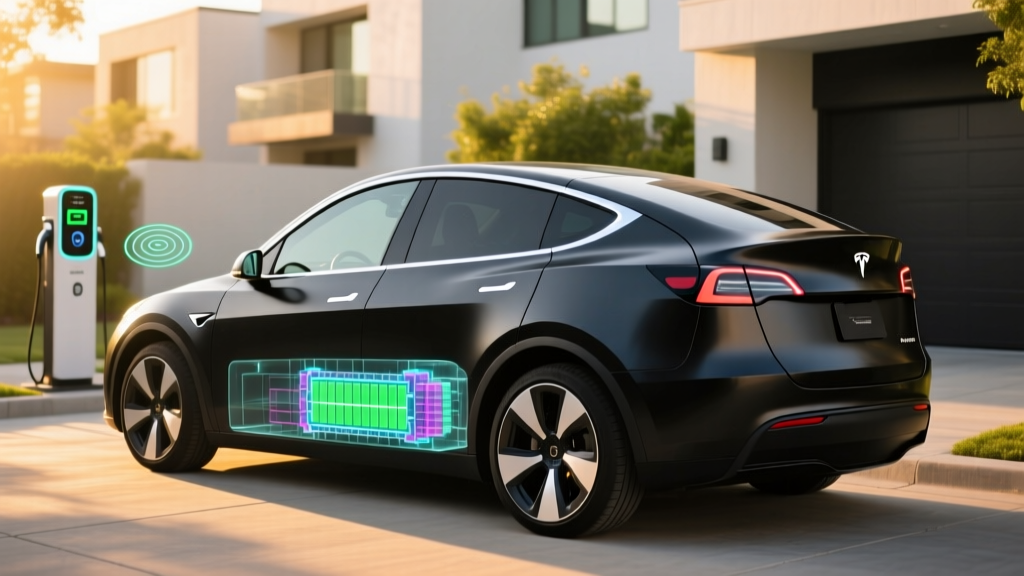
Charging is where Tesla still holds a structural advantage, though the gap is narrowing as other OEMs gain NACS access to Superchargers. Here's what the Model Y's charging looks like across all three levels:
| Level | Power | Miles Added per Hour | Notes |
|---|---|---|---|
| Level 1 (120V) | ~1.4 kW | ~4–5 mi/hr | Emergency/trickle only |
| Level 2 (240V, 48A) | 11.5 kW | ~44 mi/hr | Full charge in ~7 hours |
| DC Fast (Supercharger V3) | 250 kW peak | ~175 mi in 15 min | 10–80% in ~27 min |
A critical detail often buried in marketing: the 250 kW figure is a peak, not a sustained rate. The Model Y's charge curve is aggressive between 10–40% State of Charge (SoC), where it can pull close to 250 kW. Above 60%, the rate tapers significantly — by 80% you're typically seeing 60–80 kW. This is why Tesla (and the industry) quotes 10–80% times rather than 0–100%. Charging from 80% to 100% on DC fast charge can take nearly as long as the 10–80% session.
For home charging, a Tesla Wall Connector on a 60-amp circuit delivers the full 11.5 kW / 48 amps, adding roughly 44 miles of range per hour. Most owners who charge overnight at home never visit a public charger except on road trips. Budget $500–$1,500 for a licensed electrician to install a 240V/60A circuit, depending on your panel's proximity to the garage and whether a service upgrade is needed.
Performance, Efficiency, and Daily Drivability
The Long Range AWD's dual-motor setup produces 384 horsepower and rockets to 60 mph in 4.8 seconds — quick enough to merge onto any freeway with authority, though the Performance trim cuts that to 3.5 seconds for buyers who prioritize acceleration. The single-motor RWD variant (where available) trades some grip and power for a lower starting price and marginally better efficiency.
Regenerative braking in the Model Y is aggressive and well-calibrated. In "Hold" mode, one-pedal driving is practical in stop-and-go traffic, reducing brake wear to the point where many high-mileage Tesla owners report original brake pads well past 80,000 miles. The steering is precise but offers minimal feedback — a trade-off most commuters accept willingly.
Ride quality on the 2026 Model Y has improved over earlier Juniper-refresh models, with revised damper tuning that absorbs sharp impacts more gracefully. However, the large glass roof still contributes to noticeable cabin heat gain in summer sun, and the lack of a physical instrument cluster continues to divide buyers who prefer traditional gauge layouts.
Pricing, Trims, and Federal Tax Credit Eligibility
Tesla's pricing shifts more frequently than legacy automakers', so treat these figures as current at time of writing and verify at configuration:
| Trim | Base MSRP | Est. After §30D Credit | Notes |
|---|---|---|---|
| Long Range AWD | $44,990 | ~$37,490* | Eligible if buyer meets income caps |
| Performance AWD | $49,990 | ~$42,490* | Under $80,000 SUV MSRP cap |
*Tax credit eligibility depends on multiple factors. Always confirm with a tax professional.
The federal EV tax credit under IRS §30D offers up to $7,500, but qualification is not automatic. Key requirements include:
- Buyer income caps: Modified AGI must not exceed $150,000 (single), $225,000 (head of household), or $300,000 (joint filers).
- MSRP cap: The vehicle's MSRP must be at or below $80,000 for SUVs/pickups/vans (the Model Y qualifies as an SUV).
- Battery sourcing: A percentage of critical minerals and battery components must be sourced from the U.S. or free-trade-agreement countries. These thresholds increase annually, and Tesla's supply chain has adapted, but always verify current-year compliance on the IRS eligible vehicle list.
- Point-of-sale transfer: As of 2024+, you can transfer the credit to the dealer at purchase, reducing your out-of-pocket cost immediately rather than waiting for a tax refund.
The Model Y has consistently qualified for the full $7,500 credit, but battery-sourcing rules tighten each year. Check the DOE's eligible vehicle list on fueleconomy.gov before purchasing.
Interior Space, Tech, and the Software Gamble
The Model Y's cabin is defined by radical minimalism: a single 15.4-inch touchscreen controls virtually every function, from climate to mirrors to glovebox release. There are no physical buttons on the dash. For tech-forward buyers, this is a feature; for those who want tactile HVAC controls on a dark highway, it's a legitimate ergonomic drawback.
Cargo and passenger space is a genuine strength. With 30.2 cu ft behind the second row and 72.0 cu ft with seats folded, the Model Y swallows more gear than most compact SUVs. The rear seat offers 41.6 inches of legroom — adequate for adults on longer trips, though the seat cushion is relatively flat and low-mounted, which taller passengers notice on drives over two hours.
Driver assistance: Tesla's Autopilot (standard) and Full Self-Driving Supervised (optional, ~$8,000 or $99/month subscription) remain SAE Level 2 systems — meaning the driver must remain fully engaged, hands on or near the wheel, and eyes on the road at all times. FSD Supervised handles highway lane changes, on-ramp-to-off-ramp navigation, and some city street driving, but it is emphatically not autonomous. Treat any marketing language suggesting otherwise with skepticism.
Notable drawbacks include the absence of Apple CarPlay/Android Auto (Tesla uses its proprietary infotainment stack), no heads-up display, panel-gap inconsistency that still surfaces on delivery-day inspections, and a service-center network that, while expanding, can mean multi-week wait times for bodywork in some metro areas.
Who Should Buy the 2026 Tesla Model Y?
Choose the Model Y if:
- You have reliable home charging access (garage or driveway with 240V capability)
- You value Supercharger network access for road trips across rural or underserved charging corridors
- You want strong cargo utility in a midsize EV crossover footprint
- You're comfortable with touchscreen-centric controls and over-the-air software updates
- You qualify for the §30D tax credit, bringing effective pricing below $38,000
Look elsewhere if:
- You rely exclusively on apartment/condo charging and have no reliable Level 2 access
- You prefer physical controls, Apple CarPlay, or a traditional dealer service experience
- Build-quality consistency is a top priority (consider the Hyundai Ioniq 5 or BMW iX)
- You need third-row seating (the Model Y's optional third row is best suited for small children only)
Pros and Cons: The Honest Summary
Pros
- Supercharger network remains the most reliable DC fast-charging ecosystem in the U.S.
- Strong efficiency (28 kWh/100 mi) keeps per-mile charging costs low
- Class-leading cargo volume for the segment
- Over-the-air updates continuously add features post-purchase
- Qualifies for up to $7,500 federal tax credit (verify eligibility)
- Minimal brake wear thanks to aggressive regen braking
Cons
- No Apple CarPlay or Android Auto
- Build quality and panel gaps remain inconsistent unit-to-unit
- FSD is expensive and still SAE Level 2 — not autonomous
- Service center wait times can be lengthy for collision repair
- Low-mounted rear seat cushion compromises adult comfort on long trips
- Frequent pricing and feature changes create the 'loot box' perception
Frequently Asked Questions
What is the real-world range of the 2026 Tesla Model Y?
The EPA rates the Long Range AWD at 320 miles. In real-world highway driving at 70–80 mph, expect 260–285 miles. In cold weather below freezing, plan for 220–255 miles. City driving with regenerative braking can approach or slightly exceed the EPA figure.
How fast does the Model Y charge at home and on the road?
On a Level 2 home charger (240V, 48A), the Model Y charges at 11.5 kW, adding roughly 44 miles per hour — a full charge takes about 7 hours. On a V3 Supercharger, it peaks at 250 kW and charges from 10–80% in approximately 27 minutes, though the rate tapers significantly above 60% SoC.
How much does the Tesla Model Y cost after tax credits?
The Long Range AWD starts at $44,990 MSRP. If you qualify for the full $7,500 federal §30D credit (based on income, battery sourcing, and MSRP caps), the effective price drops to roughly $37,490. State and local incentives may reduce this further — check your jurisdiction's energy office for details.
Does the Model Y qualify for the federal EV tax credit?
As of current IRS rules, the Model Y has qualified for the full $7,500 credit under §30D. However, eligibility depends on your income (capped at $300,000 for joint filers), the vehicle's MSRP (under the $80,000 SUV cap), and battery-sourcing requirements that tighten annually. Verify current eligibility on IRS.gov and the DOE's fueleconomy.gov list before purchasing.
Is the Model Y worth buying vs. competitors like the Ioniq 5 or Ford Mustang Mach-E?
The Model Y wins on Supercharger access, cargo space, and efficiency. The Hyundai Ioniq 5 offers faster 800V charging architecture (10–80% in ~18 min on a 350 kW charger), Apple CarPlay, and generally more consistent build quality. The Mach-E provides a more traditional interior layout and competitive pricing. If Supercharger access matters for your road-trip routes and you're comfortable with Tesla's minimalist cabin, the Model Y is a strong choice. If you prioritize build consistency and faster peak charging, cross-shop the Ioniq 5 seriously.
Why do people call buying a Tesla a 'loot box'?
The term refers to Tesla's frequent, unannounced mid-production changes to hardware, software features, and pricing — meaning two Model Ys built weeks apart can have different components or capabilities. Combined with variable build quality and beta software features, some buyers feel they're gambling on what they'll receive. The fix: inspect your vehicle thoroughly at delivery, document any issues immediately, and understand that Tesla's feature roadmap is aspirational, not contractual.