The Tesla Model Y Long Range remains the best-selling electric vehicle in the United States for good reason: it threads the needle between range, practicality, charging infrastructure, and price. For the 2026 model year, Tesla has refreshed the crossover with its "Juniper" interior overhaul, improved ride quality, and a slightly revised battery pack — but the core value proposition is unchanged. This is the EV that most American buyers default to when they want an electric crossover that can do it all.
But the competitive landscape has shifted dramatically. The Hyundai Ioniq 5, Ford Mustang Mach-E, and Chevrolet Equinox EV all offer compelling alternatives, and federal tax credit rules under IRS §30D have tightened sourcing requirements. Below, we break down every number that matters — from real-world highway range to sustained DC fast-charge rates to actual out-of-pocket cost after incentives.
2026 Tesla Model Y Long Range: Key Specs at a Glance
| Spec | Value |
|---|---|
| EPA Range | 320 miles |
| Battery (usable) | ~75 kWh (NMC chemistry) |
| Drivetrain | Dual-motor AWD |
| Horsepower | 384 hp (combined) |
| 0–60 mph | 4.8 seconds |
| Max DC Fast Charge | 250 kW (peak) |
| 10–80% DC Charge Time | ~25 minutes |
| Level 2 Home Charge Rate | 11.5 kW (~44 mi/hr) |
| EPA Efficiency | 117 MPGe combined / 29 kWh/100 mi |
| Cargo Volume (rear seats up / down) | 30.2 / 72.1 cu ft |
| Base MSRP (Long Range AWD) | $44,990 |
| Battery Warranty | 8 years / 120,000 miles |
Real-World Range: What You'll Actually See
Real-World Highway (70 mph, mild weather): ~265–280 miles
Real-World City/Mixed: ~290–310 miles
Cold-Weather Highway (below 32°F): ~220–245 miles
The Model Y Long Range carries a 320-mile EPA estimate, which is competitive within the midsize electric crossover segment. However, EPA testing cycles are weighted toward city driving, where regenerative braking recovers significant energy. On a sustained 70-mph highway run in 65–75°F conditions, expect roughly 265 to 280 miles before you need to stop — a function of the Model Y's aerodynamic drag and the physics of high-speed driving.
Cold weather compounds range loss. In sub-freezing temperatures, the battery must divert energy to thermal management, and cabin heating (even with the Model Y's standard heat pump) draws substantial power. On a winter road trip through the Rockies or Upper Midwest, plan for 220–245 miles of usable range. Tesla's trip planner in the navigation system is generally accurate and will pre-route you through Superchargers, but always build in a 10–15% buffer for detours or charger outages.
The ~75 kWh usable battery uses NMC (nickel manganese cobalt) chemistry, which offers higher energy density than LFP — important for fitting enough capacity into the crossover's footprint. Tesla recommends daily charging to 80–90% for NMC packs, reserving 100% for road trips. This means your daily usable range is closer to 256–288 miles, which is still ample for most commutes.
Charging Speed: DC Fast, Level 2, and the Supercharger Advantage
| Charging Level | Power / Rate | Speed | Notes |
|---|---|---|---|
| Level 1 (120V household) | ~1.2 kW | ~4–5 mi/hr | Emergency/trickle only |
| Level 2 (240V home, 48A) | 11.5 kW | ~44 mi/hr | Full charge in ~7 hours |
| DC Fast Charge (Tesla Supercharger V3) | 250 kW peak | 10–80% in ~25 min | Peak sustained to ~50%, then tapers |
| DC Fast Charge (CCS adapter, third-party) | Up to 250 kW peak | Varies by station | Requires Tesla CCS adapter (included) |
The Model Y Long Range peaks at 250 kW on a Tesla V3 Supercharger, but like all EVs, it does not sustain that rate across the full charging session. The charge curve holds near peak power from roughly 10% to 50% state of charge, then progressively tapers. The 10–80% session takes approximately 25 minutes — competitive with the Hyundai Ioniq 5's 18-minute 10–80% time on a 350 kW charger, though the Ioniq's 800V architecture gives it an edge at the highest-power stations.
Where Tesla still excels is network reliability. The Supercharger network remains the most dependable public charging infrastructure in the U.S., with real-time stall availability shown in the car's navigation. With Tesla's CCS adapter (now included with new vehicles), you can also access Electrify America, EVgo, and other CCS networks — though reliability at those stations remains inconsistent based on our experience.
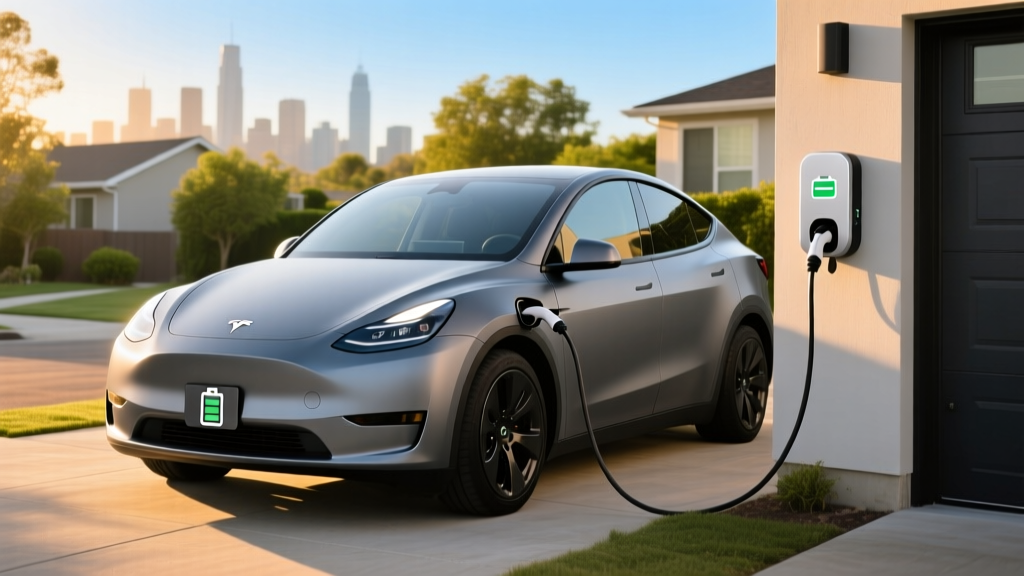
For home charging, the Model Y's onboard charger accepts up to 11.5 kW (48 amps) on a 240V Level 2 circuit. A full 0–100% charge takes roughly 7 hours, meaning an overnight session easily replenishes even a heavily depleted battery. Installation of a Tesla Wall Connector or equivalent NACS-equipped Level 2 unit typically costs $800–$2,000 depending on your electrical panel's proximity to the garage and whether a 200-amp service upgrade is needed.
Performance and Driving Dynamics
The dual-motor all-wheel-drive powertrain produces 384 combined horsepower and rockets the Model Y Long Range to 60 mph in 4.8 seconds. That's genuinely quick for a family crossover and makes highway merging and passing effortless. The instant torque delivery characteristic of electric motors means acceleration feels even more responsive than the number suggests.
Ride quality has been a historical weak point for the Model Y, but the 2026 Juniper refresh brings revised suspension tuning, improved sound insulation, and a more compliant feel over rough pavement. It's still firm compared to a Hyundai Ioniq 5 or Kia EV6, but no longer punishing. The low center of gravity from the underfloor battery pack keeps body roll well-controlled through corners, and the steering — while numb on-center — is precise.
One-pedal driving via regenerative braking is strong and predictable. Tesla removed the user-adjustable regen setting several model years ago, so you're locked into the default calibration — which most owners find natural after a brief adaptation period.
Interior, Tech, and Cargo Practicality
The 2026 Juniper interior update is the most significant cabin change since the Model Y launched. A redesigned dashboard with ambient lighting, ventilated front seats (finally standard on Long Range), a rear-seat touchscreen for climate and entertainment, and power-folding second-row seats elevate the experience. Build quality, historically a Tesla sore spot, has measurably improved — panel gaps are tighter and material quality is closer to what you'd expect at this price point.
The 15.4-inch center touchscreen remains the nerve center for all vehicle functions, including climate controls, navigation, and media. There are no physical buttons for HVAC or volume — everything is touch-based or voice-controlled. Whether you find this minimalist or frustrating is deeply personal, but it does mean fewer physical controls to fail over time.
Cargo capacity is a genuine strength: 30.2 cubic feet behind the second row and 72.1 cubic feet with the rear seats folded. The front trunk (frunk) adds a small but useful sealed compartment for charging cables or groceries. Rear-seat legroom is adequate for adults at 41.6 inches, though the sloping roofline cuts into headroom for taller passengers. A new-for-2026 panoramic glass roof with a power sunshade helps the cabin feel airy without the solar heat gain of previous years.
Pricing, Trims, and Federal Tax Credit Eligibility
| Trim | MSRP | Est. After §30D Credit* |
|---|---|---|
| Long Range AWD | $44,990 | ~$37,490 |
| Performance AWD | $48,990 | ~$41,490 |
*Tax credit eligibility depends on buyer income, battery sourcing, and MSRP caps. See checklist below.
The Model Y Long Range AWD starts at $44,990 before destination. Adding Tesla's Full Self-Driving (Supervised) package ($8,000), premium paint colors ($1,000–$2,000), or 20-inch wheels ($2,000) can push an as-tested price past $55,000 quickly. We'd recommend sticking with the base configuration — the included 19-inch wheels offer better ride quality and slightly more range anyway.
- ✅ MSRP Cap: SUVs/crossovers must be under $80,000 — Model Y qualifies at $44,990
- ⚠️ Buyer Income Cap: Modified AGI ≤ $150,000 (single) / $300,000 (joint) — verify with your tax professional
- ⚠️ Battery Sourcing: Critical minerals and battery components must meet escalating domestic-sourcing thresholds — Tesla's supply chain has adapted, but verify current-year compliance at fueleconomy.gov
- ✅ Point-of-Sale Transfer: You can transfer the credit to the dealer at purchase, reducing your out-of-pocket cost immediately
- ⚠️ Final Assembly: Must be assembled in North America — Model Y is built in Austin, TX and Fremont, CA
Source: IRS.gov — Credits for New Clean Vehicles. Rules are subject to change; confirm eligibility before purchase.
If you qualify for the full $7,500 credit and use the point-of-sale transfer, the Long Range AWD effectively drops to approximately $37,490 — a price that makes it extremely difficult for competitors to match on a total-value basis. However, not every buyer will qualify due to income limits or battery-sourcing compliance in a given model year. Always confirm your specific eligibility.
Tesla Autopilot and FSD: What You're Actually Getting
Tesla Autopilot and Full Self-Driving (Supervised) are driver-assistance systems. They do NOT make the Model Y a self-driving vehicle. The driver must remain fully engaged, hands on or near the wheel, and eyes on the road at all times. Only Level 4 services like Waymo operate without a human driver in defined areas.
Every Model Y ships with Basic Autopilot, which includes Traffic-Aware Cruise Control and Autosteer (lane-centering on marked highways). This is a competent Level 2 system for highway cruising, though it requires constant driver supervision and can struggle with faded lane markings, construction zones, and complex interchanges.
The optional FSD (Supervised) package ($8,000) adds automated lane changes, Navigate on Autopilot (highway on/off-ramp handling), Autopark, Summon, and traffic light/stop sign recognition. As of early 2026, FSD remains a supervised system — it will make mistakes, and you are legally responsible for the vehicle's operation. Tesla has not received regulatory approval for unsupervised autonomous driving in consumer vehicles. The NHTSA continues to monitor Tesla's driver-assist systems closely.
Our take: Basic Autopilot is sufficient for most buyers. FSD is a luxury convenience feature for enthusiasts, not a necessity — and its $8,000 cost is difficult to justify when it doesn't reduce your insurance premium or eliminate your driving responsibility.
Model Y Long Range vs. the Competition
| Tesla Model Y LR | Hyundai Ioniq 5 LR AWD | Ford Mach-E ER AWD | |
|---|---|---|---|
| EPA Range | 320 mi | 290 mi | 305 mi |
| Battery (usable) | ~75 kWh | ~77.4 kWh | ~88 kWh |
| DC Charge 10–80% | ~25 min | ~18 min | ~38 min |
| 0–60 mph | 4.8 sec | 5.1 sec | 5.6 sec |
| Base MSRP | $44,990 | $48,600 | $48,995 |
| Cargo (rear up) | 30.2 cu ft | 27.2 cu ft | 29.7 cu ft |
| Charging Network | Supercharger + CCS | CCS networks | CCS networks |
The Ioniq 5 charges significantly faster thanks to its 800V architecture, but gives up 30 miles of range and costs roughly $3,600 more before incentives. The Mach-E offers a more traditional driving feel and strong BlueCruise hands-free highway driving, but its DC charging speed is noticeably slower — a meaningful disadvantage on road trips. The Model Y's combination of range, Supercharger access, and cargo volume remains difficult to beat at this price point.
Pros, Cons, and the Verdict
- Class-leading Supercharger network access
- 320-mile EPA range is ample for road trips
- Spacious cargo area (30.2 cu ft rear up)
- Strong performance (4.8s 0–60) for a family crossover
- Juniper interior is a genuine quality leap
- Over-the-air updates continuously add features
- Competitive pricing after federal tax credit
- No physical buttons — all controls are touchscreen
- FSD is expensive ($8,000) and still Level 2 only
- Rear headroom limited by sloping roofline
- Charging speed trails Ioniq 5/EV6 at 350 kW stations
- Insurance costs above segment average
- No Apple CarPlay or Android Auto
The verdict: The 2026 Tesla Model Y Long Range remains the default recommendation for American EV buyers who need a do-it-all electric crossover. Its range, Supercharger network, cargo practicality, and post-credit pricing are extremely compelling. If you prioritize ultra-fast DC charging or prefer physical controls and Apple CarPlay, the Hyundai Ioniq 5 is a strong alternative. If hands-free highway driving matters most, the Ford Mach-E with BlueCruise deserves a look. But for the broadest set of needs, the Model Y Long Range is still the one to beat.
Frequently Asked Questions
What is the real-world range of the 2026 Tesla Model Y Long Range?
The EPA rates the Model Y Long Range at 320 miles, but real-world highway driving at 70 mph yields approximately 265–280 miles in mild weather. City and mixed driving gets closer to 290–310 miles thanks to regenerative braking. In freezing temperatures, expect 220–245 miles on the highway. Plan road trips around 250-mile segments for a comfortable buffer.
How fast does the Model Y Long Range charge?
On a Tesla V3 Supercharger (250 kW peak), the 10–80% session takes approximately 25 minutes. On a 240V Level 2 home charger at 48 amps (11.5 kW), you'll add roughly 44 miles per hour of charging, with a full 0–100% charge completing in about 7 hours. Level 1 (120V) trickle charging adds 4–5 miles per hour and is only practical for overnight top-ups.
Does the 2026 Tesla Model Y qualify for the federal EV tax credit?
The Model Y Long Range ($44,990 MSRP) falls well under the $80,000 SUV MSRP cap and is assembled in North America (Austin, TX and Fremont, CA). Eligibility for the full $7,500 credit depends on your modified adjusted gross income (≤$150,000 single / ≤$300,000 joint filers) and the battery's compliance with critical-mineral and component-sourcing thresholds for the current tax year. Confirm at fueleconomy.gov and with your tax professional before purchasing.
Is the Model Y Long Range worth it vs. the Hyundai Ioniq 5 or Ford Mach-E?
It depends on your priorities. Choose the Model Y if Supercharger reliability, maximum cargo space, and lowest effective price (after the tax credit) matter most. Choose the Ioniq 5 if you want the fastest DC charging (18 minutes 10–80% on 350 kW chargers) and prefer physical buttons. Choose the Mach-E if you value BlueCruise hands-free driving and a more traditional crossover driving feel. All three are excellent — the Model Y wins on total-package value for most buyers.
What are the biggest drawbacks of the Model Y Long Range?
The touchscreen-only interface is polarizing and can be distracting for climate or volume adjustments while driving. The $8,000 FSD package remains a Level 2 driver-assist system despite its name. Insurance premiums tend to run 15–25% higher than comparable gas crossovers. And while DC charging is adequate at 250 kW, it's outpaced by 800V competitors at the fastest public chargers.
How long will the Model Y battery last?
Tesla warranties the battery and drive unit for 8 years or 120,000 miles, whichever comes first, with a guaranteed minimum 70% capacity retention. Real-world data from high-mileage Tesla owners suggests NMC packs typically retain 85–90% capacity at 100,000 miles when charged primarily to 80–90% and only taken to 100% for road trips. Battery replacement outside warranty, if needed, currently costs approximately $12,000–$16,000 including labor.
Who is the Tesla Model Y Long Range best suited for?
The Model Y Long Range is ideal for families and commuters who need a versatile electric crossover for daily driving and regular road trips. Its 320-mile range, fast home charging, Supercharger access, and generous cargo space make it a strong fit for suburban households with home charging access. It's less ideal for buyers without reliable home charging, those who strongly prefer physical controls, or anyone expecting true autonomous driving capability.