Quick Verdict: The Benchmark Compact Electric SUV
The Tesla Model Y Long Range remains the default answer for American EV shoppers who need one vehicle to do everything — commute, haul a family, road-trip cross-country, and charge quickly when they do. For 2026, Tesla's Juniper refresh brings a redesigned interior, improved ride quality, and a slightly reshuffled battery strategy, but the core value proposition is unchanged: class-leading efficiency, access to the most reliable DC fast-charging network in the US, and a starting price that undercuts most AWD electric SUV competitors.
Is it still the segment leader as Hyundai, Ford, and Chevrolet close the gap? We break down every number that matters.
Range, Battery, and Real-World Efficiency
| Spec | Value |
|---|---|
| EPA Range | 320 miles (Long Range AWD) |
| Battery Capacity (usable) | ~78 kWh |
| Battery Chemistry | NMC (Long Range); LFP (Standard Range RWD) |
| Drivetrain | Dual-Motor AWD |
| Horsepower | 384 hp |
| 0–60 mph | 4.8 seconds |
| EPA Efficiency | 111 MPGe combined (29 kWh/100 mi) |
| Top Speed | 135 mph |
| Towing Capacity | 3,500 lbs (with tow package) |
Real-World Range Reality Check: The EPA rates the 2026 Model Y Long Range AWD at 320 miles. In our experience and consistent with third-party highway testing, expect roughly 270–290 miles at sustained 70–75 mph highway speeds in mild weather. In cold conditions (below 32°F), plan for 220–250 miles of usable range due to cabin heating demand and increased battery internal resistance. City driving with regenerative braking can push results above the EPA sticker, sometimes reaching 330+ miles in stop-and-go traffic.
Tesla continues to use nickel-manganese-cobalt (NMC) chemistry in the Long Range trim, prioritizing energy density for maximum range. The Standard Range RWD model uses lithium iron phosphate (LFP), which sacrifices roughly 40 miles of range but offers superior cycle life and can be charged to 100% daily without degradation concerns. If you're a high-mileage commuter who can charge at home every night, the LFP Standard Range is worth serious consideration despite the lower sticker range.
Efficiency is where the Model Y flexes hardest. At 29 kWh per 100 miles, it converts electricity to distance more effectively than nearly every competing electric SUV. The Hyundai Ioniq 5 AWD, for comparison, consumes roughly 32 kWh/100 mi. Over 15,000 annual miles and a national average electricity rate of $0.17/kWh, that efficiency gap translates to roughly $75–$100 per year in savings — small in isolation, but a signal of Tesla's thermal management and powertrain maturity.
Charging: DC Fast, Level 2, and Network Access
| Charging Level | Power / Rate | Time / Range Added |
|---|---|---|
| Level 1 (120V household) | ~1.4 kW | ~3–4 miles per hour |
| Level 2 (240V home, 48A) | 11.5 kW | ~44 miles per hour; full charge in ~8 hrs |
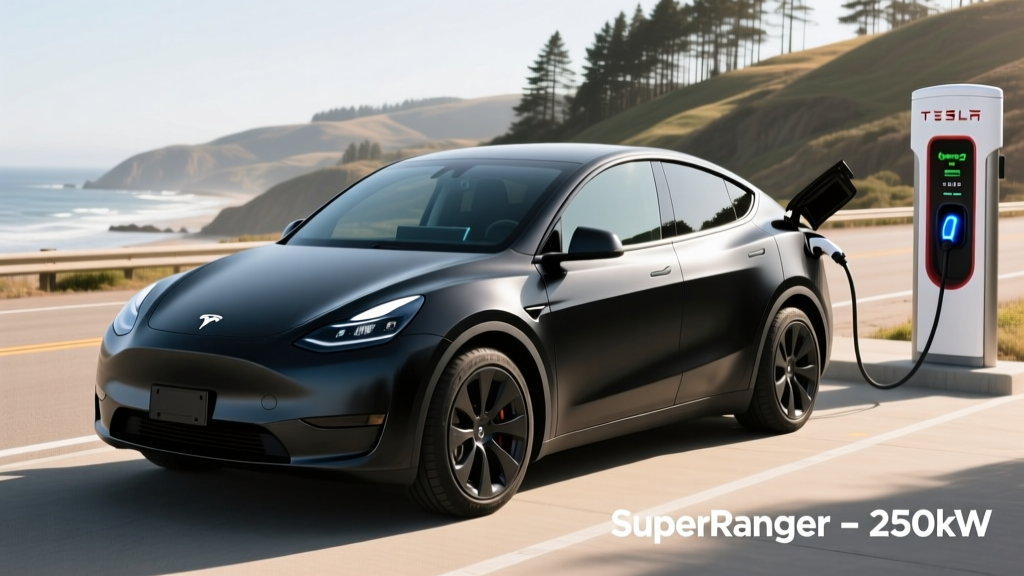
| DC Fast Charge (peak) | 250 kW (CCS via NACS adapter or native NACS at V4 Superchargers) | 10–80% in ~25 min; ~200 miles in 15 min |
The Model Y Long Range peaks at 250 kW on DC fast chargers. However, peak rate is not sustained rate. The charging curve holds above 200 kW roughly from 10% to 35% state of charge, then tapers progressively. From 80% to 100%, charging slows dramatically — a characteristic of NMC chemistry and battery management system (BMS) protections. For road-trip efficiency, plan stops from 10% to 80% and skip the final 20% unless you're ending the day.
The biggest charging advantage remains Tesla Supercharger network access. As of early 2026, Tesla operates over 6,500 Supercharger stalls across the US, with V4 cabinets increasingly deploying 350 kW-capable hardware (though the Model Y itself caps at 250 kW). More importantly, Supercharger reliability — uptime, plug-and-charge authentication, and accurate stall-status data in the Tesla app — remains measurably higher than Electrify America, EVgo, or ChargePoint networks according to J.D. Power's most recent EV charging satisfaction studies.
For home charging, a 48-amp Level 2 wall connector on a 60-amp dedicated circuit delivers 11.5 kW, replenishing the full 78 kWh battery in roughly 8 hours. Most owners who charge overnight at home never visit a public charger except on road trips. Budget $500–$1,500 for a professional Level 2 installation depending on your panel capacity and run distance — and confirm with a licensed electrician whether your service panel needs a 200-amp upgrade.
Performance and Driving Dynamics
The dual-motor AWD powertrain produces 384 horsepower and delivers a 4.8-second 0–60 mph time. That's quick by any measure — quicker than a base Porsche Macan — but the more relevant observation is how the Juniper refresh has improved ride quality. Previous Model Y iterations drew criticism for firm suspension tuning that transmitted road imperfections sharply into the cabin. The 2026 model uses revised damper tuning and additional acoustic insulation, bringing it closer to the refinement level of luxury-brand competitors.
Regenerative braking remains strong and predictable, enabling one-pedal driving in most conditions. Tesla removed the user-adjustable regen setting several model years ago, so the behavior is fixed — firm but well-calibrated. The heat pump is standard, which meaningfully improves cold-weather range and cabin heating efficiency compared to resistive heater systems used in some older EVs.
Handling is competent rather than sporty. The low center of gravity (battery pack under the floor) keeps body roll controlled, but the steering is numb and the 4,400-pound curb weight is noticeable on twisty roads. This is a family crossover optimized for comfort and efficiency, not a canyon carver.
Interior, Cargo, and Technology
The Juniper interior overhaul replaces the previous minimalist-but-sparse cabin with more premium materials, ventilated front seats, ambient lighting, and a rear-seat touchscreen for climate and media control. The 15.4-inch central display handles all infotainment, navigation, and vehicle settings — no physical instrument cluster exists, though a small secondary display ahead of the driver shows speed and range (a Juniper addition addressing a common complaint).
Cargo and passenger dimensions:
- Cargo volume (rear seats up): 30.2 cu ft
- Cargo volume (rear seats folded): 72.1 cu ft
- Front trunk (frunk): 4.1 cu ft
- Rear legroom: 41.6 inches
- Front headroom: 41.0 inches
These numbers place the Model Y squarely in the compact SUV segment, competitive with the Ioniq 5 (27.2 / 59.3 cu ft cargo) but offering more total volume with seats folded. The frunk is modest — useful for charging cables and a small bag, not a full suitcase.
On the technology front, Tesla's software remains the most responsive and feature-rich in the industry. Over-the-air updates regularly add functionality. The Tesla app provides best-in-class remote climate control, charging management, location tracking, and Sentry Mode camera access. Wireless phone mirroring is not supported — Tesla uses its own native apps for Spotify, Netflix, YouTube, and navigation.
Driver Assistance: Autopilot and FSD Supervised
SAE Automation Level: Level 2. Tesla Autopilot and Full Self-Driving (Supervised) are driver-assistance systems, not autonomous driving. The driver must remain attentive, keep hands on the wheel, and be prepared to take over at any moment. No production Tesla vehicle is capable of SAE Level 3 or Level 4 self-driving. For context, Waymo's robotaxi service (Level 4) operates without a driver in defined geographic zones — a fundamentally different capability.
Standard Autopilot includes adaptive cruise control and lane-centering, which performs competently on divided highways. FSD Supervised ($8,000 one-time purchase or $99/month as of 2026) adds automatic lane changes, traffic-light and stop-sign recognition, and city-street navigation. FSD has improved substantially through its end-to-end neural network architecture, but it still makes unpredictable decisions in construction zones, unprotected left turns, and adverse weather. Treat it as a fatigue-reducing assist on long drives, not a replacement for attention.
Competitors like Ford BlueCruise and GM Super Cruise offer comparable or superior hands-free highway driving on pre-mapped divided roads. Where Tesla's system differs is its attempt at generalizable city-street capability — ambitious but imperfect.
Pricing, Trims, and Federal Tax Credit
| Trim | Base MSRP | Est. Federal Credit (§30D) | Effective Price (if eligible) |
|---|---|---|---|
| Long Range AWD | $44,990 | Up to $7,500 (point-of-sale) | ~$37,490 |
| Performance AWD | $48,990 | Up to $7,500 (point-of-sale) | ~$41,490 |
The Model Y Long Range AWD starts at $44,990 (before destination) for the 2026 model year. As a US-assembled EV with an MSRP under the $80,000 SUV cap, it is potentially eligible for the full $7,500 federal tax credit under IRS §30D — available as a point-of-sale price reduction through a participating dealer (Tesla qualifies as a direct seller). However, eligibility depends on several conditions that change periodically:
- Buyer income cap: Modified AGI must not exceed $150,000 (single), $225,000 (head of household), or $300,000 (joint filers).
- MSRP cap: Vehicle MSRP must not exceed $80,000 for SUVs (Model Y qualifies).
- Battery sourcing: Critical minerals and battery components must meet escalating domestic/free-trade-partner thresholds. Tesla's US-built battery cells have generally met these requirements, but verify at fueleconomy.gov before purchase, as sourcing rules tighten annually.
- Point-of-sale transfer: You can elect to transfer the credit to Tesla at purchase, reducing your out-of-pocket cost immediately rather than waiting for a tax refund.
Always confirm current eligibility on IRS.gov and consult a tax professional for your specific situation. Credit rules are subject to legislative change.
Warranty and Long-Term Ownership
Tesla provides the following warranty coverage for the 2026 Model Y:
- Basic vehicle: 4 years / 50,000 miles
- Battery and drive unit: 8 years / 120,000 miles (Long Range AWD), with a minimum 70% capacity retention threshold
The 8-year/120,000-mile battery warranty is competitive with Hyundai's 10-year/100,000-mile coverage when you account for Tesla's higher mileage threshold. Real-world degradation data from Tesla's fleet suggests NMC batteries in the Model Y retain approximately 85–90% capacity after 100,000 miles, well above the warranty floor. LFP batteries in the Standard Range model show even slower degradation, often retaining 92%+ at similar mileage.
Out-of-warranty battery replacement remains expensive — estimates range from $12,000 to $16,000 depending on pack configuration and labor. However, the failure rate is low; most Model Y batteries outlast the vehicle's economic life without requiring replacement.
Insurance costs are a genuine ownership pain point. The Model Y consistently ranks among the more expensive mainstream EVs to insure, with national averages 15–25% above comparable gas-powered SUVs. Get quotes from multiple carriers before purchasing — Tesla Insurance is available in many states and can be competitive, but isn't always the cheapest option.
Pros, Cons, and Who Should Buy
Pros
- Best-in-class Supercharger network reliability
- Top-tier efficiency (29 kWh/100 mi) reduces charging costs
- Strong real-world range (270–290 mi highway)
- Spacious cargo area with practical frunk
- Excellent OTA software and app integration
- Competitive pricing after federal tax credit
- Juniper refresh meaningfully improves ride and interior quality
Cons
- FSD Supervised remains Level 2 — expensive for what it delivers
- Insurance premiums above segment average
- No Apple CarPlay / Android Auto
- DC fast-charge peak (250 kW) trails Hyundai E-GMP platform (350 kW capable)
- Service center wait times can be long in some metro areas
- Touchscreen-dependent controls frustrate some drivers
Choose the Model Y Long Range if: You want the lowest-friction EV ownership experience — reliable home and public charging, strong range, practical space, and a proven vehicle with massive fleet data backing its longevity. Ideal for families, commuters, and road-trippers who value charging infrastructure above all else.
Consider alternatives if: You prioritize hands-free highway driving (Ford BlueCruise on the Mustang Mach-E is more polished on mapped roads), you want 350 kW DC charging capability (Hyundai Ioniq 5 / Kia EV6), or you prefer traditional physical controls and phone mirroring (most competitors).
Frequently Asked Questions
What is the real-world range of the 2026 Tesla Model Y Long Range?
The EPA rates it at 320 miles. Real-world highway driving at 70–75 mph in mild weather yields 270–290 miles. Cold weather (below freezing) reduces this to 220–250 miles. City driving with regenerative braking can exceed the EPA estimate.
How fast does the Model Y Long Range charge?
On a DC fast charger, it peaks at 250 kW and charges from 10–80% in approximately 25 minutes. At home on a 48-amp Level 2 charger (11.5 kW), a full charge takes about 8 hours — easily accomplished overnight.
Does the 2026 Model Y qualify for the $7,500 federal tax credit?
It is potentially eligible. The MSRP is under the $80,000 SUV cap, it's assembled in the US, and Tesla's battery sourcing has generally met §30D requirements. However, buyer income caps apply ($150K single / $300K joint), and sourcing rules tighten annually. Verify at fueleconomy.gov and consult a tax professional before relying on the credit.
How does the Model Y compare to the Hyundai Ioniq 5 or Ford Mustang Mach-E?
The Ioniq 5 charges faster (up to 350 kW on compatible chargers) and offers a more distinctive design, but its real-world range and efficiency trail the Model Y. The Mach-E offers BlueCruise hands-free driving and a more traditional interior layout but has a smaller Supercharger-equivalent charging network. The Model Y wins on total ownership friction — charging access, efficiency, and software.
Is FSD worth buying?
For most buyers, no. At $8,000 or $99/month, FSD Supervised is a Level 2 system that still requires constant driver attention. It reduces fatigue on long highway drives but does not drive the car autonomously. Standard Autopilot (included) handles highway cruising well. Try the monthly subscription before committing to a purchase.
What does long-term battery degradation look like?
Tesla's fleet data and independent analyses show NMC Model Y batteries retaining 85–90% of original capacity at 100,000 miles. The battery is warrantied for 8 years / 120,000 miles at a minimum 70% retention threshold. Actual warranty claims for battery replacement are rare relative to the number of vehicles on the road.