Why the Length of the Tesla Model Y Matters for EV Buyers
If you're measuring your garage, comparing crossover footprints, or trying to figure out whether the Tesla Model Y will fit your life, you've likely searched for the exact length of the Tesla Model Y. The number is straightforward, but what surrounds it—cargo capacity, interior room, battery packaging, and how those dimensions translate into daily usability—is where the real buying decision lives.
The Tesla Model Y remains one of the best-selling electric vehicles in the United States for good reason: it threads the needle between compact-crossover maneuverability and midsize-SUV practicality. Below, we break down every dimension that matters, then layer in the range, charging, performance, and pricing data you need to make an informed purchase in 2026.
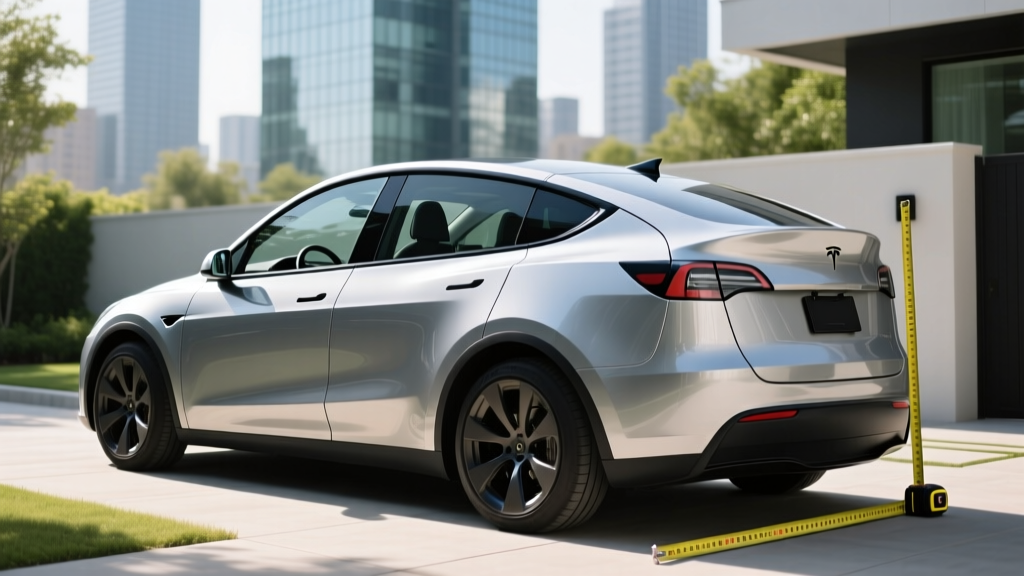
Exterior Dimensions: How Long Is the Tesla Model Y?
The current-generation Tesla Model Y (including the 2025-refreshed "Juniper" update that carries into 2026) measures as follows:
| Measurement | Inches | Millimeters |
|---|---|---|
| Overall Length | 188.6 in | 4,791 mm |
| Wheelbase | 113.8 in | 2,890 mm |
| Width (mirrors folded) | 75.6 in | 1,920 mm |
| Width (mirrors extended) | 83.8 in | 2,129 mm |
| Height | 63.9 in | 1,624 mm |
| Ground Clearance | 6.6 in | 167 mm |
| Curb Weight (Long Range AWD) | ~4,398 lbs | ~1,995 kg |
At 188.6 inches in overall length, the Model Y sits squarely in the compact-to-midsize crossover segment. For comparison, the Toyota RAV4 measures 180.9 inches, while the Ford Mustang Mach-E comes in at 186.7 inches. The Model Y is slightly longer than the Mach-E but rides on a longer wheelbase, which directly benefits interior legroom and straight-line stability.
The 113.8-inch wheelbase is notable—it's only about 4 inches shorter than the Model S sedan, meaning a significant portion of the Model Y's length is dedicated to passenger and battery space rather than overhang. This "wheels-at-the-corners" design is a hallmark of dedicated EV platforms and explains why the Model Y feels roomier inside than its exterior footprint suggests.
Interior Space and Cargo Capacity
Dimensions on paper only matter if they translate to usable space. The Model Y's hatchback design and flat floor (thanks to the absence of a transmission tunnel) maximize what you can actually carry.
| Measurement | Value |
|---|---|
| Front Headroom | 41.0 in |
| Rear Headroom | 37.7 in |
| Front Legroom | 41.8 in |
| Rear Legroom | 37.4 in |
| Cargo Volume (rear seats up) | 30.2 cu ft |
| Cargo Volume (rear seats folded) | 72.1 cu ft |
| Front Trunk (Frunk) | 4.1 cu ft |
| Total Max Cargo | 76.2 cu ft |
The 30.2 cubic feet behind the second row is competitive with gas-powered compact SUVs. Fold the 60/40 split rear seats, and the 72.1 cubic feet of flat load space can swallow furniture, camping gear, or a week's worth of family luggage. The additional 4.1-cubic-foot frunk is useful for charging cables, groceries, or items you want separated from the main cargo area.
For buyers considering the optional third row (available on certain trims), note that it reduces cargo volume significantly when deployed and is best suited for small children. With the third row in use, expect roughly 12-14 cubic feet of remaining cargo space—adequate for a few backpacks but not a full grocery run.
EPA Range, Battery Specs, and Real-World Expectations
The Model Y is offered in multiple configurations for 2026. Here are the key powertrain specs:
| Trim | Drivetrain | Battery (usable kWh) | Chemistry | EPA Range | MPGe (combined) | 0-60 mph | HP |
|---|---|---|---|---|---|---|---|
| Long Range RWD | Rear-Wheel Drive | ~75 kWh | NMC | 320 mi | 122 MPGe | 6.5 sec | ~346 hp |
| Long Range AWD | Dual-Motor AWD | ~75 kWh | NMC | 308 mi | 117 MPGe | 4.8 sec | ~384 hp |
| Performance AWD | Dual-Motor AWD | ~75 kWh | NMC | 285 mi | 109 MPGe | 3.5 sec | ~456 hp |
The EPA-estimated 320 miles on the Long Range RWD is achievable in mixed city/suburban driving at moderate temperatures (60-75°F). On sustained highway trips at 70-80 mph, expect 260-285 miles of real range. In cold weather (below 32°F), range can drop 20-30% depending on cabin heating demand and whether you precondition the battery. The AWD trims see similar proportional reductions. Plan road-trip charging stops around the 200-230 mile mark in winter conditions to maintain a comfortable buffer.
The Model Y's battery pack uses NMC (nickel manganese cobalt) chemistry across all current trims. NMC offers higher energy density than LFP (lithium iron phosphate), which is why Tesla reserves LFP for the lower-priced Model 3 Standard Range. The trade-off: NMC batteries benefit from daily charging limits of 80-90% to maximize long-term longevity, whereas LFP packs can be routinely charged to 100% without degradation concerns. Tesla's battery management system handles much of this optimization automatically.
According to fueleconomy.gov, the Long Range AWD achieves 117 MPGe combined (123 city / 111 highway), making it one of the most efficient all-wheel-drive electric crossovers available. Efficiency translates to roughly 28-30 kWh per 100 miles in real-world mixed driving.
Charging Speeds: DC Fast Charging and Home Level 2
Charging speed is often the deciding factor for EV buyers who road-trip regularly. The Model Y uses the NACS (North American Charging Standard) connector natively, giving it seamless access to Tesla's Supercharger network—the most reliable and extensive DC fast-charging infrastructure in the U.S.
| Charging Level | Max Power | Speed / Time | Notes |
|---|---|---|---|
| Level 1 (120V household) | ~1.4 kW | ~3-4 mi/hr | Emergency/trickle only |
| Level 2 (240V home/wall connector) | 11.5 kW | ~44 mi/hr (7-8 hrs full) | Recommended daily charging |
| DC Fast Charge (Supercharger V3/V4) | 250 kW peak | 10-80% in ~25 min | Tapers significantly above 80% |
A few practical notes on the Model Y's charging behavior:
- Peak vs. sustained rate: The 250 kW peak is reached between roughly 10-30% State of Charge (SoC). Above 50%, the rate tapers to ~150 kW, and above 80% it drops below 50 kW. This is normal lithium-ion charge-curve behavior, not a flaw.
- Preconditioning matters: Navigate to a Supercharger using the built-in navigation, and the car will automatically warm the battery for optimal charge acceptance. Arriving at a cold battery can add 10-15 minutes to your 10-80% session in winter.
- Home charging setup: The Tesla Wall Connector on a 60A circuit delivers the full 11.5 kW (48A continuous). Most owners installing a Level 2 charger at home should budget $500-$2,000 for equipment and electrician labor, depending on panel proximity and whether a 200A service upgrade is needed.
- Non-Tesla DC chargers: The Model Y's native NACS port works at Electrify America and other CCS networks only with a NACS-to-CCS adapter. Tesla includes or sells this adapter; confirm compatibility before relying on third-party networks for road trips.
Pricing, Trims, and Federal Tax Credit Eligibility
Tesla's pricing shifts periodically, but here are the approximate MSRPs for the 2026 Model Year lineup:
| Trim | Base MSRP | §30D Federal Credit | Effective Price (if eligible) |
|---|---|---|---|
| Long Range RWD | ~$44,990 | Up to $7,500 | ~$37,490 |
| Long Range AWD | ~$47,990 | Up to $7,500 | ~$40,490 |
| Performance AWD | ~$52,490 | Up to $7,500 | ~$44,990 |
The IRS §30D clean vehicle credit can reduce your effective cost by up to $7,500, but eligibility depends on multiple factors that change annually:
- MSRP cap: The Model Y qualifies as an SUV under IRS rules, so the MSRP cap is $80,000 (all current trims clear this).
- Buyer income limits: Modified AGI must not exceed $300,000 (joint), $225,000 (head of household), or $150,000 (single).
- Battery sourcing requirements: Critical minerals and battery component sourcing thresholds increase each year. Tesla has worked to qualify, but specific eligibility can shift. Always verify current status on the fueleconomy.gov tax credit page before purchasing.
- Point-of-sale transfer: As of 2024+, you can transfer the credit to the dealer at purchase, reducing your out-of-pocket cost immediately rather than waiting for tax filing.
Consult a tax professional to confirm your personal eligibility. State and local incentives (e.g., California's CVRP, Colorado's state credit) may stack on top.
Technology, Driver Assistance, and Standout Features
The Juniper-refreshed Model Y brought meaningful interior and tech upgrades:
- 15.4-inch center touchscreen with faster processor, ventilated front seats, and ambient lighting across all trims
- Rear 8-inch touchscreen for rear-seat passengers (climate, media, entertainment)
- Tesla Autopilot (standard): adaptive cruise, lane-keeping, auto emergency braking—this is SAE Level 2 driver assistance, requiring full driver attention at all times
- Full Self-Driving (Supervised) ($8,000 option or $99/month): adds auto lane change, navigate on Autopilot, traffic light/stop sign recognition, and city-street autosteer. Despite the name, this remains SAE Level 2—you are the driver and must supervise continuously
- Over-the-air updates continuously add features and refinements post-purchase
- Sentry Mode, Dog Mode, Camp Mode—unique software features leveraging the battery and thermal system
Tesla's Autopilot and FSD (Supervised) are not autonomous driving systems. They are SAE Level 2 driver-assist features. The driver must keep hands on or near the wheel, monitor the road, and be prepared to take over instantly. Misuse has led to serious crashes and NHTSA investigations. No Tesla vehicle sold today is capable of unsupervised self-driving.
Warranty and Long-Term Ownership
| Component | Coverage |
|---|---|
| Basic Vehicle | 4 years / 50,000 miles |
| Battery & Drive Unit | 8 years / 120,000 miles (Long Range/Performance) |
| Battery Capacity Retention | ≥70% of original capacity during warranty period |
The 8-year/120,000-mile battery warranty is competitive and backs the NMC pack with a 70% capacity retention floor. In practice, Tesla's NMC packs have shown degradation of roughly 10-15% after 150,000 miles based on fleet data, meaning most owners will retain well above 85% capacity within the warranty window. Out-of-warranty battery replacement, should it ever be needed, currently ranges from $12,000-$16,000 depending on the pack—though this is rare within the vehicle's typical lifespan.
Pros, Cons, and Who Should Buy the Model Y
Pros
- Class-leading Supercharger network access
- Excellent efficiency (117+ MPGe combined)
- Spacious cargo area for its footprint (76.2 cu ft max)
- Strong performance even in base trim
- Continuous OTA improvements
- Low maintenance costs (no oil, minimal brake wear from regen)
Cons
- Firm ride quality on rough roads
- No physical buttons—everything through the touchscreen
- FSD costs $8,000 extra and remains Level 2
- Panel gaps and build consistency still variable
- Insurance premiums tend to run higher than segment average
- Third-row seat is cramped and cargo-limiting
Who the Model Y Suits Best
Ideal for: Daily commuters who want minimal running costs, small-to-medium families needing versatile cargo space, road-trippers who value Supercharger network reliability, and tech-forward buyers who appreciate OTA updates.
Consider alternatives if: You need three rows of genuinely usable seating (look at the Kia EV9 or Rivian R1S), you prefer traditional controls and ride comfort (Hyundai Ioniq 5), or you frequently tow near the 3,500-lb limit and want more margin.
Frequently Asked Questions
What is the exact length of the Tesla Model Y?
The 2026 Tesla Model Y measures 188.6 inches (4,791 mm) in overall length. This makes it roughly 8 inches longer than a Toyota RAV4 and about 2 inches longer than a Ford Mustang Mach-E.
What is the real-world range of the Tesla Model Y?
The EPA rates the Long Range RWD at 320 miles and the Long Range AWD at 308 miles. In real-world highway driving at 70-80 mph, expect 260-285 miles. In freezing temperatures, plan for 200-240 miles before needing to charge.
How fast does the Model Y charge at home and on the road?
At home on a 240V Level 2 Tesla Wall Connector (11.5 kW), you'll add roughly 44 miles of range per hour, achieving a full charge overnight in 7-8 hours. On a 250 kW Supercharger, a 10-80% session takes approximately 25 minutes with a preconditioned battery.
Does the Tesla Model Y qualify for the $7,500 federal tax credit?
All current Model Y trims fall under the $80,000 SUV MSRP cap. However, buyer income limits, battery-sourcing requirements, and annual rule changes affect eligibility. Verify your specific situation on fueleconomy.gov and with a tax professional before purchasing.
Is the Tesla Model Y worth buying over competitors in 2026?
The Model Y's strongest advantages are its Supercharger access, efficiency, and cargo versatility. The Hyundai Ioniq 5 offers faster 800V charging and a more comfortable ride; the Ford Mustang Mach-E provides a more engaging driving experience; and the Kia EV9 offers three usable rows. If Supercharger reliability and proven efficiency top your priorities, the Model Y remains the segment benchmark.
What is the towing capacity of the Model Y?
The Tesla Model Y is rated to tow up to 3,500 pounds when properly equipped with the factory tow hitch. This covers light utility trailers, small boat trailers, and bike racks, but falls short of midsize-SUV tow ratings in the 5,000+ lb range.