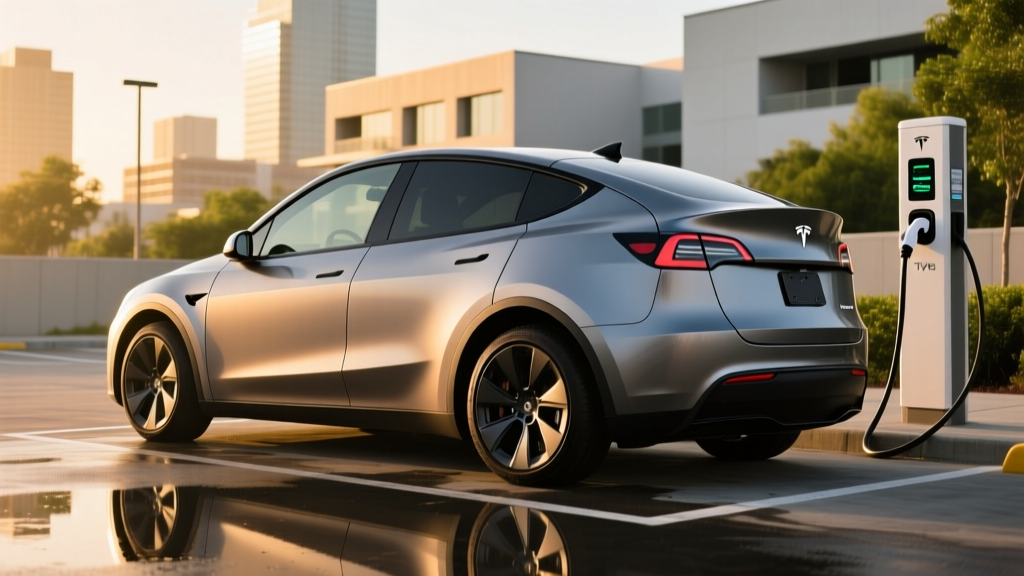
The Tesla Model Y remains one of the most popular electric vehicles in the United States, and for 2026 it arrives with a refreshed design, updated battery architecture, and a new Juniper-inspired interior. But beyond the headlines, buyers researching the Tesla length, overall dimensions, and practical specs need concrete numbers — not marketing gloss. This profile breaks down every dimension, range figure, charging speed, and ownership cost you need to make an informed purchase decision.
2026 Tesla Model Y Dimensions: Length, Width, and Cargo Space
Understanding the physical footprint of the Model Y matters for garage fitment, parking ease, and cargo utility. The 2026 refresh retains the crossover's core proportions while introducing minor aerodynamic tweaks that affect the overall profile.
| Dimension | Measurement |
|---|---|
| Overall Length | 188.6 inches (4,791 mm) |
| Wheelbase | 113.8 inches (2,890 mm) |
| Width (mirrors folded) | 75.6 inches (1,921 mm) |
| Width (mirrors extended) | 83.8 inches (2,129 mm) |
| Height | 63.9 inches (1,624 mm) |
| Ground Clearance | 6.6 inches (167 mm) |
| Cargo Volume (rear seats up) | 30.2 cu ft |
| Cargo Volume (rear seats folded) | 72.1 cu ft |
| Frunk Volume | 4.1 cu ft |
| Front Legroom | 41.8 inches |
| Rear Legroom | 37.0 inches |
| Curb Weight (Long Range AWD) | 4,398 lbs |
At 188.6 inches long, the Model Y slots between compact crossovers like the Hyundai Ioniq 5 (182.7 in) and midsize SUVs like the Ford Explorer. This Tesla length makes it manageable in tight urban parking structures while still offering enough wheelbase for comfortable highway stability. The 72.1 cu ft of total cargo space with seats folded rivals many gas-powered compact SUVs, and the 4.1 cu ft frunk adds room for charging cables or a small bag.
EPA Range and Real-World Efficiency
Tesla offers the 2026 Model Y in three primary trims, each with different battery configurations and range ratings. The Long Range AWD variant continues to be the volume seller, balancing price with daily usability.
| Trim | Battery (usable kWh) | Chemistry | EPA Range | MPGe (combined) | kWh/100 mi |
|---|---|---|---|---|---|
| RWD (Standard Range) | 60 kWh | LFP | 280 mi | 122 MPGe | 28 |
| Long Range AWD | 78 kWh | NMC | 330 mi | 120 MPGe | 28 |
| Performance AWD | 78 kWh | NMC | 305 mi | 111 MPGe | 30 |
The RWD Standard Range model uses a lithium iron phosphate (LFP) battery, which sacrifices some energy density compared to the NMC packs in Long Range and Performance trims but gains significant longevity advantages. LFP cells tolerate regular 100% charging without accelerated degradation, making the base model ideal for daily commuters who charge at home every night. The NMC packs in the Long Range and Performance trims are best charged to 80% for daily use, reserving 100% for road trips.
Charging Speed: DC Fast Charging and Home Level 2
Charging infrastructure access is the single biggest variable in EV satisfaction. The 2026 Model Y now comes equipped with the North American Charging Standard (NACS) port natively, giving it seamless access to Tesla's Supercharger network — the most reliable DC fast-charging ecosystem in the country — without an adapter.
| Charging Method | Max Power | Speed / Time | Notes |
|---|---|---|---|
| DC Fast Charge (Supercharger V4) | 250 kW peak | 10-80% in ~25 min | Sustains ~170 kW average; tapers above 80% |
| Level 2 Home (48A Wall Connector) | 11.5 kW | ~37 mi/hr added | Full charge in ~8 hours (Long Range) |
| Level 2 Home (32A / 240V outlet) | 7.7 kW | ~25 mi/hr added | Requires NEMA 14-50 outlet |
| Level 1 (120V standard outlet) | ~1.4 kW | ~4 mi/hr added | Emergency/trickle only |
A critical nuance many buyers miss: the advertised 250 kW peak charge rate is not sustained across the entire session. The charge curve peaks early (between 10-30% state of charge) and progressively tapers as the battery fills. A typical 10-80% session averages around 170 kW, adding roughly 200 miles of range in 20 minutes. Above 80%, charging slows dramatically to protect battery health — a 80-100% top-off can take an additional 20-25 minutes.
For home charging, Tesla's Wall Connector at 48 amps on a 60-amp circuit delivers the fastest Level 2 experience, adding about 37 miles of range per hour. Most owners who plug in overnight wake up to a full battery regardless of trim. Installation costs for a dedicated 240V circuit typically range from $500 to $2,000 depending on your electrical panel's capacity and the distance from panel to charger. Always consult a licensed electrician to confirm your panel can handle a 60-amp breaker — older homes may require a panel upgrade ($1,500-$3,000).
Performance, Drivetrain, and Handling
The 2026 Model Y lineup offers three distinct performance personalities, from efficient commuter to genuine sport-crossover acceleration.
| Trim | Drivetrain | Horsepower | 0-60 mph | Top Speed | Towing Capacity |
|---|---|---|---|---|---|
| RWD Standard Range | Rear-Wheel Drive | 295 hp | 6.5 sec | 135 mph | 3,500 lbs |
| Long Range AWD | Dual Motor AWD | 384 hp | 4.8 sec | 135 mph | 3,500 lbs |
| Performance AWD | Dual Motor AWD | 456 hp | 3.5 sec | 155 mph | 3,500 lbs |
The dual-motor AWD system in the Long Range and Performance trims uses an induction motor up front and a permanent-magnet synchronous motor in the rear. This setup allows the front motor to freewheel during light-load cruising, improving efficiency. The Performance trim adds a lower suspension, larger brakes, and a track-oriented drive mode, though it sacrifices roughly 25 miles of EPA range compared to the Long Range.
Regenerative braking in the Model Y is strong enough for one-pedal driving in most scenarios. The 2026 refresh retains Tesla's blended braking approach, where the friction brakes engage only during hard stops or when the battery is at full charge and cannot accept regen energy.
Pricing, Trims, and Federal Tax Credit Eligibility
Tesla's pricing strategy shifts frequently, but as of early 2026, the Model Y lineup sits in the following range before incentives:
| Trim | Base MSRP | Est. As-Tested* | §30D Credit Eligibility | Effective Price (with credit) |
|---|---|---|---|---|
| RWD Standard Range | $44,990 | $46,490 | Up to $7,500 | ~$37,490 |
| Long Range AWD | $48,990 | $51,990 | Up to $7,500 | ~$41,490 |
| Performance AWD | $53,990 | $56,490 | Up to $7,500 | ~$46,490 |
*As-tested includes destination fee and common add-ons (FSD capability, premium paint).
- MSRP Cap: SUVs must be priced at or below $80,000 — all Model Y trims qualify.
- Buyer Income Limits: AGI must not exceed $150,000 (single), $225,000 (head of household), or $300,000 (joint filers).
- Battery Sourcing: Critical minerals and battery component requirements phase in annually. Tesla's shift to North American and allied-nation sourcing has kept the Model Y eligible, but verify current-year status on IRS.gov before purchasing.
- Point-of-Sale Transfer: As of 2024+, you can transfer the credit to the dealer at purchase, reducing your out-of-pocket cost immediately rather than waiting for tax filing.
Technology, Safety, and Driver Assistance
The 2026 Model Y features Tesla's latest infotainment hardware (HW5), a 15.4-inch center touchscreen, and a rear-seat entertainment display. The Juniper-inspired interior redesign eliminates stalks for turn signals (now on the steering wheel) and introduces ventilated front seats, ambient lighting, and a powered rear cargo cover.
On the driver-assistance front, every Model Y includes Tesla's Basic Autopilot — a SAE Level 2 system that provides adaptive cruise control and lane centering. The optional Full Self-Driving (Supervised) package ($8,000 or $99/month) adds automated lane changes, traffic light recognition, and city street navigation, but it remains a Level 2 system requiring constant driver supervision.
Safety ratings remain strong. The Model Y earned a 5-star overall rating from NHTSA and top marks from IIHS in crashworthiness categories. Standard active safety includes automatic emergency braking, blind-spot monitoring, and lane departure warning.
Warranty Coverage and Battery Longevity
Tesla's warranty structure is straightforward but has some nuances worth understanding:
- Basic Vehicle Warranty: 4 years / 50,000 miles
- Battery & Drive Unit Warranty: 8 years / 120,000 miles (Long Range & Performance)
- Battery & Drive Unit Warranty: 8 years / 100,000 miles (RWD Standard Range with LFP)
- Capacity Retention Threshold: Tesla warrants that the battery will retain at least 70% of its original capacity during the warranty period
Real-world degradation data from Tesla's fleet shows that NMC packs typically lose about 8-12% capacity over the first 100,000 miles, with the curve flattening significantly afterward. LFP packs in the RWD model show even slower degradation due to the chemistry's inherent stability and tolerance for full-charge cycles. Battery replacement outside of warranty currently costs between $12,000 and $16,000 depending on the pack, though most Model Y batteries are projected to outlast 200,000+ miles before falling below 70% capacity.
Who the 2026 Tesla Model Y Suits Best
- Choose the Model Y RWD if: You commute under 60 miles daily, charge at home, want the lowest entry price, and prefer LFP battery longevity over maximum range.
- Choose the Model Y Long Range AWD if: You take regular road trips, live in a cold-weather state, need dual-motor traction, and want the best range-to-price ratio in the lineup.
- Choose the Model Y Performance if: You prioritize acceleration and handling dynamics and are willing to trade ~25 miles of range and a firmer ride for 3.5-second 0-60 times.
- Look elsewhere if: You need three-row seating (consider the Rivian R1S or Kia EV9), require 300+ miles of real-world highway range in winter (consider the Lucid Gravity), or want physical buttons and a traditional infotainment layout.
The Model Y's combination of the Tesla Supercharger network, strong resale value, and practical Tesla length that fits standard garages makes it a default choice for many EV buyers. Its weaknesses — minimal physical controls, ride firmness on rough pavement, and the camera-only vision approach to Autopilot — are well-documented and should be evaluated on a test drive.
Pros and Cons at a Glance
✓ Pros
- Access to Tesla Supercharger network (most reliable in the US)
- Strong real-world efficiency (28 kWh/100 mi)
- LFP option for worry-free daily 100% charging
- 72.1 cu ft cargo with seats folded
- Over-the-air updates add features post-purchase
- Strong resale value relative to EV competitors
✗ Cons
- No physical turn signal stalk (2026 refresh)
- Firm ride quality on broken pavement
- FSD costs $8,000 extra and remains Level 2
- Rear visibility limited by sloping roofline
- No Apple CarPlay / Android Auto support
- Panel gaps and build consistency still variable
Frequently Asked Questions
What is the overall length of the 2026 Tesla Model Y?
The 2026 Tesla Model Y measures 188.6 inches (4,791 mm) in overall length. This Tesla length is comparable to a Toyota RAV4 (180.9 in) but slightly longer, providing additional cargo room and wheelbase for ride comfort. It fits comfortably in standard residential garages (typically 20-24 feet deep).
What is the real-world range of the Model Y Long Range?
The EPA rates the Long Range AWD at 330 miles, but real-world highway driving at 70-75 mph typically yields 275-295 miles. In cold weather below 30°F, expect 250-270 miles. City driving with frequent regenerative braking can match or slightly exceed the EPA estimate.
How fast does the Model Y charge at home and on the road?
On a DC fast charger, the Model Y peaks at 250 kW and charges from 10-80% in approximately 25 minutes, averaging about 170 kW across the session. At home on a 48-amp Level 2 Wall Connector, it adds roughly 37 miles of range per hour, fully charging a Long Range in about 8 hours.
Does the 2026 Model Y qualify for the $7,500 federal tax credit?
All Model Y trims fall under the $80,000 MSRP cap for SUVs and are currently eligible for up to $7,500 under IRS §30D. However, buyer income limits ($150K single / $300K joint) and battery-sourcing requirements apply. Verify current eligibility at IRS.gov before purchasing, as sourcing rules tighten annually.
Is the Tesla Model Y worth buying over the Hyundai Ioniq 5 or Ford Mustang Mach-E?
The Model Y wins on charging network access (Superchargers), efficiency, and cargo volume. The Ioniq 5 offers faster 10-80% charging (18 min at 350 kW capable chargers), a more comfortable ride, and physical controls. The Mach-E provides a more traditional driving feel and available BlueCruise hands-free driving on mapped highways. Test-drive all three before deciding — the right choice depends on your priorities for ride comfort, interface preference, and road-trip charging needs.
How long will the Model Y battery last?
Tesla's battery warranty guarantees at least 70% capacity retention for 8 years or 100,000-120,000 miles (depending on trim). Fleet data suggests NMC packs lose roughly 8-12% capacity by 100,000 miles, with many batteries lasting 200,000+ miles before significant degradation. The LFP pack in the RWD model shows even slower degradation and tolerates daily 100% charging.