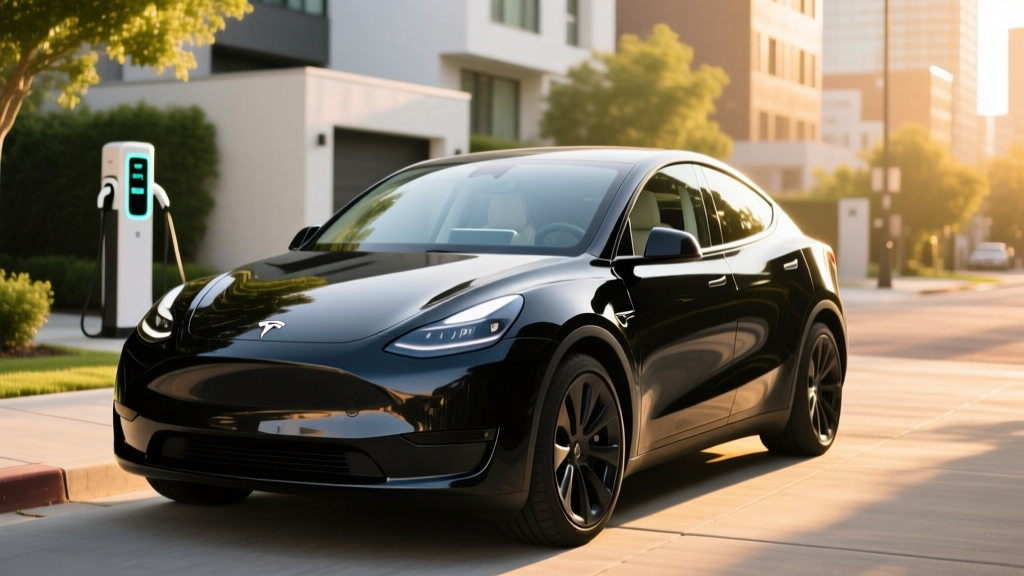
The Tesla Model Y remains one of the most leased electric vehicles in the United States, and for 2026, it continues to dominate the compact electric SUV segment. With the refreshed Juniper update now fully rolled out, the Model Y offers improved efficiency, a quieter cabin, and updated styling — but does leasing make more sense than buying in today's shifting incentive landscape? This review breaks down every number you need: real-world range, charging speeds, lease economics, and whether the Model Y still holds its crown against the Hyundai Ioniq 5, Ford Mustang Mach-E, and Chevrolet Equinox EV.
2026 Tesla Model Y: Quick Specs at a Glance
| Specification | Long Range AWD | Performance |
|---|---|---|
| EPA Range | 330 miles | 300 miles |
| Battery (usable) | ~75 kWh (NMC) | ~75 kWh (NMC) |
| Drivetrain | Dual-Motor AWD | Dual-Motor AWD |
| Horsepower | 384 hp | 456 hp |
| 0-60 mph | 4.8 seconds | 3.5 seconds |
| Max DC Fast Charge | 250 kW | 250 kW |
| 10-80% DC Charge Time | ~25 minutes | ~25 minutes |
| Level 2 Home Charge | 11.5 kW (~44 mi/hr) | 11.5 kW (~44 mi/hr) |
| MPGe (combined) | 122 MPGe | 111 MPGe |
| Efficiency | 28 kWh/100 mi | 30 kWh/100 mi |
| Cargo Volume | 72 cu ft (rear seats folded) | 72 cu ft |
| Base MSRP | $44,990 | $51,490 |
| Battery Warranty | 8 yr / 120,000 mi | 8 yr / 120,000 mi |
Source: EPA fueleconomy.gov, Tesla.com specifications (2026 model year).
Real-World Range: What the EPA Sticker Doesn't Tell You
Real-World Expectation: Plan for 270-290 miles on highway-heavy trips at 70+ mph. In cold weather (below 30°F), expect a 15-25% reduction, bringing usable range to roughly 220-260 miles depending on cabin heating use and driving style.
Why the gap? The EPA test cycle includes city driving where regenerative braking recovers energy. Sustained highway speeds and cold temperatures increase energy consumption significantly. The Model Y's heat pump helps mitigate cold-weather losses compared to resistive heating, but physics still applies.
The Juniper-refreshed Model Y Long Range achieves its 330-mile EPA rating partly through improved aerodynamics and a slightly revised thermal management system. In our experience, city and suburban drivers who rely on regenerative braking can approach or even exceed the EPA figure. However, if your commute is primarily interstate driving at 75 mph, you'll see numbers closer to 275-285 miles on a full charge in mild weather.
The battery pack in the Long Range and Performance trims uses Nickel Manganese Cobalt (NMC) chemistry, which offers higher energy density than LFP (Lithium Iron Phosphate). NMC batteries deliver more range per kilogram but are more sensitive to sustained high-state-of-charge storage — Tesla recommends daily charging to 80% for NMC packs, reserving 100% for road trips. This is a meaningful ownership consideration: if you want a battery you can charge to 100% daily without degradation concerns, the Model Y does not currently offer an LFP option in the U.S. market.
Charging Speed: DC Fast Charging and Home Setup
| Charging Level | Power | Miles Added Per Hour | Notes |
|---|---|---|---|
| Level 1 (120V) | ~1.4 kW | ~5 miles/hr | Emergency/trickle only |
| Level 2 (240V, 48A) | 11.5 kW | ~44 miles/hr | Full charge overnight (~7-8 hrs) |
| DC Fast (Tesla Supercharger) | Up to 250 kW peak | ~200+ miles in 15 min | 10-80% in ~25 min |
| DC Fast (CCS adapter at third-party stations) | Up to 250 kW | Varies by station | CCS adapter included with 2026 models |
The Model Y's peak charge rate of 250 kW is available at V3 and V4 Tesla Supercharger stalls. However, this peak rate only holds between roughly 10-30% state of charge. From 30-60%, the rate tapers to approximately 150-175 kW, and above 80%, it drops further to protect battery health. This is why Tesla — and we — quote the 10-80% time of approximately 25 minutes rather than a theoretical 0-100% figure.
For home charging, a Level 2 wall connector at 48 amps on a 60-amp circuit delivers 11.5 kW, replenishing roughly 44 miles of range per hour. A full charge from 10% to 80% takes about 5 hours on Level 2 — easily handled overnight. Installation costs for a dedicated 240V/60A circuit typically range from $800 to $2,500 depending on panel proximity and local permit requirements. If your home electrical panel is at capacity, a panel upgrade can add $1,500-$3,500 to the project.
With Tesla's adoption of the NACS (North American Charging Standard) connector and the included CCS adapter, 2026 Model Y owners can access virtually every major public charging network in the U.S. — Electrify America, EVgo, ChargePoint, and the expanding Tesla Supercharger network, which now serves non-Tesla vehicles at select locations.
Performance, Interior Space, and Daily Livability
The Long Range AWD Model Y delivers 384 horsepower and a 4.8-second 0-60 mph time — quick by any measure and more than adequate for highway merging and passing. The Performance trim bumps output to 456 hp and drops the sprint to 3.5 seconds, with upgraded brakes, a lowered suspension, and 21-inch wheels (which reduce range to 300 miles EPA).
Inside, the Juniper update brought a noticeably quieter cabin thanks to acoustic glass and additional sound deadening. The 15.4-inch center touchscreen runs Tesla's latest software, which includes streaming media, navigation with real-time Supercharger routing, and over-the-air updates that continue to add features post-purchase. Rear-seat passengers get 41.6 inches of legroom — competitive with the segment — and the 72 cubic feet of cargo space (rear seats folded) remains one of the largest in the compact electric SUV class. The front trunk (frunk) adds an additional 4.1 cubic feet for smaller items.
Notable drawbacks: The Model Y still lacks Apple CarPlay and Android Auto, relying entirely on Tesla's proprietary infotainment. The minimalist interior, with nearly all controls funneled through the touchscreen (including climate vent direction and glovebox release), frustrates some buyers who prefer physical buttons. Ride quality on the Performance trim's 21-inch wheels can be firm on rough pavement.
Lease Pricing, Tax Credits, and Total Cost
Leasing a Model Y in 2026 involves navigating both Tesla's lease terms and the evolving federal incentive structure. Tesla typically offers 24- and 36-month lease terms with mileage allowances of 10,000, 12,000, or 15,000 miles per year. Monthly payments vary significantly by region, credit tier, and current promotional offers.
| Cost Factor | Long Range AWD | Performance |
|---|---|---|
| Base MSRP | $44,990 | $51,490 |
| Destination Fee | $1,390 | $1,390 |
| Typical Lease (36 mo / 12k mi/yr)* | ~$499-$599/mo | ~$649-$749/mo |
| Due at Signing (est.) | $3,500-$5,500 | $4,500-$6,500 |
| Federal Tax Credit (§30D) | $7,500 (if eligible) | $7,500 (if eligible) |
| Lease Credit Treatment** | Applied as cap cost reduction by lessor | Applied as cap cost reduction by lessor |
*Estimates based on typical 2026 lease offers; actual terms vary by region and creditworthiness. Check Tesla.com for current offers.
**Critical tax credit nuance for leases: Under IRS §30D rules, the federal EV tax credit is technically claimed by the lessor (the financing company), not the lessee. Most major lessors pass this savings through as a capitalized cost reduction, effectively lowering your monthly payment. However, this is not legally guaranteed — always confirm with the dealer or lessor that the $7,500 credit is being applied to your lease. The IRS Clean Vehicle Credit page outlines the full eligibility requirements.
- MSRP Cap: SUVs must be under $80,000 — both Model Y trims qualify.
- Buyer Income Cap: Modified AGI must not exceed $150,000 (single), $225,000 (head of household), or $300,000 (joint). Income is checked for the year of delivery or the prior year, whichever is lower.
- Battery Sourcing: A percentage of critical minerals and battery components must be sourced from the U.S. or free-trade-agreement countries. Tesla's Fremont and Austin-built Model Y currently meets these requirements for the full $7,500, but sourcing rules tighten annually — verify at the point of sale.
- Point-of-Sale Transfer: As of 2024, buyers can transfer the credit to the dealer for an immediate price reduction. For leases, the lessor claims the credit.
Always consult a tax professional and verify eligibility at irs.gov before signing.
Tesla Model Y vs. Key Competitors: Is It Still the Best Choice?
The compact electric SUV segment has matured considerably. Here's how the Model Y stacks up against its primary rivals on the metrics that matter most:
| Metric | Tesla Model Y LR | Hyundai Ioniq 5 Limited | Ford Mustang Mach-E Premium |
|---|---|---|---|
| EPA Range | 330 mi | 305 mi | 320 mi |
| Max DC Charge | 250 kW | 350 kW | 150 kW |
| 10-80% Charge | ~25 min | ~18 min | ~38 min |
| Cargo Space | 72 cu ft | 59 cu ft | 60 cu ft |
| Base MSRP (AWD) | $44,990 | $52,600 | $48,995 |
| Supercharger Access | Native | NACS adapter avail. | NACS adapter avail. |
| Apple CarPlay | No | Yes (wireless) | Yes (wireless) |
- You want the most cargo space and the longest real-world range in the segment.
- Supercharger network reliability is a top priority for road trips.
- You prefer OTA software updates that add features over time.
- You're comfortable with a touchscreen-centric interface.
- You need Apple CarPlay/Android Auto (Ioniq 5 or Mach-E).
- Fastest possible DC charging matters (Ioniq 5 at 350 kW).
- You prefer a more traditional interior with physical controls.
Autopilot, FSD (Supervised), and Driver Assistance
Tesla Autopilot and Full Self-Driving (Supervised) are Level 2 driver-assistance systems. The driver must remain fully attentive, keep hands on the wheel (or demonstrate attention via the cabin camera), and be prepared to take over at any moment. These systems are not self-driving. Level 4 autonomous driving — where no human attention is required — is currently only available in limited robotaxi services like Waymo in select cities.
Every 2026 Model Y comes standard with Tesla's Basic Autopilot, which includes adaptive cruise control, lane centering, and automatic emergency braking. The optional FSD (Supervised) package ($8,000 one-time or $99/month subscription) adds features like automatic lane changes, navigation-guided on/off-ramp handling, and traffic light/stop sign recognition. While FSD has improved substantially, it still requires active supervision and can behave unpredictably in construction zones, unmapped areas, or adverse weather.
Tesla's safety ratings remain strong: the Model Y earned a 5-star overall rating from NHTSA and top marks from IIHS in crashworthiness testing.
Pros, Cons, and Final Verdict
- Class-leading 330-mile EPA range and 72 cu ft cargo space
- Native Supercharger network access — the most reliable DC charging infrastructure in the U.S.
- Strong efficiency (28 kWh/100 mi) keeps charging costs low
- Over-the-air updates continuously improve the vehicle
- Qualifies for full $7,500 federal tax credit (subject to eligibility)
- Excellent safety ratings (NHTSA 5-star, IIHS Top Safety Pick)
- No Apple CarPlay or Android Auto — proprietary infotainment only
- Minimalist interior frustrates buyers who want physical buttons
- NMC battery requires 80% daily charge limit for longevity
- FSD (Supervised) is expensive and still requires full driver attention
- Performance trim ride quality is firm on rough roads
- Insurance costs tend to be higher than segment average
Verdict: The 2026 Tesla Model Y remains the benchmark compact electric SUV for buyers who prioritize range, cargo space, and charging infrastructure. Leasing can be an attractive way to access the vehicle while capturing the $7,500 federal credit (passed through by the lessor) without long-term depreciation risk. However, if CarPlay support, faster peak charging, or a button-rich interior are non-negotiable, the Ioniq 5 and Mach-E deserve serious consideration.
Frequently Asked Questions
What is the real-world range of the 2026 Tesla Model Y?
The EPA rates the Long Range AWD at 330 miles and the Performance at 300 miles. In real-world highway driving at 70-75 mph, expect 270-290 miles. In cold weather below 30°F, range can drop 15-25%, yielding roughly 220-260 miles depending on conditions and heating use.
How fast does the Model Y charge at home and on the road?
At home on a Level 2 (240V/48A) charger, the Model Y adds approximately 44 miles of range per hour, fully replenishing from 10-80% in about 5 hours. On a Tesla V3/V4 Supercharger, it peaks at 250 kW and charges from 10-80% in approximately 25 minutes, though the rate tapers significantly above 60% state of charge.
How much does it cost to lease a Tesla Model Y after tax credits?
Typical 36-month leases for the Long Range AWD start around $499-$599/month with $3,500-$5,500 due at signing, depending on region and credit. The $7,500 federal tax credit is typically applied by the lessor as a capitalized cost reduction, lowering monthly payments — but confirm this with the lessor before signing.
Does the Tesla Model Y qualify for the federal EV tax credit?
Yes, both the Long Range and Performance trims qualify for the full $7,500 §30D federal tax credit as of early 2026, provided the buyer meets income caps ($150K single / $300K joint) and the vehicle's battery sourcing meets current-year critical mineral and component requirements. Verify eligibility at the point of sale and consult a tax professional.
Is the Model Y worth buying vs. the Hyundai Ioniq 5 or Ford Mach-E?
The Model Y wins on range (330 vs. 305-320 mi), cargo space (72 vs. 59-60 cu ft), and Supercharger network access. The Ioniq 5 charges faster (350 kW peak, 18 min 10-80%), offers Apple CarPlay, and has a more conventional interior. The Mach-E sits between them. Your priority — range and space vs. charging speed and CarPlay — should drive the decision.
What is the biggest drawback of the Tesla Model Y?
The most commonly cited drawbacks are the lack of Apple CarPlay/Android Auto, the touchscreen-only interface that replaces physical controls, and the NMC battery's recommended 80% daily charge limit (which effectively reduces your usable daily range to ~264 miles EPA-equivalent). Insurance premiums also tend to run higher than the segment average.