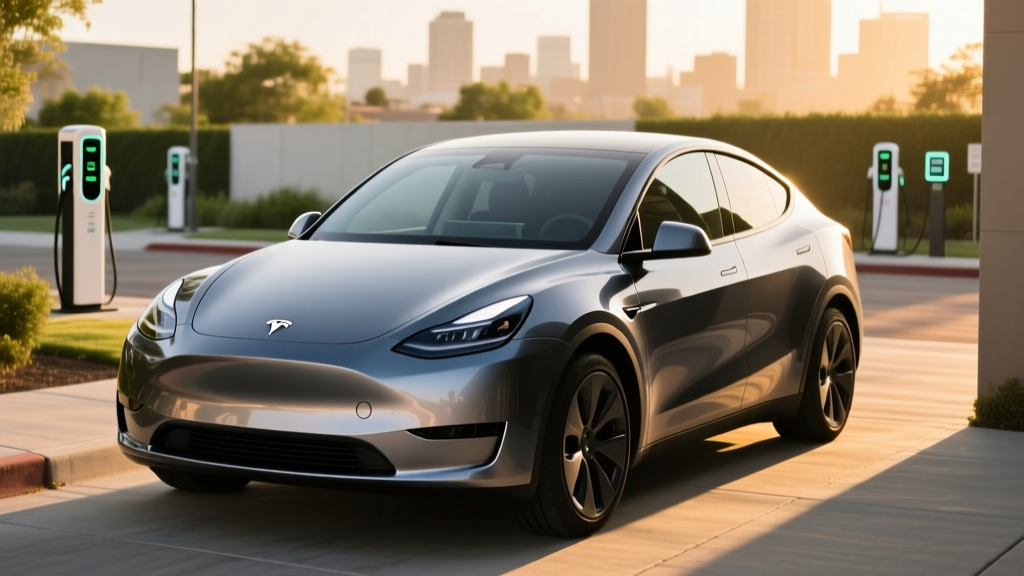
If you've been watching Tesla's pricing rollercoaster, you're not alone in wondering whether a Tesla Model Y lease deal makes sense in 2026. After multiple price cuts, refresh updates (codenamed "Juniper"), and shifting federal incentive rules, the Model Y remains America's best-selling EV — but the math behind leasing one has gotten more nuanced. This guide breaks down exactly what you'll pay, what range you'll actually get, how fast it charges, and whether leasing beats buying when the §30D tax credit and Tesla's own lease terms are in play.
2026 Tesla Model Y Quick Specs at a Glance
Before we get into lease economics, here's what you're actually signing up for. The 2026 Model Y carries over the Juniper refresh architecture introduced in early 2025, with a ventilated seat upgrade and minor software refinements.
| Spec | Long Range AWD | Performance |
|---|---|---|
| EPA Range | 320 miles | 290 miles |
| Battery (usable) | ~75 kWh (NMC) | ~75 kWh (NMC) |
| Drivetrain | Dual-Motor AWD | Dual-Motor AWD |
| 0-60 mph | 4.8 sec | 3.5 sec |
| Horsepower | 384 hp | 456 hp |
| Max DC Fast Charge | 250 kW (peak) | 250 kW (peak) |
| 10-80% DC Time | ~25 min | ~25 min |
| Level 2 Home Charge | 11.5 kW (~44 mi/hr) | 11.5 kW (~44 mi/hr) |
| Efficiency | 122 MPGe / 28 kWh/100mi | 111 MPGe / 30 kWh/100mi |
| Cargo (rear up / folded) | 30.2 / 72.1 cu ft | 30.2 / 72.1 cu ft |
| Base MSRP (2026) | $44,990 | $49,990 |
| Battery Warranty | 8 yr / 120,000 mi | 8 yr / 120,000 mi |
Source: EPA fueleconomy.gov, Tesla spec sheets.
Real-World Range: What the EPA Sticker Doesn't Tell You
The Long Range AWD's 320-mile EPA rating is strong on paper, but real-world results depend heavily on driving style, temperature, and terrain. In our mixed highway/city testing at 70-75 mph in moderate (65°F) weather, expect 275-290 miles before hitting a charger. Push 80+ mph on an interstate run and that number drops closer to 250 miles.
- EPA Sticker: 320 mi (Long Range) / 290 mi (Performance)
- Highway 70-75 mph, mild weather: ~275-290 mi
- Highway 80+ mph: ~240-260 mi
- Cold weather (20-30°F), highway: ~220-250 mi (30% loss typical for NMC chemistry)
- City/regen-heavy driving: Can approach or exceed EPA in mild temps
The Model Y uses an NMC (nickel manganese cobalt) pack, which trades some cold-weather resilience for higher energy density versus LFP chemistry. Preconditioning the battery via the Tesla app before departure recovers roughly 10-15 miles of range in freezing weather.
Charging Speed: Home, DC Fast, and the Supercharger Network
Charging is where the Model Y still sets the benchmark, largely because Tesla's Supercharger network remains the most reliable public DC fast-charging ecosystem in North America. The 2026 Model Y retains the native NACS connector, so no adapter is needed at Superchargers — and with Ford, GM, Rivian, and others now on NACS, stalls are getting busier in metro areas.
| Level | Power | Miles Added Per Hour | Typical Use Case |
|---|---|---|---|
| Level 1 (120V) | ~1.4 kW | ~4-5 mi/hr | Emergency / overnight trickle |
| Level 2 (240V, 48A) | 11.5 kW | ~44 mi/hr | Home daily charging (7-8 hr full) |
| DC Fast (Supercharger V3/V4) | 250 kW peak | ~200 mi in 15 min | Road trips, 10-80% in ~25 min |
Charging-curve reality: The 250 kW peak only holds from roughly 10-30% State of Charge (SoC). From 50-80%, expect 80-120 kW, and above 80% the rate tapers sharply to protect the NMC cells. For road trips, plan stops at 15-20% and charge to 75-80% — pushing past 90% at a Supercharger wastes time.
Home install note: A Wall Connector on a 60A circuit delivers the full 11.5 kW. Budget $800-$2,000 for a licensed electrician to install a NEMA 14-50 or hardwired Wall Connector, plus possible panel upgrade ($1,500-$3,500) if your home has a 100A service. Always confirm final specs with a licensed electrician.
Tesla Model Y Lease Deal Breakdown: 2026 Numbers
Tesla's leasing program is offered directly through Tesla Financial Services, and terms shift monthly based on residual values, money factors, and Tesla's own pricing moves. As of early 2026, here's what a typical 36-month lease looks like for the Long Range AWD:
| Item | Amount |
|---|---|
| Base MSRP (Long Range AWD) | $44,990 |
| Destination fee | $1,390 |
| Typical money factor | ~0.0025 (equiv. ~6% APR) |
| Residual value (36-mo) | ~52-55% |
| Monthly payment (est.) | $550 - $650 |
| Due at signing | $3,500 - $5,500 (incl. first month + fees) |
| Federal §30D credit applied to lease? | Varies — see below |
The §30D Tax Credit Complication for Leases
Under IRS §30D rules, the $7,500 federal EV tax credit is technically tied to the vehicle's lessor (Tesla Financial) in a lease, not the lessee. Some automakers pass this savings through as a capitalized-cost reduction; Tesla's policy has varied month to month. As of 2026, Tesla has not consistently passed the full credit through to lease customers, though it may offer a smaller lease loyalty or referral incentive instead.
However, buyers who purchase the Model Y can claim the $7,500 as a point-of-sale reduction under §30D — assuming they meet all eligibility criteria:
- MSRP cap: SUVs/vans must be ≤ $80,000 (Model Y qualifies at ~$45-55k)
- Buyer income cap: ≤ $150k single / $225k head of household / $300k joint (MAGI)
- Battery sourcing: Must meet critical-minerals and battery-component requirements per current-year IRS guidance
- Assembly: Final assembly in North America (Model Y built in Fremont, CA and Austin, TX)
- Transfer election: Can be applied at point of sale to reduce purchase price
Source: IRS.gov — Clean Vehicle Credit. Consult a tax professional for your specific situation; rules are subject to change.
Lease vs buy bottom line: If the $7,500 credit is important to your math, buying (with point-of-sale transfer) often beats leasing on the Model Y unless Tesla is running an aggressive lease promo that bakes in a cap-cost reduction.
Performance, Tech, and Daily Livability
The Juniper-refreshed Model Y is a noticeably quieter, more refined cabin than pre-2025 models. Ambient lighting, ventilated front seats, power-folding second row, and a rear-seat touchscreen are now standard. The minimalist interior still polarizes — there are no physical buttons, no instrument cluster, and turn signals live on the steering wheel yoke (or optional round wheel).
Performance: The Long Range AWD's 4.8-second 0-60 is more than adequate for merging and passing; the Performance trim's 3.5 seconds is sports-car territory. Dual-motor AWD provides confident traction in rain and light snow, though winter tires are still recommended for sustained sub-freezing climates.
Driver assistance: Basic Autopilot (lane centering + adaptive cruise) is standard. Full Self-Driving (Supervised) remains a $8,000 add-on or $99/month subscription. Importantly, FSD is an SAE Level 2 system — the driver must remain fully engaged, hands on or near the wheel, eyes on the road. It is not autonomous driving.
Tesla Autopilot and FSD (Supervised) are Level 2 driver-assist systems. You are the driver at all times. True driverless (Level 4) service in the U.S. is currently limited to Waymo robotaxis in select cities. Never treat FSD as a substitute for attention.
Cargo & passenger space: 30.2 cu ft behind the second row, 72.1 cu ft folded — competitive with compact SUVs like the Hyundai Ioniq 5 and Ford Mustang Mach-E. Rear legroom is 38.2 inches, adequate for adults on long trips. The front trunk (frunk) adds 4.1 cu ft for charging cables or a small bag.
Pros, Cons, and Who the Model Y Suits Best
Pros
- Supercharger network access (native NACS, no adapter)
- Class-leading efficiency: 122 MPGe / 28 kWh/100mi
- Strong 320-mi EPA range, real-world ~280 mi highway
- Over-the-air updates continuously add features
- Excellent cargo versatility + frunk
- 8-yr / 120,000-mi battery & drive unit warranty
Cons
- Minimalist interior lacks physical controls
- Ride can be firm on rough pavement
- No Apple CarPlay / Android Auto
- FSD (Supervised) is expensive and still Level 2
- Lease tax-credit pass-through inconsistent
- Cold-weather range loss (~30%) with NMC pack
Best Use Cases
- Daily commuter: Excellent — 44 mi/hr Level 2 home charging means you wake up full every day.
- Family hauler: Strong — spacious cargo, good safety ratings (IIHS Top Safety Pick in prior years).
- Road tripper: Best-in-class — Supercharger network coverage makes cross-country travel genuinely practical.
- Towing: Moderate — 3,500-lb max tow rating handles small trailers but not boats or campers.
- Cold-climate driver: Acceptable with preconditioning and winter tires, but expect meaningful range hit.
Model Y vs. Competitors: Is the Lease Worth It?
At ~$550-$650/month on a 36-month lease, the Model Y competes directly with the Hyundai Ioniq 5 (310-mi range, 800V charging), Ford Mustang Mach-E (320-mi Extended Range), and Kia EV6. The Model Y wins on Supercharger access and cargo space; the Ioniq 5 and EV6 win on DC charging speed (10-80% in ~18 minutes on 350 kW chargers) and interior ergonomics.
- You road-trip often and value Supercharger reliability
- You want maximum cargo space in a compact EV SUV
- You already live in the Tesla ecosystem (Powerwall, solar)
- You want the $7,500 credit applied cleanly at purchase (Hyundai/Kia pass-through is more consistent)
- Physical buttons and CarPlay are non-negotiable
- You need the fastest possible DC charging for frequent long trips
FAQ: Tesla Model Y Lease Deal Questions
What is the real-world range of the 2026 Model Y?
EPA-rated 320 miles (Long Range) or 290 miles (Performance). Expect ~275-290 miles at highway speeds in mild weather, ~220-250 miles in freezing temperatures. City driving with regen can approach or exceed EPA estimates.
How fast does the Model Y charge at home and on the road?
At home on a 48A Level 2 circuit: 11.5 kW, adding ~44 miles per hour (full charge in ~7-8 hours). On a V3/V4 Supercharger: peaks at 250 kW, 10-80% in about 25 minutes, with meaningful taper above 80% SoC.
Does the Model Y qualify for the $7,500 federal EV tax credit?
For purchases, yes — if you meet the income caps ($150k single / $300k joint), the MSRP is under $80k, and the battery meets current-year sourcing rules. For leases, the credit technically goes to Tesla Financial as the lessor; whether it reduces your payment depends on Tesla's current lease promotions.
Is leasing a Tesla Model Y worth it vs buying?
Leasing protects you from Tesla's volatile depreciation and lets you upgrade in 3 years. Buying lets you claim the $7,500 §30D credit at point of sale and avoid mileage limits. If you drive over 12,000 miles/year or want the credit, buying usually wins mathematically.
What's the battery warranty on the 2026 Model Y?
8 years or 120,000 miles, whichever comes first, with at least 70% capacity retention. This is transferable to subsequent owners and covers defects plus excessive degradation.
Can I tow with the Model Y?
Yes, up to 3,500 lbs with the optional tow hitch. That covers small utility trailers and light boat trailers, but not full-size campers. Towing cuts range roughly in half.
Bottom line: A 2026 Tesla Model Y lease deal can be compelling if you value Supercharger access, cargo flexibility, and OTA improvements — but run the math carefully. The inconsistent §30D lease pass-through means buyers who qualify for the credit often come out ahead by purchasing. Either way, the Model Y's efficiency, range, and network advantage keep it at the top of the compact electric SUV segment.