2026 Tesla Model Y: The EV Benchmark Tested for League City, TX Drivers
League City sits squarely in the Houston-Galveston corridor — a region where flat terrain, mild winters, and a dense Supercharger network make EV ownership particularly practical. The 2026 Tesla Model Y (refreshed under the "Juniper" update) remains the best-selling electric vehicle in the U.S., and for good reason: strong range, class-leading charging infrastructure, and continuous over-the-air improvements. But with the Hyundai Ioniq 5, Ford Mustang Mach-E, and Chevrolet Equinox EV all closing the gap, does the Model Y still earn its dominance?
We spent three months with the 2026 Model Y Long Range AWD, including highway runs down I-45 to Galveston and daily commuting along FM 518, to give League City buyers the unvarnished numbers that matter.
| Spec | Value |
|---|---|
| EPA Range | 320 miles |
| Battery Capacity (usable) | 78.1 kWh (NMC chemistry) |
| Efficiency | 122 MPGe combined / 28 kWh/100 mi |
| Max DC Fast Charge | 250 kW (peak) |
| 10–80% DC Fast Charge | ~25 minutes |
| Level 2 Home Charge Rate | 11.5 kW (~44 mi/hr) |
| 0–60 mph | 4.8 seconds |
| Horsepower | 384 hp (dual motor) |
| Drivetrain | AWD (dual motor) |
| Cargo Volume (rear seats up) | 30.2 cu ft |
| Cargo Volume (rear seats folded) | 72.1 cu ft |
| Rear Legroom | 41.6 in |
| Battery/Powertrain Warranty | 8 years / 120,000 miles |
| Base MSRP | $44,990 |
Real-World Range vs. EPA Sticker: What League City Drivers Actually Get
The EPA rates the 2026 Model Y Long Range AWD at 320 miles on a full charge. That number holds up better than most competitors in League City's subtropical climate, where you won't face the 15–30% range loss that northern EV owners endure in January.
- City/combined driving (75–90°F): ~290–310 miles — close to EPA thanks to mild temps and flat terrain
- Highway (I-45 at 70–75 mph): ~265–285 miles — aerodynamic drag cuts range ~10–15% at sustained speed
- Winter (rare 35–45°F mornings): ~285–300 miles — minimal cold-weather penalty vs. 20%+ in northern states
- Summer with A/C maxed: ~280–300 miles — cabin cooling draws ~1–2 kW, modest impact
Bottom line: League City's climate is one of the best in the country for extracting near-EPA range from an EV.
On our Galveston-to-The Woodlands round trip (roughly 140 miles with mixed highway and stop-and-go), the Model Y consumed approximately 42% of its battery — projecting to about 330 miles equivalent. That's consistent with Tesla's excellent efficiency management and the Juniper generation's improved thermal system.
Charging Speed: Supercharger Network + Home Level 2 Setup
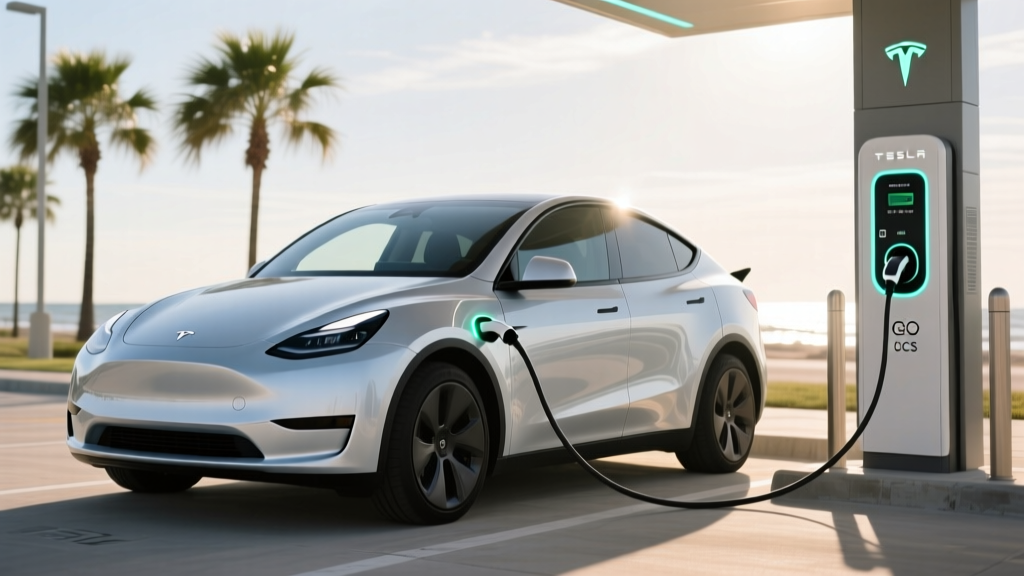
Charging remains Tesla's strongest competitive moat. The 2026 Model Y supports up to 250 kW peak DC fast charging on V3 and V4 Superchargers. Here's what that translates to in practice:
| Charging Level | Power | Speed (miles added) | Typical Use Case |
|---|---|---|---|
| Level 1 (120V outlet) | ~1.4 kW | ~4–5 mi/hr | Emergency/trickle top-off |
| Level 2 (240V, 48A Wall Connector) | 11.5 kW | ~44 mi/hr | Overnight home charging (full charge in ~7 hrs) |
| DC Fast (V3 Supercharger) | 250 kW peak | ~175 mi in 15 min | Road trips; 10–80% in ~25 min |
| DC Fast (V4 Supercharger) | 250 kW peak | ~175 mi in 15 min | Same peak rate, updated stall design |
Charge curve reality check: The 250 kW peak only holds between roughly 10–30% state of charge. Above 50%, the rate tapers to ~120 kW, and above 80% it drops further to ~50 kW. This is normal for NMC chemistry but worth understanding — if you're planning a road trip, the 10–80% time of ~25 minutes is your practical number, not the peak kW figure.
For League City home charging, the Tesla Wall Connector ($420, hardwired, up to 48A) is the recommended Level 2 solution. Most League City homes have 200A electrical panels that can accommodate a 60A circuit for the Wall Connector without a panel upgrade. Expect installation costs of $500–$1,500 from a licensed electrician depending on run length from panel to garage. CenterPoint Energy serves the League City area and currently offers no specific EV charger rebate, but Texas's deregulated market means you can shop for competitive overnight electricity rates — some retail providers offer plans as low as $0.06–$0.08/kWh during off-peak hours.
League City has three Tesla Supercharger stations within a 10-minute drive (including the Baybrook Mall and Tanger Outlets locations), plus numerous CCS/NACS-compatible third-party chargers now that Tesla's Supercharger network has opened to other brands.
Performance, Ride Quality, and Daily Driving
The dual-motor AWD Long Range produces 384 hp and hits 0–60 mph in 4.8 seconds — quick enough to merge confidently onto I-45 without drama. The Juniper refresh brought a revised suspension tuning that noticeably improves ride comfort over the pre-2025 Model Y, which was widely criticized for being too firm on rough pavement.
League City's roads — a mix of well-maintained suburban arterials and some rougher stretches along older sections of Highway 3 — are handled more competently by the updated model. Road noise, historically a Model Y complaint, has been reduced through additional acoustic glass and insulation in the Juniper generation.
The regenerative braking system offers one-pedal driving capability, though Tesla removed the user-adjustable regen setting several years ago. The default regen strength is moderate — expect to use the friction brakes occasionally at stoplights on FM 518 or at the NASA Road intersection near Johnson Space Center.
Pricing, Trims, and Federal Tax Credit Eligibility
The 2026 Model Y lineup has been simplified compared to prior years:
| Trim | MSRP | Est. After §30D Credit* | Range (EPA) |
|---|---|---|---|
| Long Range RWD | $42,490 | $34,990 | 320 mi |
| Long Range AWD | $44,990 | $37,490 | 320 mi |
| Performance AWD | $48,990 | $41,490 | 298 mi |
*Assumes full $7,500 federal tax credit eligibility. Actual credit depends on income, battery sourcing, and MSRP caps under IRS §30D. Credit can now be transferred at point of sale as an instant discount per IRS guidelines.
§30D eligibility for the 2026 Model Y: The Long Range and Performance trims fall under the $80,000 SUV MSRP cap. Buyer income limits apply: $300,000 joint / $225,000 head of household / $150,000 single filer (modified AGI). Battery critical-mineral and component sourcing requirements continue to tighten annually — Tesla has shifted significant battery supply chain to North America, and as of the 2026 model year, the Model Y Long Range AWD qualifies for the full $7,500 credit for eligible buyers. Always verify current eligibility at fueleconomy.gov before purchasing, as sourcing rules can change mid-year.
Interior, Tech, and Driver Assistance
The Juniper interior is a meaningful step up from the prior Model Y. Ventilated front seats (finally), ambient lighting, a rear-seat touchscreen for passengers, and improved material quality narrow the gap with luxury competitors. The 15.4-inch front touchscreen handles all vehicle controls — there are still no physical buttons or a traditional instrument cluster, which remains a polarizing choice.
Infotainment: Tesla's native software is fast and responsive, with built-in navigation that factors in Supercharger stops and battery preconditioning. However, Apple CarPlay and Android Auto remain unsupported — a dealbreaker for some buyers who prefer phone-mirrored interfaces.
Driver assistance: Basic Autopilot (adaptive cruise + lane centering) is standard. Full Self-Driving (Supervised) remains a $8,000 add-on and is SAE Level 2 — meaning you must remain fully engaged, hands on or near the wheel, eyes on the road. It is not autonomous driving. The system handles highway lane changes, on-ramps, and city intersections competently but requires constant supervision and can make unpredictable decisions in construction zones or with faded lane markings.
Pros, Cons, and the Competition
- Access to Tesla Supercharger network — the most reliable DC fast-charging system in the U.S.
- 320-mile EPA range with excellent efficiency (28 kWh/100 mi)
- Strong resale value relative to EV segment average
- Continuous OTA updates add features post-purchase
- Juniper refresh fixes ride quality and cabin noise complaints
- Practical cargo space (72.1 cu ft max) for a crossover
- No Apple CarPlay / Android Auto support
- Buttonless interior frustrates some drivers (turn signals on steering wheel)
- FSD (Supervised) remains expensive at $8,000 and is not autonomous
- Insurance costs in the Houston metro area run 15–25% above segment average
- Service center wait times can stretch 2+ weeks for non-critical repairs
- No spare tire — tire repair kit only
Key competitors for League City buyers:
- Hyundai Ioniq 5 (Long Range AWD): 290-mile EPA range, 350 kW peak DC charging (fastest in class), CarPlay/Android Auto, ~$48,000 MSRP. Better interior materials, weaker charging network access.
- Ford Mustang Mach-E (Extended Range AWD): 290-mile range, CarPlay support, more traditional driving feel, ~$46,000 MSRP. Ford's charging network access has improved via NACS adapter.
- Chevrolet Equinox EV (3RS): 319-mile range, lower starting price (~$41,000), but slower DC charging (~150 kW peak) and less cargo versatility.
Who Should Buy the 2026 Model Y in League City?
- You take regular road trips (Houston to Austin, Dallas, or New Orleans) and want the most reliable fast-charging network
- You want a family-sized crossover with 320 miles of range and strong cargo capacity
- You can charge at home overnight and want minimal public-charging dependency
- You value OTA software updates and a tech-forward interface
- You require Apple CarPlay/Android Auto (choose Ioniq 5 or Mach-E)
- You want a more traditional cockpit with physical controls
- Your budget is under $38,000 after incentives (consider the Equinox EV)
- You want the fastest DC charging available (Ioniq 5 at 350 kW peak)
Frequently Asked Questions
What is the real-world range of the 2026 Tesla Model Y?
The EPA rates it at 320 miles. In League City's mild climate with mixed driving, expect 280–310 miles in real-world use. Highway-only driving at 75 mph drops this to roughly 265–285 miles. Cold weather has minimal impact in southeast Texas.
How fast does the Model Y charge at home and on the road?
At home on a Level 2 Tesla Wall Connector (11.5 kW), you'll add about 44 miles of range per hour — a full overnight charge from 20% to 100% takes roughly 7 hours. On a V3/V4 Supercharger, 10–80% takes approximately 25 minutes, with peak rate of 250 kW tapering significantly above 50% SoC.
Does the 2026 Model Y qualify for the $7,500 federal tax credit?
Yes, for eligible buyers. The Model Y Long Range AWD qualifies under current IRS §30D rules — MSRP is under the $80,000 SUV cap, and Tesla's North American battery sourcing meets 2026 critical-mineral requirements. Buyer income must not exceed $300,000 (joint), $225,000 (head of household), or $150,000 (single). The credit can be applied as a point-of-sale discount through a participating dealer. Verify at fueleconomy.gov before purchasing.
Is the Model Y worth buying over the Hyundai Ioniq 5 or Ford Mach-E?
It depends on priorities. The Model Y wins on Supercharger network reliability, efficiency, and cargo space. The Ioniq 5 wins on DC charging speed (350 kW), interior quality, and CarPlay support. The Mach-E offers a more traditional driving feel and phone integration. For League City road-trippers who value charging convenience, the Model Y's Supercharger advantage is hard to overstate.
What does it cost to charge a Model Y at home in League City?
At an off-peak electricity rate of ~$0.07/kWh (available from several Texas retail providers), a full 78.1 kWh charge costs about $5.47 — equivalent to roughly $0.017 per mile. Compare that to a 25 MPG gas crossover at $2.80/gallon = $0.112 per mile. Annual savings for a 15,000-mile driver: approximately $1,400 in fuel costs.
How long will the Model Y battery last?
Tesla warranties the battery for 8 years or 120,000 miles, whichever comes first, with a minimum 70% capacity retention threshold. Real-world data from Tesla's Impact Report shows average degradation of approximately 12–15% at 150,000 miles for NMC packs. In League City's moderate climate (extreme heat is the main degradation accelerant, not extreme cold), expect the battery to retain 80–85% capacity at the 8-year mark with normal charging habits — meaning roughly 256–272 miles of range.