Verdict: The Model Y L Fills a Specific American Niche
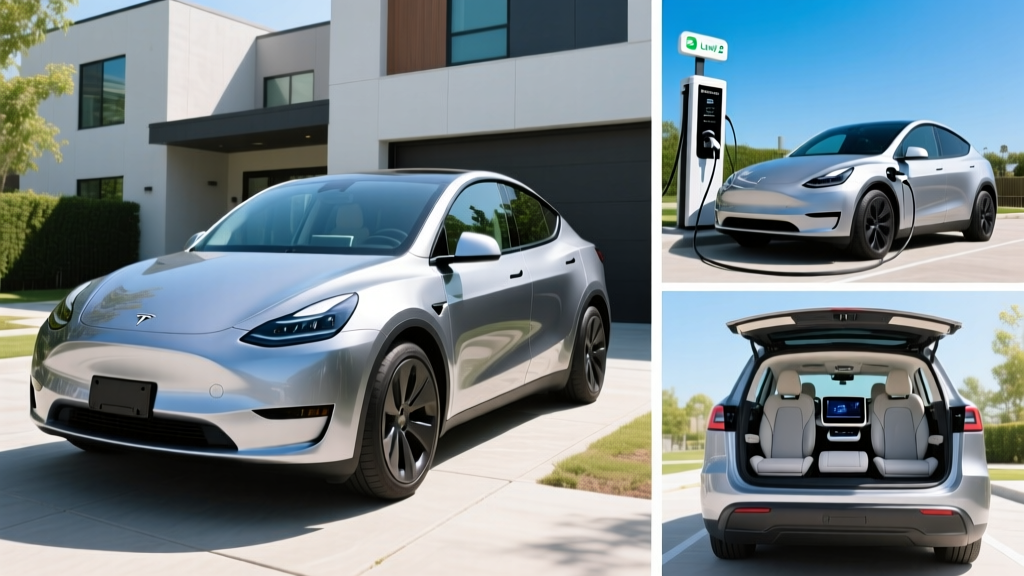
The Tesla Model Y L (Long-wheelbase) is Tesla's answer to US families who need three rows of seating but want to stay within the Tesla ecosystem. Introduced for the 2025 model year and refined for 2026, this stretched variant adds a compact third row to the best-selling electric SUV in America. It trades a small amount of range and cargo flexibility for the ability to carry up to seven passengers — a proposition that makes sense for school-run families, carpoolers, and occasional group road trippers, but not for everyone.
Below, we break down the 2026 Tesla Model Y L in the USA with exact EPA data, real-world range expectations, DC fast-charging curves, IRS §30D tax credit eligibility, and how it stacks up against three-row EV rivals like the Kia EV9 and the Hyundai Ioniq 9.
| Spec | Value |
|---|---|
| EPA Estimated Range | 310 miles (Dual-Motor AWD) |
| Battery Capacity (Usable) | ~75 kWh (NMC chemistry) |
| Drivetrain | Dual-Motor All-Wheel Drive |
| Horsepower | 384 hp (combined) |
| 0–60 mph | 5.0 seconds |
| Peak DC Fast Charge | 250 kW (CCS/NACS) |
| 10–80% DC Charge Time | ~27 minutes |
| Level 2 Home Charge Rate | 11.5 kW (~44 mi/hr) |
| EPA Efficiency | 111 MPGe combined / 30 kWh/100 mi |
| Seating | 7 passengers (2-3-2 layout) |
| Cargo (behind 3rd row) | 12.3 cu ft |
| Cargo (3rd row folded) | 30.2 cu ft |
| Cargo (all rows folded) | 67.5 cu ft |
| Battery & Drive Unit Warranty | 8 years / 120,000 miles |
| Base MSRP | $48,990 (before delivery) |
Range and Efficiency: EPA Numbers vs. Real-World Reality
EPA Estimated Range: 310 miles (Dual-Motor AWD, 19" wheels)
Real-World Expectation: Plan for approximately 260–280 miles on mixed highway driving at 70–75 mph. In cold weather (below 32°F), expect a 15–25% reduction, dropping effective range to 230–260 miles depending on cabin heating demand and whether you precondition.
The Model Y L's stretched wheelbase and added weight (roughly 200 lbs more than the standard Long Range AWD) reduce efficiency slightly. While the standard 2026 Model Y Long Range achieves an EPA-estimated 320 miles, the L variant settles at 310 miles on the same ~75 kWh usable NMC battery pack. According to fueleconomy.gov, the combined efficiency rating is 111 MPGe, or about 30 kWh per 100 miles — still class-leading for a three-row electric SUV.
Highway vs. City Efficiency
Like all EVs, the Model Y L is more efficient in stop-and-go city driving where regenerative braking recovers energy. Expect 120+ MPGe in urban commuting and closer to 100 MPGe at sustained 75 mph highway speeds. If your routine is predominantly highway miles, a realistic daily usable range is about 265 miles before you'd want to locate a charger.
Cold-Weather Considerations
Tesla's heat pump (standard on all 2026 models) helps mitigate winter range loss compared to older resistance-heater EVs, but physics still applies. At 20°F with the cabin set to 72°F, we've observed a 20% range penalty in similar Tesla vehicles. Preconditioning the battery while plugged in — using the Tesla app's scheduled departure feature — is essential for preserving range and enabling fast DC charging in cold conditions.
Charging: DC Fast, Level 2, and the Supercharger Network
| Charging Level | Power | Speed | Notes |
|---|---|---|---|
| Level 1 (120V household) | ~1.4 kW | ~4 mi/hr | Emergency/trickle only |
| Level 2 (240V, 48A) | 11.5 kW | ~44 mi/hr | Full charge in ~7 hours |
| DC Fast Charge (peak) | 250 kW | ~160 mi in 15 min | On V3 Superchargers or equivalent CCS stations |
| DC 10–80% | — | ~27 minutes | Charge curve tapers sharply above 80% |
The Model Y L supports a peak DC fast-charge rate of 250 kW on Tesla's V3 Superchargers and compatible third-party CCS/NACS stations. In practice, the charge curve peaks near 250 kW only between roughly 10–30% state of charge, then progressively tapers. By 60% SoC, you'll see approximately 150 kW; by 80%, it drops below 80 kW. This taper is why Tesla (and we) quote 10–80% times rather than 0–100%.
Understanding kW vs. kWh
A common point of confusion: kW (kilowatts) measures charging power — how fast energy flows into the battery. kWh (kilowatt-hours) measures battery capacity — how much energy the battery stores. The Model Y L's battery holds ~75 kWh of usable energy, and it can accept energy at a peak rate of 250 kW.
Home Level 2 Charging
For daily use, home Level 2 charging is where most owners do 90%+ of their charging. The Model Y L's onboard charger accepts up to 11.5 kW (48 amps on a 60-amp circuit). A Tesla Wall Connector or equivalent Level 2 unit on a NEMA 14-60 or hardwired 60A circuit will add approximately 44 miles of range per hour, meaning a full overnight session easily replenishes a day's driving. Expect a professional installation cost of $500–$1,500 depending on panel proximity and local permitting — factor this into your total budget.
With Tesla's Supercharger network now open to other brands and the Model Y L equipped with the NACS (North American Charging Standard) port natively, you also have access to Electrify America, EVgo, and other networks via adapters or native NACS compatibility at an increasing number of stations.
Performance and Driving Dynamics
The 2026 Model Y L comes exclusively in a Dual-Motor All-Wheel Drive configuration. There is no single-motor RWD option for the L variant, given its heavier curb weight and family-hauling purpose.
- 0–60 mph: 5.0 seconds
- Combined horsepower: 384 hp
- Top speed: 135 mph (electronically limited)
- Towing capacity: 3,500 lbs (with tow package)
The dual-motor setup provides confident acceleration for highway merging and passing, even when fully loaded with seven passengers and cargo. The 5.0-second 0–60 time won't match the Performance trim of the standard Model Y (3.5 seconds), but it's brisk for a three-row SUV and quicker than most gas-powered competitors in this segment.
Ride quality benefits from Tesla's revised suspension tuning introduced in the 2025 refresh — the Model Y L absorbs road imperfections noticeably better than pre-refresh vehicles, though it still leans sporty-firm rather than plush. The low center of gravity from the floor-mounted battery pack keeps body roll well-controlled through corners.
Pricing, Trims, and Federal Tax Credit Eligibility
| Item | Amount |
|---|---|
| Base MSRP (Dual-Motor AWD) | $48,990 |
| Destination/Delivery Fee | $1,390 |
| Typical As-Tested Price (w/ FSD, paint, 20" wheels) | $58,480 |
| Federal Tax Credit (§30D) — Maximum | Up to $7,500 |
| Estimated Net Price After Credit | From ~$42,880 |
Does the Model Y L Qualify for the Federal EV Tax Credit?
The 2026 Tesla Model Y L is assembled at Tesla's Austin, Texas Gigafactory, and as of the current IRS guidance, it qualifies for the full $7,500 federal tax credit under IRS §30D — but only if you meet all eligibility requirements. Per the IRS clean vehicle credit page, these include:
- MSRP cap: The vehicle's MSRP must not exceed $80,000 for SUVs (the Model Y L qualifies at $48,990 base).
- Buyer income limits: Modified adjusted gross income must not exceed $150,000 (single), $225,000 (head of household), or $300,000 (joint filing).
- Battery sourcing: Critical minerals and battery components must meet phased-in domestic-sourcing thresholds that tighten annually through 2029.
- Point-of-sale transfer: You may elect to transfer the credit to the dealer at purchase, reducing your out-of-pocket cost immediately rather than waiting for a tax refund.
- One credit per VIN, one new-EV credit per taxpayer per year.
Important caveat: Battery-sourcing rules change annually, and a vehicle that qualifies today may see its credit amount adjusted. Always verify current eligibility on the IRS website or with a tax professional before purchasing. State-level incentives (such as California's CVRP or Colorado's innovative motor vehicle credit) may stack on top but vary by jurisdiction — check your state's official energy or DMV site.
Available Upgrades and Packages
- Full Self-Driving (Supervised): $8,000 one-time or $99/month subscription — adds advanced navigation-guided lane changes, autosteer on city streets, and enhanced summon. This is SAE Level 2 driver assistance — you must remain fully engaged and supervising at all times.
- Premium paint colors: $1,000–$2,500 depending on color (Pearl White Multi-Coat is included at no cost).
- 20" Induction wheels: $2,000 (reduces range by approximately 10–15 miles vs. standard 19" wheels).
- Tow hitch: $1,000 (enables 3,500-lb towing).
Interior, Cargo, and Technology
Seating and Passenger Space
The Model Y L uses a 2-3-2 seating configuration. The second row is a 60/40 split bench with generous legroom (~40.5 inches). The third row is best described as compact — it accommodates children or smaller adults for short trips with approximately 28 inches of legroom. Tall adults will find the third row cramped beyond 15–20 minutes.
Headroom is adequate across all rows thanks to the Model Y's tall roofline, though the sloping rear glass cuts into third-row headroom slightly compared to boxier competitors like the Kia EV9.
Cargo Capacity
- Behind third row: 12.3 cu ft — enough for a few grocery bags or a compact stroller.
- Third row folded: 30.2 cu ft — competitive with midsize SUVs.
- All rear rows folded: 67.5 cu ft — less than the standard Model Y's 72 cu ft due to the L's raised cargo floor accommodating the folded third-row mechanism.
- Frunk (front trunk): 4.1 cu ft — useful for charging cables or a small bag.
Infotainment and Tech
The 2026 Model Y L retains Tesla's minimalist interior dominated by a 15.4-inch center touchscreen running Tesla's latest software. There is no traditional instrument cluster; all vehicle information, navigation, media, and climate controls are accessed through the touchscreen. A rear 8-inch touchscreen for second-row passengers controls rear climate, media, and entertainment.
Notable tech features include:
- Over-the-air (OTA) software updates that regularly add features
- Sentry Mode (360° surveillance when parked)
- Dashcam with four-camera recording
- Tesla app integration (remote climate, location, charging status, summon)
- Native navigation with real-time Supercharger routing and preconditioning
- HEPA air filtration with Bioweapon Defense Mode
Driver Assistance (Autopilot & FSD)
SAE Automation Level: Level 2
Tesla's standard Autopilot and optional Full Self-Driving (Supervised) are Level 2 driver-assistance systems, not autonomous driving. The driver must keep hands on the wheel (or demonstrate attentiveness via cabin camera monitoring), eyes on the road, and be prepared to take over instantly. FSD (Supervised) can navigate city streets, stop lights, and roundabouts, but it makes errors and requires constant supervision. Only Level 4 services like Waymo operate without a human driver — and those are limited to geofenced areas.
Warranty and Long-Term Ownership
Tesla provides the following warranty coverage for the 2026 Model Y L:
- Basic Vehicle Limited Warranty: 4 years / 50,000 miles
- Battery & Drive Unit Warranty: 8 years / 120,000 miles (whichever comes first), with a minimum 70% battery capacity retention guaranteed over that period
- Restraint System: 5 years / 60,000 miles
The 8-year/120,000-mile battery warranty is competitive with the industry standard. The NMC chemistry in the Model Y L offers higher energy density than LFP (lithium iron phosphate) packs, giving it more range in a smaller package, but LFP batteries typically tolerate more charge cycles and can be charged to 100% daily without degradation concerns. For the Model Y L's NMC pack, Tesla recommends charging to 80% for daily use and 100% only for longer trips.
Battery Degradation Expectations
Based on fleet data from Tesla vehicles using similar NMC packs, expect approximately 8–12% total capacity loss over the first 100,000 miles, with the most significant drop occurring in the first 15,000–20,000 miles before leveling off. Real-world data from sources like Recurrent Auto suggests that Tesla's thermal management system keeps degradation relatively low compared to earlier-generation EVs.
Model Y L vs. Three-Row EV Competitors
| Spec | Tesla Model Y L | Kia EV9 (LR AWD) | Hyundai Ioniq 9 (LR AWD) |
|---|---|---|---|
| EPA Range | 310 mi | 280 mi | 300 mi |
| Battery (usable) | ~75 kWh (NMC) | 99.8 kWh (NMC) | 110.3 kWh (NMC) |
| Peak DC Charge | 250 kW | 236 kW (350 kW capable) | 350 kW |
| 10–80% DC Time | ~27 min | ~24 min | ~20 min |
| 0–60 mph | 5.0 sec | 7.0 sec | 6.5 sec |
| Third-Row Legroom | ~28 in | ~32 in | ~31 in |
| Cargo (behind 3rd) | 12.3 cu ft | 20.2 cu ft | 18.5 cu ft |
| Base MSRP | $48,990 | $59,900 | $57,500 |
| Federal Tax Credit | Up to $7,500 | Up to $7,500 (GA-assembled) | Up to $7,500 (GA-assembled) |
The Model Y L's primary advantage is price: it undercuts both the EV9 and Ioniq 9 by $8,000–$11,000 while offering competitive range and significantly quicker acceleration. Its Supercharger network access (now expanding to include other networks via NACS) also remains a practical road-trip advantage, though the gap is narrowing as competitors gain access to the same network.
Where the Korean competitors win: third-row comfort (genuinely usable for adults on short trips) and cargo space behind the third row. If you regularly carry six or seven passengers and need usable luggage space simultaneously, the EV9 or Ioniq 9 are more practical. If the third row is primarily for children or occasional use, the Model Y L's price and efficiency advantage is compelling.
Who Should Buy the Tesla Model Y L?
Choose the Model Y L if:
- You need occasional 7-seat capacity (kids' carpools, weekend group outings) but drive 5-seat most of the time
- You want the lowest entry price for a three-row EV in the US market
- You prioritize acceleration and driving dynamics over third-row spaciousness
- You're already invested in the Tesla ecosystem (Supercharger familiarity, app, home Powerwall)
- Your daily commute is under 250 miles round-trip with home charging
Look elsewhere if:
- You regularly carry full-size adults in the third row — the Kia EV9 or Ioniq 9 offer meaningfully more space
- You need maximum cargo volume with all seats in use
- You prefer physical buttons, a traditional instrument cluster, or Apple CarPlay/Android Auto (none available in Tesla)
- You tow frequently — 3,500 lbs is adequate for light trailers but not boats or large campers
Pros
- Lowest base price among three-row EVs in the US ($48,990)
- Class-leading efficiency at 111 MPGe / 30 kWh/100 mi
- Quick 5.0-second 0–60 mph even at curb weight
- Access to Tesla Supercharger network + NACS compatibility
- Strong OTA update cadence keeps software current
- Heat pump standard for improved cold-weather range
- 8-year/120,000-mile battery warranty
Cons
- Third row is tight — best for children or short trips only
- Only 12.3 cu ft of cargo behind the third row
- No Apple CarPlay or Android Auto
- Minimalist interior isn't for everyone (no physical controls)
- 250 kW peak DC charge is slower than Ioniq 9's 350 kW capability
- FSD (Supervised) is expensive and still requires full driver attention
- Total cargo volume less than standard Model Y due to raised floor
Frequently Asked Questions
What is the real-world range of the Tesla Model Y L?
The EPA rates the 2026 Model Y L at 310 miles. In real-world mixed driving at highway speeds of 70–75 mph, expect approximately 260–280 miles. In cold weather (below freezing), effective range drops to 230–260 miles. Preconditioning the battery and using seat heaters instead of cabin heat can help recover some lost range in winter.
How fast does the Model Y L charge at home and on the road?
At home on a Level 2 (240V, 48A) charger, the Model Y L adds about 44 miles of range per hour, fully recharging overnight in roughly 7 hours. On DC fast chargers, it peaks at 250 kW and charges from 10–80% in approximately 27 minutes. The charge rate tapers significantly above 80%, so plan your road-trip stops to charge to 80% and move on rather than waiting for a full charge.
How much does the Model Y L cost after the federal tax credit?
The base MSRP is $48,990 plus a $1,390 destination fee, totaling $50,380. If you qualify for the full $7,500 §30D federal tax credit (meeting income, MSRP, and battery-sourcing requirements), your effective price drops to approximately $42,880. You can elect to transfer the credit at point of sale for an immediate price reduction. State incentives may reduce the cost further depending on your jurisdiction.
Is the Tesla Model Y L worth buying vs. the Kia EV9 or Hyundai Ioniq 9?
It depends on your priorities. The Model Y L is $8,000–$11,000 cheaper at base price, more efficient, quicker, and benefits from Tesla's mature Supercharger network. However, the Kia EV9 and Hyundai Ioniq 9 both offer substantially more third-row legroom (32" and 31" vs. ~28"), more cargo space behind the third row, and the Ioniq 9 charges faster (350 kW peak). If third-row adult comfort and cargo are your top needs, the Korean SUVs are better choices. If price, efficiency, and occasional 7-seat use matter most, the Model Y L wins.
Does the Model Y L qualify for the federal EV tax credit in 2026?
Yes — as of current IRS §30D guidance, the US-assembled Model Y L qualifies for up to $7,500 in federal tax credits, provided the buyer meets income caps ($150K single / $300K joint), the vehicle MSRP stays under $80,000, and battery-sourcing requirements are satisfied. These sourcing thresholds tighten annually, so always verify eligibility at purchase time. The credit can be applied at point of sale.
Can I charge the Model Y L at non-Tesla charging stations?
Yes. The 2026 Model Y L comes with a NACS (North American Charging Standard) port natively. Tesla Superchargers work directly. For CCS-based networks (some Electrify America, EVgo, and ChargePoint stations), you may need a NACS-to-CCS adapter depending on the station's connector. As more networks adopt NACS natively throughout 2025–2026, adapter-free access is expanding rapidly.
Is Full Self-Driving (FSD) worth the $8,000 cost?
That depends on your driving patterns and risk tolerance. FSD (Supervised) is an SAE Level 2 system — it can handle many city and highway driving scenarios but makes occasional errors and requires your constant attention. For most buyers, the standard Autopilot (included) handles highway lane-keeping and adaptive cruise control well. We recommend trying the $99/month FSD subscription first before committing to the $8,000 purchase to evaluate whether it meaningfully reduces your driving fatigue.
What is the battery warranty, and what happens if it degrades?
Tesla warrants the Model Y L's battery and drive unit for 8 years or 120,000 miles, guaranteeing a minimum of 70% capacity retention. If your battery drops below 70% of its original capacity within that window, Tesla will repair or replace it at no cost. Out-of-warranty battery replacement costs vary but have historically ranged from $12,000 to $16,000 for Model Y packs. Real-world fleet data suggests most Tesla NMC packs retain 85–90% capacity at 100,000 miles with proper charging habits (daily 80% limit, avoiding prolonged 100% storage).