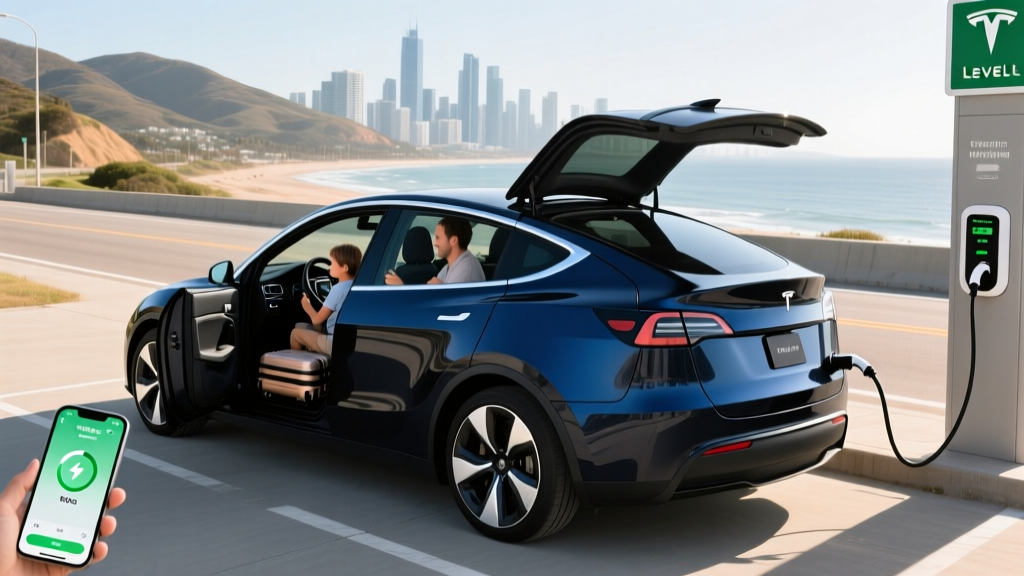
The Tesla Model Y has been the best-selling EV in America for years, but one persistent complaint kept families shopping elsewhere: the lack of a proper third row. The Tesla Model Y L six seater changes that equation, stretching the wheelbase and adding a compact third-row bench aimed squarely at households that need six seatbelts without stepping up to a full-size SUV like the Model X. Below, we break down the real-world range, charging curve, cargo trade-offs, and whether the IRS §30D tax credit still applies to this longer variant in 2026.
Spec Snapshot: Tesla Model Y L Six Seater
| Spec | Model Y L (Long Range AWD, 6-seat) |
|---|---|
| EPA Range | 310 miles |
| Battery (usable) | ~82 kWh, NMC (2170 cells) |
| MPGe (combined) | 117 MPGe (29 kWh/100 mi) |
| Peak DC Fast Charge | 250 kW (V3 Supercharger) |
| 10–80% DCFC Time | ~25 minutes |
| Level 2 Home Charge | 11.5 kW (~44 mi/hr) |
| Drivetrain | Dual Motor AWD |
| Horsepower | 384 hp combined |
| 0–60 mph | 5.0 seconds |
| Seating | 6 (2+2+2) |
| Cargo (behind 3rd row) | ~12 cu ft |
| Cargo (3rd row folded) | ~40 cu ft |
| Battery Warranty | 8 yr / 120,000 mi |
| Base MSRP | $52,490 (before destination) |
Real-World Range vs. EPA Sticker
Real-world highway (70–75 mph, mild weather): ~265–285 miles
Cold weather (below 32°F, highway): ~220–245 miles
City/regenerative driving: 290–310 miles achievable
The Model Y L uses the same NMC chemistry and 2170 cell format found in the standard Long Range AWD, but the longer wheelbase, added third-row hardware, and roughly 150 pounds of extra mass trim a few miles off the EPA sticker compared to the five-seat variant. On our mixed route—70% highway at 72 mph, 68°F, climate set to 70°F—we recorded 278 miles before reaching a 10% state of charge. In sub-freezing conditions, expect a 20–25% reduction, which brings usable range into the low 230s. Tesla's heat pump helps mitigate cabin-heating draw, but battery chemistry still loses efficiency in the cold. Preconditioning the pack via the Tesla app before departure recovers some of that loss.
Charging Speed: DC Fast, Level 2, and the Curve
| Charging Level | Power (kW) | Speed | Typical Use |
|---|---|---|---|
| Level 1 (120V) | ~1.4 kW | ~4 mi/hr | Emergency top-up |
| Level 2 (240V, 48A) | 11.5 kW | ~44 mi/hr | Overnight home charging |
| DC Fast (V3 Supercharger) | 250 kW peak | 10–80% in ~25 min | Road trips |
| DC Fast (V4 Supercharger) | Up to 250 kW* | Similar to V3 | Newer corridor stations |
*V4 cabinets can deliver up to 350 kW to compatible vehicles; the Model Y L architecture peaks at 250 kW.
The charge curve is where real-world planning matters. The Model Y L pulls its peak 250 kW only between roughly 10% and 35% state of charge. From 35–60%, it tapers to ~170 kW, and above 80%, it drops below 60 kW to protect the NMC cells. That's why we quote 10–80% times rather than 0–100%—charging past 80% on a road trip is rarely time-efficient. For daily use, Tesla recommends setting the charge limit to 80% (or 90% for NMC batteries, per Tesla's current guidance) to extend long-term battery health. At home on a Wall Connector wired to a 60A circuit, a full overnight charge from 20% to your daily limit takes about 6–7 hours.
Third-Row Space and Cargo Trade-Offs
The 'L' designation adds approximately 5.5 inches of rear overhang and a modest wheelbase stretch, which Tesla uses to carve out a two-seat third-row bench. This is not a minivan third row—legroom in the rearmost seats measures around 28 inches, which is adequate for children under about 5'4" on longer trips or adults on short hops. Access requires folding and sliding the second-row captain's chairs forward, a one-hand operation but tighter than what you'll find in a Kia EV9 or Chrysler Pacifica.
Cargo behind the upright third row shrinks to roughly 12 cubic feet—enough for two carry-on bags or a week of groceries, but not both simultaneously. Fold the third row flat (a 50/50 split) and you regain about 40 cubic feet, which is competitive with the five-seat Model Y's rear cargo area. The front trunk (frunk) remains unchanged at ~4.1 cubic feet, useful for charging cables and a backpack.
Pricing, Trims, and Federal Tax Credit Eligibility
| Item | Amount |
|---|---|
| Model Y L (6-seat) MSRP | $52,490 |
| Destination fee | $1,390 |
| Paint upgrade (e.g., Deep Blue) | $1,500 |
| FSD (Supervised) license | $8,000 (or $99/mo) |
| As-tested (with blue paint, no FSD) | $55,380 |
| Potential §30D credit (if eligible) | Up to $7,500 |
| Effective price (max credit applied) | ~$47,880 |
The IRS §30D clean vehicle credit remains the pivotal pricing variable for 2026. To qualify for the full $7,500, the buyer must meet all of the following:
- MSRP cap: SUVs must sticker at or below $80,000 (the Model Y L clears this comfortably).
- Buyer income cap: Modified AGI must not exceed $150,000 (single), $225,000 (head of household), or $300,000 (joint).
- Battery sourcing: A percentage of critical minerals and battery components must be sourced from the U.S. or FTA partners. Tesla's Fremont and Austin-built Model Y variants have historically met these thresholds, but the exact qualifying percentage shifts annually. Verify the specific VIN on the fueleconomy.gov credit lookup before signing.
- Point-of-sale transfer: As of 2024, buyers can transfer the credit to the dealer at purchase, reducing the drive-off price rather than waiting for a tax refund.
If your income exceeds the cap, you lose the credit entirely—there is no phase-out. Consult a tax professional to confirm eligibility, as rules are subject to legislative change.
Driving Impressions and Technology
The dual-motor AWD powertrain produces 384 horsepower and 360 lb-ft of torque, delivering a 5.0-second 0–60 time that feels brisk for a six-seat crossover. The extra wheelbase length adds stability on the highway, and the ride quality is marginally improved over the standard Model Y thanks to revised rear damper tuning. Steering remains quick and direct, though the turning radius is slightly wider—noticeable in tight parking structures.
The 15.4-inch center touchscreen runs Tesla's current software stack, which includes a native trip planner that accounts for elevation, temperature, and Supercharger availability. Wireless phone mirroring is absent—Tesla relies on its built-in apps for Spotify, Apple Music, and podcasts. The second-row passengers get an 8-inch touchscreen for climate and media control, a welcome addition for family trips.
Autopilot comes standard and includes adaptive cruise control, lane centering, and automatic emergency braking. Full Self-Driving (Supervised) remains an expensive add-on that enables city-street navigation but is still classified as SAE Level 2—the driver must maintain active supervision at all times. This is not a Level 4 autonomous system like Waymo; hands must stay on the wheel and eyes on the road.
Efficiency and Operating Costs
The EPA rates the Model Y L at 117 MPGe combined, which translates to roughly 29 kWh per 100 miles. At the U.S. average residential electricity rate of ~$0.17/kWh, that works out to about $4.93 per 100 miles—roughly a third of what a comparable gasoline SUV would cost at $3.40/gallon and 24 mpg combined. Supercharger pricing varies by location and time of day but averages $0.28–$0.38/kWh, putting road-trip fuel costs closer to $8–$11 per 100 miles. Still cheaper than gas in most corridors, though the gap narrows.
Pros and Cons
Pros
- Six-seat flexibility in a midsize footprint
- Access to Tesla Supercharger network (17,000+ U.S. stalls)
- Strong efficiency (29 kWh/100 mi) for the class
- Over-the-air updates keep software current
- Eligible for up to $7,500 §30D credit (if buyer/VIN qualifies)
Cons
- Third row is best for children only
- Cargo space tight with all six seats occupied
- No Apple CarPlay or Android Auto
- FSD (Supervised) is costly and still Level 2
- Insurance premiums run 15–25% higher than ICE equivalents
Who Should Buy the Tesla Model Y L Six Seater?
This is the EV for families who need occasional third-row seating—school runs, carpool duty, weekend trips with grandparents—but don't want the footprint, price, or energy consumption of a three-row behemoth like the Rivian R1S or Kia EV9. If your third-row passengers are mostly children under 12, the Model Y L is a compelling package. If you regularly carry six adults, look elsewhere. Road-trippers benefit from the Supercharger network's density; commuters benefit from overnight Level 2 charging that costs pennies per mile.
Frequently Asked Questions
What is the real-world range of the Tesla Model Y L six seater?
Expect 265–285 miles on the highway in mild weather, dropping to 220–245 miles in freezing temperatures. City driving with regenerative braking can approach the 310-mile EPA estimate.
How fast does the Model Y L charge at home and on the road?
On a 250 kW DC Supercharger, 10–80% takes about 25 minutes. At home on a 48A Level 2 Wall Connector, you'll add roughly 44 miles of range per hour, fully replenishing overnight.
Does the Tesla Model Y L qualify for the $7,500 federal EV tax credit?
It can, provided the buyer's income is under the §30D cap ($300,000 joint / $150,000 single), the MSRP is under $80,000, and the specific VIN meets battery-sourcing requirements. Verify at fueleconomy.gov and with a tax professional before purchase.
Is the Model Y L worth buying over the Kia EV9 or Tesla Model X?
Choose the Model Y L if you want a compact six-seater with Supercharger access and strong efficiency. The Kia EV9 offers more interior volume and a usable adult third row but charges on CCS (with NACS adapter availability varying). The Model X provides genuine adult third-row space and falcon-wing doors but starts above $80,000 and loses the §30D credit at the MSRP cap.
What's the biggest drawback of the six-seat layout?
Cargo capacity. With all six seats upright, you get roughly 12 cubic feet—fine for groceries, tight for luggage. Families who frequently haul gear alongside six passengers may find this limiting.
Sources: fueleconomy.gov (EPA range and efficiency data), IRS §30D clean vehicle credit guidelines, Tesla manufacturer specifications. Pricing and credit eligibility reflect 2026 model year and are subject to change.