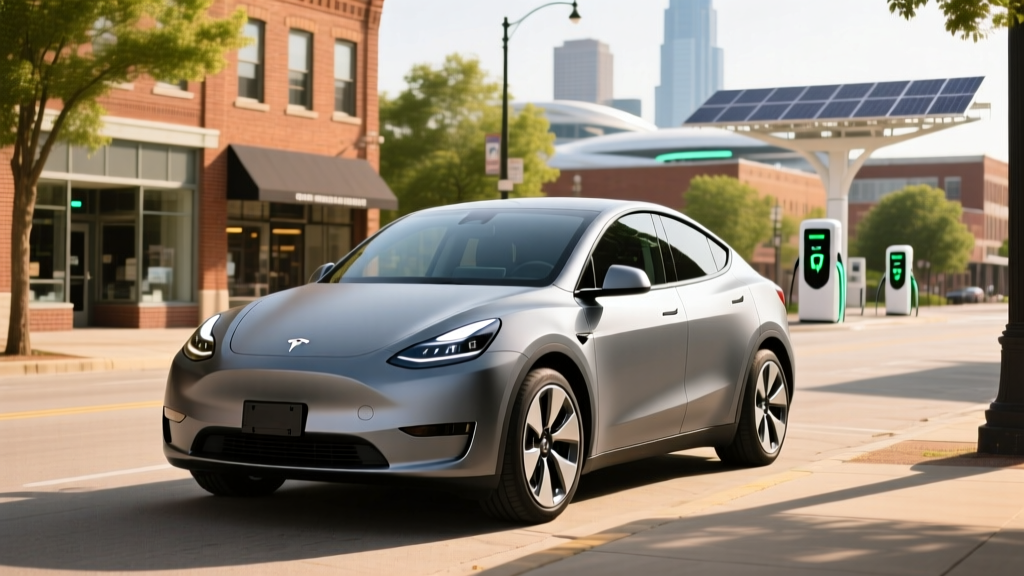
If you're shopping for a Tesla in Kansas City, MO, the Model Y remains the default electric crossover to benchmark. It dominates EV sales charts for good reason: strong range, access to the Supercharger network, and a price point that — after federal incentives — undercuts many gas-powered compact SUVs. But Kansas City's climate and driving patterns create a specific set of demands that national reviews often gloss over.
Missouri winters routinely drop into the teens, and the KC metro sprawl means highway-heavy commutes on I-70, I-35, and I-435. This review evaluates the 2026 Tesla Model Y through that lens, with exact specs, real-world range expectations, charging data, and tax-credit math tailored to Midwest buyers.
2026 Tesla Model Y at a Glance: Key Specs
| Spec | Long Range AWD | Performance AWD | RWD (Standard) |
|---|---|---|---|
| EPA Range | 320 mi | 293 mi | 278 mi |
| Battery (usable) | ~75 kWh (NMC) | ~75 kWh (NMC) | ~57.5 kWh (LFP) |
| Drivetrain | Dual-motor AWD | Dual-motor AWD | Single-motor RWD |
| Horsepower | ~384 hp | ~456 hp | ~295 hp |
| 0–60 mph | 4.8 sec | 3.5 sec | 5.8 sec |
| MPGe (combined) | 111 MPGe | 103 MPGe | 120 MPGe |
| Efficiency | 30 kWh/100mi | 33 kWh/100mi | 28 kWh/100mi |
| Max DC Fast Charge | 250 kW | 250 kW | 175 kW |
| 10–80% DCFC Time | ~27 min | ~27 min | ~30 min |
| Level 2 Home Rate | 11.5 kW (~44 mi/hr) | 11.5 kW (~44 mi/hr) | 11.5 kW (~44 mi/hr) |
| Cargo (rear seats up) | 30.2 cu ft | 30.2 cu ft | 30.2 cu ft |
| Cargo (rear seats folded) | 72.1 cu ft | 72.1 cu ft | 72.1 cu ft |
| Rear Legroom | 36.0 in | 36.0 in | 36.0 in |
| Base MSRP | $44,990 | $49,990 | $38,990 |
| Battery Warranty | 8 yr / 120,000 mi | 8 yr / 120,000 mi | 8 yr / 100,000 mi |
Source: fueleconomy.gov and Tesla specifications, 2026 model year. Prices before destination fee.
Real-World Range in Kansas City Conditions
Real-World Expectation: ~270–290 mi on highway loops at 70–75 mph in mild weather; ~220–250 mi in January cold (15–25°F) with cabin heat. City driving with regen braking recovers closer to sticker.
The EPA's 320-mile figure for the Long Range AWD assumes a mix of city and highway driving at moderate temperatures. Kansas City drivers face two range-reducing realities:
Highway-heavy commutes. The KC metro is sprawling. A round-trip commute from Olathe to downtown Kansas City via I-35, or from Lee's Summit to the Plaza, runs mostly at 65–75 mph. At those speeds, aerodynamic drag eats into efficiency — expect roughly 270–290 miles from a full charge on the Long Range in spring and fall conditions, based on observed consumption of 280–310 Wh/mi at highway speed.
Midwest winters. January temperatures in Kansas City average 22°F as a low. Battery chemistry slows in cold, and resistive cabin heating (Tesla uses a heat pump, which helps significantly versus older resistive systems) still draws energy. In sustained sub-30°F driving, plan for 220–250 miles of usable range. Preconditioning the battery while plugged in — a feature accessible through the Tesla app — recovers some of that loss and is essential before DC fast charging in winter.
For the RWD trim with its smaller LFP battery, the calculus is tighter. The 278-mile EPA rating drops to roughly 190–210 miles in cold highway driving. That's adequate for most KC commutes but leaves less margin for weekend trips to Lake of the Ozarks without a charging stop.
Charging Speed: Supercharger Access and Home Setup
Charging infrastructure is where Tesla ownership in Kansas City carries a distinct advantage. The Supercharger network remains the most reliable DC fast-charging option in the region, with multiple stations along I-70, I-35, and I-29 providing redundancy for road trips.
| Charging Level | Power (kW) | Rate | Best Use Case |
|---|---|---|---|
| Level 1 (120V outlet) | ~1.4 kW | ~5 mi/hr | Emergency top-ups, overnight trickle |
| Level 2 (240V home) | 11.5 kW | ~44 mi/hr | Daily charging, full overnight refill |
| DC Fast (Supercharger V3) | Up to 250 kW | ~180 mi in 15 min (peak) | Road trips, rapid top-ups |
DC fast charging reality check. The 250 kW peak rate applies only to the Long Range and Performance trims (NMC batteries). That peak is sustained roughly from 10–30% State of Charge (SoC), then tapers progressively. The 10–80% session takes about 27 minutes — competitive but not class-leading versus Hyundai's 800V E-GMP platform (Ioniq 5, EV6), which achieves 10–80% in roughly 18 minutes at a 350 kW charger.
The RWD trim's LFP battery peaks at 175 kW. LFP chemistry charges more linearly and can safely be held at 100% SoC daily (unlike NMC, where Tesla recommends 80% for daily use). This is a practical advantage for RWD owners who want maximum range available every morning without managing charge limits.
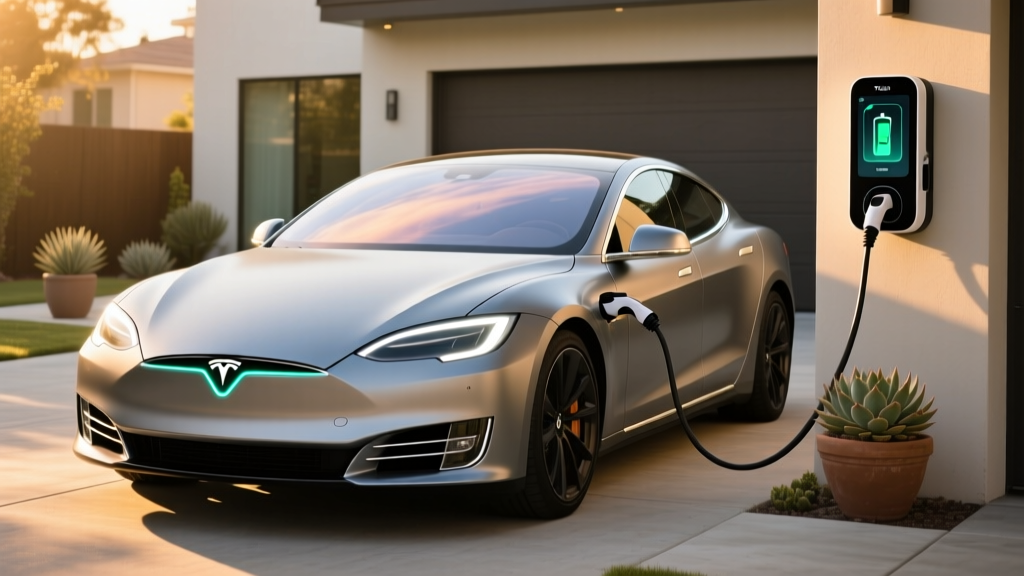
Home charging in KC. A Level 2 home installation using the Tesla Wall Connector ($420 for the unit) at 48 amps / 11.5 kW adds roughly 44 miles of range per hour — enough to fully replenish even the Long Range overnight in about 7–8 hours. Installation costs in the Kansas City metro typically run $800–$2,000 for a straightforward panel-to-garage run, or $2,500–$4,500 if your home needs a 200-amp service panel upgrade (common in older homes in neighborhoods like Brookside or Waldo). Get a quote from a licensed electrician before purchasing.
Performance, Efficiency, and Daily Drivability
The Long Range AWD's 4.8-second 0–60 mph time puts it in sports-sedan territory, and the dual-motor AWD system provides confident traction on the icy patches that plague KC's hillier streets (Westport, the Country Club Plaza, and North Kansas City's bluffs). The Performance trim's 3.5-second sprint is genuinely quick but costs $5,000 more and sacrifices 27 miles of EPA range.
Efficiency is where the Model Y earns its reputation. At 30 kWh/100 miles (Long Range), it's among the most efficient electric crossovers sold. For context, the Ford Mustang Mach-E Extended Range AWD consumes roughly 34 kWh/100 mi. Over 12,000 miles/year of driving, that efficiency gap translates to approximately $80–$120 in annual electricity savings at Missouri's average residential rate of ~$0.13/kWh.
Regenerative braking is strong and predictable. Tesla removed the driver-adjustable regen setting in recent years — it's always in maximum-regen mode, which enables near one-pedal driving in stop-and-go traffic on I-70. Some buyers love this; others find the learning curve abrupt. A 15-minute test drive through Kansas City traffic is the best way to decide.
Pricing, Tax Credits, and What Kansas City Buyers Actually Pay
| Trim | Base MSRP | Est. After §30D Credit | Notes |
|---|---|---|---|
| RWD (Standard) | $38,990 | $31,490 | MSRP under cap; check income + sourcing |
| Long Range AWD | $44,990 | $37,490 | MSRP under $80K cap; check income + sourcing |
| Performance AWD | $49,990 | $42,490 | MSRP under $80K cap; check income + sourcing |
Federal tax credit (§30D) — the details matter. The Tesla Model Y qualifies for up to $7,500 under the Inflation Reduction Act's Clean Vehicle Credit, but eligibility is not automatic. Per IRS guidelines, you must meet all of the following:
- Income caps: Modified AGI ≤ $150,000 (single), ≤ $225,000 (head of household), ≤ $300,000 (married filing jointly)
- MSRP cap: Vehicle MSRP must not exceed $80,000 for SUVs — all Model Y trims clear this
- Battery sourcing: Critical minerals and battery components must meet phased percentage thresholds from US or FTA-partner countries. Tesla's US-built Model Y has largely met these requirements, but confirm at point of sale
- Point-of-sale transfer: As of 2024+, you can transfer the credit to the dealer at purchase for an immediate price reduction — no need to wait until tax filing
Missouri does not currently offer a state EV tax credit, though the state does not impose additional EV registration fees beyond a small annual electric vehicle surcharge. Check with your tax professional to confirm your personal eligibility before relying on the $7,500 figure.
Tech, Interior, and Driver Assistance
The Model Y's interior remains polarizing: minimalist to the point of austerity, with nearly all controls funneled through the 15.4-inch center touchscreen. There are no physical buttons for climate, media, or glovebox release. For some, this is elegant simplicity; for others, it's a frustration — particularly when adjusting mirrors or windshield wipers requires menu diving while driving.
Autopilot and FSD (Supervised). Every Model Y ships with basic Autopilot (traffic-aware cruise control and lane-keeping). Tesla's Full Self-Driving (Supervised) package — currently a $8,000 option — adds automatic lane changes, traffic light/stop sign recognition, and city-street navigation. However, it is critical to understand:
Standout tech features:
- Over-the-air (OTA) updates that add features post-purchase
- Sentry Mode dashcam recording when parked
- Dog Mode and Camp Mode for climate control while stationary
- Tesla app with remote preconditioning, location tracking, and charging management
- Native NACS charging port — no adapter needed at Superchargers or the growing number of NACS-equipped public stations
Notable drawbacks:
- No Apple CarPlay or Android Auto — Tesla's proprietary system only
- Ride quality on 20-inch wheels can be firm over KC's potholed streets
- Panel-gap inconsistency remains a documented quality concern
- No heads-up display or traditional instrument cluster
Pros and Cons for Kansas City Buyers
Pros
- Best-in-class Supercharger network coverage across Missouri and Kansas
- Excellent efficiency (30 kWh/100mi) keeps per-mile cost low
- Strong AWD traction for ice and snow
- Heat pump minimizes winter range loss vs. competitors
- Spacious 72.1 cu ft cargo area with seats folded
- OTA updates keep the car current
- Qualifies for $7,500 §30D credit (verify eligibility)
Cons
- No CarPlay/Android Auto — a dealbreaker for some
- FSD (Supervised) is expensive ($8,000) and still Level 2 only
- Firm ride on larger wheels over rough pavement
- RWD trim's cold-weather range may be tight for longer trips
- Service center wait times in KC can stretch weeks for bodywork
- Minimalist interior lacks physical controls
Who Should Buy the Model Y in Kansas City?
Choose the Long Range AWD if: You commute 40+ miles daily on I-70 or I-35, want year-round AWD confidence, and plan road trips to Colorado, Arkansas, or Chicago. The 320-mile EPA range and heat pump make it the most versatile trim for Missouri's climate.
Choose the RWD if: Your daily drive is under 50 miles round-trip, you garage the car (reducing cold-weather impact), and you want the lowest entry price after the tax credit (~$31,490). The LFP battery's tolerance for daily 100% charging is a practical bonus.
Choose the Performance if: You prioritize acceleration and track-capability and don't mind sacrificing 27 miles of range and $5,000 in budget. Best for enthusiasts, not efficiency seekers.
Look at competitors if: You need Apple CarPlay (Hyundai Ioniq 5, Ford Mustang Mach-E), prefer a more traditional interior with physical controls (Mach-E), or want faster DC charging on a 350 kW-capable platform (Ioniq 5/EV6 at ~18 min 10–80%).
Frequently Asked Questions
What is the real-world range of the Tesla Model Y in Kansas City winters?
Expect roughly 220–250 miles from the Long Range AWD when temperatures stay below 30°F and you're driving highway speeds with cabin heat running. The heat pump helps, but cold still reduces battery efficiency by 15–25%. Preconditioning while plugged in recovers some of that range.
How fast does the Model Y charge at home and at Superchargers?
At home on a Level 2 Wall Connector (11.5 kW), you'll add about 44 miles of range per hour — a full overnight charge. At a V3 Supercharger (250 kW peak), the Long Range goes from 10–80% in approximately 27 minutes. Kansas City has Superchargers at multiple locations including the Legends Outlets, Ward Parkway, and along I-70.
Does the Tesla Model Y qualify for the $7,500 federal tax credit?
Yes, the Model Y is eligible for up to $7,500 under IRS §30D, provided you meet the income caps ($150K single / $300K joint), the vehicle MSRP is under $80,000 (all trims qualify), and battery sourcing requirements are met at time of purchase. You can transfer the credit at point of sale for an immediate price reduction. Always confirm current eligibility with your tax professional or at irs.gov.
Is the Model Y worth buying over the Ford Mustang Mach-E or Hyundai Ioniq 5?
The Model Y wins on efficiency, cargo space, and Supercharger network access. The Mach-E offers Apple CarPlay, a more conventional interior, and competitive range. The Ioniq 5 charges faster on 350 kW stations and has a more distinctive design. If Supercharger reliability matters most to you, Tesla still leads. If you want CarPlay or faster peak charging, look at the alternatives.
What is the battery warranty on the Tesla Model Y?
The Long Range and Performance trims carry an 8-year/120,000-mile battery and drive unit warranty. The RWD (LFP) trim is covered for 8 years/100,000 miles. Tesla guarantees the battery will retain at least 70% of its original capacity over the warranty period. Real-world degradation data from high-mileage owners suggests most NMC packs lose 8–12% over the first 100,000 miles, with the curve flattening afterward.
How much does it cost to charge a Model Y in Kansas City?
At Missouri's average residential electricity rate of ~$0.13/kWh, fully charging the Long Range's ~75 kWh battery at home costs about $9.75 — roughly equivalent to $3.25 per gallon of gas in cost-per-mile terms. Supercharger rates in the KC area vary from $0.28–$0.36/kWh, making a 10–80% session approximately $15–$19. Home charging is dramatically cheaper than public DC fast charging.
For official EPA efficiency data, see fueleconomy.gov. Safety ratings available at NHTSA and IIHS. Tax credit rules subject to change — verify at irs.gov before purchase.