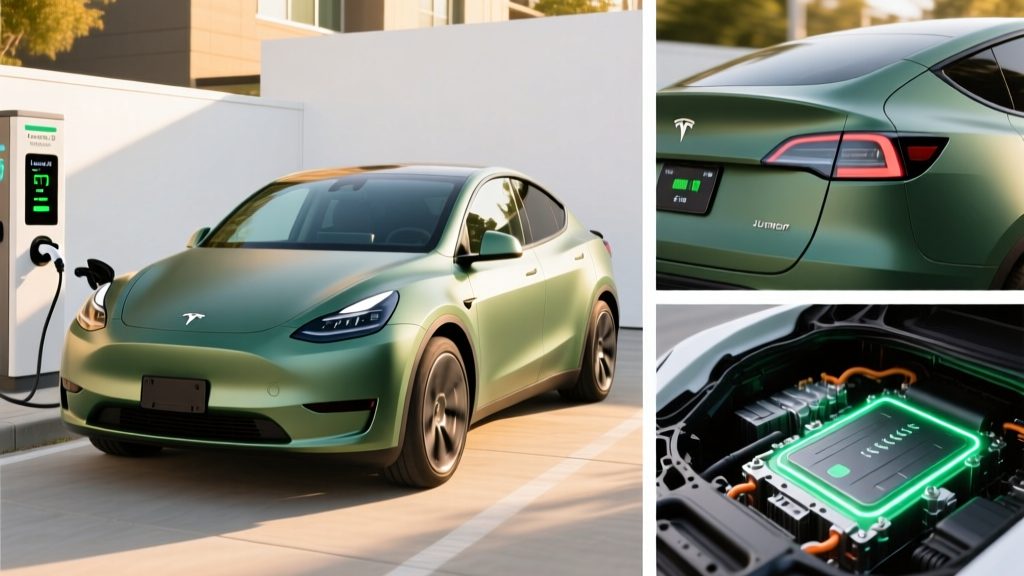
The Tesla Model Y Juniper refresh arrived in 2025 as Tesla's answer to a rapidly closing gap from Hyundai, Ford, and Kia in the compact electric SUV segment. Now well into the 2026 model year, the Juniper-generation Model Y has settled into production, and we've spent enough time with one to separate marketing polish from daily-driver reality. This is the most refined Model Y Tesla has ever built — quieter, more efficient, and equipped with a revamped interior — but it still carries familiar compromises that buyers need to weigh carefully.
Below, we break down every number that matters: EPA range versus what you'll actually see on the highway in January, the real charging curve (not just the peak kW figure), tax credit eligibility under current IRS §30D rules, and whether the Juniper Model Y still deserves its sales-crown position against competitors that have been nipping at its heels.
Quick Verdict: Who Should Buy the 2026 Model Y Juniper
Buy the Model Y Juniper if: You want access to the Supercharger network without adapters, prioritize over-the-air updates and software integration, need a practical family SUV with strong cargo space, and value a mature charging ecosystem above all else.
Look elsewhere if: You want a traditional instrument cluster, prefer physical buttons for climate and volume, need maximum rear-seat legroom for tall teenagers, or want to qualify for the full $7,500 federal tax credit on a Long Range AWD trim (MSRP cap issues apply — details below).
Range, Battery, and Efficiency
The 2026 Model Y Juniper is offered in three primary configurations in the US market, each with a distinct battery and range profile:
| Trim | Battery (usable kWh) | Chemistry | EPA Range | Efficiency | Drivetrain |
|---|---|---|---|---|---|
| RWD (Standard) | ~60 kWh | LFP (CATL) | 275 mi | 123 MPGe / 27 kWh/100mi | Rear-Wheel Drive |
| Long Range AWD | ~78 kWh | NMC (Panasonic) | 320 mi | 119 MPGe / 28 kWh/100mi | Dual-Motor AWD |
| Performance AWD | ~78 kWh | NMC (Panasonic) | 295 mi | 111 MPGe / 30 kWh/100mi | Dual-Motor AWD |
The Long Range AWD's 320-mile EPA figure is impressive on paper, and the Juniper's improved aerodynamics (Tesla claims a drag coefficient reduction to approximately 0.23 Cd) and revised heat pump contribute to real efficiency gains over the pre-refresh Model Y. The RWD trim's LFP battery trades range for longevity — LFP cells tolerate repeated 100% charges without the degradation concerns that NMC owners manage.
Real-World Range Reality: The EPA's 320-mile estimate for the Long Range AWD assumes a mix of city and highway driving at moderate temperatures. In our experience:
- Highway (70-75 mph, 70°F): Expect ~270-285 miles on a full charge. Aerodynamic drag dominates at speed.
- City/suburban mixed driving (65°F): ~295-315 miles, closely tracking the EPA sticker thanks to regenerative braking.
- Cold weather (20-30°F, highway): ~220-250 miles. The Juniper's heat pump mitigates cabin-heating losses, but battery chemistry still suffers in the cold. Preconditioning helps but doesn't eliminate the penalty.
- Cold weather city (20-30°F): ~250-275 miles, with regen partially offsetting the cold.
For the RWD LFP model, plan for roughly 235-250 highway miles in mild weather and as low as 185-210 in deep cold. If your commute or road-trip pattern regularly pushes past 200 miles one-way in winter, the Long Range is the safer pick.
Charging Speed: DC Fast, Level 2, and the Curve
Charging speed is where the Juniper generation makes one of its most tangible improvements. Tesla upgraded the thermal management system to sustain higher charge rates longer, though the familiar taper above 80% State of Charge still applies.
| Charging Level | Power / Rate | Speed (approx.) | Notes |
|---|---|---|---|
| Level 1 (120V household) | 1.4 kW | ~4-5 mi/hr | Emergency/trickle only |
| Level 2 (240V, 48A Wall Connector) | 11.5 kW | ~37-44 mi/hr | Full charge overnight (~7-8 hrs for LR) |
| Level 2 (240V, 32A mobile connector) | 7.7 kW | ~25-30 mi/hr | Standard Mobile Connector included |
| DC Fast (Supercharger V4) | Peak 250 kW | 10-80% in ~22 min (LR AWD) | Sustains ~170-200 kW through 50% SoC |
| DC Fast (RWD LFP) | Peak 170 kW | 10-80% in ~28 min | Smaller battery, lower peak rate |
The Long Range AWD peaks at 250 kW at a Supercharger V3 or V4 station, but — and this is critical — peak kW is not sustained kW. The charge curve holds above 170 kW through roughly 40-50% SoC, then tapers progressively. From 80-100%, expect the rate to drop below 50 kW. This is normal lithium-ion behavior, not a Tesla-specific flaw, but it means a 10-90% session takes closer to 35-40 minutes, not 22.
For home charging, Tesla's Wall Connector at 48 amps on a 60-amp circuit delivers 11.5 kW — enough to fully replenish the Long Range's 78 kWh battery in about 7 hours. Most owners who plug in nightly never need to visit a public charger for daily driving. Tesla's home charging guide provides circuit and installation details, but confirm your panel capacity with a licensed electrician before committing.
The Juniper Model Y uses the NACS (North American Charging Standard) connector natively. As of 2026, this is the dominant standard in North America, with Ford, GM, Rivian, and others adopting NACS access to the Supercharger network. You will not need an adapter at Superchargers, and CCS stations are accessible via Tesla's CCS adapter (sold separately, ~$250).
Performance and Drivetrain
| Trim | 0-60 mph | Horsepower | Top Speed | Towing Capacity |
|---|---|---|---|---|
| RWD | 6.6 sec | ~295 hp | 135 mph | 3,500 lbs |
| Long Range AWD | 4.8 sec | ~384 hp | 135 mph | 3,500 lbs |
| Performance AWD | 3.5 sec | ~456 hp | 155 mph | 3,500 lbs |
Even the base RWD Model Y Juniper delivers brisk acceleration by any SUV standard. The Long Range AWD's 4.8-second 0-60 time is genuinely quick for a family hauler, and the dual-motor setup provides confident all-weather traction without the efficiency penalty of a mechanical AWD system. The Performance trim's 3.5-second sprint borders on sports-car territory, though it costs you roughly 25 miles of EPA range versus the Long Range.
One-pedal driving remains strong across all trims. Tesla's regenerative braking calibration is among the most intuitive in the industry — lift off the accelerator and the car decelerates predictably to a stop. The Juniper refresh also improved ride quality with revised damper tuning, addressing one of the most common complaints about the pre-2025 Model Y's harshness over broken pavement.
Interior, Cargo, and Technology
The Juniper interior is the most significant visual and tactile upgrade over the outgoing Model Y. Tesla added ventilated front seats, ambient lighting, a rear-seat touchscreen for climate and entertainment controls, improved sound deadening (noticeably quieter at highway speed), and higher-quality materials across the dashboard and door panels.
Cargo and passenger dimensions:
- Cargo volume (behind 2nd row): 30.2 cu ft
- Cargo volume (2nd row folded): 72.1 cu ft
- Front trunk (frunk): 4.1 cu ft
- Rear legroom: 38.4 inches
- Front headroom: 40.3 inches
- Seating: 5-passenger standard (7-seat option available on Long Range, reduces cargo to 12.8 cu ft behind 3rd row)
The 15.4-inch center touchscreen handles everything: navigation, climate, media, vehicle settings, and the Tesla app ecosystem. The Juniper refresh removed the stalk-mounted turn signals and gear selector found on older Model Ys — indicators are now on the steering wheel, and gear selection is via the touchscreen or a roof-mounted backup control. This is polarizing. Some owners adapt within a week; others find it persistently annoying, especially in roundabouts and parking maneuvers.
Driver assistance: Tesla's Autopilot (basic lane-keeping and adaptive cruise) is standard. Full Self-Driving (Supervised) remains an $8,000 option or $99/month subscription. FSD Supervised is an SAE Level 2 system — it does not make the car self-driving. The driver must remain fully engaged, hands on or near the wheel, eyes on the road. It handles many highway and urban scenarios competently but requires constant supervision and can make unexpected errors. Treat it as an advanced cruise control, not autonomy.
ADAS Limitation Notice: Tesla Autopilot and FSD (Supervised) are SAE Level 2 driver-assistance systems. They require continuous driver supervision. They do not make the vehicle autonomous. You are legally and practically responsible for all driving decisions. Performance degrades in heavy rain, construction zones, faded lane markings, and unmapped roads.
Pricing, Trims, and Federal Tax Credit Eligibility
| Trim | Base MSRP | As-Tested (typical options) | §30D Credit Eligibility | Effective Price (if eligible) |
|---|---|---|---|---|
| RWD | $44,990 | $46,490 (w/ paint + FSD sub) | Up to $3,750 (partial) | ~$41,240 |
| Long Range AWD | $48,990 | $52,490 (w/ paint, wheels, FSD) | Up to $3,750 (partial) | ~$45,240 |
| Performance AWD | $53,990 | $57,990 (w/ paint, FSD purchase) | Up to $3,750 (partial) | ~$50,240 |
Federal tax credit reality check: Under current IRS §30D rules, the Model Y qualifies for a partial credit — typically $3,750 — because it meets the critical-minerals sourcing requirement but does not fully satisfy the battery-component manufacturing requirement as of 2026. The full $7,500 credit is not available for any 2026 Model Y trim. Key eligibility rules:
- MSRP cap: SUVs must be under $80,000 — all Model Y trims qualify.
- Buyer income cap: Modified AGI must not exceed $150,000 (single), $225,000 (head of household), or $300,000 (joint). Check your prior-year or current-year AGI.
- Battery sourcing: Critical minerals and component rules phase in stricter requirements yearly. The Model Y currently meets minerals but not full component rules, hence the partial credit.
- Point-of-sale transfer: You can transfer the credit to the dealer at purchase to reduce the upfront price, rather than waiting for a tax refund.
- Lease loophole: Leased EVs may qualify for the full $7,500 via the commercial clean vehicle credit (§45W), which has no MSRP or income caps. Tesla Financial leases may pass this savings through — confirm at purchase.
Always verify current eligibility on IRS.gov's clean vehicle credit page before purchasing, as sourcing determinations and eligible-vehicle lists update periodically. A tax professional can confirm your personal eligibility.
Warranty and Long-Term Ownership
Tesla's warranty structure for the 2026 Model Y Juniper:
- Basic vehicle: 4 years / 50,000 miles
- Battery & drive unit (RWD): 8 years / 100,000 miles
- Battery & drive unit (Long Range & Performance): 8 years / 120,000 miles
- Battery capacity retention threshold: 70% of original capacity during the warranty period
Real-world battery degradation data for Tesla's NMC packs shows an average of roughly 10-12% capacity loss over 150,000 miles, based on fleet data aggregated by sources like fueleconomy.gov and owner-community tracking. LFP packs in the RWD model degrade more slowly but start with less total capacity. A full battery replacement outside warranty currently runs $12,000-$16,000 at a Tesla Service Center — a number that matters if you plan to keep the vehicle past 120,000 miles.
Insurance costs for the Model Y remain above the compact-SUV average. Expect annual premiums in the $1,800-$2,800 range depending on your state, driving record, and coverage level. Tesla's own insurance product, available in many states, uses real-time driving data and can be competitive for safe drivers.
How the Juniper Model Y Stacks Up Against Competitors
The compact electric SUV segment in 2026 is genuinely competitive. Here's how the Model Y Long Range AWD compares to its most direct rivals:
| Spec | Tesla Model Y LR AWD | Hyundai Ioniq 5 Limited AWD | Ford Mustang Mach-E Premium AWD |
|---|---|---|---|
| EPA Range | 320 mi | 290 mi | 300 mi |
| Battery (kWh) | ~78 NMC | 84 NMC | 91 NMC |
| Peak DC Charge | 250 kW | 238 kW | 150 kW |
| 10-80% Time | ~22 min | ~18 min | ~36 min |
| 0-60 mph | 4.8 sec | 5.0 sec | 5.1 sec |
| Cargo (rear seats up) | 30.2 cu ft | 27.2 cu ft | 29.7 cu ft |
| Base MSRP (comparable trim) | $48,990 | $54,200 | $49,995 |
| Charging Network | NACS (native Supercharger) | NACS (adapter or native '26) | NACS (adapter) |
The Model Y's advantages are clear: best-in-class range, native Supercharger access (still the most reliable DC network in the US as of 2026), strong cargo space, and the lowest starting price in this comparison. The Ioniq 5 charges faster from 10-80% thanks to its 800V architecture, offers a more conventional interior with physical controls, and has a slightly more compliant ride. The Mach-E provides a more engaging driving feel and a more traditional SUV design language, but its slower charging speed is a real road-trip limitation.
Pros
- Best-in-segment EPA range (320 mi LR AWD)
- Native NACS / Supercharger access — no adapter needed
- Excellent cargo space (30.2 cu ft + 4.1 cu ft frunk)
- Strong efficiency (28 kWh/100mi LR AWD)
- Continuous OTA updates add features post-purchase
- Improved ride quality and cabin quietness vs. pre-Juniper
- Strong resale value relative to EV segment average
Cons
- No physical controls — all climate/media via touchscreen
- Stalkless turn signals and gear selection require adaptation
- Only partial $3,750 federal tax credit (not full $7,500)
- Rear-seat legroom tighter than Ioniq 5 and some competitors
- FSD (Supervised) is expensive and still requires full driver attention
- Insurance premiums above segment average
- Service center wait times can be long in some metro areas
Who the 2026 Model Y Juniper Suits Best
Daily commuters (20-60 miles round trip): Any trim works. The RWD is the value pick if you have home charging and rarely road-trip. Charge nightly on Level 2, never think about range.
Families with young children: Long Range AWD. The extra range provides flexibility for activities, weekend trips, and the 7-seat option accommodates growing families (though the third row is best for small children only). Cargo space handles strollers and groceries easily.
Road-trippers: Long Range AWD, without question. 320 EPA miles plus Supercharger access makes this the least stressful EV for multi-state drives. Plan stops around 200-220 real-world miles for comfort and to stay in the fast portion of the charge curve.
Towing (light trailers, bikes, small boats): All trims tow up to 3,500 lbs. Towing cuts range by 30-50% depending on trailer aerodynamics and weight. Budget for 160-200 miles between charge stops when towing near capacity.
Cold-climate owners: Long Range AWD with the heat pump (standard on Juniper). Precondition the battery before fast-charging stops. Expect 220-250 real highway miles in 20-30°F weather. Garage parking helps enormously with cold-weather range preservation.
Frequently Asked Questions
What is the real-world range of the 2026 Tesla Model Y Juniper?
For the Long Range AWD, expect 270-285 miles on the highway in mild weather, 295-315 miles in mixed city driving, and 220-250 miles in cold-weather highway driving. The RWD model delivers roughly 235-250 highway miles in mild conditions and 185-210 in the cold. These figures assume normal driving habits — aggressive acceleration and high speeds reduce range further.
How fast does the Model Y Juniper charge at home and on the road?
At home on a 240V / 48A Tesla Wall Connector, the Long Range charges at 11.5 kW, adding roughly 37-44 miles per hour — a full overnight charge. On a Tesla Supercharger V3/V4, the Long Range peaks at 250 kW and reaches 10-80% in approximately 22 minutes. The RWD model peaks at 170 kW DC and takes about 28 minutes for 10-80%.
How much does the 2026 Model Y cost after the federal tax credit?
The Long Range AWD starts at $48,990 MSRP. With the current partial $3,750 §30D credit (subject to income and sourcing rules), the effective price drops to approximately $45,240. If you lease through Tesla Financial, you may benefit from the full $7,500 commercial credit passed through as a lease discount — confirm with the dealer. State and local incentives may stack on top; check AFDC's state incentive database for your area.
Does the 2026 Tesla Model Y qualify for the full $7,500 federal EV tax credit?
No. As of 2026, the Model Y qualifies for a partial credit of $3,750 because it meets the critical-minerals sourcing requirement but does not fully satisfy the battery-component domestic-manufacturing requirement. Eligibility also depends on your income (AGI caps: $150K single / $300K joint) and the vehicle's MSRP (all Model Y trims are under the $80K SUV cap). Always confirm on IRS.gov before purchasing.
Is the Model Y Juniper worth buying over the Hyundai Ioniq 5 or Ford Mach-E?
It depends on your priorities. The Model Y wins on range (320 vs. 290-300 mi), native Supercharger access, and cargo space. The Ioniq 5 charges faster (18 min 10-80% vs. 22 min) and offers a more conventional, button-friendly interior. The Mach-E provides more engaging driving dynamics but charges significantly slower. If Supercharger reliability and maximum range are your top criteria, the Model Y remains the segment benchmark. If you prefer physical controls and faster charging, test-drive the Ioniq 5 before deciding.
What are the biggest drawbacks of the Juniper Model Y?
The stalkless controls (turn signals on the steering wheel, gear selection via touchscreen) are the most common complaint and take genuine adaptation. The all-touchscreen interface lacks physical buttons for climate or volume. Rear-seat legroom, while adequate, trails some competitors. The partial tax credit is disappointing versus the full $7,500 some rivals qualify for. And Tesla's service-center capacity in some regions means longer wait times for repairs compared to legacy brands with larger dealer networks.
How long will the Model Y Juniper battery last?
Tesla warranties the Long Range and Performance battery for 8 years / 120,000 miles with a 70% capacity retention guarantee. Fleet data suggests NMC packs lose roughly 10-12% capacity over 150,000 miles under normal use. The RWD's LFP battery degrades more slowly and can be charged to 100% daily without concern. A replacement battery outside warranty costs approximately $12,000-$16,000 as of 2026.