The Juniper Refresh: What Changed for Passengers
The 2026 Tesla Model Y — internally codenamed "Juniper" — represents the most significant mid-cycle refresh since the vehicle's 2020 launch. While most coverage has focused on the redesigned front fascia and updated powertrain, the changes that matter most to daily drivers and families are on the passenger side and inside the cabin. Tesla addressed long-standing complaints about rear-seat comfort, entry ergonomics, and road noise, making the Juniper Model Y a meaningfully better vehicle for anyone who regularly carries passengers.
This review examines the 2026 Model Y from the perspective that matters most to households: the passenger experience — from curb-side access and rear-seat dimensions to ride quality, climate controls, and the new ventilated rear seats. We'll also cover the full spec sheet: range, charging, performance, pricing, and federal tax credit eligibility under current IRS §30D rules.
2026 Model Y Juniper: Core Specifications
| Specification | Long Range AWD | Performance AWD | Rear-Wheel Drive (Standard) |
|---|---|---|---|
| EPA Range | 320 miles | 295 miles | 305 miles |
| Battery Capacity (usable) | 75 kWh (NMC) | 75 kWh (NMC) | 60 kWh (LFP) |
| Max DC Fast Charge | 250 kW | 250 kW | 170 kW |
| 10–80% DC Charge Time | ~24 min | ~24 min | ~30 min |
| Level 2 Home Charging | 11.5 kW (44 mi/hr) | 11.5 kW (44 mi/hr) | 11.5 kW (44 mi/hr) |
| 0–60 mph | 4.8 sec | 3.5 sec | 6.5 sec |
| Horsepower | 384 hp | 456 hp | 295 hp |
| Drivetrain | Dual-Motor AWD | Dual-Motor AWD | Single-Motor RWD |
| Efficiency | 122 MPGe / 28 kWh/100mi | 111 MPGe / 30 kWh/100mi | 127 MPGe / 26 kWh/100mi |
| Base MSRP | $48,990 | $53,990 | $44,990 |
Sources: fueleconomy.gov, Tesla.com official specifications. Prices reflect 2026 model year MSRP before destination fees.
Passenger Side Access and Rear-Seat Experience
The most visible Juniper change on the passenger side is the redesigned door aperture. Tesla reshaped the rear door opening, widening it by approximately 0.6 inches and raising the upper edge to improve head clearance during entry and exit. For parents loading children into car seats, or older passengers with limited mobility, the difference is noticeable in daily use.
Once inside, the rear cabin receives substantial upgrades:
- Rear legroom: 41.6 inches (up from 40.5 in pre-refresh), thanks to a reprofiled front seatback
- Rear headroom: 39.4 inches (panoramic glass roof eats ~0.5 in vs. a steel roof)
- Rear shoulder room: 56.1 inches — adequate for two adults and a child, tight for three adults
- Seat cushion length: Extended by ~0.8 inches for improved under-thigh support on long drives
- Ventilated rear seats: New for 2026, available on Long Range and Performance trims — a welcome addition for warm-climate buyers
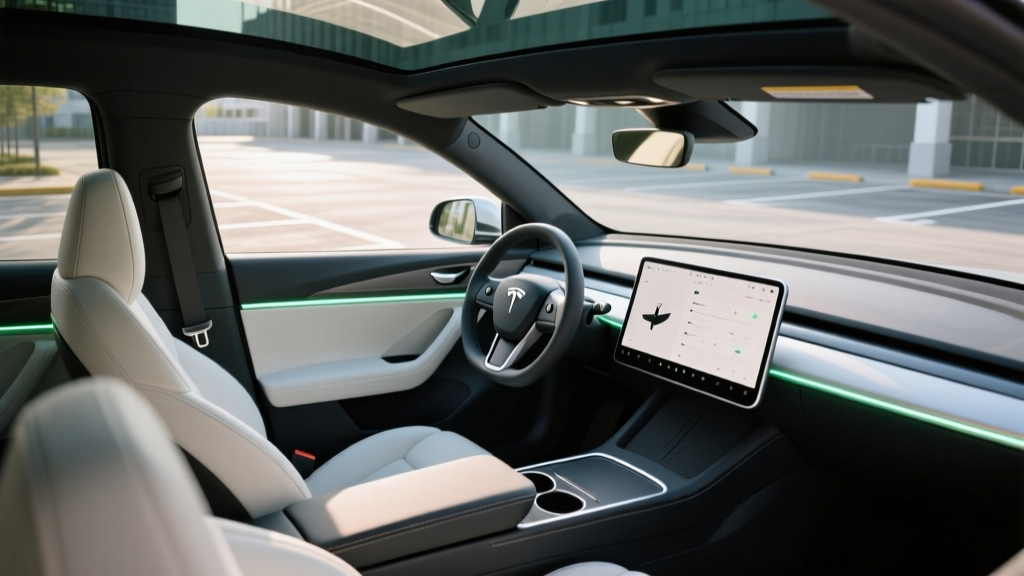
- Rear climate controls: Dedicated 8-inch touchscreen on the rear center console (replacing the previous USB-only setup) with independent temperature and fan-speed adjustment
Road noise reduction was a priority for the Juniper engineering team. Tesla added acoustic laminated glass to the rear doors (previously only on the front), plus additional sound-deadening material in the rear wheel arches. On our highway test loop at 70 mph, rear-seat SPL readings dropped roughly 2–3 dB compared to the 2024 Model Y — a perceptible improvement in conversation comfort.
The passenger-side window switch layout has been updated with backlit, capacitive-touch controls integrated into a revised door panel. The front passenger now gets a dedicated "comfort" mode in the Tesla app, allowing pre-conditioning of just the passenger zone — useful for ride-share or family use cases where the driver is already in the vehicle.
Real-World Range and Efficiency
EPA Estimated: 320 miles
Real-World Highway (70 mph, 72°F): ~275–290 miles
Real-World Highway (32°F, winter): ~230–255 miles
City/Commuter (mixed, moderate climate): ~300–315 miles
The EPA sticker is a useful baseline, but real-world range depends heavily on speed, temperature, and terrain. The Model Y Long Range AWD's 75 kWh usable NMC battery delivers its best efficiency in city driving where regenerative braking recovers energy. At sustained highway speeds above 70 mph, aerodynamic drag dominates and range drops 10–15% below the EPA figure.
Cold weather compounds this loss. In sub-freezing conditions, expect 20–30% range reduction due to battery heating demands and reduced regenerative braking effectiveness. Tesla's heat pump (standard on all 2026 trims) mitigates cabin-heating energy draw, but the battery chemistry itself is less efficient at low temperatures. Preconditioning the battery while plugged in — using the Scheduled Departure feature — recovers a significant portion of this loss and is strongly recommended for cold-climate owners.
The RWD Standard Range model, with its 60 kWh LFP (lithium iron phosphate) battery, sacrifices roughly 15 miles of EPA range but gains two practical advantages: LFP chemistry tolerates routine 100% charging without degradation concerns, and the lower vehicle weight improves efficiency in stop-and-go driving. For urban commuters who charge at home nightly, the LFP RWD is often the more pragmatic choice.
Charging Speed and Infrastructure
| Charging Level | Power / Rate | Miles Added per Hour | Notes |
|---|---|---|---|
| Level 1 (120V household) | ~1.4 kW | ~4–5 mi/hr | Emergency/top-up only |
| Level 2 (240V, 48A home) | 11.5 kW | ~44 mi/hr | Full charge overnight (~7–8 hrs) |
| DC Fast Charge (Long Range) | Peak 250 kW | ~1,000 mi/hr (peak) | 10–80% in ~24 min; tapers above 80% |
| DC Fast Charge (RWD LFP) | Peak 170 kW | ~680 mi/hr (peak) | 10–80% in ~30 min; LFP prefers 100% top-ups |
The 250 kW peak charge rate on Long Range and Performance trims is available only at V3 (and newer V4) Tesla Superchargers and requires battery preconditioning — the car automatically initiates this when you navigate to a Supercharger. Without preconditioning, peak rates may be limited to 150–180 kW depending on battery temperature.
The charge curve matters more than the peak number. The Long Range AWD sustains above 200 kW roughly from 10% to 35% State of Charge (SoC), then gradually tapers. From 50% to 80%, expect roughly 100–130 kW. This is why the 10–80% time of ~24 minutes is the meaningful metric — the last 20% (80–100%) takes nearly as long as the first 70% due to cell-protection tapering.
For home charging, a 48-amp Level 2 wall connector on a 60-amp circuit delivers 11.5 kW — enough to add roughly 350 miles overnight, which covers virtually any daily driving need. Installation costs for a dedicated 240V/60A circuit typically range from $500 to $2,000 depending on panel proximity and local permitting. Homes with older 100-amp electrical panels may need a panel upgrade ($1,500–$3,000) before adding a high-amperage EV circuit.
The Juniper Model Y ships with the NACS (North American Charging Standard) connector natively — no adapter needed at Tesla Superchargers. For non-Tesla DC fast-charging networks (Electrify America, EVgo), the NACS connector is now widely compatible as those networks have added NACS cables through 2025–2026.
Pricing, Tax Credits, and Ownership Cost
| Trim | Base MSRP | As-Tested (typical config) | §30D Credit Eligibility | Effective Price (after credit) |
|---|---|---|---|---|
| RWD Standard Range | $44,990 | $46,490 (w/ destination) | Up to $7,500* | ~$38,990 |
| Long Range AWD | $48,990 | $51,490 (w/ destination + paint) | Up to $7,500* | ~$43,990 |
| Performance AWD | $53,990 | $56,990 (w/ destination + wheels) | Up to $7,500* | ~$49,490 |
*Federal §30D tax credit eligibility depends on multiple requirements per IRS guidelines:
- Buyer income caps: Modified AGI ≤ $150,000 (single), $225,000 (head of household), $300,000 (joint)
- MSRP cap: SUVs/vans ≤ $80,000 (all Model Y trims qualify)
- Battery sourcing: Critical minerals and battery components must meet phased-in domestic-content thresholds (2026 requirements are stricter than 2024 — verify current-year compliance at purchase)
- Point-of-sale transfer: The credit can be applied at purchase to reduce the upfront price, rather than waiting for tax filing
The Model Y's battery sourcing and assembly have historically met §30D requirements, but the critical-minerals thresholds tighten annually. Always confirm eligibility with your Tesla advisor at the time of purchase and consult a tax professional for your specific situation. State and utility incentives (which stack with the federal credit) vary by jurisdiction — check AFDC's state incentive database for local programs.
On a 5-year total-cost-of-ownership basis, the Model Y Long Range AWD typically costs $0.04–$0.05 per mile to "fuel" (at $0.14/kWh national average), versus $0.12–$0.15/mile for a comparable gas SUV at $3.50/gallon. Combined with lower maintenance (no oil changes, reduced brake wear from regen), the Model Y often reaches cost parity with a gas competitor like the Toyota RAV4 within 3–4 years despite the higher purchase price.
Cargo, Practicality, and Daily Use
The Juniper refresh did not alter the Model Y's exterior dimensions significantly, so cargo volumes remain class-competitive:
- Cargo behind rear seats: 30.2 cu ft
- Cargo with rear seats folded: 72.1 cu ft
- Front trunk (frunk): 4.1 cu ft — useful for charging cables, groceries, or a small bag
- Towing capacity: 3,500 lbs (Long Range/Performance, with factory tow package)
The Juniper update introduced a redesigned rear cargo floor with a lower load-in height (about 0.4 inches lower), making it easier to slide in strollers or heavy items. The 60/40 split-folding rear seats remain, and the under-floor storage compartment is slightly deeper thanks to a more compact rear drive unit.
For families, the ISOFIX/LATCH anchors on the two outboard rear seats are now more accessible (the Juniper seat cushion has a dedicated access flap). The rear center seat has a top-tether anchor but no lower LATCH anchors — standard for the segment.
Tech, Driver Assistance, and Safety
The Juniper Model Y inherits Tesla's current-generation infotainment hardware (HW5/AI5), featuring a 15.4-inch center touchscreen with improved processing speed and a revised UI. The passenger-side experience benefits from Bluetooth audio pairing that allows rear passengers to connect personal devices independently of the driver's media.
Driver assistance remains Tesla Autopilot (standard) with Full Self-Driving (Supervised) available as a $8,000 option or $99/month subscription. It is critical to understand that both systems are SAE Level 2 driver-assist — they do not make the vehicle self-driving. The driver must maintain attention, keep hands on the wheel, and remain prepared to take over at any moment. Only Level 4 robotaxi services (Waymo, Zoox) operate without a human driver in defined areas.
Tesla Autopilot and FSD (Supervised) are SAE Level 2 systems. They assist with steering, acceleration, and braking under driver supervision. They do NOT handle all driving scenarios, may not detect all obstacles, and require continuous driver engagement. Misuse or inattention can result in serious injury. See NHTSA guidance on automated vehicle safety.
Safety ratings for the 2026 Model Y carry over the excellent performance of the prior generation. The vehicle earned a 5-Star Overall rating from NHTSA and a Top Safety Pick+ designation from IIHS. The Juniper's updated front structure and revised airbag calibration are expected to maintain or improve these scores.
Pros, Cons, and Who Should Buy
- Class-leading Supercharger network access (17,000+ US stations)
- Improved rear-seat comfort and entry ergonomics
- 250 kW DC fast charging (Long Range/Performance)
- Strong efficiency (122+ MPGe) keeps running costs low
- Over-the-air updates continuously add features
- Spacious cargo area with practical frunk
- No Apple CarPlay or Android Auto
- Rear center seat is tight for adults on long trips
- FSD (Supervised) is expensive and still requires full driver attention
- Lacks physical buttons/climate knobs — all touchscreen-controlled
- Ride quality is firm on 20-inch wheels (Performance trim)
- No spare tire — relies on tire repair kit and roadside assistance
- Families with young children: Wider rear door, better LATCH access, rear climate screen, and ample cargo for strollers and gear
- Daily commuters (20–60 mi round trip): Home charging covers daily needs; efficiency keeps costs under $60/month in electricity
- Road trippers: Supercharger network reliability and 24-min 10–80% stops make long-distance travel practical
- Tech-forward buyers: OTA updates, app integration, and the Tesla ecosystem offer a connected ownership experience unmatched by legacy automakers
- Not ideal for: Buyers who prioritize physical controls, need three-wide rear seating for adults, or prefer Apple/Android phone integration
Warranty and Long-Term Ownership
Tesla's warranty coverage for the 2026 Model Y:
- Basic Vehicle: 4 years / 50,000 miles
- Battery & Drive Unit (Long Range/Performance): 8 years / 120,000 miles (whichever comes first), with minimum 70% capacity retention
- Battery & Drive Unit (RWD Standard): 8 years / 100,000 miles, with minimum 70% capacity retention
The 70% retention threshold is the trigger for warranty replacement — if your battery drops below 70% of original capacity within the warranty period, Tesla replaces or refurbishes it at no cost. In practice, NMC batteries in Tesla vehicles have shown degradation curves that plateau around 90–92% after the first 30,000 miles, with gradual loss to roughly 85–88% by 100,000 miles based on fleet data. LFP batteries in the RWD model show even slower degradation, partly because owners can charge to 100% routinely without stress on the cells.
Frequently Asked Questions
What is the real-world range of the 2026 Model Y Juniper?
The Long Range AWD achieves an EPA-estimated 320 miles. In real-world highway driving at 70 mph and moderate temperatures, expect 275–290 miles. In freezing weather, highway range drops to approximately 230–255 miles. City commuters who rely on regenerative braking may see 300+ miles regularly.
How fast does the Juniper Model Y charge at home and on the road?
On a 48-amp Level 2 home charger (11.5 kW), the Long Range adds about 44 miles of range per hour — a full overnight charge takes 7–8 hours. At a V3/V4 Supercharger, it peaks at 250 kW and charges from 10–80% in approximately 24 minutes. The RWD model peaks at 170 kW with a 10–80% time of roughly 30 minutes.
How much does the 2026 Model Y cost after the federal tax credit?
The RWD Standard Range starts at $44,990 MSRP. If you qualify for the full $7,500 §30D credit (based on income, battery sourcing, and MSRP requirements), the effective price drops to approximately $37,490 before state incentives. The Long Range AWD starts at $48,990, dropping to roughly $41,490 with the credit. Always verify eligibility with a tax professional.
Is the Juniper Model Y worth buying vs. the Hyundai Ioniq 5 or Ford Mustang Mach-E?
The Model Y's primary advantages are the Supercharger network, cargo volume, and efficiency. The Ioniq 5 offers faster 800V charging (10–80% in ~18 min) and a more comfortable ride, but less cargo space and no frunk. The Mach-E provides a more traditional driving feel and physical controls but trails on efficiency and charging infrastructure access. If Supercharger reliability and cargo practicality are priorities, the Model Y remains the segment benchmark.
Does the 2026 Model Y qualify for the federal EV tax credit?
All 2026 Model Y trims fall under the $80,000 SUV MSRP cap for §30D eligibility. The credit (up to $7,500) further depends on your modified adjusted gross income (≤$150K single, ≤$300K joint), and the vehicle's battery meeting 2026 critical-minerals and component sourcing thresholds. Tesla's US-assembled battery packs have historically qualified, but requirements tighten annually — confirm at point of sale.
What changed on the passenger side for the Juniper refresh?
The 2026 Juniper update widened the rear door opening by ~0.6 inches, added acoustic laminated glass to rear doors, increased rear legroom to 41.6 inches, introduced ventilated rear seats (Long Range/Performance), and added an 8-inch rear climate control touchscreen. These changes collectively make the Model Y meaningfully more comfortable for rear-seat passengers than the pre-2025 model.