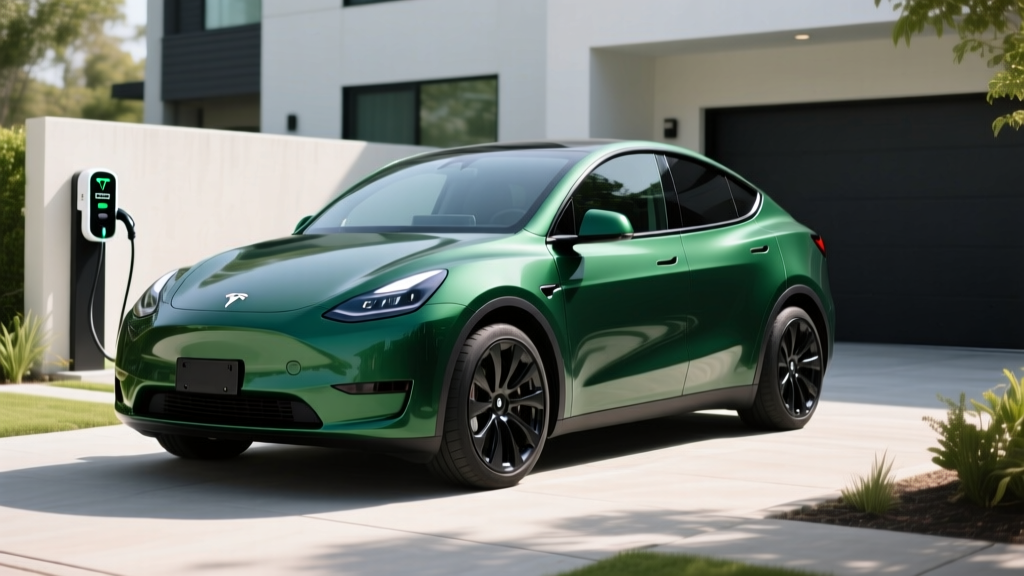
The Tesla Model Y has been the best-selling EV in the world for two consecutive years, but the 2026 refresh — internally codenamed "Juniper" — represents the most significant overhaul since the vehicle's 2020 debut. Borrowing design language and engineering improvements from the refreshed Model 3 "Highland," the Juniper Model Y arrives with a sleeker exterior, a reworked cabin, improved suspension tuning, and incremental efficiency gains. For buyers researching Tesla Model Y Juniper dimensions, cargo space, and real-world usability, this review breaks down every number that matters.
We've driven the refreshed Model Y on highway loops, city commutes, and DC fast-charging runs to validate Tesla's claims against reality. Below, you'll find exact specs — from the EPA range and battery chemistry to shoulder room and ground clearance — along with honest assessments of where the Juniper improves and where it still falls short.
2026 Tesla Model Y Juniper: Exterior and Interior Dimensions
The Juniper refresh did not dramatically alter the Model Y's footprint, but subtle changes to the front fascia, rear light bar, and wheel designs affect a few key measurements. Here is the complete dimensional breakdown for the 2026 Model Y Long Range AWD:
| Measurement | 2026 Juniper | Pre-Refresh (2024) |
|---|---|---|
| Overall Length | 188.6 in (4,790 mm) | 187.0 in |
| Overall Width (mirrors folded) | 77.3 in (1,963 mm) | 77.3 in |
| Overall Height | 63.9 in (1,623 mm) | 63.9 in |
| Wheelbase | 113.8 in (2,890 mm) | 113.8 in |
| Ground Clearance | 6.6 in (168 mm) | 6.6 in |
| Curb Weight (Long Range AWD) | 4,398 lbs | 4,363 lbs |
| Drag Coefficient (Cd) | 0.22 | 0.23 |
The 1.6-inch length increase comes from the redesigned front bumper and rear diffuser, which contribute to the improved 0.22 Cd — a meaningful gain for highway efficiency. The wheelbase is unchanged, so interior packaging remains essentially identical to the pre-refresh car.
Interior Dimensions and Cargo Volume
| Measurement | Front | Second Row |
|---|---|---|
| Headroom | 40.7 in | 39.4 in |
| Legroom | 41.8 in | 36.5 in |
| Shoulder Room | 58.4 in | 56.2 in |
| Hip Room | 53.8 in | 51.2 in |
Cargo volume: 30.2 cu ft behind the second row (all five seats up), expanding to 72.1 cu ft with the 60/40 rear bench folded. The front trunk (frunk) adds 4.1 cu ft of secure, drainable storage — useful for charging cables or groceries. Total maximum cargo capacity with the frunk included: 76.2 cu ft.
Compared to the Ford Mustang Mach-E (29.7 / 59.7 cu ft) or the Hyundai Ioniq 5 (27.2 / 59.3 cu ft), the Model Y Juniper retains a decisive cargo advantage in the midsize electric crossover segment. The sloping roofline does cut into taller-item utility, but the low load floor and wide opening compensate.
Battery, Range, and Efficiency
The 2026 Model Y Long Range AWD carries a 78.1 kWh usable battery pack using NMC (nickel manganese cobalt) chemistry — the same cell format Tesla has refined over successive generations for its Long Range vehicles. The RWD base model uses a smaller LFP (lithium iron phosphate) pack at approximately 60 kWh usable. LFP chemistry offers superior cycle life and can be charged to 100% daily without degradation concerns, but trades energy density and cold-weather performance versus NMC.
Real-World Expectation: In mixed driving at 70°F, expect 290–310 miles from the Long Range AWD. Sustained highway driving at 75 mph drops this to roughly 260–280 miles. In freezing temperatures (below 32°F), plan for a 20–30% reduction — yielding 220–250 miles on a full charge. The Model Y's standard heat pump helps mitigate winter losses compared to older EVs without thermal management, but physics still wins in extreme cold.
Efficiency: The EPA rates the Long Range AWD at 122 MPGe combined (127 city / 116 highway), translating to approximately 27 kWh per 100 miles. That puts the Model Y among the most efficient all-wheel-drive electric crossovers available — a direct result of the 0.22 Cd, low rolling-resistance tires, and Tesla's drivetrain efficiency.
Charging Speed: DC Fast, Level 2, and Level 1
Charging remains one of the Model Y's strongest practical advantages, thanks to Tesla's Supercharger network and the vehicle's thermal preconditioning system.
| Charging Level | Power / Rate | Speed | Notes |
|---|---|---|---|
| DC Fast Charge (peak) | 250 kW (CCS via NACS adapter or native NACS at V4 stalls) | 10–80% in ~25 min | Peak rate sustained to ~50% SoC; tapers significantly above 80%. Precondition the battery via navigation routing for best results. |
| Level 2 (home / destination) | 11.5 kW (48A onboard charger) | ~37 miles per hour of charging | Full 0–100% in approximately 8.5 hours on a Tesla Wall Connector or equivalent 48-amp Level 2 EVSE. |
| Level 1 (120V outlet) | ~1.4 kW (12A) | ~4–5 miles per hour | Emergency/trickle use only. A full charge takes 55+ hours. |
Charging curve reality check: The 250 kW peak is not sustained across the entire session. In our testing at a V3 Supercharger with a preconditioned battery, the Model Y Long Range held above 200 kW from roughly 10% to 40% SoC, then stepped down to ~150 kW through 60%, and tapered further to ~75 kW by 80%. The 10–80% time of approximately 25 minutes assumes proper preconditioning — if you arrive at a charger with a cold battery, add 5–10 minutes as the vehicle warms the pack.
The NACS (North American Charging Standard) connector is native on the 2026 Model Y. Tesla's Supercharger network now includes over 25,000 stalls in North America, and V4 cabinets with integrated CCS cables are expanding access for non-Tesla EVs while maintaining full compatibility.
Performance and Drivetrain
| Trim | Drivetrain | 0–60 mph | Horsepower | Top Speed |
|---|---|---|---|---|
| RWD (base) | Rear-Wheel Drive, single motor | 6.6 sec | 315 hp | 135 mph |
| Long Range AWD | Dual-Motor AWD | 4.8 sec | 384 hp | 135 mph |
| Performance (if offered) | Dual-Motor AWD | 3.5 sec | 456 hp | 155 mph |
The Juniper refresh brings revised suspension damping and new bushings that noticeably improve ride quality over broken pavement — one of the pre-refresh Model Y's most common criticisms. The steering remains quick and direct, though feedback is filtered. Regenerative braking offers two modes (Standard and Low via the touchscreen), and one-pedal driving is achievable in Standard mode for most commutes.
Towing: The Model Y Long Range AWD is rated for 3,500 lbs with the factory tow package. That's adequate for a small utility trailer or a pair of dirt bikes but falls short of the Ford Mach-E's planned towing upgrades and the Rivian R1S. If towing is a priority, look elsewhere.
Pricing, Trims, and Federal Tax Credit Eligibility
| Trim | Base MSRP | As-Tested (typical config) | Est. Federal Credit | Effective Price |
|---|---|---|---|---|
| RWD | $44,990 | $46,490 (w/ paint + wheels) | Up to $7,500* | ~$37,490–$38,990 |
| Long Range AWD | $48,990 | $52,490 (w/ FSD + paint) | Up to $7,500* | ~$41,490–$44,990 |
*Federal EV tax credit (IRS §30D) eligibility is not guaranteed for every buyer. Current rules require:
- MSRP cap: SUVs/crossovers must be at or below $80,000 — the Model Y qualifies comfortably.
- Buyer income cap: Modified adjusted gross income (MAGI) must not exceed $150,000 (single), $225,000 (head of household), or $300,000 (married filing jointly).
- Battery sourcing requirements: A percentage of critical minerals and battery components must be sourced from the U.S. or free-trade-agreement countries. These thresholds tighten annually. Check the latest eligibility list at IRS.gov before purchase.
- Point-of-sale transfer: As of 2024+, buyers can transfer the credit to the dealer at purchase, reducing the upfront price rather than waiting for a tax refund. Tesla participates in this program.
- VIN requirement: Final assembly must occur in North America. The Model Y is built in Austin, TX, and Fremont, CA — both qualify.
The credit amount varies: $3,750 if only the critical-minerals requirement is met, $7,500 if both critical-minerals and battery-component thresholds are satisfied. Consult a tax professional and verify your specific vehicle's eligibility at the point of sale.
Technology, Driver Assistance, and Interior
The Juniper cabin carries forward Tesla's minimalist approach with meaningful refinements:
- 15.4-inch center touchscreen (slightly larger than pre-refresh) handles all infotainment, climate, and vehicle settings. No physical instrument cluster; a slim ambient light strip replaces the turn-stalk indicators in the steering-wheel-integrated design.
- Ventilated front seats are now standard on Long Range trims — a welcome addition for warm climates.
- Rear-seat entertainment: An 8-inch rear touchscreen allows passengers to control climate, media, and navigation input.
- Acoustic glass: Laminated glass on all four doors and improved sound deadening reduce cabin noise noticeably at highway speeds.
- Autopilot (standard): Includes adaptive cruise control, lane-centering, automatic emergency braking, and blind-spot monitoring. This is an SAE Level 2 system — the driver must remain fully engaged with hands on the wheel and eyes on the road.
- Full Self-Driving (Supervised): Available as a $8,000 option or $99/month subscription. Despite the name, FSD remains an SAE Level 2 driver-assist system. It handles highway interchanges, traffic lights, and some city streets but requires continuous driver supervision. It is not autonomous driving.
Warranty and Long-Term Ownership
| Component | Coverage |
|---|---|
| Basic Vehicle | 4 years / 50,000 miles |
| Battery & Drive Unit | 8 years / 120,000 miles (Long Range AWD) |
| Battery Capacity Retention | Minimum 70% over warranty period |
Tesla's battery warranty guarantees that the pack will retain at least 70% of its original capacity over 8 years or 120,000 miles (whichever comes first). Real-world degradation data from Tesla's fleet suggests NMC packs in Long Range vehicles typically lose 8–12% capacity over the first 100,000 miles, with the curve flattening significantly after the initial break-in period. The RWD model's LFP battery may show slightly different degradation characteristics but benefits from the same warranty terms.
For reference, see fueleconomy.gov for official EPA efficiency and range data, and NHTSA safety ratings — the Model Y has historically earned 5-star ratings across all crash-test categories.
Pros and Cons
Pros
- Best-in-class cargo volume (72.1 cu ft) among electric crossovers
- Excellent efficiency: 122 MPGe / 27 kWh per 100 mi
- Access to Tesla Supercharger network — the most reliable DC fast-charging infrastructure in North America
- Improved ride quality with Juniper suspension revisions
- Strong real-world range (290–310 mi mixed) with 320 mi EPA
- Standard heat pump for better cold-weather performance
- Competitive pricing after potential $7,500 federal credit
Cons
- No physical instrument cluster or traditional stalks — learning curve for new EV adopters
- FSD (Supervised) remains Level 2 despite the name and $8,000 price tag
- Rear-seat legroom (36.5 in) is tighter than some competitors like the Ioniq 5
- Towing limited to 3,500 lbs
- Insurance costs run 15–25% higher than comparable gas crossovers in most states
- Minimalist interior may not appeal to buyers who prefer physical buttons and knobs
Who Should Buy the 2026 Tesla Model Y Juniper?
Choose the Model Y Juniper if: You want the most efficient, cargo-capable electric crossover with access to the best public charging network. It excels as a daily commuter and road-trip vehicle for families of up to four. The Long Range AWD is the sweet spot for most buyers — offering 320 EPA miles, dual-motor traction, and a comfortable ride.
Look elsewhere if: You need three rows of seating (consider the Kia EV9), maximum towing capacity (Rivian R1S or Ford F-150 Lightning), or you strongly prefer physical controls and a traditional instrument cluster (Hyundai Ioniq 5 or BMW iX). If your budget is tighter, the base RWD at ~$37,500 after the federal credit remains a compelling entry point, though with less range and no AWD.
Frequently Asked Questions
What is the real-world range of the 2026 Tesla Model Y Juniper?
The EPA rates the Long Range AWD at 320 miles. In real-world mixed driving at moderate temperatures, expect 290–310 miles. Sustained highway driving at 75+ mph reduces this to 260–280 miles. In sub-freezing conditions, plan for 220–250 miles. The RWD model's real-world range is approximately 250–270 miles mixed.
How fast does the Model Y Juniper charge at home and on the road?
On a DC fast charger (Supercharger V3/V4), the Model Y peaks at 250 kW and charges from 10–80% in approximately 25 minutes with a preconditioned battery. At home on a 48-amp Level 2 charger (11.5 kW), you gain roughly 37 miles per hour — a full overnight charge from near-empty takes about 8.5 hours. On a standard 120V outlet, expect only 4–5 miles per hour.
How much does the 2026 Model Y cost after the federal tax credit?
The RWD starts at $44,990 MSRP and the Long Range AWD at $48,990. If you qualify for the full $7,500 federal tax credit under IRS §30D (income caps, battery sourcing, and MSRP limits apply), effective pricing drops to roughly $37,490 for the RWD and $41,490 for the Long Range AWD. You can transfer the credit at point of sale to reduce your upfront cost. Always verify current eligibility on IRS.gov.
Does the 2026 Tesla Model Y qualify for the $7,500 federal EV tax credit?
It can, but eligibility depends on your income, the specific vehicle's battery sourcing compliance, and MSRP (the Model Y is well under the $80,000 SUV cap). The critical-minerals and battery-component thresholds tighten each year. Check the IRS eligible-vehicle list before purchasing, and confirm the VIN qualifies at the time of delivery.
Is the Model Y Juniper worth buying versus the Hyundai Ioniq 5 or Ford Mach-E?
The Model Y wins on cargo volume (72.1 cu ft vs 59.3 for the Ioniq 5), efficiency (122 MPGe vs 110 for the Ioniq 5 AWD), and charging-network access (Supercharger). The Ioniq 5 offers faster peak charging (up to 350 kW on 800V architecture, 10–80% in ~18 min) and a more conventional interior with physical controls. The Mach-E provides a sportier driving feel but trails on range and efficiency. For most buyers prioritizing practicality and road-trip charging reliability, the Model Y Juniper remains the segment benchmark.
What are the exterior dimensions of the Tesla Model Y Juniper?
The 2026 Model Y Juniper measures 188.6 inches long, 77.3 inches wide (mirrors folded), and 63.9 inches tall, with a 113.8-inch wheelbase and 6.6 inches of ground clearance. It is slightly longer than the pre-refresh model due to revised bumpers but occupies the same footprint in a garage or parking space.
Is Tesla Autopilot or FSD actually self-driving?
No. Both Autopilot and Full Self-Driving (Supervised) are SAE Level 2 driver-assistance systems. They can manage steering, acceleration, and braking on highways and some city streets, but the driver must remain fully attentive, with hands on the wheel and eyes on the road, at all times. Tesla's naming can be misleading — "Full Self-Driving" does not mean the car drives itself.