The Tesla Model Y remains the best-selling electric vehicle in the United States, and much of that success comes down to the cabin. Buyers searching for Tesla Model Y interior details want to know whether the minimalist design translates to real-world usability for families, commuters, and road-trippers. In this 2026 profile, we break down the cabin space, materials, technology, and the powertrain specs that determine how far and how fast this crossover actually goes.
2026 Tesla Model Y Interior: Dimensions, Materials, and Layout
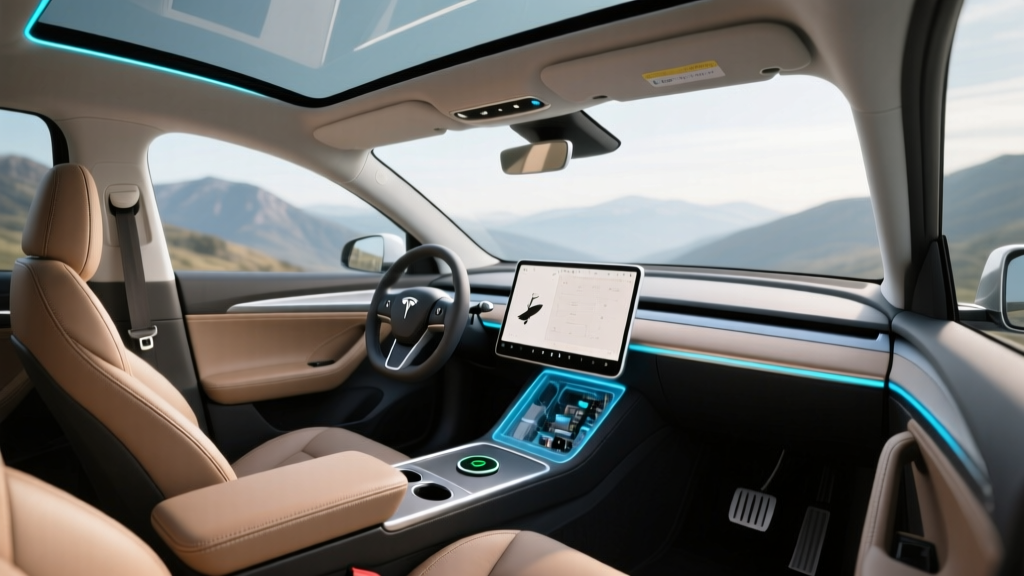
The 2026 Model Y continues with Tesla's signature minimalist cabin: a single 15.4-inch center touchscreen dominates the dashboard, with virtually no physical buttons. The refreshed "Juniper" styling introduced in 2025 carries forward, adding ambient lighting strips across the dash and doors, ventilated front seats, and a rear-seat touchscreen for climate and media control.
Material quality has improved over earlier builds. Soft-touch surfaces now cover the dash top and door uppers, though lower door panels and the center console sides remain harder plastics — a cost-saving measure that competitors like the Hyundai Ioniq 5 and Ford Mustang Mach-E have largely eliminated at similar price points.
Passenger and Cargo Dimensions
| Measurement | 2026 Model Y (Long Range AWD) |
|---|---|
| Front headroom | 41.0 in |
| Rear headroom | 38.4 in |
| Front legroom | 41.8 in |
| Rear legroom | 37.0 in |
| Cargo (rear seats up) | 30.2 cu ft |
| Cargo (rear seats folded) | 72.1 cu ft |
| Front trunk (frunk) | 4.1 cu ft |
| Seating capacity | 5 (7-seat option discontinued for 2026) |
The rear seat is where the Model Y shows its age against newer platforms. The floor is high due to the battery pack underneath, creating a knees-up seating position that taller passengers notice on longer drives. By contrast, the Hyundai Ioniq 5's dedicated E-GMP platform offers a flatter floor and more natural rear-seat ergonomics. For families with children in car seats, the Model Y's rear space works well, but adults on a 300-mile road trip will want more under-thigh support.
Range, Battery, and Efficiency: What the EPA Says vs. Reality
Real-World Expectation: Expect 260–285 miles on highway road trips at 70+ mph. In freezing temperatures (below 32°F), plan for 200–230 miles before needing a charge. City driving with regenerative braking can match or slightly exceed the EPA sticker.
The 2026 Model Y Long Range AWD uses a ~75 kWh usable battery pack with a mix of NMC (nickel manganese cobalt) cells sourced from Panasonic and LG Energy Solution, depending on production batch. The standard-range RWD variant uses a ~60 kWh LFP (lithium iron phosphate) pack from CATL. LFP chemistry sacrifices some energy density but offers longer cycle life and can be charged to 100% daily without degradation concerns — a practical advantage for commuters who can charge at home every night.
| Spec | Long Range AWD | Performance AWD | RWD (Standard Range) |
|---|---|---|---|
| EPA Range | 320 mi | 295 mi | 260 mi |
| Battery (usable) | ~75 kWh (NMC) | ~75 kWh (NMC) | ~60 kWh (LFP) |
| MPGe (combined) | 122 MPGe | 111 MPGe | 128 MPGe |
| kWh/100 mi | 28 | 30 | 26 |
| Drivetrain | Dual-motor AWD | Dual-motor AWD | Single-motor RWD |
| Horsepower | 384 hp | 456 hp | 295 hp |
| 0–60 mph | 4.8 sec | 3.5 sec | 6.6 sec |
Efficiency is where Tesla still leads the industry. At 28 kWh/100 miles (Long Range AWD), the Model Y extracts more miles per kilowatt-hour than nearly any competing crossover. The Ioniq 5 AWD consumes roughly 32 kWh/100 mi, and the Mach-E Extended Range AWD sits around 33 kWh/100 mi. This efficiency advantage means the Model Y costs less to charge per mile and needs fewer charging stops on road trips.
Charging Speed: DC Fast Charging and Home Level 2
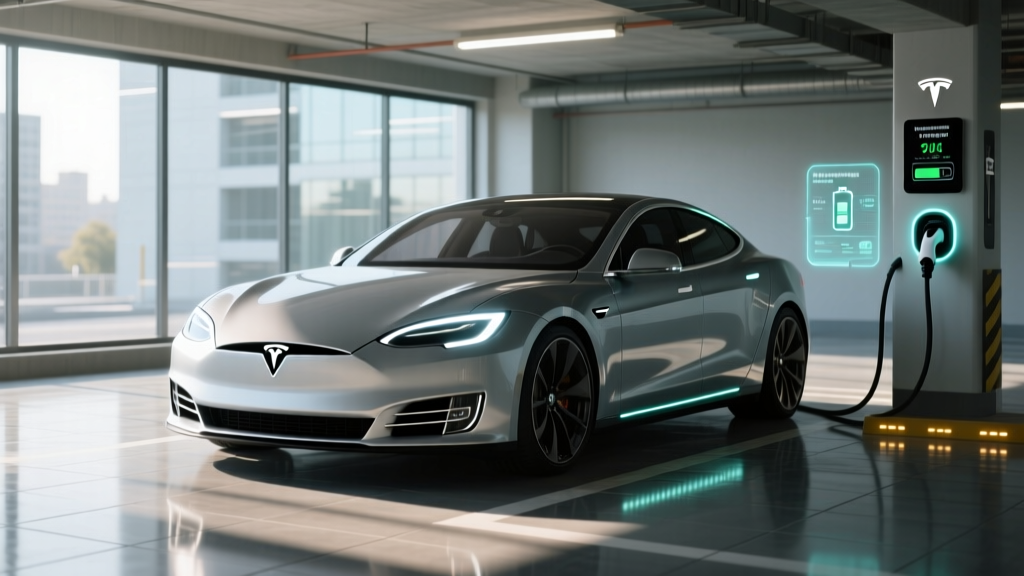
Tesla's Supercharger network remains the most reliable public charging ecosystem in North America, and the Model Y is optimized to take advantage of it. Here is what charging looks like across all three levels:
| Charging Level | Power | Speed / Time |
|---|---|---|
| Level 1 (120V household) | ~1.4 kW | ~3–4 miles per hour |
| Level 2 (240V home/public) | 11.5 kW (48A) | ~44 miles per hour; 0–100% in ~8 hours |
| DC Fast Charge (Supercharger V3/V4) | Peak 250 kW | 10–80% in ~25 minutes; adds ~160 mi in 15 min |
The 250 kW peak charge rate is competitive but no longer class-leading. The Hyundai Ioniq 5 and Kia EV6, with their 800V architectures, can peak at 350 kW and achieve a 10–80% charge in roughly 18 minutes at compatible chargers. Tesla's 400V architecture holds the 250 kW peak only briefly — typically from about 10–30% state of charge — before tapering. On a real Supercharger stop, expect an average sustained rate closer to 150–170 kW across the full 10–80% session.
For home charging, Tesla's Wall Connector ($420) delivers up to 44 miles of range per hour at 48 amps. Most owners will need a NEMA 14-50 outlet installation or a hardwired connection. Budget $800–$2,000 for a professional electrician installation, depending on panel proximity and whether your home's electrical panel needs an upgrade to 200 amps.
With the 2025 adoption of the NACS (North American Charging Standard) connector as the industry norm, the Model Y natively uses NACS — no adapter needed at Tesla Superchargers. For CCS-equipped public chargers (Electrify America, EVgo, etc.), Tesla provides a CCS adapter, and most newer third-party stations now include NACS cables.
Pricing, Trims, and Federal Tax Credit Eligibility
The 2026 Model Y lineup has been streamlined. Here is the current pricing structure before any incentives:
| Trim | Base MSRP | As-Tested (typical options) |
|---|---|---|
| Long Range AWD | $44,990 | $47,500–$50,000 |
| Performance AWD | $49,990 | $52,000–$55,000 |
| RWD (Standard Range) | $39,990 | $41,500–$44,000 |
Common add-ons include Ultra Red paint ($2,000), 20-inch wheels ($2,000), and Full Self-Driving (Supervised) capability ($8,000). Tesla frequently adjusts pricing, so check the configurator for current figures.
Federal Tax Credit: Does the Model Y Qualify?
- Credit amount: Up to $7,500, split into $3,750 for critical-minerals sourcing and $3,750 for battery-component sourcing.
- MSRP cap: SUVs/crossovers must be under $80,000 — all Model Y trims qualify.
- Buyer income cap: AGI must not exceed $150,000 (single), $225,000 (head of household), or $300,000 (joint).
- Battery sourcing: Critical minerals and battery components must meet phased-in domestic/free-trade-agreement thresholds. Tesla sources some battery materials from FTA-partner countries, but exact eligibility can shift by production batch.
- Point-of-sale transfer: Eligible buyers can transfer the credit to the dealer at purchase, reducing the out-of-pocket price immediately.
Source: IRS.gov — Clean Vehicle Credits. Confirm eligibility with your tax professional before purchasing, as sourcing rules are updated periodically.
As of early 2026, the Model Y Long Range AWD has qualified for the full $7,500 credit for most buyers, but Tesla's battery-sourcing documentation can change mid-year. Always verify current eligibility at fueleconomy.gov before finalizing a purchase.
Tech, Driver Assistance, and the Tesla Software Experience
The Model Y's interior is defined by its software. The 15.4-inch touchscreen runs Tesla's proprietary infotainment system, which includes native navigation with real-time Supercharger routing, Netflix/YouTube/theater-mode streaming (while parked), a full web browser, and over-the-air updates that regularly add features.
There is no Apple CarPlay or Android Auto — a dealbreaker for some buyers. Tesla's native navigation is excellent, but if you rely on Waze, Spotify's Car Thing, or specific phone-integrated apps, the lack of smartphone mirroring is a genuine limitation.
Autopilot and Full Self-Driving (Supervised)
Tesla Autopilot and FSD (Supervised) are Level 2 driver-assistance systems. The driver must remain fully attentive, keep hands on the wheel, and be prepared to take over at any moment. These systems do NOT make the Model Y self-driving. Only Level 4 services (e.g., Waymo in designated geofenced areas) operate without a human driver.
Standard Autopilot includes Traffic-Aware Cruise Control and Autosteer (lane-centering on highways). The optional $8,000 FSD (Supervised) package adds Navigate on Autopilot (automatic highway on/off-ramp handling), Auto Lane Change, Autopark, and Smart Summon. In our experience, FSD performs well on well-marked divided highways but still requires frequent interventions in construction zones, on poorly marked rural roads, and in complex urban intersections.
Warranty and Long-Term Ownership
| Coverage | Term |
|---|---|
| Basic vehicle warranty | 4 years / 50,000 miles |
| Battery & drive unit (Long Range/Performance) | 8 years / 120,000 miles |
| Battery & drive unit (RWD) | 8 years / 100,000 miles |
| Battery capacity retention threshold | 70% minimum over warranty period |
Tesla's battery warranty guarantees that the pack will retain at least 70% of its original capacity during the warranty period. Real-world data from high-mileage Tesla owners suggests that NMC packs in the Long Range model typically degrade 8–12% over the first 100,000 miles, with degradation slowing significantly after the initial break-in period. LFP packs in the RWD model show even less degradation, often losing only 5–8% over the same distance.
One ownership consideration: Tesla does not have a traditional dealership network. Service is handled through mobile technicians and Tesla-owned service centers. In metro areas, service access is generally good. In rural regions, wait times for service appointments and parts can stretch to weeks — a meaningful drawback compared to legacy automakers with established dealer networks.
Pros, Cons, and the Verdict
- Class-leading efficiency (28 kWh/100 mi)
- Supercharger network access — most reliable public charging in the US
- Spacious cargo area (72.1 cu ft with seats folded)
- Excellent OTA software updates and native navigation
- Strong 0–60 performance across all trims
- LFP option for daily 100% charging without degradation worry
- Rear seat comfort: high floor, limited under-thigh support
- No Apple CarPlay or Android Auto
- DC fast charging (250 kW peak) trails 800V competitors
- FSD ($8,000) is still Level 2 — not self-driving
- Hard-plastic interior trim at this price point
- Service access limited outside major metro areas
Who Should Buy the 2026 Tesla Model Y?
- You take regular road trips and want the most reliable public charging network.
- You value efficiency and want the lowest cost-per-mile among electric crossovers.
- You need flexible cargo space for family gear, bikes, or camping equipment.
- You can charge at home and want minimal charging-fuss ownership.
- Rear-seat passenger comfort is a priority (consider the Ioniq 5 or Kia EV9).
- You depend on Apple CarPlay or Android Auto for your daily drive.
- You need the fastest possible DC charging (800V rivals charge 10–80% ~7 min faster).
- You live far from a Tesla service center.
Frequently Asked Questions
What is the real-world range of the 2026 Tesla Model Y?
The EPA rates the Long Range AWD at 320 miles. In real-world highway driving at 70–80 mph, expect 260–285 miles. In cold weather below freezing, range drops to roughly 200–230 miles due to battery resistance and cabin heating demands. City driving with regenerative braking can match or exceed the EPA figure.
How fast does the Model Y charge at home and on the road?
At home on a 240V Level 2 connection (48A), the Model Y adds about 44 miles of range per hour, fully charging overnight in roughly 8 hours. On a Tesla V3/V4 Supercharger, it peaks at 250 kW and charges from 10–80% in about 25 minutes. Expect to add roughly 160 miles of range in a 15-minute stop.
Does the 2026 Model Y qualify for the $7,500 federal EV tax credit?
Most Model Y trims qualify for up to $7,500 under IRS §30D, as the MSRP is well under the $80,000 SUV cap. However, buyer income limits ($150K single / $300K joint) and battery-sourcing requirements apply. Eligibility can shift based on production batch. Verify at fueleconomy.gov and consult a tax professional before purchasing.
Is the Model Y worth buying over the Hyundai Ioniq 5 or Ford Mach-E?
The Model Y wins on efficiency, Supercharger network access, and cargo space. The Ioniq 5 wins on DC charging speed (350 kW capable), rear-seat comfort, and interior material quality. The Mach-E offers a more traditional driving feel and better service-center access. If road-trip charging reliability is your top priority, the Model Y's Supercharger advantage is difficult to match.
What are the biggest drawbacks of the Tesla Model Y interior?
The rear seat has a high floor that creates a knees-up position, reducing comfort for taller adults on long drives. The cabin uses some hard plastics at a price point where competitors offer softer materials. There is no Apple CarPlay or Android Auto, and nearly all controls are buried in the touchscreen, which some drivers find distracting.
Is Tesla's FSD actually self-driving?
No. Full Self-Driving (Supervised) is an SAE Level 2 driver-assistance system. The driver must remain fully engaged, monitor the road, and keep hands on the steering wheel at all times. It handles many highway scenarios well but requires regular interventions in construction zones, on poorly marked roads, and in complex city driving.
Sources: EPA Fuel Economy (fueleconomy.gov), IRS Clean Vehicle Credits, Tesla Model Y Specifications, NHTSA. All specifications reflect 2026 model year data as of publication. Pricing and tax credit eligibility are subject to change.