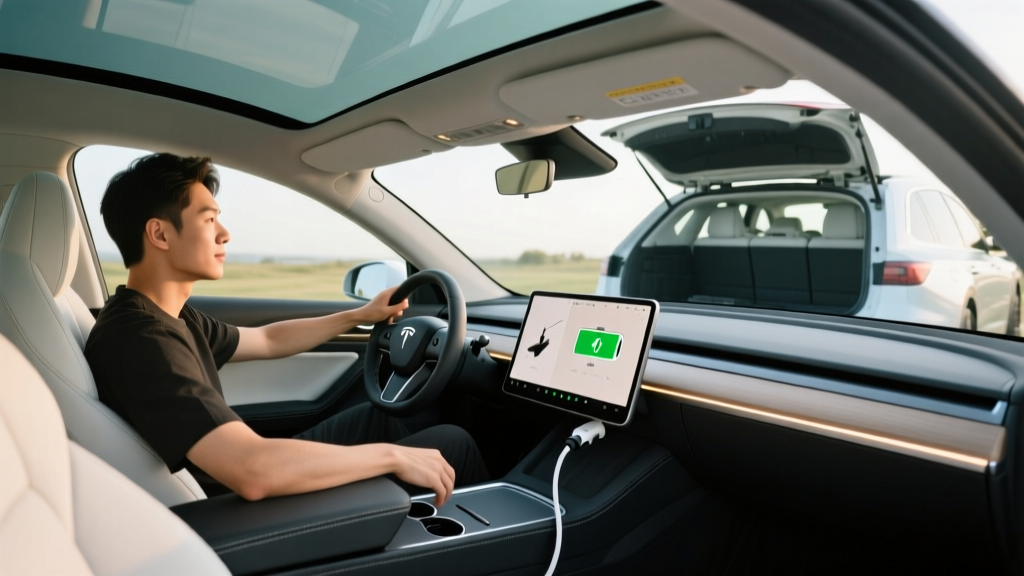
The Tesla Model Y has been the best-selling EV in America for several years running, and it's easy to see why: crossover practicality wrapped in a sedan-like footprint, access to the Supercharger network, and a starting price that undercuts many rivals. But for buyers considering this as a family hauler or daily commuter, the most pressing question isn't always about 0-60 times — it's about whether the Tesla Model Y interior space actually works for real life. Can you fit two car seats and a stroller? Is the rear seat comfortable for adults on long trips? How much cargo can you actually load?
This review breaks down the 2026 Tesla Model Y from the inside out — cabin dimensions, cargo versatility, and the full ownership picture including range, charging, pricing, and federal tax credit eligibility.
Quick Verdict: Who Is the Model Y For?
The 2026 Tesla Model Y is best suited for small-to-mid-size families, tech-forward commuters, and road-trippers who value charging-network access and over-the-air updates. Its cargo area is competitive with compact crossovers like the Hyundai Ioniq 5 and Ford Mustang Mach-E, though the sloping roofline limits tall-item stacking. Solo commuters and couples will find the space generous; families with three across the back or frequent bulky-cargo needs should test-fit their gear before committing.
Interior Dimensions & Passenger Space
Tesla's minimalist cabin philosophy means fewer buttons and more screen, but it also means the packaging is efficient. The Model Y rides on a 113.8-inch wheelbase, and Tesla has pushed the wheels to the corners to maximize cabin volume. Here's how the numbers break down:
| Measurement | Front Row | Second Row | Optional Third Row |
|---|---|---|---|
| Headroom | 41.0 in | 37.7 in | 34.6 in |
| Legroom | 41.8 in | 40.5 in | 26.5 in |
| Shoulder Room | 58.4 in | 54.0 in | 42.0 in |
| Hip Room | 53.8 in | 51.2 in | 38.7 in |
Real-world take: The front seats offer excellent space for tall drivers — the flat floor (no transmission tunnel) makes the footwell feel expansive. The second row accommodates adults comfortably on trips up to a few hours, though the seat cushion is relatively flat and thigh support is modest compared to rivals like the Kia EV9. The optional third row is strictly for small children; an adult back there would be miserable beyond a short hop.
Two rear-facing car seats fit without issue, but installing a third across the middle is tight due to the 54-inch shoulder width. The panoramic glass roof adds an airy feel but does reduce headroom slightly compared to a solid roof — worth noting if you're over 6'2".
Cargo Capacity: Frunk, Trunk, and Folded Seats
Cargo versatility is where the Model Y earns its crossover credentials. Tesla offers multiple cargo zones that add up to more total volume than the exterior footprint suggests:
- Behind second row (seats up): 30.2 cu ft
- Behind front row (second row folded): 72.1 cu ft
- Front trunk (frunk): 4.1 cu ft
- Lower sub-trunk compartment: Additional ~2.5 cu ft of hidden storage beneath the rear load floor
The liftgate opening is wide, and the load floor is relatively flat when the 60/40 split rear seats are folded. However, the sloping roofline — which gives the Model Y its coupe-like silhouette — cuts into vertical space. A large dog crate or tall box won't fit as easily as in the boxier Ford Mustang Mach-E (which offers 29.7 cu ft behind the second row but more vertical clearance). The frunk is useful for charging cables, a small gym bag, or groceries you want to keep separate from the main cabin.
Spec Table: Range, Battery, Charging & Performance
| Spec | Long Range RWD | Long Range AWD | Performance AWD |
|---|---|---|---|
| EPA Range | 320 miles | 308 miles | 285 miles |
| Battery (usable) | ~75 kWh (NMC) | ~75 kWh (NMC) | ~75 kWh (NMC) |
| MPGe (combined) | 122 MPGe | 117 MPGe | 111 MPGe |
| Efficiency | 28 kWh/100 mi | 29 kWh/100 mi | 30 kWh/100 mi |
| Drivetrain | Rear-Wheel Drive | Dual-Motor AWD | Dual-Motor AWD |
| Horsepower | 346 hp | 384 hp | 456 hp |
| 0-60 mph | 5.8 sec | 4.8 sec | 3.5 sec |
| Max DC Fast Charge | 250 kW (peak) | 250 kW (peak) | 250 kW (peak) |
| 10-80% DC Time | ~25 min | ~25 min | ~25 min |
| Level 2 Home Charging | 11.5 kW (~44 mi/hr) | 11.5 kW (~44 mi/hr) | 11.5 kW (~44 mi/hr) |
| Base MSRP | $44,990 | $47,990 | $52,490 |
Real-World Range: What the EPA Number Doesn't Tell You
EPA Estimate: 320 miles (Long Range RWD)
Real-World Highway (70-80 mph): Expect ~260-280 miles
Cold Weather (below 32°F): Expect ~220-250 miles (20-30% reduction)
Mixed City/Suburban: ~290-310 miles (closest to EPA)
The Model Y's efficiency is among the best in its class — Tesla's heat pump and thermal management system extract more miles per kWh than most competitors. On a 75°F day with mixed suburban driving at 45-55 mph, hitting or slightly exceeding the EPA number is realistic. But highway speeds and cold weather change the equation significantly.
At sustained 75-80 mph on the interstate, aerodynamic drag increases energy consumption by roughly 15-20%. Add winter temperatures, and the battery's internal resistance rises while cabin heating draws additional power. Tesla's heat pump mitigates this better than resistive heaters, but physics still wins. If your typical commute is a 40-mile round trip with highway segments, you'll rarely think about range. If you regularly drive 250+ miles in winter, plan your charging stops accordingly.
EPA fueleconomy.gov data confirms the Model Y Long Range AWD at 117 MPGe combined — competitive with the Hyundai Ioniq 5 (114 MPGe) and slightly ahead of the Ford Mustang Mach-E Extended Range (101 MPGe).
Charging Speed: DC Fast, Level 2 & Home Setup
| Charging Level | Power / Rate | Miles Added per Hour | Typical Use Case |
|---|---|---|---|
| Level 1 (120V outlet) | ~1.4 kW | ~5 mi/hr | Overnight trickle / emergency |
| Level 2 (240V, 48A Wall Connector) | 11.5 kW | ~44 mi/hr | Daily home charging |
| DC Fast Charge (Supercharger V3) | 250 kW peak | ~1,000 mi/hr (peak) | Road trips / public charging |
The Model Y charges at a peak rate of 250 kW on Tesla's V3 Superchargers, but as with all EVs, that peak is not sustained. The charging curve is aggressive at low states of charge (10-30%), then tapers progressively. From 10% to 80%, expect roughly 25 minutes at a V3 Supercharger. From 80% to 100%, add another 20-25 minutes — the taper is steep above 80% to protect the NMC battery chemistry.
At home, Tesla's Wall Connector on a 60-amp circuit delivers 11.5 kW (48 amps), adding roughly 44 miles of range per hour of charging. An overnight session (8-10 hours) easily replenishes a full day's driving. Installation typically requires a 240V/60A circuit; expect $500-$2,000 for a professional electrician install depending on panel proximity and local permit costs. If your home's electrical panel is maxed at 100 amps, a panel upgrade ($1,500-$3,000) may be necessary.
Tesla's NACS (North American Charging Standard) connector is now the industry standard adopted by Ford, GM, Rivian, and others. The Model Y natively uses NACS, giving it seamless access to Tesla's Supercharger network — currently the most reliable DC fast-charging network in the U.S. by uptime metrics.
Pricing, Trims & Federal Tax Credit Eligibility
| Trim | Base MSRP | Est. Federal Credit (§30D) | Effective Price |
|---|---|---|---|
| Long Range RWD | $44,990 | Up to $7,500* | ~$37,490* |
| Long Range AWD | $47,990 | Up to $7,500* | ~$40,490* |
| Performance AWD | $52,490 | Up to $7,500* | ~$44,990* |
*Federal tax credit eligibility depends on multiple factors under IRS §30D rules. All 2026 Model Y trims fall under the $80,000 SUV MSRP cap. However, buyers must meet income thresholds ($150,000 single / $300,000 joint modified AGI) and the vehicle must meet critical-mineral and battery-component sourcing requirements, which Tesla has historically satisfied but can change with supply-chain shifts. The credit can now be transferred at point of sale as a down-payment reduction. Always confirm current eligibility with your tax professional and Tesla at time of purchase.
Destination fees add $1,390. Popular options include FSD (Supervised) capability at $8,000 (or $99/month subscription), premium paint colors ($1,000-$2,500), and 20-inch wheels ($2,000, which reduce range by ~10 miles). A well-equipped Long Range AWD with FSD and premium paint can approach $60,000 before credit.
Technology, Driver Assistance & Notable Drawbacks
The Model Y's tech stack remains a strong selling point. The 15.4-inch center touchscreen controls virtually every vehicle function — climate, navigation, media, vehicle settings, and even the glovebox release. The interface is responsive and regularly improved via over-the-air updates. A rear 8-inch screen for second-row passengers was added in the latest refresh, offering climate controls and entertainment.
Autopilot comes standard and includes adaptive cruise control, lane-centering, and automatic emergency braking. Full Self-Driving (Supervised) adds automatic lane changes, traffic-light recognition, and city-street navigation — but this is SAE Level 2 driver assistance, not autonomous driving. The driver must remain attentive and hands on (or near) the wheel at all times. NHTSA continues to monitor Level 2 systems for safety compliance.
Notable drawbacks:
- No physical instrument cluster — all driving info is on the center screen, which some drivers find distracting
- No Apple CarPlay or Android Auto — Tesla's native infotainment only
- Rear visibility is compromised by the sloping roofline and thick C-pillars; the camera-based mirror helps but takes adjustment
- Turn-signal stalks were removed in the latest refresh; signals are now on the steering wheel, which draws consistent complaints from owners
- Ride quality on 20-inch wheels is firm over broken pavement
Warranty & Ownership Costs
Tesla's warranty coverage is standard for the premium EV segment:
- Basic Vehicle: 4 years / 50,000 miles
- Battery & Drive Unit: 8 years / 120,000 miles (Long Range) with minimum 70% capacity retention
- Roadside Assistance: 4 years / 50,000 miles
The 70% battery capacity threshold means Tesla warrants the battery will retain at least 70% of its original capacity over the warranty period. If degradation exceeds 30%, Tesla will repair or replace the battery. In practice, Tesla's NMC packs have shown strong longevity — most owners report 5-8% degradation over the first 50,000 miles, with the curve flattening significantly afterward.
Insurance costs tend to run higher than comparable gas crossovers due to repair costs and parts pricing. Expect $1,800-$2,500/year depending on your profile and state. Maintenance is minimal — no oil changes, cabin air filter replacement every 2 years, and tire rotations every 6,250 miles are the primary scheduled items.
Pros and Cons
✅ Pros
- Class-leading Supercharger network access
- Excellent efficiency (122 MPGe LR RWD)
- Generous cargo space with frunk + sub-trunk
- Strong OTA update track record
- Competitive pricing after tax credit
- Fast DC charging (250 kW peak)
❌ Cons
- No Apple CarPlay / Android Auto
- Turn signals on steering wheel are unintuitive
- Sloping roof limits tall cargo
- Firm ride on 20-inch wheels
- Third row is impractical for anyone but small children
- Insurance premiums above segment average
Frequently Asked Questions
What is the real-world range of the 2026 Tesla Model Y?
The EPA rates the Long Range RWD at 320 miles. In real-world highway driving at 70-80 mph, expect 260-280 miles. In freezing temperatures, plan for 220-250 miles. Mixed city driving at moderate speeds can approach or match the EPA figure.
How fast does the Model Y charge at home and on the road?
On a Tesla V3 Supercharger (DC fast charge), the Model Y peaks at 250 kW and charges from 10-80% in approximately 25 minutes. At home on a Level 2 Wall Connector (11.5 kW), it adds about 44 miles of range per hour, fully replenishing overnight.
Does the 2026 Tesla Model Y qualify for the $7,500 federal EV tax credit?
All Model Y trims are under the $80,000 SUV MSRP cap. Eligibility depends on your income (≤$150K single / ≤$300K joint), the vehicle's battery-component and critical-mineral sourcing compliance, and current IRS rules. The credit can be applied at point of sale. Confirm with your tax professional before purchasing.
Is the Model Y worth buying over the Hyundai Ioniq 5 or Ford Mustang Mach-E?
Choose the Model Y if Supercharger network reliability, efficiency, and cargo versatility are top priorities. The Ioniq 5 offers faster 800V charging (~18 min 10-80%), a more conventional interior with physical controls, and Apple CarPlay. The Mach-E provides a more engaging driving feel and a boxier cargo area. All three are strong — test-drive each with your specific cargo and passenger needs in mind.
How much interior space does the Tesla Model Y have for families?
The Model Y offers 41.8 inches of front legroom and 40.5 inches in the second row, with 30.2 cu ft of cargo space behind the rear seats (72.1 cu ft with seats folded). Two car seats fit easily; three across is tight. The optional third row fits only small children. For families needing regular third-row use, consider the Kia EV9 instead.