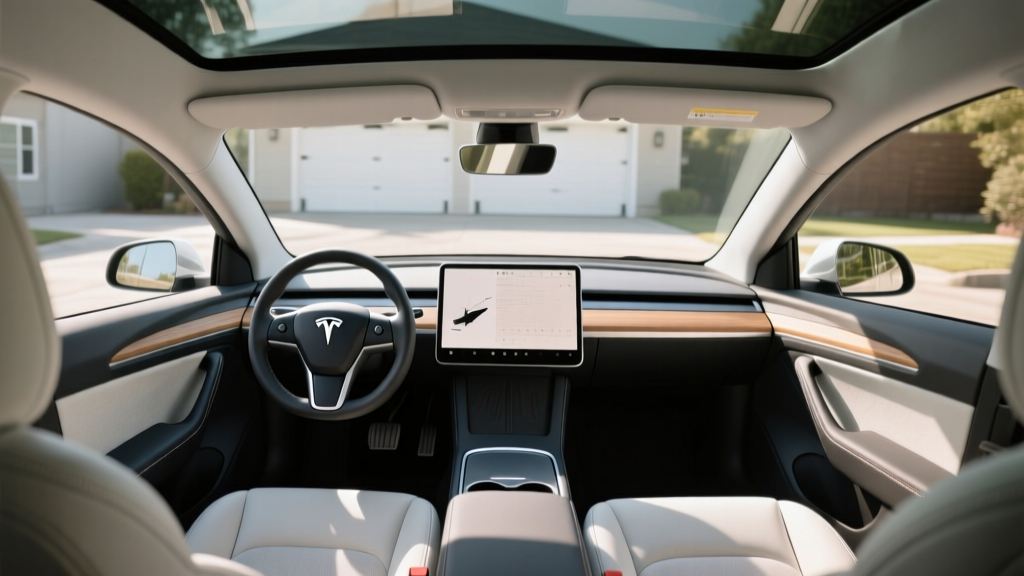
If you have ever sat behind the wheel of a Tesla, you know the conversation inevitably turns to the cabin. The interior of a Tesla — and specifically the refreshed Model Y Juniper — is a study in radical minimalism married to practical utility. There are no physical buttons, no instrument cluster, and no traditional gauge pod. Everything routes through a single 15.4-inch center touchscreen. For some buyers, that is liberating. For others, it is a dealbreaker.
After spending extended time with the 2026 Tesla Model Y Long Range AWD, we are breaking down exactly what this interior offers in terms of space, materials, technology, and daily livability — and pairing that with the hard numbers on range, charging, and pricing that every EV buyer needs.
Quick Verdict: Who the Model Y Interior Actually Serves
The 2026 Model Y's cabin is engineered for tech-forward buyers who prioritize cargo versatility, over-the-air software updates, and a clean aesthetic over traditional luxury cues. It excels as a daily commuter and family hauler with best-in-class cargo volume. It falls short for buyers who want physical climate controls, premium material richness on par with German rivals, or a dedicated driver display.
Choose the Model Y if: You want maximum cargo space in a compact electric SUV, value software-driven features, and accept the all-touchscreen interface.
Look elsewhere if: You need physical buttons for climate/audio, prefer a traditional luxury interior with leather and wood, or want a head-up display and dedicated instrument cluster.
2026 Tesla Model Y Long Range AWD: Core Specifications
| Spec | Value |
|---|---|
| EPA Estimated Range | 320 miles |
| Battery Capacity (Usable) | ~75 kWh, NMC chemistry |
| Drivetrain | Dual-Motor AWD |
| Horsepower | 384 hp (combined) |
| 0–60 mph | 4.8 seconds |
| Max DC Fast Charge Rate | 250 kW (peak) |
| 10–80% DC Fast Charge Time | ~25 minutes |
| Level 2 Home Charge Rate | 11.5 kW (~44 miles/hr) |
| EPA Efficiency | 111 MPGe combined / 30 kWh/100mi |
| Cargo Volume (rear seats up) | 30.2 cu ft |
| Cargo Volume (rear seats folded) | 72.0 cu ft |
| Rear Legroom | 41.6 inches |
| Battery Warranty | 8 years / 120,000 miles |
| Base MSRP (Long Range AWD) | $48,990 |
Real-World Range: What the EPA Sticker Does Not Tell You
EPA Estimate: 320 miles
Real-World Expectation: Plan for roughly 270–290 miles on mixed highway driving at 70–75 mph. In cold weather (below 30°F), expect a 15–25% reduction, bringing usable range to approximately 240–270 miles depending on cabin heating demand and terrain.
The 2026 Model Y Long Range AWD earns a 320-mile EPA estimate thanks to Tesla's heat pump (standard on all trims), aerodynamic refinements from the Juniper refresh, and the efficiency of its NMC battery pack. On fueleconomy.gov, the Long Range AWD posts 111 MPGe combined.
However, real-world highway efficiency drops noticeably above 70 mph. Tesla's own energy app shows consumption climbing from roughly 250 Wh/mi at 65 mph to over 300 Wh/mi at 80 mph. If your commute is primarily stop-and-go city driving, you will likely match or slightly exceed the EPA figure thanks to regenerative braking recapturing energy. On sustained interstate road trips, budget for 250–270 miles of practical range before needing a charge stop.
The Juniper refresh improved thermal management, reducing cold-weather range loss compared to the pre-2025 Model Y. The heat pump scavenges waste heat from the drivetrain, cutting cabin-heating energy draw significantly — but physics still wins in deep winter. Preconditioning the battery while plugged in (a feature accessible via the Tesla app) remains the single most effective habit for preserving range in cold climates.
Inside the Interior of a Tesla: Materials, Layout, and Livability
The Minimalist Dashboard Philosophy
The 2026 Model Y interior carries forward Tesla's signature approach: one screen, zero buttons. The 15.4-inch center touchscreen handles everything — climate control, navigation, media, vehicle settings, glovebox release, and mirror adjustment. The Juniper update moved the gear selector to a stalk on the steering column (reversing the earlier touchscreen-only swipe-to-shift experiment), which most drivers find more intuitive.
Ambient lighting along the dashboard and door panels (new for the Juniper generation) adds warmth that earlier Model Y cabins lacked. Ventilated front seats are now standard on Long Range trims, addressing a frequent complaint from prior model years. The steering wheel is a flat-bottom design with two scroll wheels and haptic-touch buttons — functional, but still divisive among owners who prefer tactile feedback.
Materials and Build Quality
Tesla uses vegan leather (synthetic polyurethane) across all Model Y trims. The material is durable, easy to clean, and avoids the weight and environmental concerns of animal hide. However, it does not have the hand-feel of the Nappa leather found in a BMW iX or Genesis GV60. Soft-touch materials cover the upper dashboard and door uppers, but lower door panels and the center console base use harder plastics that feel appropriate for the price point but not exceptional.
Panel gap consistency — historically a Tesla criticism — has improved markedly since the Shanghai and Berlin Gigafactory production ramps. The 2026 US-market Model Y (Fremont-built) shows tighter tolerances than 2022–2023 examples, though a close inspection may still reveal minor asymmetries that a Mercedes-Benz or Audi QC process would reject.
Passenger Space and Cargo Utility
The Model Y's dimensional advantage over rivals is real and measurable:
- Front headroom: 41.0 inches — generous even for tall occupants
- Rear legroom: 41.6 inches — competitive with midsize SUVs, not just compacts
- Rear headroom: 39.4 inches — adequate, though the sloping roofline limits space for passengers over 6'2"
- Cargo (seats up): 30.2 cu ft — enough for a week's groceries or two large suitcases
- Cargo (seats folded): 72.0 cu ft — approaches small minivan territory
- Front trunk (frunk): 4.1 cu ft — useful for charging cables or a small bag
The 60/40 split-folding rear seats create a nearly flat load floor, and the power liftgate is standard. For families, the Model Y fits two rear-facing child seats with room to spare for a center passenger — a genuine advantage over the Model 3 sedan.
Charging Speed: DC Fast, Level 2, and the Supercharger Advantage
| Charging Level | Power (kW) | Speed |
|---|---|---|
| Level 1 (120V household) | ~1.4 kW | ~4 miles per hour |
| Level 2 (240V home, 48A) | 11.5 kW | ~44 miles per hour |
| DC Fast Charge (peak) | 250 kW | 10–80% in ~25 minutes |
| Tesla Supercharger V4 | Up to 250 kW | Comparable to V3 for Model Y |
The Model Y Long Range AWD peaks at 250 kW on DC fast chargers — whether at a Tesla Supercharger or a third-party CCS station (using the NACS-to-CCS adapter Tesla includes, or natively at NACS-equipped non-Tesla networks that now widely support the connector).
Charging curve reality: The 250 kW peak is not sustained. Expect peak rates between 10–30% State of Charge (SoC), tapering to ~170 kW by 50% SoC, and dropping sharply above 80%. This is standard for NMC chemistry — the battery management system protects cell longevity by reducing current as the pack fills. For road-trip planning, Tesla's navigation automatically preconditions the battery when a Supercharger is set as your destination, which can shave 3–5 minutes off your stop by arriving at optimal battery temperature.
At home on a Level 2 Wall Connector (48 amps / 11.5 kW), a full 10–80% charge takes roughly 7.5 hours — easily achievable overnight. Most owners who charge nightly at home rarely visit a public charger except on road trips.
Pricing, Trims, and Federal Tax Credit Eligibility
| Trim | Base MSRP | Est. After §30D Credit |
|---|---|---|
| Long Range AWD | $48,990 | ~$41,490 (if eligible) |
| Performance AWD | $53,990 | ~$46,490 (if eligible) |
The 2026 Model Y Long Range AWD starts at $48,990 (including destination). The Performance trim, which drops 0–60 to 3.5 seconds and adds track-oriented suspension tuning, starts at $53,990. Both trims fall under the IRS §30D MSRP cap of $80,000 for SUVs.
Federal tax credit eligibility is not automatic. The §30D credit offers up to $7,500, split into two halves:
- $3,750 — Battery Components: A percentage of battery components must be manufactured or assembled in North America (threshold increases annually).
- $3,750 — Critical Minerals: A percentage of critical minerals must be sourced from the US or a free-trade-agreement partner (threshold increases annually).
- Buyer Income Caps: Modified adjusted gross income must not exceed $150,000 (single), $225,000 (head of household), or $300,000 (joint).
- Point-of-Sale Transfer: Eligible buyers can transfer the credit to the dealer at purchase, reducing the upfront price rather than waiting for a tax refund.
Tesla's battery sourcing has shifted over time, and the specific credit amount available for a given Model Y can change as supply chains evolve. Always verify current eligibility on the fueleconomy.gov tax credit page before purchasing. Tesla also lists current credit eligibility on each vehicle's configuration page.
Tech, Driver Assistance, and What the Interior Screen Actually Controls
The 15.4-inch touchscreen runs Tesla's proprietary operating system, which remains one of the most responsive and feature-rich infotainment platforms in any vehicle. Key capabilities include:
- Navigation: Real-time traffic, Supercharger routing with automatic preconditioning, and trip energy prediction
- Media: Native Spotify, Apple Music, Tidal, podcasts, and streaming video (YouTube, Netflix) while parked
- Climate: Dual-zone automatic climate with Bioweapon Defense Mode (HEPA filtration) and Dog Mode for pet safety
- Vehicle controls: Suspension settings, steering feel, regenerative braking strength, mirror adjustment, and glovebox — all via screen
- Over-the-air updates: Tesla pushes feature additions and improvements regularly, from UI refinements to new entertainment options
Autopilot and Full Self-Driving (Supervised)
SAE Automation Level: Level 2 — The driver must remain fully engaged, hands on or near the wheel, eyes on the road. This is not self-driving. Tesla's Autopilot (standard) and Full Self-Driving Supervised ($8,000 option or $99/month subscription) are driver-assistance systems that require continuous human oversight.
Standard Autopilot includes Traffic-Aware Cruise Control and Autosteer (lane centering) on divided highways. FSD Supervised adds automatic lane changes, traffic light and stop sign recognition, and navigation-guided on/off-ramp transitions. It is impressive technology, but it makes errors — particularly in construction zones, faded lane markings, and unprotected left turns. Treat it as a fatigue-reducing assistant, not a replacement for attention.
What Autopilot/FSD Does NOT Do: Navigate unmapped roads, handle all weather conditions, recognize every obstacle (including emergency vehicles in all scenarios), or absolve the driver of legal responsibility. You are the driver. NHTSA continues to monitor all Level 2 systems for safety compliance.
Pros and Cons: The Honest Assessment
Pros
- Best-in-class cargo volume (72.0 cu ft seats folded)
- Excellent efficiency — 111 MPGe combined with real-world heat pump performance
- Supercharger network access — the most reliable DC fast-charging ecosystem in North America
- Over-the-air updates continuously add features post-purchase
- Strong resale value relative to most EV competitors
- Spacious rear seat with 41.6 inches of legroom
- Standard ventilated front seats and ambient lighting (Juniper refresh)
Cons
- No physical buttons for climate, audio, or mirrors — everything is screen-dependent
- No dedicated instrument cluster or head-up display
- Lower door and console plastics feel average for a ~$49,000 vehicle
- FSD Supervised is expensive ($8,000) and remains a Level 2 system — not autonomous
- Rear visibility is compromised by the sloping roofline and thick C-pillars
- No Apple CarPlay or Android Auto — Tesla's ecosystem is closed
- Panel gaps, while improved, still trail luxury-brand competitors
How the Model Y Interior Compares to Key Rivals
The Model Y does not exist in a vacuum. Its closest competitors include the Hyundai Ioniq 5, Ford Mustang Mach-E, and Kia EV6. Here is how the interior experience compares:
- Hyundai Ioniq 5: More physical buttons, dual-screen layout with a dedicated instrument cluster, and available reclining rear seats. Cargo space is slightly less (59.3 cu ft max). The Ioniq 5 charges faster on paper (up to 350 kW on 800V architecture, 10–80% in ~18 min), but relies on CCS or NACS adapters for non-Tesla networks.
- Ford Mustang Mach-E: Traditional SUV cabin feel with a large portrait screen but physical volume/climate controls. Slightly less rear legroom. Competitive range but slower DC charging (~150 kW peak on most trims).
- Kia EV6: Shares the Ioniq 5's 800V fast-charging architecture. Interior materials feel a step above the Model Y, with more textured surfaces and a curved dual-screen display. Cargo space trails at 50.2 cu ft max.
The Model Y wins on pure cargo volume, Supercharger network reliability, and software sophistication. It loses on material richness, physical controls, and charging flexibility (Tesla's NACS connector is now the North American standard, but third-party NACS charger availability is still expanding).
Frequently Asked Questions
What is the real-world range of the 2026 Tesla Model Y?
The EPA estimates 320 miles for the Long Range AWD. In real-world highway driving at 70–75 mph, expect 270–290 miles. In cold weather below 30°F, plan for 240–270 miles depending on heating demand and whether you precondition while plugged in.
How fast does the Model Y charge at home and on the road?
On DC fast chargers, the Model Y peaks at 250 kW, achieving a 10–80% charge in approximately 25 minutes (with tapering above 80%). At home on a Level 2 Wall Connector (11.5 kW), expect roughly 44 miles of range added per hour, or a full overnight charge.
How much does the 2026 Model Y cost after federal tax credits?
The Long Range AWD starts at $48,990. If you qualify for the full $7,500 §30D credit (meeting income, battery sourcing, and MSRP requirements), the effective price drops to approximately $41,490. Eligibility depends on current-year IRS rules — verify at irs.gov before purchasing.
Does the Tesla Model Y qualify for the $7,500 federal EV tax credit?
It can, but eligibility is not guaranteed for every buyer. The §30D credit requires meeting buyer income caps ($150K single / $300K joint), battery component and critical mineral sourcing thresholds, and the vehicle must be under the $80,000 SUV MSRP cap. The Model Y meets the MSRP cap. Check fueleconomy.gov for current sourcing compliance status.
Is the Model Y worth buying over the Ioniq 5 or Mach-E?
The Model Y is the strongest choice if cargo space, Supercharger access, and software features are your priorities. Choose the Ioniq 5 if you want faster DC charging and physical buttons. Choose the Mach-E if you prefer a more traditional SUV cabin layout and Ford's dealer network for service.
What are the biggest drawbacks of the Tesla interior?
The absence of physical controls (climate, mirrors, glovebox all screen-operated), no head-up display or instrument cluster, no Apple CarPlay/Android Auto, and rear visibility limited by the sloping roofline are the most common complaints from owners and reviewers.
What is the battery warranty on the Model Y?
Tesla covers the Model Y Long Range battery and drive unit for 8 years or 120,000 miles, whichever comes first, with a minimum 70% capacity retention guarantee over that period.
Final Take: The Interior of a Tesla Works — If You Buy Into the Philosophy
The 2026 Model Y interior is not trying to be a Mercedes. It is trying to be an efficient, software-defined, cargo-hauling platform that happens to have seats. For buyers who embrace the touchscreen-centric approach, the Juniper refresh adds meaningful quality-of-life improvements — ambient lighting, ventilated seats, better sound insulation, and refined materials.
With 320 miles of EPA range, 250 kW DC fast charging, 72 cu ft of cargo space, and a starting price of $48,990 (potentially ~$41,490 after the federal credit), the Model Y Long Range AWD remains the benchmark electric compact SUV by the numbers. The question is whether those numbers — and the minimalist interior that houses them — align with how you want to interact with your car every day.