The Tesla Model Y remains one of the best-selling electric vehicles in the United States, and for 2026 it continues to anchor Tesla's lineup as the practical choice for families who want an EV without compromise. But with rising competition from the Hyundai Ioniq 5, Ford Mustang Mach-E, and Chevrolet Equinox EV, buyers are scrutinizing every detail — especially the cabin. This review covers the Model Y Tesla interior dimensions, materials, and technology alongside the hard numbers on range, charging, and ownership costs that matter when you're writing a check.
Model Y Tesla Interior: Space, Materials, and the Minimalist Cabin
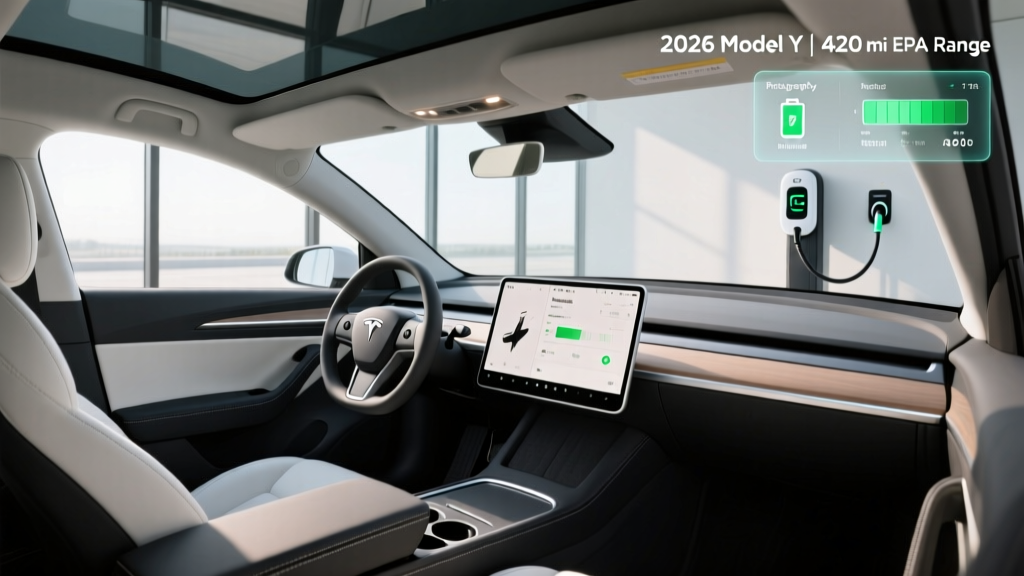
Step inside the 2026 Model Y and the design philosophy is immediately clear: Tesla has stripped away nearly every physical control in favor of a single 15.4-inch center touchscreen. There is no instrument cluster behind the steering wheel, no traditional HVAC buttons, and no start button. The car powers on when you sit down with your phone key and powers off when you leave.
For the 2026 model year, Tesla has continued to refine the cabin with ventilated front seats (a long-requested feature added during the "Juniper" refresh), ambient lighting integrated into the dashboard trim, and improved sound-deadening materials that noticeably reduce road noise compared to pre-2025 models. The synthetic leather upholstery (Tesla calls it "vegan leather") is durable and wipes clean easily, though it lacks the breathability of genuine perforated leather in summer heat — the ventilated seats help offset this.
Passenger and Cargo Dimensions
The Model Y is classified as a compact crossover SUV, and its interior volume reflects that positioning while punching above its weight in cargo space:
- Front headroom: 41.0 inches
- Front legroom: 41.8 inches
- Rear headroom: 39.4 inches
- Rear legroom: 38.4 inches
- Cargo volume (rear seats up): 30.2 cu ft
- Cargo volume (rear seats folded): 72.1 cu ft
- Front trunk (frunk): 4.1 cu ft
Those rear-seat dimensions comfortably fit two adults on long trips, though the middle seat is best reserved for a child or short journeys — the floor-mounted battery raises the floor height, which creates a knees-up seating position for the center passenger. The 60/40 split-folding rear seats lay nearly flat, and the powered liftgate opens to a wide, square load area that swallows a full set of golf clubs or a week's worth of family luggage without issue.
The 4.1-cubic-foot frunk is useful for storing charging cables, a small soft cooler, or a laptop bag, but it's not deep enough for a full grocery run. Compared to the Ford Mustang Mach-E's 4.7-cu-ft frunk or the Hyundai Ioniq 5's 2.0-cu-ft frunk, the Model Y sits in a reasonable middle ground.
Infotainment and Technology
The 15.4-inch touchscreen runs Tesla's proprietary software, which remains one of the most responsive and visually clean systems in any vehicle at any price point. Navigation, media, climate controls, vehicle settings, and even the glovebox release are all accessed through the screen. The 2026 Model Y includes:
- Native navigation with real-time Supercharger routing and battery preconditioning
- Netflix, YouTube, and Disney+ streaming while parked
- Arcade-quality gaming (Cyberpunk 2077, Stardew Valley) via the built-in AMD Ryzen processor
- Bluetooth and USB-C connectivity (no Apple CarPlay or Android Auto)
- Over-the-air software updates that regularly add features
- Dashcam and Sentry Mode recording using the vehicle's external cameras
The absence of Apple CarPlay and Android Auto remains a dealbreaker for some buyers. Tesla's position is that its native system is superior, and for navigation and media it generally is — but if your digital life is deeply embedded in Apple or Google ecosystems, the lack of phone projection is a genuine friction point you should test-drive before purchasing.
| Specification | Long Range AWD | Performance |
|---|---|---|
| EPA Range | 320 miles | 293 miles |
| Battery (usable) | ~75 kWh (NMC) | ~75 kWh (NMC) |
| Drivetrain | Dual-Motor AWD | Dual-Motor AWD |
| Horsepower | 384 hp | 456 hp |
| 0–60 mph | 4.8 seconds | 3.5 seconds |
| Top Speed | 125 mph | 155 mph |
| Peak DC Charge Rate | 250 kW | 250 kW |
| 10–80% DC Charge Time | ~25 minutes | ~25 minutes |
| Level 2 Charge Rate | 11.5 kW (~37 mi/hr) | 11.5 kW (~37 mi/hr) |
| MPGe (combined) | 122 MPGe | 111 MPGe |
| Efficiency | 28 kWh/100 mi | 30 kWh/100 mi |
| Base MSRP | $44,990 | $51,490 |
Range and Efficiency: EPA vs. Real-World Expectations
EPA Estimated Range: 320 miles (Long Range AWD) / 293 miles (Performance)
Real-World Expectation: Plan for approximately 270–290 miles in mixed highway/city driving at moderate temperatures. Sustained highway driving at 75+ mph reduces range to roughly 250–270 miles. In cold weather (below 30°F), expect a 15–25% reduction, bringing usable range down to approximately 220–250 miles depending on conditions and whether you precondition the battery.
The Model Y's efficiency is among the best in the compact electric SUV segment. At 28 kWh per 100 miles (Long Range), it extracts more distance from each kilowatt-hour than the Ford Mustang Mach-E Extended Range (31 kWh/100 mi) and roughly matches the Hyundai Ioniq 5 AWD (29 kWh/100 mi). This efficiency advantage compounds on road trips: fewer stops, shorter charging sessions, lower electricity costs.
Tesla's heat pump (standard on all trims) is a significant factor in cold-weather efficiency. Unlike resistive cabin heaters that can draw 3–5 kW continuously, the heat pump moves thermal energy more efficiently, typically consuming 1–2 kW for cabin heating in moderate cold. This translates directly to preserved range in winter — a meaningful advantage for buyers in northern climates.
According to fueleconomy.gov, the 2026 Model Y Long Range AWD achieves 127 MPGe city, 117 MPGe highway, and 122 MPGe combined. These figures place it near the top of its class for energy efficiency.
Charging Speed: DC Fast Charging and Home Level 2
Charging infrastructure access is one of the Model Y's strongest competitive advantages. Tesla's Supercharger network — now exceeding 6,000 stations and 65,000+ stalls in North America — remains the most reliable and widely distributed DC fast-charging network available to any EV owner.
| Charging Level | Power | Speed / Time | Connector |
|---|---|---|---|
| Level 1 (120V outlet) | ~1.4 kW | ~4–5 miles per hour | NACS (J3400) |
| Level 2 (240V home) | 11.5 kW (48A) | ~37 miles per hour | NACS (J3400) |
| DC Fast Charge | Peak 250 kW | 10–80% in ~25 min | NACS (J3400) |
| DC Fast (CCS adapter) | Up to 150 kW* | 10–80% in ~35 min | CCS1 via adapter |
*CCS adapter charging speed varies by station capability and adapter version. Tesla's Magic Dock adapter at some Superchargers enables CCS vehicles to charge; the reverse (Model Y at CCS stations) depends on the third-party adapter used.
At a V3 or V4 Tesla Supercharger, the Model Y peaks at 250 kW but does not sustain that rate for the entire session. The charging curve is aggressive in the 10–40% state-of-charge (SoC) window, then tapers progressively. Expect roughly 170 miles of range added in the first 15 minutes, with the session from 10–80% completing in approximately 25 minutes under ideal conditions (battery preconditioned via navigation routing to the charger).
For home charging, the Model Y's onboard charger accepts up to 11.5 kW on a 240V Level 2 circuit (48 amps, requiring a 60-amp breaker). This adds approximately 37 miles of range per hour of charging, meaning a full overnight charge from 20% to 100% takes roughly 7–8 hours. A standard Tesla Wall Connector costs approximately $425, with professional installation typically running $500–$2,000 depending on your electrical panel's capacity and the distance from the panel to your parking spot.
Performance and Driving Dynamics
The 2026 Model Y Long Range AWD produces 384 horsepower from its dual-motor setup and reaches 60 mph in 4.8 seconds — quick by any measure and decisively faster than most gas-powered compact SUVs. The Performance trim bumps output to 456 hp and drops the 0–60 time to 3.5 seconds, which enters sports-car territory.
Acceleration is instant and linear, as is characteristic of electric motors. There's no transmission lag, no turbo spool, no gear hunting on inclines. The all-wheel-drive system can independently torque-vector between front and rear axles, providing confident traction in rain and light snow. Ground clearance is 6.6 inches — adequate for snow and gravel roads but not intended for serious off-road use.
The ride quality has improved substantially with the Juniper refresh. Earlier Model Y vehicles were criticized for a firm, sometimes harsh ride over broken pavement. The 2026 model uses revised damper tuning and improved bushings that absorb sharp impacts more gracefully, though it still leans toward sporty-firm rather than plush. If ride comfort is your top priority, the Hyundai Ioniq 5 or Kia EV6 offer a more compliant feel over rough surfaces.
Pricing, Trims, and Federal Tax Credit Eligibility
The 2026 Model Y is offered in two primary trims:
- Long Range AWD: $44,990 MSRP (before destination and incentives)
- Performance AWD: $51,490 MSRP (before destination and incentives)
A rear-wheel-drive (RWD) base variant with the smaller LFP battery has been available in previous years at a lower price point (~$39,990), but availability fluctuates by market and production cycle. Check Tesla's configurator for current offerings.
| Trim | MSRP | §30D Credit (if eligible) | Effective Price |
|---|---|---|---|
| Long Range AWD | $44,990 | Up to $7,500* | ~$37,490* |
| Performance AWD | $51,490 | Up to $7,500* | ~$43,990* |
*Federal §30D tax credit eligibility depends on buyer income limits (AGI ≤ $150K single / $300K joint), vehicle MSRP caps ($80,000 for SUVs — both trims qualify), and battery component/critical mineral sourcing requirements that are subject to change. The credit can be applied as a point-of-sale price reduction through a registered dealer. Always verify current eligibility at IRS.gov before purchasing.
Tesla's direct-to-consumer sales model means there are no dealer markups or negotiation — the price on Tesla.com is the price you pay, plus destination fee and applicable taxes. This transparency is a significant advantage in a market where some EV buyers still encounter dealer add-ons above MSRP.
Warranty Coverage
- Basic Vehicle: 4 years / 50,000 miles
- Battery & Drive Unit: 8 years / 120,000 miles (Long Range & Performance), with minimum 70% capacity retention guaranteed
Tesla's battery warranty is competitive with the segment. The 70% retention threshold means that if your battery degrades below 70% of its original capacity within 8 years or 120,000 miles, Tesla will repair or replace it at no cost. In practice, Tesla's NMC batteries in the Model Y have shown degradation curves that level off around 8–12% loss after the first 50,000 miles, based on aggregated fleet data — well within the warranty threshold for typical ownership.
Autopilot, FSD, and Driver Assistance
SAE Automation Level: Level 2
Tesla's Autopilot and Full Self-Driving (Supervised) are Level 2 driver-assistance systems. The driver must remain fully attentive, keep hands on the steering wheel, and be prepared to take over at any moment. These systems are not self-driving and do not replace an engaged human driver.
The 2026 Model Y comes standard with Basic Autopilot, which includes adaptive cruise control and lane-centering on marked highways. Enhanced Autopilot ($6,000) adds auto lane-change, Navigate on Autopilot (automatic highway on/off-ramp handling), AutoPark, and Summon. Full Self-Driving (Supervised) ($8,000 or $99/month subscription) adds traffic light and stop sign recognition, and city-street autosteer capability.
FSD (Supervised) has improved considerably through Tesla's end-to-end neural network approach, but it still requires constant supervision. It handles most suburban and highway scenarios competently, but can make unexpected decisions at complex intersections, construction zones, or in heavy rain. The Insurance Institute for Highway Safety (IIHS) has noted that partial-automation systems across all brands, including Tesla's, still rely on the driver as the primary safety system.
What Autopilot and FSD Do NOT Do:
- Drive without human supervision — you are the driver at all times
- Handle all weather conditions — heavy rain, fog, and snow degrade camera performance
- Navigate unmapped construction zones or temporary lane shifts reliably
- Replace your attention — looking away from the road is dangerous and can result in warnings or system disengagement
Pros, Cons, and Who Should Buy the Model Y
Pros
- Class-leading Supercharger network access (65,000+ stalls, highest uptime in the industry)
- Excellent efficiency (28 kWh/100 mi) stretches range and lowers charging costs
- Spacious cargo area (72.1 cu ft seats-down) rivals midsize SUVs
- Strong performance even in the base Long Range trim (4.8s 0–60)
- Continuous OTA updates add features post-purchase
- No dealer markup — transparent direct pricing
Cons
- No Apple CarPlay or Android Auto — phone projection absent
- Minimalist interior forces all controls through the touchscreen (climate, mirrors, glovebox)
- Rear middle seat is cramped for adults due to raised floor
- FSD ($8,000) remains a Level 2 system despite the "Full Self-Driving" name
- Insurance premiums run 15–30% higher than comparable gas SUVs in many markets
- Paint quality and panel gaps, while improved, still draw owner complaints
Choose the Tesla Model Y if:
- You take regular road trips and want the most reliable DC fast-charging network
- You value acceleration, efficiency, and cargo space in a compact SUV footprint
- You're comfortable with a touchscreen-centric interface and no phone projection
- You want OTA updates that genuinely add new features over time
Consider a competitor (Ioniq 5, Mach-E, EV6) if:
- You need Apple CarPlay or Android Auto as a daily interface
- You prefer physical buttons for climate and volume
- Ride comfort on rough roads is your top priority
- You want an 800V architecture for faster peak charging (Ioniq 5/EV6: up to 350 kW)
Frequently Asked Questions
What is the real-world range of the 2026 Tesla Model Y?
The EPA rates the Long Range AWD at 320 miles. In real-world mixed driving, expect 270–290 miles. Sustained highway speeds above 75 mph reduce this to roughly 250–270 miles, and cold weather below 30°F can drop range to 220–250 miles. Preconditioning the battery and cabin while plugged in helps preserve range in cold conditions.
How fast does the Model Y charge at home and on the road?
At home on a 240V Level 2 charger (48A), the Model Y adds approximately 37 miles of range per hour — a full overnight session covers any daily driving. On a Tesla V3/V4 Supercharger, it peaks at 250 kW and charges from 10–80% in approximately 25 minutes when the battery is preconditioned.
Does the 2026 Tesla Model Y qualify for the federal EV tax credit?
Both the Long Range ($44,990) and Performance ($51,490) trims fall well under the $80,000 MSRP cap for SUVs. Eligibility for the full $7,500 credit depends on your adjusted gross income (≤$150K single, ≤$300K joint) and the battery's critical-mineral and component sourcing compliance for the current tax year. The credit can be transferred to Tesla at point of sale as a direct price reduction. Verify current rules at IRS.gov.
Is the Model Y worth buying over the Hyundai Ioniq 5 or Ford Mach-E?
The Model Y wins on charging network access, cargo volume, and efficiency. The Ioniq 5 offers faster peak charging (350 kW on 800V architecture), a more comfortable ride, and physical climate controls. The Mach-E provides a more traditional SUV interior layout with a driver display and available CarPlay. Test-drive all three — the "best" EV is the one whose interface and driving feel match your daily habits.
How long will the Model Y battery last?
Tesla warrants the battery for 8 years or 120,000 miles with a minimum 70% capacity retention. Fleet data suggests the NMC batteries in the Long Range and Performance models degrade approximately 8–12% in the first 50,000 miles, then the curve flattens significantly. Many high-mileage Tesla owners report 85–90% capacity retention at 100,000 miles. Battery replacement outside of warranty currently costs approximately $12,000–$16,000 depending on the pack.
Is Tesla's Full Self-Driving worth the $8,000 cost?
For most buyers, no. FSD (Supervised) is a Level 2 driver-assist system that requires your full attention at all times. The standard Autopilot (included) handles highway cruising well, and the $99/month subscription option lets you try FSD without committing $8,000 upfront. Unless you have a specific use case that benefits from city-street autosteer and are comfortable supervising the system closely, the subscription is the more financially rational choice.