Quick Verdict: The Best-Selling EV Gets a Roomier Refresh
The Tesla Model Y remains the benchmark compact electric crossover for 2026, now riding on the refreshed "Juniper" architecture that debuted in early 2025. While the exterior styling borrows heavily from the Cybertruck and refreshed Model 3, the real story for buyers is inside: improved materials, a ventilated-seat option, ambient lighting, and slightly revised packaging that nudges Tesla Model Y interior dimensions in a more family-friendly direction. Combined with class-leading efficiency, access to the Supercharger network, and a starting price that undercuts several rivals, the 2026 Model Y continues to be the default recommendation for EV-curious families — though competitors like the Hyundai Ioniq 5 and Ford Mustang Mach-E are closer than ever.
Real-World Range Reality Check
EPA Estimated Range: 320 miles (Long Range AWD) | 290 miles (RWD)
What to expect on the road: In mixed highway driving at 70 mph, plan for roughly 270–290 miles from the Long Range AWD before you'll want to stop. In freezing temperatures (below 30°F), range can drop 20–30%, meaning a 320-mile sticker may yield 220–250 miles of usable distance. City driving with regenerative braking recovers energy and often exceeds the EPA combined figure. The Model Y's heat pump (standard on all 2026 trims) helps mitigate cold-weather cabin-heating losses compared to older resistance-heater EVs.
Tesla Model Y Interior Dimensions: What Fits and What Doesn't
Shoppers searching for Tesla Model Y interior dimensions are usually trying to answer two questions: will my family fit, and will our gear fit? Here's the full breakdown for the 2026 model year:
| Measurement | Front Row | Second Row | Third Row (Optional) |
|---|---|---|---|
| Headroom | 41.0 in | 39.4 in | 36.5 in (est.) |
| Legroom | 41.8 in | 38.4 in | 26.5 in (est.) |
| Shoulder Room | 58.4 in | 56.4 in | N/A |
| Hip Room | 53.8 in | 51.2 in | N/A |
Cargo Volume: 30.2 cubic feet behind the second row (up from 26.6 cu ft pre-refresh), expanding to approximately 72 cu ft with the rear seats folded. The optional third-row seat reduces behind-third-row cargo to roughly 12 cu ft — usable for groceries but not luggage. The front trunk (frunk) adds about 4.1 cu ft of secure, weatherproof storage ideal for charging cables or a small bag.
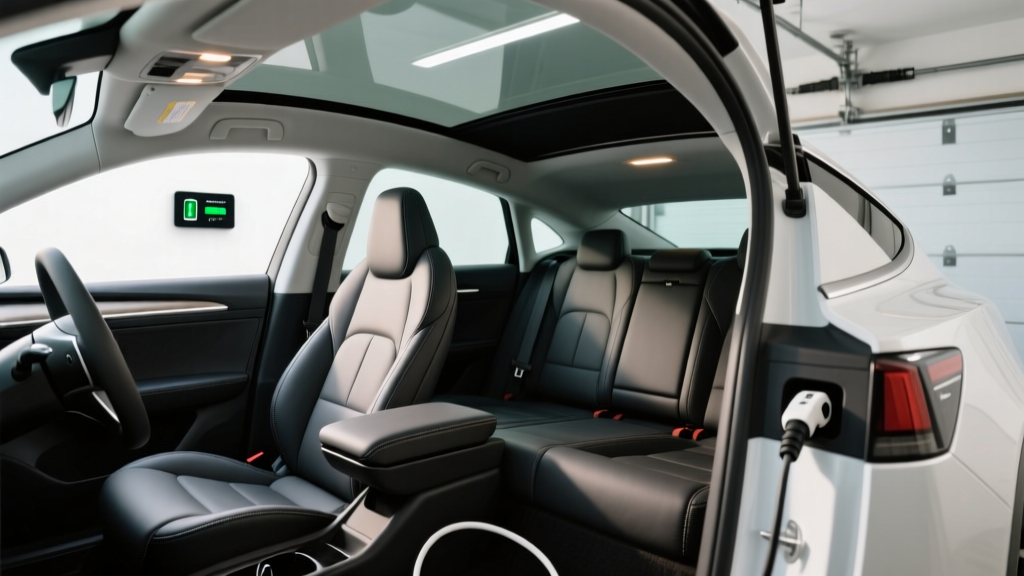
Real-world fitment notes: Two rear-facing child seats fit in the second row with adequate front-passenger legroom remaining. The 38.4 inches of rear legroom is competitive with the Ioniq 5 (39.4 in) but tighter than the Mach-E (38.9 in). For taller passengers over 6'2", the sloping roofline reduces effective rear headroom — a known Model Y trade-off versus boxier crossovers. The Juniper refresh slightly reshaped the rear seat cushion angle and added a small rear-seat touchscreen for HVAC and media controls, improving long-trip comfort for second-row occupants.
Spec Table: Range, Battery, Charging & Performance at a Glance
| Spec | Long Range AWD | RWD (Standard) | Performance (if avail.) |
|---|---|---|---|
| EPA Range | 320 mi | 290 mi | 295 mi (est.) |
| Battery (usable) | ~75 kWh (NMC) | ~60 kWh (LFP) | ~75 kWh (NMC) |
| Drivetrain | Dual-Motor AWD | Single-Motor RWD | Dual-Motor AWD |
| Horsepower | 384 hp | 295 hp | ~450 hp (est.) |
| 0–60 mph | 4.8 sec | 6.6 sec | 3.5 sec (est.) |
| Max DC Fast Charge | 250 kW | 170 kW | 250 kW |
| 10–80% DCFC Time | ~25 min | ~30 min | ~25 min |
| Level 2 Home Charge | 11.5 kW (~44 mi/hr) | 11.5 kW (~44 mi/hr) | 11.5 kW (~44 mi/hr) |
| MPGe (combined) | 111 MPGe | 119 MPGe | 104 MPGe (est.) |
| Efficiency | 28 kWh/100 mi | 26 kWh/100 mi | 30 kWh/100 mi (est.) |
| Towing Capacity | 3,500 lbs | 2,300 lbs | 3,500 lbs |
| Base MSRP | $48,990 | $44,990 | $53,990 (est.) |
Battery chemistry explained: The RWD trim uses a lithium iron phosphate (LFP) battery — heavier and slightly lower in energy density than NMC, but more durable over thousands of cycles, less prone to thermal runaway, and tolerant of daily 100% charging. Tesla recommends charging LFP packs to 100% at least once a week for accurate state-of-charge calibration. The Long Range and Performance trims use nickel manganese cobalt (NMC) chemistry for higher energy density and better cold-weather performance; daily charging to 80% is recommended to preserve longevity. (Tesla Battery Guide)
Charging Speed: Home, DC Fast, and the Supercharger Advantage
| Charging Level | Power | Miles Added per Hour | Typical Use Case |
|---|---|---|---|
| Level 1 (120V outlet) | ~1.4 kW | ~4–5 mi/hr | Overnight trickle, emergencies |
| Level 2 (240V home) | 11.5 kW | ~44 mi/hr | Daily home charging, full overnight refill |
| DC Fast (Supercharger V3/V4) | Up to 250 kW | ~200 mi in 15 min (peak) | Road trips, quick top-ups |
Charging-curve reality: The 250 kW peak on Long Range/Performance trims is not sustained across the full session. Peak draw holds from roughly 10–30% state of charge, then tapers progressively. A 10–80% session takes approximately 25 minutes at a V3 Supercharger (250 kW capable). Above 80%, charging slows dramatically to protect battery health — expect 80–100% to take an additional 20+ minutes. For road trips, plan stops around the 10–80% window for maximum efficiency.
Home charging setup: Tesla includes a Mobile Connector (Gen 2) with a NEMA 14-50 adapter. For full 11.5 kW / 48A charging, Tesla recommends the Wall Connector hardwired to a 60A circuit. Installation costs typically range from $500–$2,000 depending on panel proximity and local permit requirements. The 2026 Model Y ships with the NACS (North American Charging Standard) connector natively — no adapter needed for Superchargers. CCS adapters are available for third-party networks like Electrify America, though Tesla's native network remains the most reliable in the U.S.
Pricing, Trims & Federal Tax Credit Eligibility
| Trim | Base MSRP | Est. Federal Credit (§30D) | Effective Price |
|---|---|---|---|
| RWD (Standard) | $44,990 | Up to $7,500* | ~$37,490* |
| Long Range AWD | $48,990 | Up to $7,500* | ~$41,490* |
| Performance | $53,990 (est.) | Up to $7,500* | ~$46,490* |
Federal tax credit rules (IRS §30D) — critical caveats: The full $7,500 credit is not guaranteed for every buyer. Eligibility depends on:
- Buyer income caps: Modified AGI must not exceed $150,000 (single), $225,000 (head of household), or $300,000 (joint filers).
- MSRP cap: The vehicle's base MSRP plus dealer-installed options must not exceed $80,000 for SUVs/crossovers (the Model Y qualifies).
- Battery sourcing requirements: A percentage of critical minerals and battery components must be sourced from the U.S. or free-trade-agreement partners. These thresholds increase annually. Tesla has historically met these requirements for U.S.-built Model Y vehicles, but specific battery batches may vary. Always verify the VIN-specific eligibility at fueleconomy.gov before purchase.
- Point-of-sale transfer: As of 2024, buyers can transfer the credit to the dealer at purchase, reducing the out-of-pocket price immediately rather than waiting for a tax refund. (IRS Clean Vehicle Credits)
*Effective price assumes full $7,500 credit eligibility. Consult a tax professional for your specific situation. State and local incentives (e.g., California CVRP, Colorado state credit) may stack on top.
Technology, Driver Assistance & Standout Features
The 2026 Model Y's tech stack is dominated by its 15.4-inch center touchscreen running Tesla's proprietary infotainment OS. Notable features include:
- Autopilot (standard): Adaptive cruise control, lane-centering, automatic emergency braking, blind-spot monitoring. This is an SAE Level 2 driver-assist system — the driver must remain engaged with hands on the wheel and eyes on the road at all times.
- Full Self-Driving (Supervised) — $8,000 option or $99/mo subscription: Adds automatic lane changes, Navigate on Autopilot, traffic-light/stop-sign recognition, and Autopark. Despite the name, FSD Supervised is still SAE Level 2 — not autonomous. The driver bears full legal responsibility. (NHTSA Automated Vehicle Safety)
- Rear-seat touchscreen (Juniper refresh): An 8-inch rear display for climate, media, and navigation input — a welcome addition for families.
- Ventilated front seats: New for the Juniper generation; a significant comfort upgrade in warm climates.
- Ambient lighting & acoustic glass: Reduced cabin noise versus pre-2025 models, with customizable interior LED strips.
- Over-the-air updates: Tesla continues to push feature additions, UI refinements, and efficiency tweaks post-purchase.
- Sentry Mode & Dashcam: Always-on surround-camera recording when parked or driving, with cloud and USB storage options.
⚠️ What Autopilot & FSD Do NOT Do
Neither Autopilot nor FSD Supervised makes the Model Y a self-driving car. Both are SAE Level 2 systems requiring continuous driver supervision. They do not reliably handle construction zones, unmapped roads, severe weather, or complex urban scenarios. You are the driver. Hands-on-wheel detection and camera-based attention monitoring are active. Misuse can result in Autopilot suspensions and legal liability.
Warranty, Ownership Costs & Longevity
Basic Vehicle Warranty: 4 years / 50,000 miles (whichever comes first)
Battery & Drive Unit Warranty:
- Long Range / Performance (NMC): 8 years / 120,000 miles, with minimum 70% capacity retention
- RWD (LFP): 8 years / 100,000 miles, with minimum 70% capacity retention
Real-world degradation data: Tesla's fleet data and third-party tracking (e.g., Recurrent Auto) show Model Y NMC batteries typically lose 5–8% capacity over the first 50,000 miles, then degradation flattens. LFP packs may show slightly more variance in early calibration but tend to age well over high cycle counts. At 100,000 miles, most Model Y packs retain 88–93% of original capacity — well within warranty thresholds.
Insurance: Model Y insurance premiums remain above the segment average due to repair costs (aluminum/mixed-material body, integrated sensor suite). Expect $1,800–$2,800/year depending on location, driving record, and coverage level — roughly 15–25% higher than a comparably priced ICE crossover.
Maintenance: Minimal. No oil changes, no transmission fluid. Cabin air filter replacement every 2–3 years, tire rotation every 6,250 miles, brake fluid check every 2 years. Regenerative braking significantly extends pad life — many owners report original brake pads at 80,000+ miles.
Pros & Cons: The Honest Take
✅ Pros
- Class-leading efficiency (26–28 kWh/100 mi) means lower charging costs per mile
- Supercharger network remains the most reliable DC fast-charging ecosystem in the U.S.
- Generous cargo space (30.2 cu ft / 72 cu ft max) with practical frunk
- LFP battery option (RWD) offers exceptional cycle life and 100% daily charging tolerance
- Strong resale value relative to EV segment average
- OTA updates add features post-purchase
- Federal tax credit eligible (subject to sourcing/income rules)
❌ Cons
- Rear headroom compromised by sloping roofline vs. boxier rivals
- Optional third row is cramped — best for small children only
- No Apple CarPlay / Android Auto — Tesla's proprietary UI only
- Insurance premiums above segment average
- FSD Supervised is expensive ($8,000) and still Level 2 — not autonomous
- Minimal physical controls — everything routed through touchscreen
- Ride quality firm on 20" wheels; road noise improved but still present
Who the 2026 Model Y Is For (and Who Should Look Elsewhere)
Choose the Tesla Model Y if:
- You want the lowest cost-per-mile EV with proven efficiency and Supercharger access for road trips
- You need 30+ cu ft of cargo space and a practical frunk for daily family logistics
- You can charge at home (Level 2) and want a 250 kW DC fast-charging capability for travel
- You value OTA updates and a tech-forward cabin experience
- You qualify for the §30D federal credit and want point-of-sale price reduction
Look at competitors if:
- You need maximum rear-seat headroom or a genuinely usable third row (consider Kia EV9 or Hyundai Ioniq 5 three-row variant)
- You want Apple CarPlay/Android Auto integration (Hyundai, Ford, Kia all offer it)
- You prefer a more traditional ride quality and physical button layout (Ford Mustang Mach-E, BMW iX)
- You need over 3,500 lbs towing capacity (consider Rivian R1S or Ford F-150 Lightning)
Frequently Asked Questions
What is the real-world range of the 2026 Tesla Model Y?
The EPA rates the Long Range AWD at 320 miles and the RWD at 290 miles. In real-world highway driving at 70 mph, expect 270–290 miles from the Long Range. In sub-freezing temperatures, plan for a 20–30% reduction (220–250 miles). City driving with regenerative braking often exceeds the EPA combined figure.
How fast does the Model Y charge at home and on the road?
At home on a Level 2 (240V) Wall Connector, the Model Y charges at up to 11.5 kW, adding approximately 44 miles of range per hour — a full overnight refill. On DC fast chargers (Supercharger V3/V4), the Long Range peaks at 250 kW, achieving a 10–80% charge in about 25 minutes. The RWD peaks at 170 kW with a 10–80% time of roughly 30 minutes.
How much does the 2026 Model Y cost after tax credits?
The RWD starts at $44,990 and the Long Range AWD at $48,990. If you qualify for the full $7,500 federal §30D credit (income, MSRP, and battery-sourcing requirements met), the effective prices drop to approximately $37,490 and $41,490 respectively. State incentives may reduce the price further. Always verify VIN-specific eligibility at fueleconomy.gov before purchasing.
Is the Tesla Model Y worth buying vs. the Hyundai Ioniq 5 or Ford Mach-E?
The Model Y wins on efficiency, Supercharger network access, cargo volume, and resale value. The Ioniq 5 offers faster 800V charging (10–80% in ~18 min on compatible chargers), more rear headroom, and CarPlay/Android Auto. The Mach-E provides a more traditional driving feel, physical controls, and competitive range. If Supercharger access and efficiency are your top priorities, the Model Y leads. If cabin ergonomics and third-party infotainment matter more, test-drive the Ioniq 5 and Mach-E before committing.
Does the 2026 Model Y qualify for the federal EV tax credit?
Yes, the U.S.-built Model Y is eligible for up to $7,500 under IRS §30D, subject to buyer income caps ($150K single / $300K joint), the $80K MSRP cap for SUVs (all trims qualify), and battery critical-mineral/component sourcing requirements that tighten annually. Point-of-sale transfer is available. Verify your specific VIN's eligibility at fueleconomy.gov and consult a tax professional.
What are the Tesla Model Y interior dimensions for car seats and cargo?
Front legroom is 41.8 inches; rear legroom is 38.4 inches. Two rear-facing child seats fit in the second row with front-passenger room to spare. Cargo volume is 30.2 cu ft behind the second row, 72 cu ft with seats folded, plus a 4.1 cu ft frunk. The optional third row reduces cargo to ~12 cu ft and is best suited for small children only.
How long will the Model Y battery last?
Tesla warranties the NMC battery (Long Range/Performance) for 8 years/120,000 miles and the LFP battery (RWD) for 8 years/100,000 miles, with a minimum 70% capacity retention guarantee. Real-world data shows most packs retain 88–93% capacity at 100,000 miles. With proper charging habits (NMC: daily 80% limit; LFP: regular 100% calibration), 200,000+ miles of usable service is realistic before significant degradation.