The Tesla Model Y remains the best-selling electric vehicle in the United States for good reason: it threads the needle between sedan efficiency and SUV practicality. But for buyers comparing it against the Hyundai Ioniq 5, Ford Mustang Mach-E, and a growing field of electric crossovers, the question often comes down to space. Can a family of four actually live with this car on road trips? Will the cargo area swallow a week's worth of gear? This review breaks down every 2026 Tesla Model Y interior dimension you need, alongside the range, charging, and pricing data that determine whether it earns a spot in your driveway.
2026 Tesla Model Y Core Specs at a Glance
| Spec | Value |
|---|---|
| EPA Range | 320 miles (Long Range AWD) |
| Battery Capacity | ~75 kWh usable (NMC chemistry, 2170 cells) |
| Peak DC Fast Charge | 250 kW (V3 Supercharger) |
| 10–80% DC Charge Time | ~27 minutes |
| Level 2 Home Charge Rate | 11.5 kW (~44 mi/hr) |
| 0–60 mph | 4.8 seconds (Long Range AWD) |
| Horsepower | 384 hp (dual-motor) |
| Drivetrain | Dual-motor AWD |
| Efficiency | 122 MPGe combined / 27 kWh/100 mi |
| Base MSRP | $44,990 (Long Range AWD) |
| Battery Warranty | 8 years / 120,000 miles |
Sources: EPA fueleconomy.gov, Tesla Model Y Design Studio.
Interior Dimensions: Passenger Space and Cargo Volume
This is the section buyers cross-shop against the Ioniq 5 and Mach-E. The Model Y's packaging advantage comes from its dedicated EV platform — no transmission tunnel, no engine bay intrusion — and Tesla's Juniper refresh (introduced for the 2025 model year and carried into 2026) improved rear-seat comfort with revised cushion angles and additional sound insulation.
Passenger Dimensions
| Measurement | Front Row | Rear Row |
|---|---|---|
| Headroom | 40.3 in | 39.4 in |
| Legroom | 41.8 in | 41.6 in |
| Shoulder Room | 58.4 in | 56.4 in |
| Hip Room | 53.8 in | 52.1 in |
Rear legroom of 41.6 inches is genuinely generous — it exceeds the Ford Mustang Mach-E (38.9 in) and sits close to the Hyundai Ioniq 5 (41.7 in). Three adults across the rear bench is feasible for short trips, though the 56.4-inch shoulder room means elbows will touch. For two adults plus a child seat, it's comfortable.
Cargo Volume
| Configuration | Volume |
|---|---|
| Behind 2nd row (seats up) | 30.2 cu ft |
| 2nd row folded | 72.1 cu ft |
| Front trunk (frunk) | 4.1 cu ft |
| Hidden under-floor rear storage | ~2.5 cu ft (sub-trunk well) |
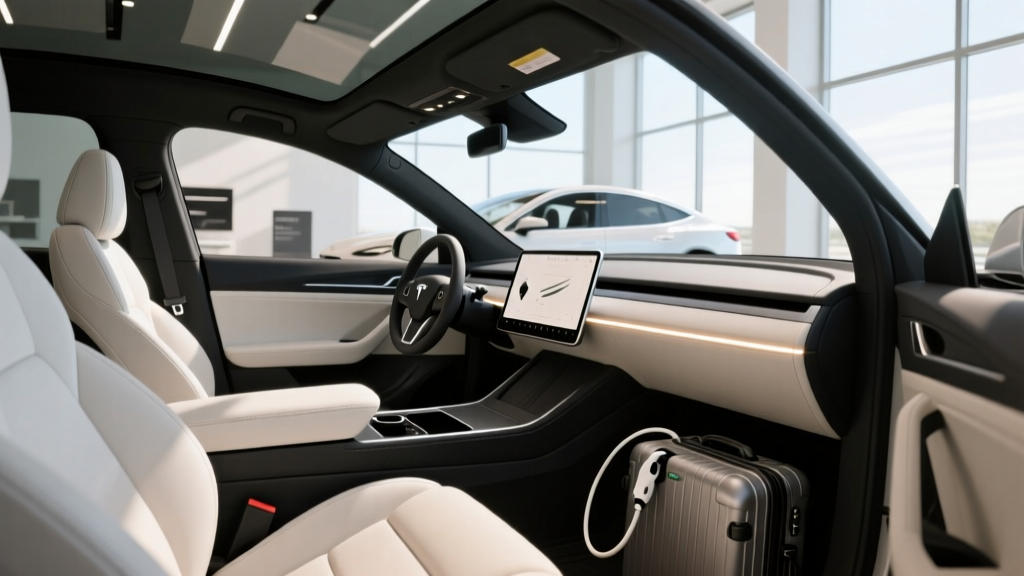
The 72.1 cu ft maximum with seats folded is competitive with midsize gas crossovers, and the 30.2 cu ft behind the second row handles a full family grocery run or two large suitcases plus carry-ons without folding seats. The 4.1 cu ft frunk is useful for charging cables, a laptop bag, or groceries you want separated from the main cabin. Compared to the Ioniq 5's 59.3 cu ft max, the Model Y holds a clear cargo advantage — though the Ioniq 5 offers a flat-load floor that some buyers prefer for bulky items.
Range and Efficiency: EPA vs. Real World
EPA Rated: 320 miles
Expect in mixed real-world driving: 270–295 miles (warm weather, 65–75 mph highway)
Cold-weather (below 32°F): 220–260 miles depending on cabin heating use and trip length
City-heavy commuting with regen: Up to 305 miles (regenerative braking recovers energy in stop-and-go traffic)
The Model Y Long Range AWD's 320-mile EPA rating is anchored by its ~75 kWh usable NMC (nickel manganese cobalt) battery pack using 2170-format cells. The heat pump, standard on all Juniper-generation Model Y variants, significantly reduces cold-weather range loss compared to older resistive-heating EVs — but physics still applies. On a 300-mile highway trip in January across the Midwest, plan for one Supercharger stop. In July on the same route, you might arrive with 30 miles to spare.
Efficiency of 122 MPGe combined (27 kWh per 100 miles) makes the Model Y one of the most efficient electric crossovers on the market. That efficiency directly translates to lower charging costs and longer intervals between stops on road trips.
Charging Speed: DC Fast, Level 2, and the Home Setup
| Charging Level | Power / Rate | Time or Miles Added |
|---|---|---|
| Level 1 (120V household) | ~1.4 kW | ~4–5 mi/hr |
| Level 2 (240V, 48A Wall Connector) | 11.5 kW | ~44 mi/hr — full charge in ~7 hours |
| DC Fast (V3 Supercharger, 250 kW peak) | 250 kW peak | 10–80% in ~27 minutes |
| DC Fast (V4 Supercharger, where available) | Up to 250 kW (vehicle-limited) | Similar to V3 — Model Y architecture caps at 250 kW |
The Model Y's charging curve is well-documented: it pulls peak 250 kW from roughly 10% to 30% State of Charge, then tapers progressively — dropping to ~150 kW by 50%, ~100 kW by 65%, and below 50 kW past 80%. This is normal lithium-ion behavior, but it means the advertised 250 kW peak is not a sustained rate. Your real Supercharger experience is 10–80% in about 27 minutes, with the last 20% taking nearly as long as the first 70%.
For home charging, Tesla's Gen 3 Wall Connector at 48 amps on a 60A circuit delivers 11.5 kW — enough to add 44 miles of range per hour or fully replenish the battery overnight. Installation typically runs $800–$2,000 depending on panel proximity and whether your home needs a 200A service upgrade. Always get a quote from a licensed electrician before committing.
Tesla's NACS (North American Charging Standard) connector is now the dominant plug in North America, with Ford, GM, Rivian, Volvo, and others adopting it. Model Y owners have the widest fast-charging network access in the country, including over 17,000 V3/V4 Supercharger stalls and growing third-party NACS stations.
Performance and Drivetrain
The 2026 Model Y Long Range AWD pairs dual permanent-magnet motors producing a combined 384 horsepower. The 0–60 mph sprint takes 4.8 seconds — quick enough to merge confidently onto any freeway and quicker than most gas-powered crossovers in this price range. The single-speed reduction transmission delivers instant torque with no shift lag.
The dual-motor AWD system continuously varies torque front-to-rear for traction, and the low center of gravity (battery pack under the floor) keeps body roll controlled through corners. It's not a sports car, but it handles better than its crossover proportions suggest. Ride quality improved meaningfully with the Juniper refresh — new damper tuning and additional acoustic insulation address the most common complaints from pre-2025 owners.
Pricing, Trims, and Federal Tax Credit Eligibility
| Trim | Base MSRP | Est. Price After §30D Credit* |
|---|---|---|
| Long Range AWD | $44,990 | ~$37,490 |
| Performance AWD | $48,990 | ~$41,490 |
*Tax credit estimates assume full $7,500 §30D eligibility. Actual credit depends on buyer income, battery sourcing, and MSRP caps. Consult a tax professional.
The 2026 Model Y qualifies for the full $7,500 federal tax credit under IRS §30D for eligible buyers, and as of 2024 rules, this credit can be transferred to the dealer at point of sale — effectively reducing your purchase price at signing rather than waiting for a tax refund. However, eligibility has strict requirements:
- MSRP Cap: SUVs/crossovers must be under $80,000 — the Model Y clears this easily.
- Buyer Income Cap: Modified AGI must not exceed $150,000 (single), $225,000 (head of household), or $300,000 (joint filers).
- Battery Sourcing: Critical minerals and battery components must meet phased-in domestic/free-trade sourcing requirements. Tesla's supply chain has largely met these thresholds, but the IRS publishes a qualifying vehicle list that you should verify before purchase.
The Long Range AWD at $44,990 (before options, delivery, and destination) is the volume trim and the one most buyers should target. Adding Full Self-Driving (Supervised) capability adds $8,000 — a purchase we recommend against for most buyers given its Level 2 SAE classification and ongoing supervision requirements.
Tech, Driver Assistance, and Notable Drawbacks
The Model Y's tech stack remains industry-leading in some areas and frustrating in others. The 15.4-inch center touchscreen runs Tesla's proprietary OS — responsive, regularly updated over-the-air, and featuring integrated navigation with real-time Supercharger routing and preconditioning. The Juniper refresh moved rear-seat controls to a dedicated 8-inch rear screen, a meaningful upgrade for passengers.
Both Autopilot (standard) and Full Self-Driving Supervised ($8,000 option) are SAE Level 2 driver-assist systems. The driver must remain fully engaged, hands on or near the wheel, eyes on the road at all times. These are NOT self-driving systems. Tesla's "Supervised" branding reflects this. Level 4 driverless operation (no human needed) currently exists only in geofenced robotaxi services like Waymo.
Standout tech: OTA updates that add features post-purchase, Sentry Mode dashcam recording, Dog Mode climate control for pets, integrated trip planner with battery preconditioning, and one of the most reliable phone-as-key implementations in the industry.
Notable drawbacks: No Apple CarPlay or Android Auto (dealbreaker for some), no physical buttons for climate or mirrors (everything is screen-controlled), no heads-up display, turn signal stalks removed in Juniper refresh (now steering-wheel-mounted buttons — polarizing), and panel gap quality, while improved, still varies by production batch.
Warranty Coverage
| Coverage | Term |
|---|---|
| Basic Vehicle | 4 years / 50,000 miles |
| Battery & Drive Unit | 8 years / 120,000 miles (Long Range/Performance) |
| Battery Capacity Retention | Minimum 70% over warranty period |
The 8-year/120,000-mile battery warranty with a 70% capacity retention floor is competitive with the industry standard. Real-world degradation data from Tesla's fleet suggests most Model Y packs retain 88–92% capacity at 100,000 miles, with the steepest drop occurring in the first 15,000–20,000 miles before leveling off. Charging habits matter: regularly charging to 100% on an NMC pack accelerates degradation — Tesla recommends daily charging to 80–90% and 100% only for trips.
Who the Model Y Suits Best
- You need a two-row electric crossover with class-leading cargo space (72 cu ft) and strong rear legroom
- You road-trip frequently and want access to the Supercharger network — still the most reliable DC fast-charging ecosystem in the US
- You want strong efficiency (122 MPGe) to minimize charging costs and maximize range per stop
- You value OTA software updates and a tech-forward cabin
- You need three rows — the Model X or Kia EV9 are better family haulers
- You refuse to live without Apple CarPlay/Android Auto
- You prefer physical controls for climate and mirrors
- You tow frequently — the Model Y's 3,500-lb towing capacity is adequate for light trailers but trails the Rivian R1S and F-150 Lightning
Pros and Cons
- 72.1 cu ft cargo — best in electric crossover class
- 320-mile EPA range with 122 MPGe efficiency
- Supercharger network access — most reliable public charging
- 250 kW DC fast charging, 10–80% in ~27 min
- Strong real-world performance (4.8s 0–60)
- $7,500 federal tax credit eligible (point-of-sale)
- Heat pump standard — better cold-weather range retention
- No Apple CarPlay or Android Auto
- Everything on the touchscreen — no physical climate buttons
- Turn signal buttons on steering wheel (Juniper) are divisive
- Rear visibility is compromised by sloping roofline
- FSD (Supervised) is expensive ($8K) and still Level 2
- Panel gap inconsistency across production batches
- Insurance premiums run 15–25% higher than comparable gas crossovers
Frequently Asked Questions
What is the real-world range of the 2026 Tesla Model Y?
The EPA rates the Long Range AWD at 320 miles. In real-world highway driving at 70–75 mph in moderate temperatures, expect 270–295 miles. In cold weather (below freezing), plan for 220–260 miles depending on trip length and cabin heating use. City commuting with regenerative braking can push closer to 300+ miles.
How fast does the Model Y charge at home and on the road?
At home on a 240V/48A Tesla Wall Connector, the Model Y charges at 11.5 kW — adding roughly 44 miles of range per hour, or a full charge in about 7 hours. On a V3 Supercharger, it peaks at 250 kW and charges from 10–80% in approximately 27 minutes, though the rate tapers significantly above 50% State of Charge.
Does the 2026 Model Y qualify for the $7,500 federal EV tax credit?
Yes, the Model Y currently qualifies for the full $7,500 §30D credit for eligible buyers. You must fall under the income caps ($150K single / $300K joint), and the credit can be applied at point of sale. Always verify current eligibility on the IRS qualifying vehicle list before purchasing, as battery sourcing rules evolve.
How much does the Model Y cost after tax credits?
The Long Range AWD starts at $44,990. With the full $7,500 point-of-sale credit, the effective price drops to approximately $37,490 before state incentives, delivery fees, or options. The Performance trim at $48,990 drops to roughly $41,490 with the same credit.
Is the Model Y worth buying vs. the Hyundai Ioniq 5 or Ford Mustang Mach-E?
The Model Y wins on cargo space (72 vs. 59 cu ft), Supercharger network access, and efficiency. The Ioniq 5 offers 800V architecture for faster peak charging on compatible 350 kW stations, a more comfortable ride, and Apple CarPlay. The Mach-E offers a more traditional driving feel and BlueCruise hands-free driving on mapped highways. If range, cargo, and charging infrastructure are your priorities, the Model Y still leads. If you value ride comfort and CarPlay, test-drive the Ioniq 5 before committing.
What are the interior dimensions of the Tesla Model Y compared to competitors?
The Model Y offers 41.6 inches of rear legroom (vs. 38.9 in the Mach-E, 41.7 in the Ioniq 5) and 72.1 cu ft of max cargo (vs. 59.3 Ioniq 5, 59.7 Mach-E). It is the packaging leader in this segment for buyers who prioritize cargo flexibility alongside passenger comfort.