The Tesla Model Y Juniper: A Cabin-Forward Redesign
The 2026 Tesla Model Y Juniper refresh represents the most significant interior overhaul in the crossover's history. Where earlier Model Y cabins drew criticism for sparse materials and minimal sound insulation, the Juniper generation addresses nearly every pain point with new acoustic glass, ventilated front seats, ambient lighting, and a rear-seat entertainment screen. For buyers researching the interior of a Tesla car before committing to a purchase, this review covers the cabin in depth — then backs it up with the range, charging, and pricing data that actually determine whether the Model Y earns a spot in your driveway.
Real-World Range Expectation
EPA Estimated: 320 miles (Long Range AWD, 19-inch wheels)
Real-World Highway: Expect 265–285 miles at 70–75 mph in mild weather. Cold-weather highway driving (below 32°F) can reduce range to 220–245 miles. City and mixed driving with regen braking typically yields 290–310 miles.
Interior Materials, Layout, and What Changed
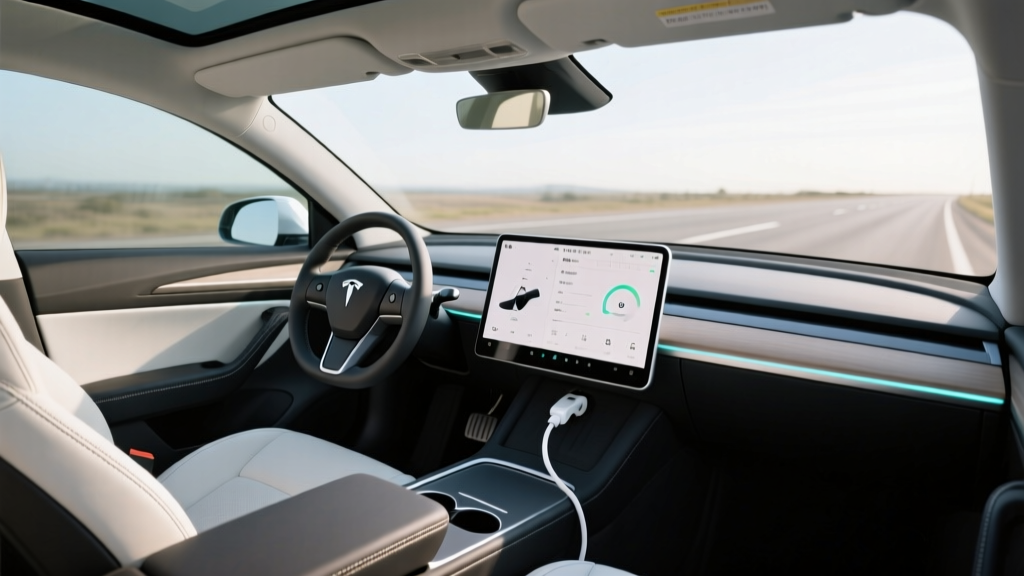
Tesla redesigned the Model Y cabin around a "lounge-like" philosophy borrowed from the Cybertruck and refreshed Model 3 Highland. The dashboard now features a wrapped textile-and-suede upper surface replacing the previous hard plastic. Door panels use soft-touch materials with contrast stitching on Premium and Long Range trims. The center console offers a ventilated wireless phone charger (15W Qi2), two USB-C ports (65W front, 27W rear), and a hidden storage compartment beneath the armrest.
The 15.4-inch center touchscreen remains the primary interface for climate, navigation, media, and vehicle settings. Physical controls are still limited — turn-signal stalks have been replaced by steering-wheel buttons (a polarizing choice carried over from the Cybertruck and refreshed Model 3). Tesla added a 6-inch rear touchscreen for climate and media control, addressing a long-standing complaint from rear passengers who previously had no independent control.
Cabin Dimensions and Cargo
| Measurement | 2026 Model Y |
|---|---|
| Front headroom | 41.0 in |
| Front legroom | 41.8 in |
| Rear headroom | 39.4 in |
| Rear legroom | 41.6 in |
| Cargo (rear seats up) | 30.2 cu ft |
| Cargo (rear seats folded) | 72.1 cu ft |
| Front trunk (frunk) | 4.1 cu ft |
The rear legroom increase of 1.4 inches over the pre-refresh Model Y is noticeable on long trips. The cargo area gains a powered tonneau cover on Long Range trims and a deeper under-floor storage well thanks to the more compact rear drive unit.
Battery, Range, and Efficiency by Trim
The 2026 Model Y is offered in three configurations in the US market. Tesla uses NMC (nickel manganese cobalt) chemistry in Long Range and Performance trims for maximum energy density, while the Standard Range RWD uses LFP (lithium iron phosphate) cells — a chemistry that trades some range for longer cycle life, lower cost, and the ability to charge to 100% daily without degradation concerns.
| Spec | Standard Range RWD | Long Range AWD | Performance AWD |
|---|---|---|---|
| EPA Range | 275 mi | 320 mi | 295 mi |
| Battery (usable) | 60 kWh (LFP) | 78.4 kWh (NMC) | 78.4 kWh (NMC) |
| Drivetrain | RWD single motor | AWD dual motor | AWD dual motor |
| Horsepower | 295 hp | 384 hp | 456 hp |
| 0-60 mph | 6.5 sec | 4.8 sec | 3.5 sec |
| MPGe (combined) | 128 MPGe | 122 MPGe | 115 MPGe |
| Efficiency | 26 kWh/100mi | 28 kWh/100mi | 30 kWh/100mi |
| Top Speed | 135 mph | 135 mph | 155 mph |
The LFP battery in the Standard Range trim is sourced from CATL and represents a practical choice for commuters who can charge nightly at home. LFP cells tolerate 100% state-of-charge without the calendar-degradation penalty that NMC cells face, making them ideal for drivers who want full range available every morning without battery-management anxiety.
Charging Speed: DC Fast, Level 2, and Level 1
Charging speed remains one of the Model Y's strongest competitive advantages, particularly on Tesla's Supercharger network where preconditioning and plug-and-charge integration eliminate most friction.
| Charging Level | Power / Rate | Speed (approx.) | Notes |
|---|---|---|---|
| Level 1 (120V) | 1.4 kW | ~4–5 mi/hr | Emergency / overnight trickle only |
| Level 2 (240V home) | 11.5 kW (48A) | ~38–42 mi/hr | Full charge in 8–10 hours (LR) |
| DC Fast (Supercharger V4) | 250 kW peak (LR) | 10–80% in ~24 min | Sustains ~170 kW to 50%, tapers above 80% |
| DC Fast (SR LFP) | 170 kW peak | 10–80% in ~28 min | Lower peak due to LFP charge curve |
On a V4 Supercharger, the Long Range Model Y peaks at 250 kW but sustains roughly 170–200 kW through the 10–50% state-of-charge window before tapering. The charge curve slows significantly above 80% — a 10–90% session takes approximately 38 minutes. For road trips, plan stops at 15–20% remaining and charge to 80% for the best time-to-miles ratio. The LFP Standard Range model charges at a lower peak (170 kW) because LFP chemistry has a flatter voltage curve, but the smaller 60 kWh battery means total session time remains competitive.
At home, a Wall Connector on a 60-amp circuit delivers 11.5 kW (48 amps), adding roughly 40 miles per hour of charging. Most owners arrive home at 30–50% SoC and wake to a full battery. Installation typically costs $800–$2,000 depending on panel proximity and conduit runs — budget for a potential panel upgrade if your home has a 100-amp service.
Tech, Driver Assistance, and the Autopilot Reality
The Model Y ships with Tesla's HW4.0 computer and a camera-only vision suite (Tesla abandoned ultrasonic sensors in 2023). Standard Autopilot includes Traffic-Aware Cruise Control and Autosteer — a solid SAE Level 2 system that handles highway lane-keeping and adaptive speed well but requires continuous driver attention.
⚠️ Autopilot and FSD (Supervised) Are Not Self-Driving
Both Autopilot and the optional Full Self-Driving (Supervised) package are SAE Level 2 driver-assistance systems. The driver must remain engaged, hands on the wheel (or providing torque), and eyes on the road at all times. FSD adds city-street navigation, traffic-light recognition, and automatic turns, but it makes errors — particularly in construction zones, unprotected left turns, and inclement weather. Only Level 4 services like Waymo operate without a human driver. See the IIHS assessment of driver-assist limitations for context.
The infotainment system runs on Tesla's proprietary OS with Netflix, YouTube, and Spotify integration, a gaming suite (the Ryzen-based processor handles titles like Cyberpunk 2077 while parked), and over-the-air updates that add features quarterly. Apple CarPlay and Android Auto remain unavailable — a deliberate Tesla choice that frustrates some buyers but keeps the interface unified. The new rear 6-inch screen handles climate and media for back-seat passengers, a meaningful quality-of-life improvement for families.
Pricing, Trims, and Federal Tax Credit Eligibility
| Trim | Base MSRP | Est. After §30D Credit* |
|---|---|---|
| Standard Range RWD | $44,990 | ~$37,490 |
| Long Range AWD | $48,990 | ~$41,490 |
| Performance AWD | $52,990 | ~$45,490 |
*Federal §30D credit eligibility requires meeting all criteria below. The $7,500 credit can now be transferred to the dealer at point of sale as an upfront discount under current IRS rules.
- MSRP Cap: SUVs/crossovers must be under $80,000 — all Model Y trims qualify.
- Buyer Income Cap: Modified AGI must not exceed $150,000 (single), $225,000 (head of household), or $300,000 (joint).
- Battery Sourcing: Critical minerals and battery components must meet phased-in domestic/free-trade sourcing thresholds. Verify current-year compliance on Tesla's configurator or fueleconomy.gov before purchasing.
- Point-of-Sale Transfer: The credit can be applied as an immediate price reduction at the dealer rather than claimed on your tax return.
Who Should Buy the Model Y — And Who Shouldn't
Pros
- Best-in-class Supercharger network access with 60,000+ global stalls
- Strong real-world efficiency (122 MPGe combined LR)
- Spacious cargo area (72.1 cu ft) with flat load floor
- LFP option for daily 100% charging without degradation worry
- OTA updates continuously add features post-purchase
- Excellent 0-60 performance across all trims
Cons
- No Apple CarPlay or Android Auto
- Steering-wheel turn-signal buttons require relearning
- Ride quality firm on 20-inch Performance wheels
- FSD subscription ($99/mo) adds cost for Level 2 features
- Limited service center availability in rural areas
- Insurance premiums 15–25% above segment average
Best for: Tech-forward commuters and small families who have home Level 2 charging access, take regular road trips (Supercharger coverage is unmatched), and value OTA-improving software. The Long Range AWD at ~$41,490 after the tax credit is the value sweet spot.
Look elsewhere if: You need CarPlay integration, prefer traditional controls, live in a charging desert without reliable DC fast-charging access, or require a third row (consider the Kia EV9 or Tesla Model X).
Warranty and Long-Term Ownership
| Coverage | Term |
|---|---|
| Basic Vehicle | 4 years / 50,000 miles |
| Battery & Drive Unit (LR/Perf) | 8 years / 120,000 miles (70% capacity retention) |
| Battery & Drive Unit (SR LFP) | 8 years / 100,000 miles (70% capacity retention) |
Tesla's battery warranty guarantees 70% capacity retention over the term — meaning a Long Range Model Y with 320 miles new would be covered if it dropped below 224 miles within 8 years or 120,000 miles. Real-world degradation data from fleet aggregators shows NMC Tesla packs typically retain 88–92% capacity at 100,000 miles, while LFP packs show even slower degradation curves. A full battery replacement outside warranty currently ranges from $12,000–$16,000 depending on pack size and labor.
Frequently Asked Questions
What is the real-world range of the 2026 Tesla Model Y?
The Long Range AWD is EPA-rated at 320 miles. In real-world highway driving at 70–75 mph in mild temperatures, expect 265–285 miles. Cold weather (below freezing) reduces this to roughly 220–245 miles due to battery resistance and cabin heating load. The Standard Range RWD delivers approximately 230–250 real-world highway miles.
How fast does the Model Y charge at home and on road trips?
At home on a 240V Level 2 Wall Connector, the Model Y adds roughly 40 miles per hour (11.5 kW). A full overnight charge takes 8–10 hours for the Long Range. On a V4 Supercharger, the Long Range peaks at 250 kW and charges from 10–80% in approximately 24 minutes. The Standard Range LFP peaks at 170 kW with a 10–80% time of about 28 minutes.
Does the 2026 Model Y qualify for the $7,500 federal EV tax credit?
All three trims fall under the $80,000 SUV MSRP cap. Eligibility depends on your modified adjusted gross income (under $150K single / $300K joint) and current-year battery-sourcing compliance. The credit can be transferred to Tesla at point of sale as an upfront discount. Verify current sourcing eligibility on fueleconomy.gov before ordering, as compliance status can shift with supply-chain changes.
Is the Model Y worth buying over the Hyundai Ioniq 5 or Ford Mustang Mach-E?
The Model Y wins on charging infrastructure (Supercharger access), software integration, and cargo volume. The Ioniq 5 offers faster 10–80% charging (18 minutes on 350 kW), CarPlay support, and a more distinctive design. The Mach-E provides a more traditional driving feel and dealer service network. If Supercharger access and OTA software are priorities, the Model Y remains the default choice.
What are the biggest drawbacks of the Model Y interior?
The steering-wheel turn-signal buttons require an adjustment period and frustrate some drivers in roundabouts and parking maneuvers. The absence of Apple CarPlay/Android Auto means you're locked into Tesla's interface. The panoramic glass roof lacks a shade (Tesla sells an aftermarket one), which can make the cabin warm in summer despite UV-blocking tint. Road noise is improved over the pre-refresh model but still trails the Hyundai Ioniq 5 and BMW iX at highway speeds.
How long will the Model Y battery last?
Tesla's NMC batteries typically retain 88–92% capacity at 100,000 miles based on fleet data. LFP batteries in the Standard Range model degrade even more slowly, often retaining 90%+ at the same mileage. The warranty guarantees 70% retention at 8 years / 120,000 miles (LR) or 100,000 miles (SR). Most Model Y batteries are projected to outlast 200,000 miles before reaching the 70% threshold.