Quick Verdict: The Model Y Remains the EV Benchmark — But Insurance Costs Tell a Complicated Story
The 2026 Tesla Model Y continues to dominate the compact electric SUV segment for good reason: class-leading efficiency, access to the Supercharger network, and over-the-air updates that keep the vehicle evolving post-purchase. But as more buyers move from browsing to signing, one question surfaces repeatedly in forums and dealership conversations alike: is Tesla insurance expensive compared to insuring rival EVs like the Hyundai Ioniq 5, Ford Mustang Mach-E, or Chevrolet Equinox EV?
The short answer is nuanced. Tesla's own insurance product — available in most states — uses real-time driving data to price premiums, which can mean significant savings for careful drivers but steep penalties for those with hard braking or aggressive acceleration patterns. Traditional insurers, meanwhile, often place Teslas in higher rate tiers due to elevated repair costs, aluminum-intensive body panels, and the brand's historically high total-loss frequencies.
This review breaks down the 2026 Model Y's specs, ownership economics, insurance realities, and how it stacks up against the competition — so you can decide whether the numbers work for your household budget.
Range, Battery, and Real-World Efficiency
| Specification | Long Range AWD | Performance |
|---|---|---|
| EPA Range | 320 miles | 293 miles |
| Battery Capacity (usable) | 75 kWh (NMC) | 75 kWh (NMC) |
| Efficiency | 27 kWh/100 mi (124 MPGe) | 30 kWh/100 mi (112 MPGe) |
| Drivetrain | Dual-Motor AWD | Dual-Motor AWD |
| 0-60 mph | 4.8 seconds | 3.5 seconds |
| Horsepower | 384 hp | 456 hp |
| Cargo Volume (rear seats up) | 30.2 cu ft | 30.2 cu ft |
| Cargo Volume (rear seats down) | 72.0 cu ft | 72.0 cu ft |
| Rear Legroom | 41.6 in | 41.6 in |
The Model Y uses an NMC (nickel manganese cobalt) battery pack, which offers higher energy density than LFP chemistry — critical for fitting 75 usable kWh into the vehicle's platform without excessive weight. NMC batteries do degrade slightly faster than LFP over thousands of cycles, but Tesla's thermal management system is among the best in the industry, and most owners report less than 10% degradation after 100,000 miles.
Efficiency is where the Model Y shines. At 27 kWh per 100 miles (Long Range), it extracts more miles per kilowatt-hour than nearly every competing electric SUV. For context, the Hyundai Ioniq 5 AWD achieves roughly 30 kWh/100 mi, and the Ford Mustang Mach-E Extended Range AWD sits around 31 kWh/100 mi. That efficiency gap translates directly into lower charging costs and more range from the same battery size.
Charging Speed: Supercharger Network Advantage
| Charging Method | Power (kW) | Miles Added per Hour | Notes |
|---|---|---|---|
| Level 1 (120V household) | ~1.4 kW | ~4-5 mi/hr | Emergency/trickle only |
| Level 2 (240V home, 48A) | 11.5 kW | ~37 mi/hr | Full charge in ~7 hours |
| DC Fast Charge (V3 Supercharger) | Peak 250 kW | ~1,000+ mi/hr (peak) | 10-80% in ~20 minutes |
| DC Fast Charge (V4 Supercharger) | Peak 325 kW | ~1,200+ mi/hr (peak) | 10-80% in ~15 minutes (select locations) |
Tesla's Supercharger network remains the gold standard for DC fast charging reliability. With over 6,000 V3 and expanding V4 stations across the U.S., Tesla owners face far fewer broken chargers and payment-app frustrations than drivers relying on third-party networks.
The 2026 Model Y Long Range peaks at 250 kW on V3 Superchargers, reaching 80% state of charge in approximately 20 minutes under optimal conditions (battery preconditioned via navigation routing). On newer V4 Superchargers — rolling out at high-traffic corridors — peak rates can reach 325 kW, shaving the 10-80% session to roughly 15 minutes.
Charging curve reality: Peak 250 kW is sustained only between roughly 10-30% state of charge. From 30-60%, the rate tapers to approximately 150-180 kW. Above 80%, charging slows dramatically to protect battery longevity — expect 80-100% to take an additional 15-20 minutes. Plan road-trip stops around 10-80% sessions for maximum efficiency.
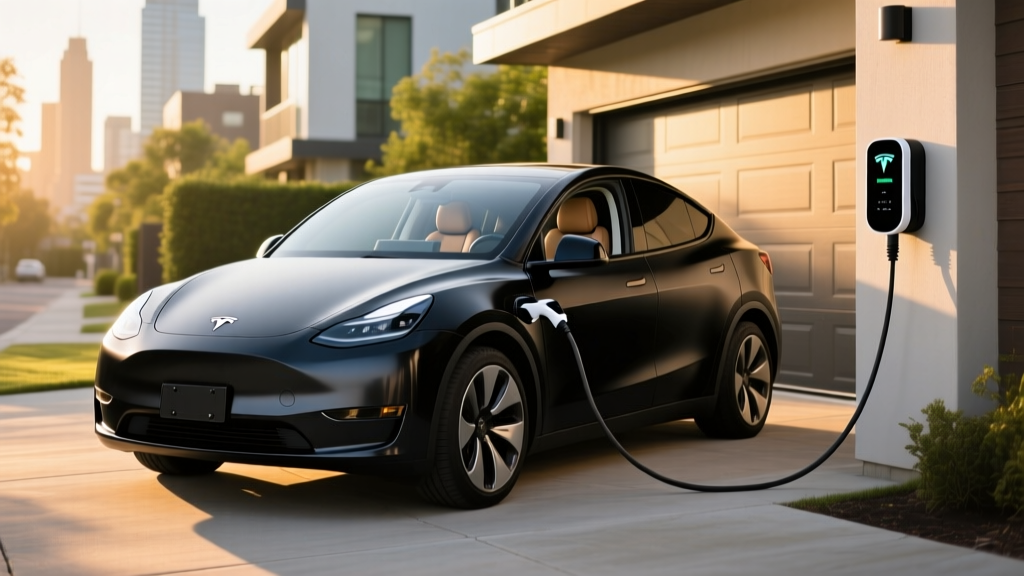
At home, the Model Y accepts up to 11.5 kW on Level 2 (48 amps on a 60-amp circuit). A full charge from near-empty takes approximately 7 hours — easily accomplished overnight. Tesla's Wall Connector costs around $475, and professional installation typically runs $500-$1,500 depending on your electrical panel's capacity and proximity to the parking spot.
Is Tesla Insurance Expensive? Breaking Down the Numbers
This is the question that brought you here, and the answer depends heavily on your driving profile, location, and which insurance avenue you choose.
Tesla Insurance (Real-Time Data Product)
Tesla offers its own insurance product in most U.S. states, priced dynamically based on a monthly Safety Score (0-100) calculated from real-time driving data: hard braking, aggressive turning, forward collision warnings, and Autopilot engagement patterns. As of early 2026:
- Low-risk drivers (Safety Score 90+): premiums can be 20-40% below traditional insurers, sometimes $100-$140/month for the Model Y Long Range.
- Average drivers (Safety Score 70-89): premiums are roughly competitive with traditional quotes, around $160-$210/month.
- Higher-risk drivers (Safety Score below 70): premiums can spike above $250-$350/month, making traditional insurers more attractive.
The advantage: safe drivers save meaningfully. The drawback: one month of aggressive driving or a single hard-braking event can raise the next month's premium. Privacy-conscious owners may also object to continuous telematics monitoring.
Traditional Insurers
Major carriers (GEICO, Progressive, State Farm, Allstate) typically classify the Model Y in a higher-than-average rate tier due to:
- Repair costs: Tesla's aluminum body panels, integrated structural battery pack, and proprietary parts mean collision repairs often cost 30-50% more than comparable vehicles.
- Total-loss frequency: Teslas have historically higher rates of vehicles being declared total losses after moderate collisions, partly because battery-pack damage triggers write-offs.
- Performance profile: Insurers factor in the 3.5-second 0-60 time of the Performance trim, associating it with higher risk.
Average traditional premiums for the 2026 Model Y Long Range range from $1,800 to $3,200 per year depending on driver age, location, credit score (where permitted), and coverage levels. The Performance trim typically adds $300-$600 annually.
How Does It Compare?
For context, insuring a 2026 Hyundai Ioniq 5 SEL AWD averages $1,400-$2,400/year through traditional carriers — roughly 15-25% less than the Model Y. The Ford Mustang Mach-E Premium AWD sits in a similar range to the Ioniq 5. The Chevrolet Equinox EV, with its lower MSRP and more conventional repair network, can be 20-30% cheaper to insure.
Bottom line: Yes, Tesla insurance tends to be more expensive than insuring mainstream EV competitors — unless you qualify for Tesla's own Safety Score-based product and consistently drive conservatively. Budget at least $150-$250/month for insurance when calculating total ownership cost.
Pricing, Trim Levels, and Federal Tax Credit Eligibility
| Trim | Base MSRP | Est. Federal Credit (§30D) | Effective Price |
|---|---|---|---|
| Long Range AWD | $44,990 | Up to $7,500* | ~$37,490* |
| Performance | $51,490 | Up to $7,500* | ~$43,990* |
*Federal tax credit eligibility under IRS §30D depends on multiple factors that change periodically:
- Buyer income caps: Modified adjusted gross income must not exceed $150,000 (single), $225,000 (head of household), or $300,000 (joint filing).
- MSRP cap: SUVs must have an MSRP at or below $80,000 (both Model Y trims qualify).
- Battery sourcing requirements: A percentage of critical minerals and battery components must be sourced from the U.S. or free-trade-agreement countries. Tesla has worked to localize its supply chain, and as of early 2026, the Model Y assembled at Giga Texas is expected to qualify for the full $7,500 — but buyers should verify current eligibility at fueleconomy.gov before purchasing, as sourcing rules tighten annually.
- Point-of-sale transfer: The credit can now be transferred to the dealer at purchase, reducing your out-of-pocket cost immediately rather than waiting for tax filing.
As-tested pricing on a well-equipped Long Range AWD with Full Self-Driving (Supervised) capability ($8,000 add-on), premium interior, and 20-inch Induction wheels can reach $55,000-$58,000 before credits.
Technology, Driver Assistance, and Ownership Experience
The 2026 Model Y runs Tesla's latest software on a 15.4-inch center touchscreen that controls virtually every vehicle function — climate, media, navigation, vehicle settings, and even the glovebox release. There is no traditional instrument cluster; speed and navigation prompts appear in the upper-left corner of the main display.
Autopilot and Full Self-Driving (Supervised)
Standard Autopilot includes Traffic-Aware Cruise Control and Autosteer (lane-centering). The optional Full Self-Driving (Supervised) package ($8,000 or $99/month) adds automatic lane changes, Navigate on Autopilot (highway on/off-ramp routing), Autopark, and Smart Summon (low-speed parking-lot navigation to the driver). FSD has improved substantially but still requires active supervision — treat it as an advanced convenience feature, not a replacement for attentive driving.
Notable Tech Features
- Over-the-air software updates that add features, improve efficiency, and refine the UI
- Sentry Mode (360-degree parking surveillance using the vehicle's cameras)
- Dog Mode (climate control maintains cabin temperature for pets with a display message for passersby)
- Theater mode (streaming Netflix, YouTube, Disney+ on the main display while parked)
- Phone-as-key with Bluetooth proximity detection
- Heat pump for efficient cabin heating (reduces winter range loss vs. resistive heaters)
Notable Drawbacks
- No physical buttons or stalks for turn signals (capacitive touch buttons on the steering wheel — divisive among owners)
- Minimalist interior feels sparse to buyers accustomed to traditional luxury materials
- Panel-gap quality has improved but still lags behind Hyundai/Kia and German competitors
- Service center availability remains limited in rural areas — mobile service handles minor issues but not collision repair
- No Apple CarPlay or Android Auto (Tesla's native system is capable but a dealbreaker for some)
Who Should Buy the 2026 Model Y?
- You prioritize Supercharger network access for frequent road trips
- You want best-in-class efficiency (lowest cost per mile among electric SUVs)
- You value over-the-air updates that keep the vehicle current
- You have home Level 2 charging and a conservative driving style (to benefit from Tesla Insurance)
- Cargo versatility matters (72 cu ft with seats folded, plus a small front trunk)
- Insurance cost is your top ownership concern (Ioniq 5 or Equinox EV will be cheaper to insure)
- You prefer physical controls, a traditional instrument cluster, or Apple CarPlay
- You live far from a Tesla Service Center and want dealer-based maintenance convenience
- You want the longest possible EPA range in a single charge (consider the Hyundai Ioniq 5 at 320+ mi or the Chevy Silverado EV at 400+ mi)
Pros and Cons at a Glance
- Class-leading efficiency (27 kWh/100 mi)
- Supercharger network reliability
- 250-325 kW DC fast charging (10-80% in 15-20 min)
- Spacious cargo area (72 cu ft max)
- Strong performance (0-60 in 3.5s on Performance trim)
- Continuous OTA software improvements
- Heat pump for cold-weather efficiency
- Insurance costs above segment average
- Capacitive turn-signal buttons are polarizing
- No Apple CarPlay or Android Auto
- Service center gaps in rural areas
- FSD (Supervised) is expensive and still Level 2
- NMC battery degrades slightly faster than LFP over time
Warranty Coverage
| Component | Coverage |
|---|---|
| Basic Vehicle | 4 years / 50,000 miles |
| Battery & Drive Unit | 8 years / 120,000 miles (Long Range/Performance) |
| Battery Capacity Retention | Minimum 70% over warranty period |
Tesla's battery warranty guarantees that the pack will retain at least 70% of its original capacity over 8 years or 120,000 miles. In practice, Tesla's NMC packs with active thermal management typically retain 85-90% capacity at 100,000 miles based on long-term fleet data. Full battery replacement outside of warranty currently runs $12,000-$16,000 depending on the pack configuration — a cost worth factoring into long-term ownership projections for high-mileage drivers.
Frequently Asked Questions
What is the real-world range of the 2026 Tesla Model Y?
The EPA rates the Long Range AWD at 320 miles. Expect 265-280 miles in real-world highway driving, and 220-240 miles in cold weather (below freezing). City driving with regenerative braking can approach or slightly exceed the EPA estimate.
How fast does the Model Y charge at home and on road trips?
At home on a 240V Level 2 charger (48A), the Model Y adds about 37 miles of range per hour, fully charging in roughly 7 hours. On a V3 Supercharger (250 kW peak), 10-80% takes approximately 20 minutes. On V4 Superchargers (325 kW), that drops to around 15 minutes.
How much does the 2026 Model Y cost after federal tax credits?
The Long Range AWD starts at $44,990 MSRP. If you meet all IRS §30D requirements (income caps, battery sourcing rules), the effective price can drop to approximately $37,490 with the full $7,500 point-of-sale credit. Verify current eligibility at fueleconomy.gov before purchasing.
Is the Model Y worth buying vs. the Hyundai Ioniq 5 or Ford Mach-E?
The Model Y wins on efficiency, Supercharger access, and software. The Ioniq 5 offers a more conventional interior, physical controls, 800V architecture for ultra-fast charging on compatible stations, and lower insurance costs. The Mach-E provides a more engaging driving feel and CarPlay support. Test-drive all three — the best choice depends on your priorities.
Does the 2026 Model Y qualify for the $7,500 federal EV tax credit?
As of early 2026, the Model Y assembled at Giga Texas is expected to qualify for the full $7,500 under §30D, provided the buyer meets income caps ($150K single / $300K joint) and the vehicle's MSRP is below $80,000 (it is). Battery-sourcing requirements tighten annually, so confirm current eligibility on the IRS Clean Vehicle Credits page before finalizing your purchase.
Why is Tesla insurance more expensive than other EVs?
Traditional insurers charge more for Teslas due to higher repair costs (aluminum body, structural battery pack, proprietary parts), elevated total-loss frequencies, and the performance profile of the vehicle. Tesla's own insurance product can be cheaper for safe drivers who score well on the Safety Score telematics system.