Why Tesla and India Is the EV Story of 2026
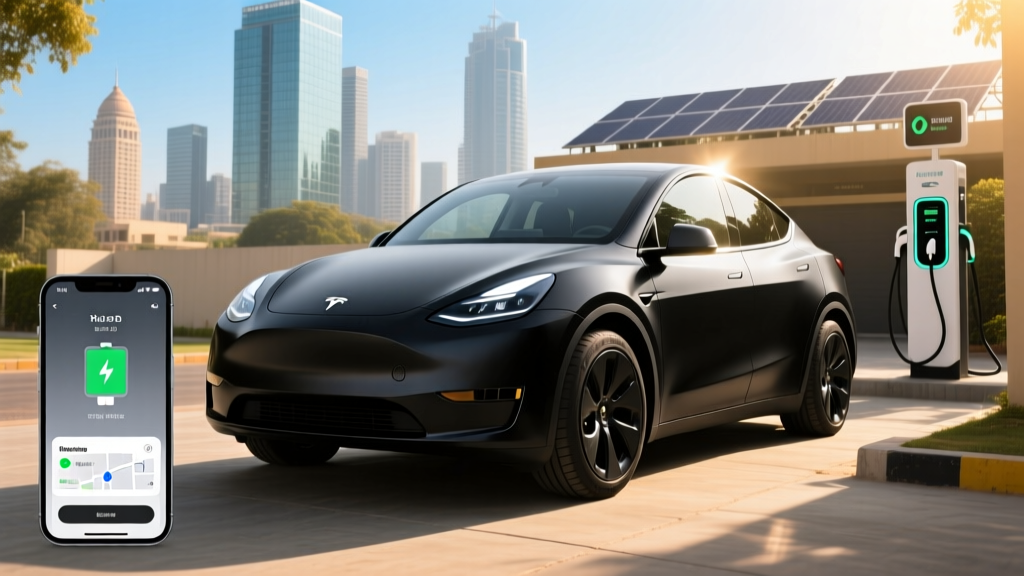
After years of speculation, stalled negotiations, and shifting policy, Tesla has officially launched sales in India as of early 2026. The vehicle chosen for market entry is the Tesla Model Y, imported initially from Gigafactory Shanghai and later supplemented by a local assembly operation near Pune. For Indian EV buyers and global observers alike, the arrival of Tesla represents the most significant market disruption since Tata introduced the Nexon EV.
This review covers the India-spec Model Y with exact figures on range, charging, pricing (including India's complex import-duty structure), and how it compares to established competitors like the Tata Nexon EV, MG ZS EV, Hyundai Creta Electric, and BYD Atto 3. Whether you're evaluating Tesla and India as a purchase decision or tracking global EV expansion, here's the data-driven breakdown.
2026 Tesla Model Y India: Quick Verdict
The India-spec Model Y arrives in two trims: Rear-Wheel Drive (RWD) and Long Range All-Wheel Drive (AWD). It carries over the same 2025 "Juniper" refresh hardware seen in North American and European markets, including the redesigned interior, ventilated seats, ambient lighting, and rear touchscreen. However, pricing is substantially higher than in the U.S. due to import duties, and the Supercharger network does not yet exist in India — Tesla is relying on third-party DC fast-charging partners and home Wall Connector installations at launch.
Spec Table: Tesla Model Y India (2026)
| Specification | RWD (Base) | Long Range AWD |
|---|---|---|
| EPA Range | 295 mi (475 km) | 320 mi (515 km) |
| Battery Capacity | 60 kWh usable (LFP) | 75 kWh usable (NMC) |
| Drivetrain | Rear-Wheel Drive | Dual-Motor AWD |
| Horsepower | 295 hp | 384 hp |
| 0-60 mph (0-100 km/h) | 6.5 sec (6.9 sec) | 4.8 sec (5.0 sec) |
| Max DC Fast Charge | 170 kW peak | 250 kW peak |
| 10–80% DC Charge Time | ~28 min | ~22 min |
| Level 2 Home Charge | 11 kW (44 mi/hr / 70 km/hr) | 11 kW (44 mi/hr / 70 km/hr) |
| Efficiency | 125 MPGe (27 kWh/100mi) | 118 MPGe (29 kWh/100mi) |
| Cargo Volume | 30.2 cu ft (rear up) / 72.1 cu ft (folded) | 30.2 cu ft / 72.1 cu ft |
| Rear Legroom | 40.5 in (1029 mm) | 40.5 in (1029 mm) |
| Battery Warranty | 8 yr / 100,000 mi (160,000 km) | 8 yr / 120,000 mi (192,000 km) |
| India MSRP (est.) | ₹59.9 lakh (~$71,000 USD) | ₹74.9 lakh (~$89,000 USD) |
Source: fueleconomy.gov (EPA ratings); India pricing is estimated based on import-duty calculations and Tesla's announced pricing strategy. Final on-road prices vary by state due to registration and insurance costs.
Charging in India: Speeds, Infrastructure, and Reality
The biggest question for Tesla and India is charging infrastructure. Unlike in North America, where Tesla's Supercharger network provides seamless coast-to-coast coverage, India launches with zero Tesla Superchargers. Tesla has announced partnerships with Tata Power, Ather Energy's public charging grid, and select luxury hotel chains for destination charging, but the network is nascent.
DC Fast Charging
The Model Y Long Range AWD peaks at 250 kW on compatible CCS2 chargers (India uses the CCS2 standard, not NACS). However, India's public DC chargers are predominantly 50 kW and 60 kW units. At a 60 kW charger, expect a 10–80% charge in roughly 55–65 minutes. Higher-power 150 kW+ chargers from Tata Power and Jio-bp are being deployed along the Delhi–Mumbai and Delhi–Jaipur expressways, where the Model Y can actually approach its peak charge rate.
Charge curve reality: The 250 kW peak is sustained only between approximately 10–35% State of Charge (SoC). Between 35–60%, the rate tapers to ~150 kW. Above 80%, it drops below 50 kW. This is standard for NMC chemistry. The LFP battery in the RWD variant has a flatter charge curve and can safely be charged to 100% regularly without degradation concerns — a significant advantage for Indian owners who may lack home charging and rely on public DC.
Home Level 2 Charging
Tesla's Gen 3 Wall Connector (included with the vehicle in India) delivers up to 11 kW on a single-phase 48-amp connection. Most Indian residences have single-phase 7 kW sanctioned loads, which means owners may need to upgrade their electricity connection to a 3-phase supply (typically 10–15 kW sanctioned) to unlock full 11 kW charging. Budget ₹25,000–₹60,000 for a licensed electrician to install a dedicated 40-amp circuit with proper earthing — essential given India's voltage fluctuation issues. A full overnight charge (0–100%) at 11 kW takes approximately 5.5 hours for the RWD and 7 hours for the Long Range.
Pricing, Import Duties, and Tax Incentives
India's EV import-tax structure is the single largest factor inflating Tesla's price. As of 2026, the Indian government imposes a 70% customs duty on fully built imported EVs priced above $40,000 USD (CIF), with a reduced 15% duty for manufacturers who commit to local production within three years — a policy designed specifically to attract Tesla. Tesla has committed to a local assembly facility, qualifying for the reduced rate on a portion of its imports.
| Cost Component | RWD | Long Range AWD |
|---|---|---|
| U.S. MSRP (reference) | $44,990 | $48,990 |
| India Ex-Showroom (est.) | ₹59.9 lakh | ₹74.9 lakh |
| GST on EV (5%) | Included in ex-showroom | Included in ex-showroom |
| State Road Tax + Registration | ₹1.5–4 lakh (varies) | ₹2–5 lakh (varies) |
| Estimated On-Road Price | ₹62–65 lakh | ₹78–82 lakh |
U.S. Federal Tax Credit Note: For U.S. readers tracking Tesla and India from an investment or comparison standpoint — the IRS §30D federal tax credit of up to $7,500 applies only to vehicles purchased and delivered in the United States. It does not apply to India-spec vehicles. India's own FAME-III subsidy program (expected 2026) provides purchase incentives primarily for EVs priced below ₹30 lakh, meaning the Model Y is unlikely to qualify for direct buyer subsidies in India.
Performance and Driving Impressions
The Model Y Long Range AWD delivers 384 horsepower and a 4.8-second 0–60 mph time, making it the quickest vehicle in its price bracket in India. The RWD variant, at 295 hp and 6.5 seconds, is still brisk by Indian market standards. Both variants feature Tesla's adaptive suspension tuning, which has been revised for the Juniper generation to better absorb rough surfaces — relevant for Indian road conditions.
The dual-motor AWD system provides excellent traction during monsoon-season driving, and the 189 mm ground clearance is competitive with compact SUVs in this segment. However, the Model Y's low-profile tires (255/45 R19 on the Long Range) are a vulnerability on potholed urban roads; owners should budget for tire replacement more frequently than in U.S. or European markets.
Tech, Interior, and Driver Assistance
The 2026 Model Y retains Tesla's minimalist interior with a 15.4-inch front touchscreen, a new 8-inch rear passenger screen, and ventilated front seats. India-spec vehicles include Hindi and regional-language voice navigation, and the navigation system has been mapped for Indian cities.
Standout tech features:
- Over-the-air (OTA) software updates that add features post-purchase
- Sentry Mode dashcam recording (valuable for Indian traffic incident documentation)
- Phone-as-key with Bluetooth LE
- Heat pump HVAC (efficient in both extreme heat and cold — critical for Indian summers where A/C draw significantly impacts range)
- 17-speaker premium audio with immersive sound
Notable drawbacks:
- No physical buttons — all climate and mirror adjustments via touchscreen
- No Apple CarPlay or Android Auto (Tesla uses proprietary infotainment)
- Panel gaps and paint quality remain inconsistent on Shanghai-built units
- Service center network is extremely limited in India at launch (Mumbai, Delhi, Bangalore only)
Tesla Model Y vs. India Competitors
| Attribute | Tesla Model Y LR | BYD Atto 3 | Hyundai Creta EV | Tata Nexon EV Max |
|---|---|---|---|---|
| Price (ex-showroom) | ₹74.9L | ₹33.9L | ₹22–28L | ₹18–20L |
| Range (ARAI/est.) | ~515 km | 521 km (ARAI) | ~450 km | 437 km (ARAI) |
| Battery | 75 kWh NMC | 60.5 kWh LFP | 51 kWh NMC | 40.5 kWh LFP |
| DC Fast Charge Peak | 250 kW | 88 kW | ~70 kW | 50 kW |
| 0-100 km/h | 5.0 sec | 7.3 sec | ~7.9 sec | ~8.6 sec |
| Service Network | 3 cities | 25+ cities | 500+ cities | 800+ cities |
The Model Y dominates on performance and charging speed but costs 2–4x more than its Indian competitors. The BYD Atto 3 is the closest rival in terms of tech and range, at less than half the price. For buyers who prioritize service accessibility and value, the Creta EV and Nexon EV Max remain pragmatic choices.
Pros
- Class-leading performance (0–100 km/h in 5.0 sec for LR AWD)
- Fastest DC charging capability available in India (250 kW peak)
- OTA updates keep the vehicle current post-purchase
- Superior build platform and thermal management (heat pump standard)
- Strong brand cachet and resale-value potential
- Sentry Mode and dashcam — practical for Indian roads
Cons
- Extremely expensive vs. Indian EV alternatives (₹60–82 lakh on-road)
- Only 3 service centers at launch — a serious ownership risk
- No Supercharger network; reliant on third-party charging
- FSD (Supervised) unavailable in India at launch
- Low-profile tires vulnerable on poor road surfaces
- No Apple CarPlay / Android Auto
Who Should Buy the Tesla Model Y in India?
Choose the Model Y if:
- You live in Mumbai, Delhi-NCR, or Bangalore (near a service center) and have home charging access
- Performance and tech are your top priorities, and you're willing to pay a premium
- You drive 40–80 km daily and can charge overnight at home
- You value OTA updates, software integration, and brand prestige
Consider alternatives if:
- You live outside the three launch cities — service logistics will be challenging
- Your budget is under ₹40 lakh — the BYD Atto 3 or Hyundai Creta EV offers strong value
- You frequently drive long intercity routes where public charging infrastructure is still sparse
- You prefer physical controls, CarPlay, or a dealership service experience
Frequently Asked Questions
What is the real-world range of the Tesla Model Y in India?
The Long Range AWD achieves approximately 400–440 km in mixed Indian driving conditions (city traffic with A/C, moderate highway use). The RWD LFP variant delivers roughly 370–400 km. Extreme summer heat (45°C+) with maximum A/C can reduce range by 10–15% below these figures. Highway-only driving at steady speeds of 90–100 km/h yields the best efficiency.
How fast does the Model Y charge in India?
On a 250 kW-capable CCS2 DC fast charger, the Long Range AWD charges from 10–80% in approximately 22 minutes. However, most Indian public DC chargers are 50–60 kW, where the same 10–80% charge takes 55–65 minutes. At home on an 11 kW Wall Connector, a full charge takes 5.5–7 hours depending on battery size.
Does the Tesla Model Y qualify for India's EV subsidies?
Under India's current FAME-II and expected FAME-III programs, purchase subsidies target EVs priced below ₹30 lakh (ex-showroom). The Model Y, at ₹60–75 lakh, does not qualify for direct buyer subsidies. Some Indian states offer reduced road tax and registration fees for EVs, which can save ₹1–3 lakh depending on the state.
Is the Model Y worth buying vs. the BYD Atto 3 or Hyundai Creta EV?
On pure specs — range, performance, charging speed, software — the Model Y is objectively superior. However, it costs 2–4x more. The BYD Atto 3 offers 521 km ARAI range, 88 kW DC charging, and a proven LFP battery at ₹33.9 lakh with a wider service network. For most Indian buyers, the Atto 3 or Creta EV is the rational choice. The Model Y is a premium lifestyle purchase for buyers who want Tesla's ecosystem and don't mind the price premium and early-stage service limitations.
Will Tesla build a factory in India?
Tesla has announced a local assembly facility near Pune, Maharashtra, expected to begin operations by late 2027. This facility will assemble vehicles from imported kits (CKD/SKD), which will reduce pricing by an estimated 15–20% once operational. A full Gigafactory with cell manufacturing has not been confirmed and remains speculative.
Can I use third-party chargers with the Tesla Model Y in India?
Yes. The India-spec Model Y uses the CCS2 connector (the European/Indian standard), which is compatible with Tata Power, Ather Grid, Jio-bp, and other public DC fast-charging networks. No adapter is needed. For AC charging, the vehicle accepts a Type 2 connector, standard across India's public Level 2 chargers.
For official EPA range and efficiency data, consult fueleconomy.gov. For India-specific EV policy details, refer to the Ministry of Heavy Industries FAME scheme documentation. Tesla India pricing and availability are subject to change; verify current figures at tesla.com/en_in.