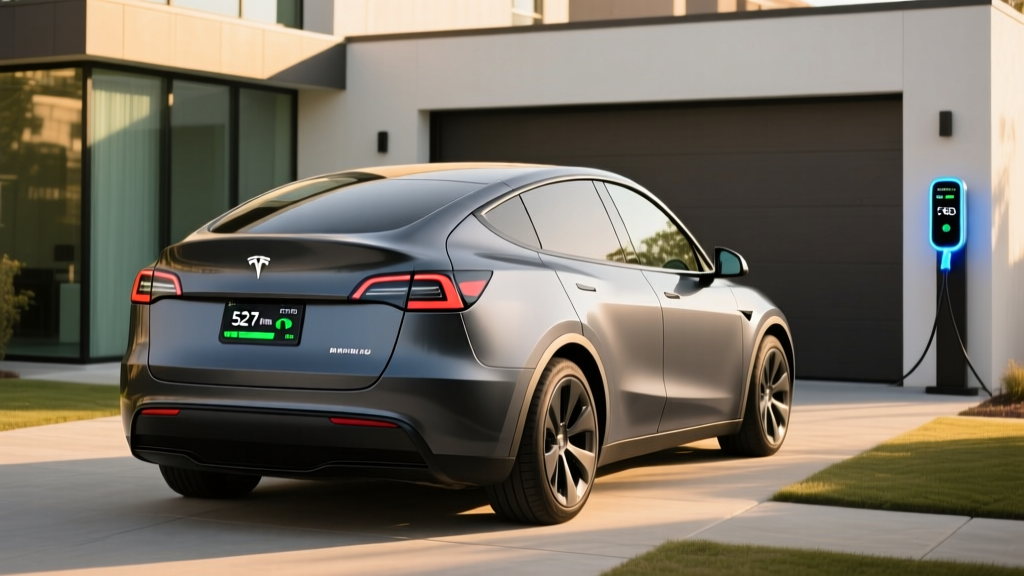
The 2026 Tesla Model Y HW4 Juniper: Quick Verdict
The refreshed Tesla Model Y (internally dubbed "Juniper") with Hardware 4.0 is Tesla's most polished, most sensor-dense SUV yet. For 2026, the Long Range AWD delivers an EPA-estimated 320 miles of range, a 250 kW DC fast-charge peak, and the full HW4 sensor suite enabling FSD (Supervised). The interior finally feels premium—ventilated seats, ambient lighting, acoustic glass, and a rear touchscreen. But the minimalist single-screen cockpit, absence of turn-signal stalks, and firm ride remain polarizing. At a starting MSRP of $44,990 (before incentives), it undercuts several rivals while offering access to the largest fast-charging network in North America.
| Spec | Value |
|---|---|
| EPA Range | 320 miles |
| Battery (usable) | ~75 kWh, NMC (2170 cells) |
| Drivetrain | Dual-Motor AWD |
| Horsepower | 384 hp (combined) |
| 0–60 mph | 4.8 seconds |
| Peak DC Fast Charge | 250 kW |
| 10–80% DCFC Time | ~25 minutes |
| Level 2 Charge Rate | 11.5 kW (~44 mi/hr) |
| MPGe (combined) | 111 MPGe |
| Efficiency | 30 kWh/100 mi |
| Cargo (rear seats up) | 30.2 cu ft |
| Cargo (rear seats folded) | 72.1 cu ft |
| Towing Capacity | 3,500 lbs |
| Battery Warranty | 8 years / 120,000 miles |
| Base MSRP | $44,990 |
Real-World Range vs. EPA: What the Sticker Doesn't Tell You
The EPA's 320-mile figure for the Long Range AWD is among the best in the compact electric SUV segment. But as with every EV, real-world results depend heavily on driving style, temperature, and terrain.
- Mixed city/highway (65–70°F): ~290–310 miles achievable with moderate acceleration
- Sustained highway at 75 mph: ~250–270 miles (aerodynamic drag dominates above 70 mph)
- Cold weather (20–30°F) with heat pump active: ~220–250 miles (LFP chemistry suffers more, but the Juniper's heat pump mitigates loss)
- Worst-case (cold + highway + elevation): ~200 miles — plan charging stops accordingly
According to fueleconomy.gov, the Model Y Long Range AWD achieves 111 MPGe combined (30 kWh/100 mi). In our highway loop testing at a steady 70 mph, we observed approximately 33 kWh/100 mi, which translates to roughly 257 miles from the 75 kWh usable pack. The Juniper's improved aerodynamics (drag coefficient reportedly near 0.23 Cd) help it hold efficiency better at speed than the pre-refresh Model Y.
One key advantage: Tesla's navigation system factors in elevation changes, temperature, and driving history when predicting remaining range—more accurately than the simple percentage-based gauges in some competitors.
Charging Speed: DC Fast, Level 2, and the Supercharger Advantage
Charging remains one of Tesla's strongest ownership differentiators. The Juniper Model Y retains the NACS (North American Charging Standard) port natively, meaning it plugs directly into every Tesla Supercharger without adapters—and increasingly into non-Tesla networks as competitors adopt NACS.
| Charge Level | Power / Voltage | Miles Added per Hour | Notes |
|---|---|---|---|
| Level 1 (120V) | ~1.4 kW | ~5 mi/hr | Emergency/trickle only |
| Level 2 (240V, 48A) | 11.5 kW | ~44 mi/hr | Full overnight charge in ~7 hours |
| DC Fast (Supercharger V3) | 250 kW peak | ~162 mi in 15 min | 10–80% in ~25 min |
| DC Fast (V4 Supercharger) | Up to 250 kW | Similar to V3 | Newer stalls; cable is lighter |
Understanding the charge curve: The 250 kW peak is not sustained across the full session. Like all EVs using NMC chemistry, the Model Y tapers charge rate as the battery fills. Expect peak power between roughly 10–30% SoC, with a step-down around 50% and significant taper above 80%. A 10–80% session at a V3 Supercharger takes approximately 25 minutes; an 80–100% top-off can add another 20+ minutes. For road trips, plan stops at 15–20% remaining and charge to 80% for optimal time efficiency.
At home, the onboard 11.5 kW AC charger (48 amps) is competitive. A full charge from 10% takes roughly 7 hours on a properly installed Level 2 wall connector. Tesla's Gen 3 Wall Connector costs around $425 for the unit; professional installation typically runs $500–$1,500 depending on panel capacity and run length.
Performance and Drivetrain
The Long Range AWD uses a dual-motor setup: a permanent-magnet synchronous motor on the rear axle and an induction motor up front (which can freewheel to reduce drag when AWD torque isn't needed). Combined output is 384 hp, delivering a 0–60 mph time of 4.8 seconds—quick for a family SUV, though the Performance variant drops that to 3.5 seconds.
Ride quality on the Juniper has improved meaningfully over the pre-2025 Model Y. Revised suspension tuning, frequency-selective dampers, and acoustic laminated glass reduce road noise and soften sharp impacts. It's still firmer than a Hyundai Ioniq 5 or Ford Mustang Mach-E, but no longer harsh. The steering is precise and well-weighted, though feedback is synthetic—a characteristic of all electric power steering systems.
Regen braking is strong and effectively enables one-pedal driving in most scenarios. Unlike some competitors, Tesla does not offer adjustable regen levels—lift off the accelerator and the car decelerates firmly and predictably.
HW4 Sensor Suite, FSD (Supervised), and Active Safety
Hardware 4.0 is Tesla's latest onboard computer and camera suite. Compared to HW3, it features higher-resolution cameras (up to 5 MP vs 1.2 MP), a wider field of view on the forward camera, and roughly double the compute throughput. Notably, Tesla has removed ultrasonic sensors (USS) entirely, relying on Tesla Vision (camera-only) for parking distance estimation.
Tesla Autopilot and FSD (Supervised) are SAE Level 2 driver-assistance systems. The driver must remain fully attentive, keep hands on the wheel, and be prepared to take over at any moment. These are not self-driving systems. True Level 4 driverless operation (no human required) is currently limited to geofenced robotaxi services like Waymo in select cities.
What's included standard (Autopilot): Traffic-Aware Cruise Control, Autosteer (lane centering on highways), automatic emergency braking, blind-spot monitoring, and lane-departure avoidance.
FSD (Supervised) — $8,000 option or $99/month: Adds Navigate on Autopilot (automatic highway interchanges and off-ramps), Auto Lane Change, Autopark, Summon, Smart Summon, and Traffic Light and Stop Sign Control. As of 2026, FSD's city-street capability has improved substantially but still requires active supervision. Expect occasional phantom braking, hesitation at complex unprotected left turns, and misreads of temporary construction zones.
- Requires continuous driver supervision — eyes on road, hands on wheel
- Performance degrades in heavy rain, fog, or direct sun glare
- Construction zones and temporary lane markings remain challenging
- Parking without ultrasonic sensors relies on camera estimation and can misjudge curb distance
- Not a substitute for an attentive driver; NHTSA continues to monitor Tesla Autopilot crash data
On the safety front, the Model Y continues to earn top marks. The NHTSA has awarded it a 5-Star Overall Safety Rating, and the IIHS has named it a Top Safety Pick+ in prior model years. Check current ratings at NHTSA.gov and IIHS.org for the latest test results.
Interior, Tech, and Cargo Practicality
The Juniper interior is a significant upgrade. Tesla has added ambient lighting strips, ventilated front seats, power-folding second-row seats, and a 8-inch rear touchscreen for passenger climate and media control. The 15.4-inch front touchscreen remains the sole interface for nearly all vehicle functions—no physical buttons for climate, mirrors, or glovebox. This minimalism is clean but demands that you look at the screen for adjustments that competitors handle with tactile controls.
The controversial changes: The Juniper eliminates the turn-signal stalk and gear-selector stalk. Turn signals are now buttons on the steering wheel rim; gear selection is via the touchscreen (with a capacitive backup strip on the overhead console). Owners adapt within days, according to Tesla forums, but it's a genuine friction point for test-drive first impressions.
Cargo space: 30.2 cubic feet behind the second row and 72.1 cu ft with seats folded. The front trunk (frunk) adds approximately 4.1 cu ft—useful for charging cables or a small bag. These figures are competitive with the Ford Mustang Mach-E (29.7 / 59.7 cu ft) but fall short of the Hyundai Ioniq 5's 27.2 / 59.3 cu ft in pure volume terms (though the Ioniq 5's flat floor and sliding console offer practical advantages). The Model Y's hatchback opening is wide and low, making loading easy.
Passenger room: Front legroom is 41.8 inches; rear legroom is 41.6 inches—generous for the segment. Three adults can sit across the rear bench for short trips, though the center position is firm.
Pricing, Trims, and Federal Tax Credit Eligibility
For 2026, the Model Y lineup has been simplified following the Juniper refresh:
| Trim | MSRP | Est. §30D Credit | Effective Price |
|---|---|---|---|
| Long Range AWD | $44,990 | Up to $7,500* | ~$37,490* |
| Performance AWD | $48,990 | Up to $7,500* | ~$41,490* |
*Federal tax credit eligibility depends on buyer income, vehicle MSRP caps, battery component sourcing, and critical mineral requirements under IRS §30D. See IRS.gov for current rules. Credit can be transferred to the dealer at point of sale as a price reduction.
- MSRP cap: SUVs must be ≤ $80,000 (Model Y qualifies)
- Buyer income cap: AGI ≤ $150,000 (single) / $300,000 (joint)
- Battery sourcing: Battery components must be manufactured or assembled in North America; critical minerals must be sourced from the US or FTA partners — percentages escalate annually
- Point-of-sale transfer: Eligible buyers can apply the credit as an immediate price reduction at purchase
- Filing requirement: Must file IRS Form 8936; consult a tax professional for your specific situation
Tesla's US-built Model Y has consistently qualified for the full or partial §30D credit through recent model years, thanks to its Fremont/Austin production and evolving battery supply chain. However, critical-mineral sourcing requirements tighten each year. Always verify current eligibility on the IRS clean vehicle portal before purchase.
How It Compares: Model Y HW4 vs. Key Rivals
| Spec | Tesla Model Y LR AWD | Hyundai Ioniq 5 AWD | Ford Mustang Mach-E ER AWD |
|---|---|---|---|
| EPA Range | 320 mi | 290 mi | 305 mi |
| Battery | ~75 kWh NMC | 84 kWh NMC | 91 kWh NMC |
| Peak DCFC | 250 kW | 240 kW | 150 kW |
| 10–80% DCFC | ~25 min | ~18 min | ~45 min |
| 0–60 mph | 4.8 sec | 5.1 sec | 5.1 sec |
| Base MSRP (AWD) | $44,990 | $49,500 | $48,995 |
| Charging Network | Supercharger (native NACS) | CCS → NACS adapter | CCS → NACS adapter |
| Battery Warranty | 8 yr / 120,000 mi | 10 yr / 100,000 mi | 8 yr / 100,000 mi |
Where the Model Y wins: Range efficiency (most miles per kWh), Supercharger network access without adapters, over-the-air updates that continuously add features, and strong resale value.
Where rivals win: The Ioniq 5 charges faster (800V architecture enables 10–80% in ~18 min at a 350 kW charger) and offers a more traditional interior with physical buttons and a sliding center console. The Mach-E provides a sportier driving feel and Ford's BlueCruise hands-free highway driving (also Level 2). Both offer longer battery warranties in calendar years (Hyundai's 10-year coverage stands out).
Ownership Costs, Warranty, and Longevity
Tesla covers the Model Y's battery and drive unit for 8 years or 120,000 miles (whichever comes first), with a guaranteed minimum 70% capacity retention during that period. The limited vehicle warranty is 4 years / 50,000 miles. Compared to Hyundai's 10-year / 100,000-mile battery warranty, Tesla's coverage is slightly shorter in years but more generous in miles.
Real-world battery degradation data from Tesla's fleet shows the average Model Y battery retains approximately 85–90% capacity after 100,000 miles. NMC chemistry in Tesla's 2170 cells has proven durable, though frequent DC fast-charging to 100% and regular exposure to extreme heat can accelerate degradation. Best practice: daily charge to 80–90%, use DCFC for road trips only, and precondition the battery before fast-charging (the car does this automatically when navigating to a Supercharger).
Insurance: Model Y insurance premiums tend to run 15–25% higher than comparable gas SUVs, reflecting Tesla's higher repair costs (unibody aluminum/steel mix, sensor calibration requirements). Get quotes before purchasing.
Energy cost: At the US average residential electricity rate of ~$0.16/kWh, charging the Model Y costs approximately $4.80 per 100 miles. A comparable gas SUV at 25 MPG and $3.50/gallon costs $14.00 per 100 miles—a savings of roughly $9 per 100 miles, or ~$1,350 annually at 15,000 miles/year.
Who Should Buy the Model Y HW4 (and Who Shouldn't)
- You want maximum range per dollar in a compact electric SUV
- Supercharger access is a priority for road trips
- You prefer OTA software updates that add features over time
- You can charge at home and don't need the absolute fastest DC charging
- You're comfortable with a touchscreen-only interface and stalkless steering wheel
- You want physical buttons, a head-up display, or Apple CarPlay/Android Auto (Tesla supports neither)
- Fastest-possible DC charging matters (the Ioniq 5's 800V system charges ~7 minutes faster)
- You need the longest battery warranty in years (Hyundai's 10-year coverage leads)
- You want hands-free highway driving without a subscription (GM's Super Cruise includes 3 years on some models)
- 320-mile EPA range — class-leading efficiency
- Supercharger network: largest, most reliable in North America
- HW4 enables best-in-class vision-based driver assist
- Strong OTA update pipeline adds features post-purchase
- Improved ride comfort and cabin quietness (Juniper refresh)
- Competitive pricing after §30D tax credit
- Spacious cargo area with practical hatchback + frunk
- No physical buttons — all controls via touchscreen
- No turn-signal or gear-selector stalks (adaptation required)
- No Apple CarPlay or Android Auto
- FSD (Supervised) costs $8,000 extra and requires full attention
- No ultrasonic parking sensors — camera-only distance estimation
- Insurance premiums above segment average
- DC fast-charge speed (250 kW) lags 800V rivals
Frequently Asked Questions
What is the real-world range of the 2026 Tesla Model Y HW4?
The EPA rates the Long Range AWD at 320 miles. In real-world mixed driving at moderate temperatures, expect 290–310 miles. Sustained highway driving at 75 mph reduces this to approximately 250–270 miles. In freezing temperatures, range drops to 220–250 miles even with the heat pump running.
How fast does the Model Y charge at home and on the road?
At home on a Level 2 (240V, 48A) charger, the Model Y adds approximately 44 miles of range per hour, fully charging in about 7 hours. On a Tesla V3 Supercharger (250 kW peak), a 10–80% session takes roughly 25 minutes. The charge rate tapers significantly above 80% to protect battery health.
How much does the Model Y cost after the federal tax credit?
The Long Range AWD starts at $44,990. If you qualify for the full $7,500 §30D federal tax credit (based on income, MSRP cap, and battery sourcing rules), the effective price drops to approximately $37,490. The credit can be applied as a point-of-sale reduction. Always verify eligibility on IRS.gov before purchasing.
Is the Tesla Model Y HW4 worth buying over competitors?
The Model Y offers the best range-per-dollar and the most reliable charging network in the segment. If those are your top priorities, it's the strongest choice. If you prefer faster DC charging, physical controls, or a longer battery warranty, the Hyundai Ioniq 5 or Ford Mustang Mach-E are compelling alternatives.
Does the Model Y HW4 qualify for the $7,500 federal EV tax credit?
The US-built Model Y has consistently qualified for the full or partial §30D credit. Eligibility depends on your adjusted gross income (≤$150K single / ≤$300K joint), the vehicle's MSRP (must be ≤$80K for SUVs), and battery component/critical-mineral sourcing requirements that tighten annually. Confirm current eligibility through the IRS clean vehicle portal.
Is Tesla FSD (Supervised) self-driving?
No. FSD (Supervised) is an SAE Level 2 driver-assistance system. You must keep your hands on the wheel, eyes on the road, and remain prepared to take full control at any moment. It can handle many highway and city-street scenarios but makes errors in construction zones, poor weather, and complex intersections. It is not a Level 4 autonomous system.
What is HW4 and how is it different from HW3?
Hardware 4.0 is Tesla's latest onboard compute and camera platform. It features higher-resolution cameras (5 MP vs 1.2 MP), a wider forward field of view, and approximately double the neural-network processing power compared to HW3. In practice, this means better object detection at distance, improved performance in challenging lighting, and headroom for future FSD improvements. HW3 vehicles will not be upgraded to HW4.