Quick Verdict: Home Charging the 2026 Tesla Model Y
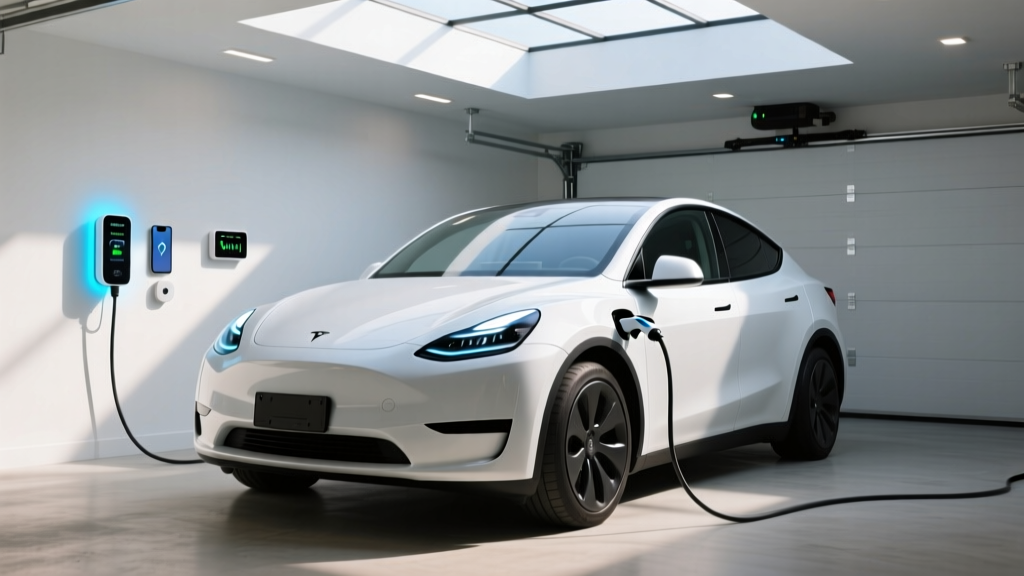
If you're searching for how long to charge a Tesla at home, the answer depends on your electrical setup and the specific Model Y variant you choose. With a hardwired Level 2 Tesla Wall Connector on a 60-amp circuit, a 2026 Model Y Long Range AWD (78 kWh usable battery) replenishes from 10% to 80% in roughly 6.5 hours — ideal for overnight top-ups. On a standard 240V/48A circuit (the most common residential install), expect about 7.5 to 8 hours for the same swing. Level 1 trickle charging on a 120V outlet? Plan on 3 to 4 days for a full charge, adding only about 3 to 5 miles of range per hour.
This review covers the 2026 Tesla Model Y lineup — the best-selling EV in the U.S. — with a focus on real-world home charging logistics, true range expectations, and whether the federal tax credit applies to your purchase.
EPA estimate: 320 miles (Long Range AWD, 19" wheels)
Real-world expectation: ~270–290 miles on mixed highway driving at 70–75 mph; ~230–260 miles in freezing temperatures (below 32°F) due to battery heating demands and cabin climate load. City driving with frequent regen braking can push efficiency closer to or slightly above the EPA sticker.
2026 Model Y Lineup: Specs, Battery Chemistry & Efficiency
Tesla simplified the Model Y range for 2026 into three primary trims. The Standard Range RWD uses a lithium iron phosphate (LFP) battery, while the Long Range AWD and Performance variants use nickel-manganese-cobalt (NMC) chemistry. This distinction matters for both longevity and charging habits.
| Spec | Standard Range RWD | Long Range AWD | Performance |
|---|---|---|---|
| EPA Range | 270 mi | 320 mi | 295 mi |
| Battery (Usable) | ~60 kWh (LFP) | ~78 kWh (NMC) | ~78 kWh (NMC) |
| MPGe (Combined) | 128 MPGe | 122 MPGe | 115 MPGe |
| kWh/100 mi | 26 | 28 | 29 |
| 0–60 mph | 6.5 sec | 4.8 sec | 3.5 sec |
| Horsepower | 295 hp | 384 hp | 456 hp |
| Drivetrain | RWD (single motor) | AWD (dual motor) | AWD (dual motor) |
| Base MSRP | $44,990 | $48,990 | $53,990 |
Chemistry note: LFP batteries (Standard Range) tolerate regular 100% charging without degradation concerns — Tesla actually recommends it. NMC batteries (Long Range, Performance) are best kept between 20–80% for daily use, reserving 100% for road trips. This affects your usable daily range: a Long Range owner charging to 80% effectively has ~256 miles available each morning.
How Long to Charge a Tesla at Home: Level 1, Level 2 & Wall Connector
Home charging speed is the single biggest ownership variable. Here's the breakdown by setup, using the Long Range AWD (78 kWh battery) as the baseline:
| Charging Level | Voltage / Amps | Power (kW) | Miles Added/Hr | 10–80% Time | Equipment Needed |
|---|---|---|---|---|---|
| Level 1 (Trickle) | 120V / 12A | ~1.4 kW | ~3–5 mi/hr | ~48–55 hrs | Standard outlet + Mobile Connector |
| Level 2 (Common) | 240V / 48A | ~11.5 kW | ~35–40 mi/hr | ~7.5–8 hrs | NEMA 14-50 outlet or hardwired |
| Level 2 (Max Tesla WC) | 240V / 48A (60A circuit) | ~11.5 kW | ~40–44 mi/hr | ~6.5–7 hrs | Tesla Wall Connector, hardwired |
| DC Fast Charge | Supercharger V4 | Peak 250 kW | N/A | ~25 min (10–80%) | Public Supercharger network |
Key insight on the charge curve: The 250 kW peak on a V3/V4 Supercharger is not sustained. The Model Y pulls maximum power between roughly 10–40% State of Charge, then tapers progressively. By 70%, you're typically seeing 60–80 kW. This is why the 10–80% time is 25 minutes rather than the ~18 minutes that sustained peak power would suggest.
Home charging cost: At the U.S. residential average of ~$0.16/kWh (per EIA data), a full 78 kWh charge for the Long Range costs about $12.48 — roughly $0.04 per mile. Compare that to a 25 MPG gas SUV at $3.30/gallon: $0.13 per mile.
Home Charger Installation: What You Actually Need
Most Tesla owners install a Level 2 solution at home. You have two paths:
- NEMA 14-50 outlet: A 240V/50A receptacle installed by a licensed electrician. Works with the Tesla Mobile Connector (included with some trims, ~$200 separately) or third-party Level 2 chargers. Typical install: $800–$1,500 depending on panel proximity and local permit costs.
- Tesla Wall Connector (hardwired): $475 for the unit, plus $500–$1,200 for professional installation on a 60A circuit. Delivers up to 11.5 kW (48A) to the vehicle. Hardwired installations avoid the GFCI breaker requirement that 14-50 outlets need in many jurisdictions, saving $100–$200 on the electrical panel side.
Panel upgrade warning: If your home has a 100-amp main panel, adding a 60-amp EV circuit may require a panel upgrade to 200 amps — costing $1,500–$3,000+. A licensed electrician should perform a load calculation before you commit. Some homes with 200-amp panels still need upgrades if existing loads (electric range, dryer, HVAC) are high.
Performance, Interior & Tech: The Ownership Experience
The 2026 Model Y received a significant refresh (internally called "Juniper") that addressed the most common criticisms of prior model years: ride harshness, cabin noise, and minimalist-to-a-fault interior controls.
Ride & handling: Revised suspension tuning and acoustic glass on all trims make the 2026 Model Y noticeably quieter at highway speeds. The Performance variant adds adaptive dampers. All trims ride on a 113.8-inch wheelbase.
Interior dimensions:
- Front headroom: 40.3 in | Rear headroom: 38.2 in
- Front legroom: 41.8 in | Rear legroom: 38.8 in
- Cargo (rear seats up): 30.2 cu ft
- Cargo (rear seats folded): 72.1 cu ft
- Frunk: 4.1 cu ft
Infotainment: The 15.4-inch center touchscreen remains the control hub. The refresh added ventilated front seats (all trims), a rear-seat 8-inch touchscreen for climate and entertainment, and ambient lighting. No Apple CarPlay or Android Auto — Tesla's proprietary system handles navigation, media, and vehicle controls natively.
Driver assistance: Basic Autopilot (Traffic-Aware Cruise Control + Autosteer) is standard. Full Self-Driving (Supervised) remains an $8,000 add-on or $99/month subscription. Per NHTSA SAE definitions, FSD Supervised is a Level 2 system — the driver must remain attentive with hands on or near the wheel at all times. This is not autonomous driving.
Pricing, Tax Credit Eligibility & 5-Year Ownership Cost
| Trim | Base MSRP | Destination | Federal Credit (§30D) | Effective Price (if eligible) |
|---|---|---|---|---|
| Standard Range RWD | $44,990 | $1,390 | Up to $7,500* | ~$38,880 |
| Long Range AWD | $48,990 | $1,390 | Up to $7,500* | ~$42,880 |
| Performance | $53,990 | $1,390 | Up to $7,500* | ~$47,880 |
*Federal tax credit caveats (IRS §30D): The $7,500 credit is not automatic. Per IRS guidelines, eligibility requires:
- MSRP cap: SUVs must be under $80,000 — all Model Y trims qualify.
- Buyer income cap: Modified AGI ≤ $150,000 (single) / ≤ $300,000 (joint).
- Battery sourcing: Critical minerals and battery components must meet escalating domestic/free-trade sourcing thresholds. Tesla's Fremont-built Model Y has historically qualified for the full $7,500, but component sourcing rules tighten annually. Verify current eligibility at fueleconomy.gov before purchasing.
- Point-of-sale transfer: You can transfer the credit to the dealer at purchase, reducing your out-of-pocket cost immediately rather than waiting for a tax refund.
Warranty: All Model Y trims include a 4-year/50,000-mile basic warranty and an 8-year/120,000-mile battery and drive unit warranty (Long Range/Performance) or 8-year/100,000-mile (Standard Range). The battery warranty guarantees at least 70% capacity retention over the coverage period.
Model Y vs. Competitors: Is It Worth Buying?
- Best-in-class Supercharger network access (17,000+ U.S. stalls, growing with NACS adoption by Ford, GM, Rivian)
- Lowest cost-per-mile in the compact electric SUV segment at ~$0.04/mi (home charging)
- Strong resale value relative to EV peers
- Over-the-air updates continuously add features
- Spacious cargo area with flat load floor (72.1 cu ft)
- No Apple CarPlay/Android Auto — Tesla ecosystem lock-in
- FSD (Supervised) remains Level 2 despite the "Full Self-Driving" name
- Insurance premiums run 15–25% higher than comparable gas SUVs
- Touchscreen-only controls (no physical buttons for climate, mirrors, glovebox) frustrate some buyers
- Competition closing the gap: Hyundai Ioniq 5, Ford Mustang Mach-E, Chevrolet Equinox EV all offer competitive range at lower prices
Consider competitors if: You want Apple CarPlay (Ioniq 5, Mach-E), a lower entry price (Equinox EV starts ~$33,000), or prefer physical buttons and traditional dealership service.
Frequently Asked Questions
What is the real-world range of the 2026 Tesla Model Y?
The Long Range AWD carries a 320-mile EPA estimate, but expect 270–290 miles on highway-heavy trips at 70–75 mph, and 230–260 miles in sub-freezing conditions. The Standard Range RWD (270 EPA) delivers roughly 230–245 miles in real-world mixed driving. Preconditioning the battery via the Tesla app before departure helps recover cold-weather range.
How fast does the Model Y charge at home vs. on the road?
At home on a Level 2 Wall Connector (11.5 kW), the Long Range adds ~40–44 miles of range per hour, reaching 10–80% in about 6.5–7 hours — perfect for overnight charging. On a V3/V4 Supercharger, the Long Range peaks at 250 kW DC and hits 10–80% in approximately 25 minutes, though the charge curve tapers significantly above 60%.
Does the 2026 Model Y qualify for the $7,500 federal EV tax credit?
All trims fall under the $80,000 SUV MSRP cap, but you must also meet IRS income limits ($150K single / $300K joint) and the vehicle must satisfy battery component and critical mineral sourcing requirements. As of early 2026, the U.S.-built Model Y has qualified for the full $7,500, but verify at fueleconomy.gov before purchasing — rules change periodically.
Is the Model Y worth buying over the Hyundai Ioniq 5 or Ford Mach-E?
The Model Y wins on Supercharger network access, cargo volume, and efficiency. The Ioniq 5 offers faster 800V DC charging (10–80% in ~18 minutes at 350 kW chargers), Apple CarPlay, and a more distinctive design. The Mach-E provides a more traditional driving experience with physical controls. If reliable public charging is your top priority, Tesla's network advantage remains significant.
Do I need to upgrade my electrical panel to charge a Tesla at home?
Not always, but possibly. A 200-amp panel with moderate existing loads usually supports a 48A or 60A EV circuit. A 100-amp panel almost certainly requires an upgrade ($1,500–$3,000+). Request a load calculation from a licensed electrician before purchasing equipment.
How long will the Model Y battery last before replacement?
Tesla's battery warranty guarantees 70%+ capacity retention for 8 years/120,000 miles (Long Range/Performance). Real-world data from high-mileage Tesla owners suggests NMC batteries typically retain 85–90% capacity at 100,000 miles with proper charging habits (20–80% daily, avoid frequent 100% charges and DC fast charging when not needed). Full battery replacement out of warranty runs $12,000–$16,000.