The Tesla Model Y remains one of the most popular electric SUVs on the road, and for many owners, its appeal extends beyond commuting to hauling bikes, small campers, and utility trailers. But executing a proper Tesla Model Y hitch install requires understanding the vehicle's structural tow rating, electrical harness requirements, and — critically — how towing affects range, charging logistics, and long-term drivetrain health.
This guide breaks down everything you need to know about adding a hitch to the 2026 Tesla Model Y, alongside a complete review of the vehicle's current specs, pricing, and ownership profile so you can decide whether it's the right tow-capable EV for your needs.
2026 Tesla Model Y: Quick Specs at a Glance
| Specification | Long Range AWD | Performance |
|---|---|---|
| EPA Range | 320 miles | 295 miles |
| Battery Capacity (usable) | ~75 kWh (NMC) | ~75 kWh (NMC) |
| Drivetrain | Dual-Motor AWD | Dual-Motor AWD |
| Horsepower | ~384 hp | ~456 hp |
| 0–60 mph | 4.8 sec | 3.5 sec |
| Max DC Fast Charge | 250 kW | 250 kW |
| 10–80% DC Charge Time | ~27 min | ~27 min |
| Level 2 Home Charge Rate | 11.5 kW (~44 mi/hr) | 11.5 kW (~44 mi/hr) |
| Efficiency | 122 MPGe / 28 kWh/100mi | 111 MPGe / 30 kWh/100mi |
| Max Towing Capacity | 3,500 lbs | 3,500 lbs |
| Cargo Volume (rear seats folded) | 72.1 cu ft | 72.1 cu ft |
| Base MSRP | $44,990 | $49,990 |
| Battery/Powertrain Warranty | 8 yr / 120,000 mi | 8 yr / 120,000 mi |
Tesla Model Y Hitch Install: What's Involved
Tesla offers an official tow hitch accessory for the Model Y, and the installation process is more straightforward than on many ICE vehicles because there's no exhaust routing to work around. Here's what a typical install entails:
Hitch Hardware and Receiver
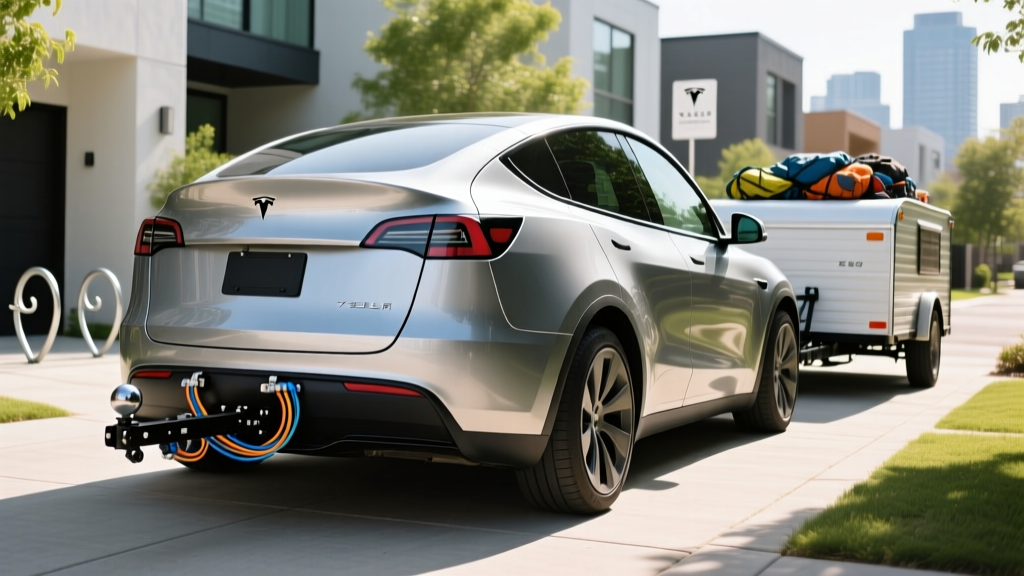
The Tesla OEM hitch uses a 2-inch receiver and bolts directly to reinforced structural points on the Model Y's rear subframe. The kit includes the receiver bar, mounting hardware, and a trim bezel that integrates with the rear bumper fascia. Aftermarket options from Curt, Draw-Tite, and EcoHitch are also available, typically ranging from $200–$450 for the hardware alone.
Wiring Harness and 7-Pin Connector
This is where most DIY installs get complicated. The Model Y requires a dedicated wiring harness that connects to the vehicle's rear electrical junction to power trailer lights (brake, turn, running). Tesla's official tow package includes a 7-pin connector and software enablement — the car's onboard computer must recognize the trailer to adjust stability control and regenerative braking behavior. Aftermarket harnesses from companies like Curt and Tekonsha are available, but some owners report that third-party harnesses require additional programming steps or may not fully integrate with Tesla's trailer mode.
Software Enablement
Once the physical hardware is installed, the Model Y needs a software activation to unlock "Trailer Mode" in the vehicle settings. When ordering the OEM hitch through Tesla, this is handled automatically at the service center. For aftermarket installs, owners may need to visit a Tesla service center to have the software enabled — a step that some have reported Tesla will perform and others have been denied, depending on the service center.
Professional vs. DIY
A Tesla service center hitch install typically runs $1,200–$1,500 total (parts and labor). Independent EV-qualified shops may offer it for $800–$1,100. A full DIY is possible for mechanically inclined owners, but the wiring harness integration and software activation make it more complex than a bolt-on hitch for a conventional SUV.
Real-World Range and Efficiency When Towing
Real-World Without Trailer: Expect ~270–290 miles on highway trips at 70 mph; ~300+ miles in mixed city driving where regen recovers energy.
Real-World Towing (1,500–2,500 lb trailer): Expect a 40–55% range reduction — roughly 145–180 miles of practical range depending on trailer aerodynamics, terrain, and speed.
Cold-Weather Impact: Add another 15–25% reduction in freezing temperatures, whether towing or not.
Towing is the single biggest range destroyer for any EV. The Model Y's aerodynamic profile is optimized for low drag, but attaching a boxy trailer or boat eliminates that advantage entirely. In real-world testing by owners pulling lightweight teardrop campers (~1,800 lbs), energy consumption climbs from the stock ~28 kWh/100mi to 55–70 kWh/100mi, depending on speed and trailer shape.
For context, a 2,000-lb utility trailer on a flat highway at 65 mph might leave you with ~170 miles of range. A heavier camper at 70 mph through rolling hills could drop that to 130–140 miles. Plan charging stops accordingly — the Supercharger network is robust, but not every station is positioned for easy trailer maneuvering.
Charging Speed: DC Fast and Home Level 2
| Charging Level | Power (kW) | Speed / Notes |
|---|---|---|
| Level 1 (120V household) | ~1.4 kW | ~5 mi/hr — emergency/trickle only |
| Level 2 (240V home, 48A) | 11.5 kW | ~44 mi/hr — full charge in ~7.5 hours |
| DC Fast Charge (peak) | 250 kW | 10–80% in ~27 min; tapers significantly above 80% |
| DC Fast Charge (sustained avg 10–80%) | ~140 kW | Peak 250 kW is only sustained briefly below 30% SoC |
The Model Y's charging architecture tops out at 250 kW on V3 Superchargers. In practice, the charge curve is aggressive: you'll see peak rates only between roughly 10–30% State of Charge, after which the rate tapers progressively. By 60% SoC, you're typically pulling 100–120 kW; by 80%, it drops to ~50 kW. This is standard lithium-ion behavior — the battery management system protects cell health by reducing current as voltage rises.
At home on a Level 2 wall connector (48 amps / 240V), the Model Y adds roughly 44 miles of range per hour. A full overnight charge from 20% to 100% takes about 8 hours — plenty for daily driving recovery.
Towing charging tip: When towing long distances, precondition the battery by navigating to a Supercharger in the car's built-in nav. This warms the pack and enables peak charge rates on arrival. Without preconditioning, cold-soak can cut your peak DC rate by 30–50%.
Pricing, Tax Credits, and Total Cost
| Item | Long Range AWD | Performance |
|---|---|---|
| Base MSRP | $44,990 | $49,990 |
| Destination Fee | $1,390 | $1,390 |
| OEM Tow Hitch (installed) | ~$1,200 | ~$1,200 |
| Federal §30D Tax Credit | Up to $7,500 (see eligibility) | Up to $7,500 (see eligibility) |
| Estimated Out-the-Door (with credit) | ~$40,080 | ~$45,080 |
The Model Y qualifies for the IRS §30D federal tax credit of up to $7,500, but eligibility is not automatic. Current rules impose:
- MSRP cap: SUVs must be under $80,000 — the Model Y clears this easily.
- Buyer income cap: Modified AGI must not exceed $150,000 (single), $225,000 (head of household), or $300,000 (joint).
- Battery sourcing: A percentage of critical minerals and battery components must be sourced from the U.S. or free-trade-agreement countries. Tesla's U.S.-built packs have generally met these thresholds, but the specific requirements tighten annually. Verify current-year compliance on the IRS clean vehicle credit page or via the fueleconomy.gov tax credit lookup.
- Point-of-sale transfer: As of 2024, buyers can transfer the credit to the dealer at purchase, reducing the out-of-pocket price immediately rather than waiting for a tax refund.
Always confirm eligibility with a tax professional before relying on the credit — rules change, and individual circumstances vary.
Interior, Cargo, and Practicality
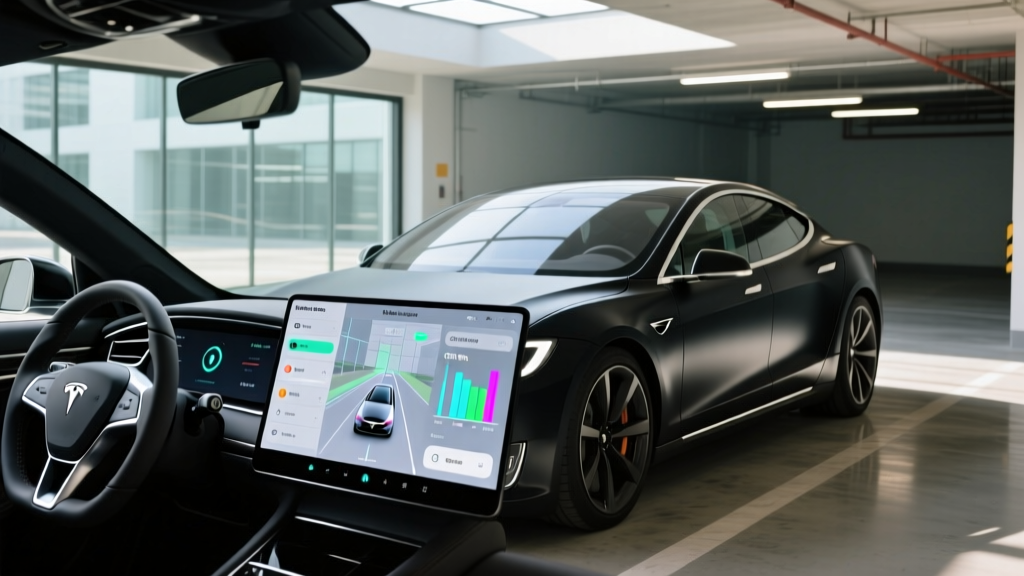
The Model Y's cabin prioritizes minimalism. There's a single 15-inch touchscreen controlling all functions — no physical instrument cluster or head-up display. Build quality on 2025–2026 models has improved noticeably over earlier Fremont-built units, with tighter panel gaps and better sound insulation.
- Cargo (behind 2nd row): 30.2 cu ft
- Cargo (seats folded): 72.1 cu ft
- Frunk (front trunk): 4.1 cu ft — useful for charging cables or a small bag
- Rear legroom: 41.6 inches
- Seating: 5-passenger standard; a 7-seat option was previously offered but has been discontinued on recent model years
For towing use cases, the cargo area is generous enough for camping gear, and the low load floor (no transmission tunnel) makes sliding in heavy items easier than in many ICE crossovers.
Driver Assistance and Technology
The Model Y ships with Tesla's basic Autopilot (adaptive cruise control + lane centering). The optional FSD (Supervised) package adds automated lane changes, traffic light/stop sign recognition, and Navigate on Autopilot for highway ramps. It remains a supervised system — impressive on long highway stretches but not a replacement for an attentive driver.
When towing, Trailer Mode adjusts the stability control algorithms and modifies regenerative braking behavior to account for the additional mass behind the axle. This is a meaningful safety feature — unassisted regen can cause trailer sway under heavy deceleration.
Who Should Buy the Model Y for Towing?
- 3,500-lb tow rating covers bikes, kayaks, small campers, utility trailers
- Supercharger network enables long-distance towing (with planning)
- Trailer Mode integrates stability and regen for safer towing
- Massive cargo space with flat load floor
- Low running costs vs. gas SUV (~$0.04–0.08/mile on home charging)
- Strong 0–60 and passing power even with a trailer
- 40–55% range loss when towing — frequent charging stops required
- Not all Supercharger stalls accommodate trailers easily
- Hitch install requires software activation — limits pure DIY
- No spare tire — Tesla provides tire repair kit only
- Insurance premiums tend to run higher than competitors
- Minimalist interior isn't for everyone — no physical buttons
Best for: Weekend warriors pulling lightweight campers, bike racks, or cargo trailers who also want a daily-driver commuter with low operating costs. The Model Y's tow rating and efficiency make it viable for towing, but it's not a heavy-duty hauler.
Look elsewhere if: You need to tow over 3,500 lbs regularly, frequently tow in remote areas with sparse charging, or prefer a traditional SUV interface with physical controls and a spare tire.
Frequently Asked Questions
What is the real-world range of the Tesla Model Y?
The EPA rates the Long Range AWD at 320 miles. In real-world highway driving at 70 mph, expect ~270–290 miles. In cold weather (below 32°F), that can drop to ~230–260 miles. City driving with regenerative braking can exceed the EPA estimate.
How fast does the Model Y charge at home and on the road?
On a Level 2 home charger (48A/240V), it adds ~44 miles per hour, fully charging overnight. On a 250 kW V3 Supercharger, it charges from 10–80% in about 27 minutes, though peak rate is only sustained briefly at low SoC.
How much does the Model Y cost after federal tax credits?
The Long Range AWD starts at $44,990 plus destination. With the full $7,500 §30D credit (if eligible), the effective price drops to ~$38,880. Eligibility depends on buyer income, battery sourcing compliance, and MSRP caps — verify with the IRS or a tax professional.
Is the Model Y worth buying vs. competitors for towing?
Against the Ford Mustang Mach-E (which has no official tow rating in the U.S.) and Hyundai Ioniq 5 (1,650-lb tow rating), the Model Y's 3,500-lb capacity is class-leading among electric crossovers. The Rivian R1S offers 7,700 lbs but starts significantly higher. For light-to-medium towing on an EV budget, the Model Y is the strongest option.
Does the Tesla Model Y qualify for the federal EV tax credit?
Yes, the Model Y currently qualifies for up to $7,500 under IRS §30D, subject to buyer income limits ($300k joint / $150k single), the $80k SUV MSRP cap, and battery critical-mineral sourcing requirements. Check irs.gov for current-year rules.
Can I install a hitch on the Model Y myself?
The physical hitch hardware can be bolted on by a capable DIYer, but the wiring harness integration and Trailer Mode software activation typically require a Tesla service center visit. Budget installs run $800–$1,500 depending on OEM vs. aftermarket parts and who does the work.