Why the Tesla Model Y GVWR Matters for Real-World Buyers
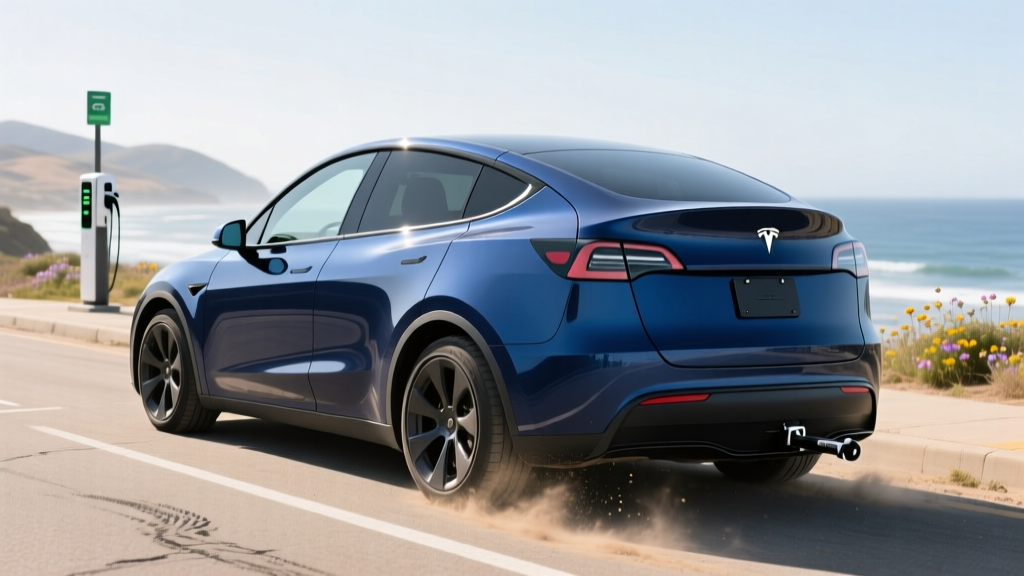
Most Tesla Model Y reviews focus on 0-60 times and Autopilot updates. But if you plan to load up the cargo area, mount a hitch rack, tow a small trailer, or simply understand how much weight the chassis is legally rated to carry, you need one number above all others: the Gross Vehicle Weight Rating (GVWR). The 2026 Tesla Model Y's GVWR dictates the maximum allowable combined weight of the vehicle, passengers, cargo, and tongue load — and exceeding it voids warranty coverage, compromises braking distances, and can invalidate insurance claims.
This review walks through the 2026 Model Y's GVWR, payload math, towing limits, and every spec that flows from weight — including range loss under load, charging realities, and after-credit pricing.
2026 Tesla Model Y Spec Table: Weight, Range, Power, and Price
| Specification | Long Range AWD (5-seat) | Performance AWD | Long Range RWD |
|---|---|---|---|
| GVWR | 5,602 lb (2,541 kg) | 5,602 lb (2,541 kg) | 5,434 lb (2,465 kg) |
| Curb Weight (approx.) | 4,363 lb | 4,416 lb | 4,212 lb |
| Max Payload | ~1,239 lb | ~1,186 lb | ~1,222 lb |
| Max Towing Capacity | 3,500 lb | 3,500 lb | 3,500 lb |
| EPA Range | 320 mi | 277 mi | 337 mi |
| Battery (usable) | ~75 kWh, NMC | ~75 kWh, NMC | ~75 kWh, NMC |
| 0-60 mph | 4.8 sec | 3.5 sec | 5.8 sec |
| Horsepower | 384 hp | 456 hp | 295 hp |
| Base MSRP | $48,990 | $52,990 | $45,990 |
Sources: Tesla spec sheets, fueleconomy.gov. Specs reflect 2026 model-year Long Range and Performance variants with the 19" Gemini or 20" wheels. Refresh (Juniper) trims may vary slightly.
Breaking Down the Model Y GVWR and Payload Math
The 2026 Model Y Long Range AWD carries a GVWR of 5,602 lb. Subtract the curb weight (~4,363 lb) and you get roughly 1,239 lb of payload — the budget for five passengers, groceries, roof cargo, and tongue weight from a trailer.
That payload number sounds generous until you do family math: four 180-lb adults (720 lb) plus a week of luggage (200 lb) plus a hitch-mounted bike rack (60 lb rack + 120 lb bikes) pushes you to 1,100 lb. You're still legal, but you have little margin. The Model Y's payload is competitive with the Ford Mustang Mach-E (~1,100 lb) and slightly lower than the Hyundai Ioniq 5 (~1,300 lb) because Tesla's structural battery pack adds mass low in the chassis.
Critical note: tongue weight from a trailer counts against payload, not against the 3,500-lb tow rating. A 3,000-lb trailer typically imposes 300-450 lb of tongue weight, which eats 25-35% of your remaining payload. Buyers planning to tow near the limit must budget passengers and cargo accordingly.
Real-World Range: What Happens Under Load
Real-World Expectation: 260-290 mi highway at 70 mph; 220-250 mi in sub-30°F weather
While Towing 3,000 lb: Expect 150-180 mi usable range on flat terrain, less in mountains
The Model Y's efficiency is among the best in its class — roughly 26 kWh/100 mi (130 MPGe combined) on the EPA cycle. But physics punishes weight. Every 500 lb of added mass costs roughly 5-8% of range in mixed driving. Towing a loaded trailer roughly halves range because you're fighting both mass and aerodynamic drag from the trailer's flat face.
Owners who frequently tow should treat 150 miles as a practical maximum between charges on a flat route and plan Supercharger stops accordingly. The Model Y's trip planner accounts for trailer load when Tow Mode is engaged, but real-world terrain and wind routinely beat its estimates by 10-15%.
Charging Speed: DC Fast, Level 2, and the Weight Penalty
| Charging Level | Max Power | Practical Delivery |
|---|---|---|
| DC Fast (V3/V4 Supercharger) | 250 kW peak | 10-80% in ~25 min; sustained ~150 kW average |
| Level 2 (home wall connector, 48A) | 11.5 kW | ~44 mi/hr; full charge in ~8 hrs |
| Level 1 (120V, 12A) | 1.4 kW | ~5 mi/hr; emergency/trickle only |
The 2026 Model Y uses NACS natively and can access the full Supercharger network plus the growing NACS-open networks (Ford, Rivian, GM, Volvo adopters). On a V3 or V4 Supercharger, the charge curve peaks at 250 kW below 30% SoC, holds ~170 kW through 50%, then tapers steeply past 80%. A 10-80% session takes about 25 minutes in warm conditions; preconditioning is essential in cold weather to hit these numbers.
At home on a 48-amp Level 2 wall connector (requiring a 60-amp circuit — budget $800-$1,500 for installation including panel evaluation), you'll add roughly 44 miles per hour of charging, which is ample for daily driving. Heavy-tow days that drain the pack to 20% require an overnight charge.
Pricing, Tax Credits, and Out-the-Door Cost
| Trim | Base MSRP | Est. After §30D Credit* | Notes |
|---|---|---|---|
| Long Range RWD | $45,990 | ~$38,490 | Below $55k SUV cap |
| Long Range AWD | $48,990 | ~$41,490 | Most popular config |
| Performance AWD | $52,990 | ~$45,490 | Still under cap |
*The IRS §30D credit requires buyer AGI ≤ $150k single / $300k joint, MSRP ≤ $80k for SUVs, and battery/critical-mineral sourcing compliance. Tesla's US-built Model Y has historically qualified for the full $7,500, and point-of-sale transfer is now available via registered dealers. Always verify current-year eligibility on irs.gov before purchase — sourcing rules tightened in 2025-2026.
Destination fee (~$1,390), state registration, and any FSD Supervised subscription ($99/mo or $8,000 purchase) add to the final price. Insurance averages $1,800-$2,400/yr depending on state and driver profile, higher than the Mach-E and Ioniq 5.
Cargo Space, Interior, and Daily-Use Practicality
The Model Y's liftback design remains its strongest packaging advantage over SUV competitors with traditional tailgates. Cargo volume measures 30.2 cu ft behind the second row and 72.1 cu ft with seats folded, plus a usable 4.1 cu ft frunk. Rear legroom is 40.5 in — adequate for adults but tighter than the Ioniq 5's 41.7 in.
The minimalist interior (single 15.4" center screen, no instrument cluster, stalkless steering column) is polarizing but functional. The 2026 Juniper refresh added ventilated front seats, ambient lighting, and a rear touchscreen, addressing longstanding complaints. Build quality has improved materially since the Fremont-era panel-gap reputation, with Shanghai and Austin cars showing tighter tolerances.
Driver-Assist Tech: What It Does and Does Not Do
Standard Autopilot includes Traffic-Aware Cruise Control and Autosteer. FSD (Supervised) adds automatic lane changes, Navigate on Autopilot, traffic-light/stop-sign recognition, and limited city-street autosteer. It is impressive on well-marked highways but remains a convenience feature, not a substitute for an attentive driver. Competitors like GM's Super Cruise and Ford's BlueCruise offer hands-off operation on mapped highways — a meaningful differentiation for frequent road-trippers who want reduced fatigue.
Pros and Cons
Pros
- Best-in-class Supercharger network access (250 kW peak)
- Excellent efficiency (130 MPGe combined)
- Liftback cargo versatility beats most compact SUVs
- Strong §30D credit eligibility keeps effective price competitive
- OTA updates continuously add features post-purchase
Cons
- GVWR payload tight when towing near 3,500-lb limit with passengers
- Range drops sharply (40-50%) under heavy tow loads
- Insurance costs 15-25% above class average
- Vision-only driver assist still falters in adverse weather
- No physical controls for mirrors, glovebox, or wipers — screen dependency
Who Should Buy the 2026 Model Y (And Who Should Look Elsewhere)
Buy the Model Y if: you want the most efficient long-range electric SUV with the most mature DC fast-charging network, you tow occasionally but not daily, and you value cargo versatility. It remains the default EV choice for families who road-trip.
Look at the Hyundai Ioniq 5 or Kia EV6 if: you prioritize rear-seat comfort, 800V ultra-fast charging (10-80% in ~18 min on 350-kW chargers), and a more traditional interior layout. Both trail the Model Y in range and charging-network breadth but lead in cabin refinement.
Consider the Ford F-150 Lightning or Rivian R1S if: you need genuine 7,000+ lb towing or serious payload for work use. The Model Y's 3,500-lb tow rating is fine for bike racks and small camping trailers but not for boats or horse trailers.
Frequently Asked Questions
What is the exact GVWR of the 2026 Tesla Model Y?
The Long Range AWD and Performance variants are rated at 5,602 lb (2,541 kg). The Long Range RWD is rated at 5,434 lb. The door-jamb sticker on any specific vehicle is the definitive source — tire size, options, and production batch cause small variance.
Can I tow a 3,500-lb trailer with five passengers in the Model Y?
Mathematically, no — not safely. A 3,500-lb trailer with ~400 lb of tongue weight, plus five 170-lb passengers (850 lb), totals 1,250 lb of payload demand against the AWD's ~1,239-lb capacity. You'd be at or over GVWR. Reduce passenger count or cargo when towing near the limit.
Does the Model Y still qualify for the $7,500 federal tax credit in 2026?
As of current IRS published lists, the US-built Model Y qualifies for the full $7,500 under §30D, subject to buyer income caps ($150k single / $300k joint AGI) and point-of-sale transfer at a registered dealer. Verify current-year eligibility before signing paperwork — critical-mineral sourcing rules evolve annually.
How much range do I lose towing with the Model Y?
Expect 40-50% range reduction towing a 3,000-lb trailer at highway speeds on flat terrain (320 mi EPA → ~160-180 mi real). Mountain routes, headwinds, and cold weather compound the loss. Plan Supercharger stops at 100-120 mile intervals when towing.
Is the Model Y worth buying vs the Mustang Mach-E or Ioniq 5?
The Model Y wins on range, Supercharger network access, and cargo versatility. The Mach-E edges it on driving dynamics; the Ioniq 5 wins on 800V charge speed and interior comfort. If network access and efficiency dominate your decision, the Model Y remains the default. If cabin quality and DC charge peak matter more, test-drive the Korean alternatives.
Does the 2026 Model Y have a frunk?
Yes — a 4.1 cu ft front trunk, useful for charging cables, a soft cooler, or a laptop bag. It's smaller than the Ioniq 5's 0.85 cu ft (which is actually smaller) but larger than most competitors. The power-latch release is now standard.
Always verify specific vehicle GVWR on the door-jamb certification label and confirm tax-credit eligibility on irs.gov before purchase. Specs in this article reflect 2026 model-year data available at publication.