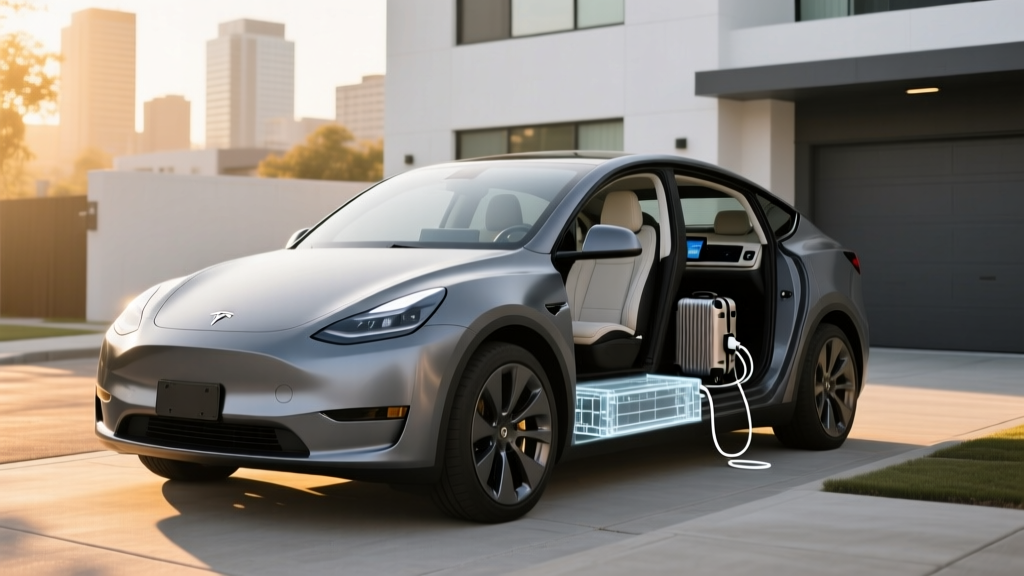
Why GVWR Matters for the Tesla Model Y
When EV shoppers research the Tesla Model Y, most focus on range, 0-60 times, and price. But if you plan to tow a trailer, haul cargo, or load up the cabin with passengers and gear, the number that actually limits you is the Gross Vehicle Weight Rating (GVWR) — the maximum allowable total weight of the vehicle, passengers, cargo, and tongue weight combined.
The 2026 Tesla Model Y (refreshed "Juniper" generation) carries a GVWR of approximately 5,644 lbs (2,560 kg) across its Long Range AWD and Performance trims. That figure determines everything from how much you can safely tow to whether you'll need a weight-distribution hitch for a camping trailer.
This guide breaks down the Model Y's GVWR alongside its real-world range, charging speeds, pricing, and tax-credit status — the data points that matter when you're deciding if this crossover fits your lifestyle.
2026 Tesla Model Y: Key Specifications at a Glance
| Specification | Long Range AWD | Performance AWD |
|---|---|---|
| EPA Range | 320 miles | 294 miles |
| Battery (usable) | ~78 kWh, NMC | ~78 kWh, NMC |
| GVWR | ~5,644 lbs | ~5,644 lbs |
| Curb Weight | ~4,398 lbs | ~4,460 lbs |
| Max Payload | ~1,246 lbs | ~1,184 lbs |
| Towing Capacity | 3,500 lbs | 3,500 lbs |
| Peak DC Charge | 250 kW | 250 kW |
| 10–80% DC Time | ~27 min | ~27 min |
| Level 2 Charge Rate | 11.5 kW (~44 mi/hr) | 11.5 kW (~44 mi/hr) |
| 0–60 mph | 4.8 sec | 3.5 sec |
| Horsepower | 384 hp | 456 hp |
| Drivetrain | Dual-Motor AWD | Dual-Motor AWD |
| MPGe (combined) | 111 MPGe | 102 MPGe |
| Efficiency | 30 kWh/100 mi | 33 kWh/100 mi |
| Base MSRP | $44,990 | $52,490 |
| Battery Warranty | 8 yr / 120,000 mi | 8 yr / 120,000 mi |
Sources: fueleconomy.gov, Tesla.com Model Y specs. Specs reflect 2026 model year; always verify on your specific build.
GVWR, Payload, and Towing: What the Numbers Mean
Understanding GVWR requires looking at three related figures:
- Curb weight: The vehicle's weight with fluids but no passengers or cargo. For the Long Range AWD, that's approximately 4,398 lbs.
- GVWR: The manufacturer's maximum safe total weight — ~5,644 lbs.
- Max payload: GVWR minus curb weight — roughly 1,246 lbs for the Long Range AWD. This includes passengers, cargo, and tongue weight from a trailer.
Practical Payload Scenarios
With a 1,246-lb payload on the Long Range, here's how the math works for typical loading:
- Five 170-lb passengers = 850 lbs → 396 lbs remaining for cargo
- Two passengers (340 lbs) + 300 lbs trunk cargo = 640 lbs → 606 lbs remaining
- Towing a 2,500-lb trailer with 250 lbs tongue weight: tongue weight counts against payload, leaving ~996 lbs for people and gear inside the car
Towing Capacity: 3,500 lbs — With Caveats
The 2026 Model Y is rated to tow 3,500 lbs when equipped with the factory tow hitch and wiring harness. This covers most small camping trailers, utility trailers, and a pair of jet skis. However, towing at maximum capacity with a full cabin will push you close to the GVWR ceiling. Tesla's onboard software estimates range loss based on trailer weight and aerodynamics — expect a 30–50% range reduction when towing near the limit at highway speeds.
Charging Speeds: Supercharger to Home Level 2
The 2026 Model Y supports Tesla's V3 and V4 Supercharger network at up to 250 kW peak, using the NACS (North American Charging Standard) connector — the connector now adopted industry-wide.
| Charging Level | Power | Speed (miles/hr) | Notes |
|---|---|---|---|
| Level 1 (120V) | ~1.4 kW | ~5 mi/hr | Emergency/trickle only |
| Level 2 (240V, 48A) | 11.5 kW | ~44 mi/hr | Home Wall Connector; full charge ~7.5 hrs |
| DC Fast (Supercharger V3/V4) | Up to 250 kW | ~1,000+ mi/hr peak | 10–80% in ~27 min; tapers above 80% |
Understanding the Charge Curve
The 250 kW peak rate is not sustained across the entire session. The Model Y's NMC battery charges fastest between 10–50% State of Charge, then progressively tapers. By 80%, the rate drops to roughly 60–80 kW. Charging from 80–100% on DC is slow and generally unnecessary — Tesla recommends daily charging to 80–90% for NMC battery longevity.
At home on a Level 2 Tesla Wall Connector (48 amps, 240V), the Model Y adds roughly 44 miles of range per hour. A full overnight charge from 20% to 100% takes about 7.5 hours — easily handled while you sleep. Installation costs for a 240V/60A circuit typically range from $800 to $2,500 depending on panel proximity and whether your home's electrical panel needs an upgrade to 200A service.
Performance, Efficiency, and Driving Dynamics
The dual-motor AWD powertrain in the Long Range produces 384 hp and delivers a 0–60 mph time of 4.8 seconds — quick for a family crossover that returns 111 MPGe combined. The Performance trim bumps output to 456 hp and drops the sprint to 3.5 seconds, at the cost of roughly 26 miles of EPA range and a stiffer ride.
Efficiency is where the Model Y continues to lead the compact electric SUV segment. At 30 kWh per 100 miles (Long Range), it's one of the most efficient vehicles in its class, translating to lower electricity costs per mile and more range from the ~78 kWh usable battery. The Juniper refresh improved aerodynamic drag and introduced a heat pump as standard, reducing cold-weather energy consumption versus earlier resistance-heater models.
Driver Assistance: Autopilot and FSD (Supervised)
Every Model Y includes Basic Autopilot — lane centering and adaptive cruise control. Tesla's optional Full Self-Driving (Supervised) package ($8,000 or $99/month subscription) adds automated lane changes, navigation-on-autopilot, traffic light/stop sign recognition, and parking assist.
Pricing, Tax Credits, and Ownership Costs
The 2026 Model Y lineup starts at $44,990 for the Long Range AWD and $52,490 for the Performance — before destination fees, options, or incentives.
| Trim | Base MSRP | Destination | Est. Total | §30D Credit Eligibility |
|---|---|---|---|---|
| Long Range AWD | $44,990 | $1,390 | $46,380 | Up to $7,500 (see rules) |
| Performance AWD | $52,490 | $1,390 | $53,880 | Up to $7,500 (see rules) |
Federal Tax Credit: §30D Eligibility Rules
The Model Y may qualify for up to $7,500 under the IRS §30D New Clean Vehicle Credit, but eligibility depends on several requirements that change periodically:
- MSRP cap: SUVs must be at or below $80,000 — both trims qualify.
- Buyer income cap: Modified AGI must not exceed $150,000 (single), $225,000 (head of household), or $300,000 (joint).
- Battery sourcing: A percentage of critical minerals and battery components must be sourced from the U.S. or FTA partners. Tesla's U.S.-built batteries generally satisfy current thresholds, but percentages increase annually — verify on the fueleconomy.gov credit lookup for your specific build date.
- Point-of-sale transfer: As of 2024, buyers can transfer the credit to the dealer at purchase, effectively reducing the purchase price by up to $7,500 at the point of sale rather than waiting for a tax refund.
Tax rules are complex and subject to change. Consult a tax professional and verify current IRS guidance before relying on credit eligibility.
Cargo Space, Interior, and Technology
The Juniper-refreshed Model Y offers meaningful interior improvements over its predecessor:
- Cargo (rear seats up): 30.2 cu ft
- Cargo (rear seats folded): 72.1 cu ft
- Front trunk (frunk): 4.1 cu ft — enough for a charging cable bag and small soft cooler
- Rear legroom: 41.6 inches
- Front headroom: 41.0 inches
The 15.4-inch center touchscreen controls virtually all vehicle functions — climate, navigation, media, and vehicle settings — with a redesigned, more responsive interface in the Juniper generation. A rear 8-inch touchscreen gives back-seat passengers control over climate and entertainment. Ventilated front seats, ambient lighting, and power-folding second-row seats are now standard on Long Range.
Notable Drawbacks
- No physical buttons for climate or volume — everything routes through the touchscreen or steering-wheel scroll wheels
- Ride quality on the Performance trim is firm over broken pavement
- Panel gaps and paint quality, while improved, still lag legacy luxury brands
- Insurance premiums run 15–25% higher than comparable gas crossovers in many states
Pros, Cons, and Who Should Buy the Model Y
Pros
- Class-leading efficiency (30 kWh/100 mi)
- Access to Tesla Supercharger network — the most reliable DC fast-charging network in the U.S.
- 3,500-lb towing with integrated software trailer mode
- Strong real-world range (320 EPA / ~270–290 highway)
- Spacious cargo area with flat-load floor
- Over-the-air updates add features post-purchase
Cons
- Touchscreen-only controls frustrate some drivers
- Performance trim ride is stiff for daily commuting
- Towing near 3,500 lbs cuts range by 30–50%
- Insurance costs above segment average
- No Apple CarPlay or Android Auto
- Build quality still inconsistent vs. Hyundai/Kia
Best Use Cases
The Model Y is ideal for: Families needing a two-row electric crossover with strong range, frequent road-trippers who benefit from Tesla's Supercharger network, and commuters who want low per-mile energy costs. The 3,500-lb tow rating handles weekend camper trailers, but if you regularly tow above 2,500 lbs, the real-world range hit demands careful route planning around Supercharger stops.
Look elsewhere if: You need three rows of seating (consider the Kia EV9), you prefer physical buttons and Apple CarPlay (Hyundai Ioniq 5, Ford Mustang Mach-E), or you tow heavy loads regularly (the Rivian R1S or Ford F-150 Lightning are better suited).
Frequently Asked Questions
What is the real-world range of the 2026 Tesla Model Y?
The EPA rates the Long Range AWD at 320 miles. In mixed real-world driving at moderate temperatures, owners typically see 280–310 miles. Sustained 75–80 mph highway driving drops this to 270–290 miles. In sub-freezing temperatures, expect 220–250 miles unless you precondition the battery. The Performance trim's 294-mile EPA rating translates to roughly 250–270 miles in typical mixed driving.
How fast does the Model Y charge at home and on the road?
On a Tesla Wall Connector (Level 2, 48A/240V), the Model Y charges at 11.5 kW, adding about 44 miles of range per hour — a full charge takes roughly 7.5 hours. On a V3 or V4 Supercharger, it peaks at 250 kW and charges from 10–80% in approximately 27 minutes, though the rate tapers significantly above 80% State of Charge.
Does the Tesla Model Y qualify for the federal EV tax credit?
The Model Y is eligible for up to $7,500 under IRS §30D, provided the buyer meets income caps ($300K joint / $150K single), the MSRP is under $80,000 (both trims qualify), and the battery meets critical-mineral and component sourcing thresholds for the model year. The credit can be transferred to the dealer at the point of sale to reduce your purchase price directly. Always verify current eligibility on fueleconomy.gov and with a tax professional.
What is the Tesla Model Y's GVWR and why does it matter?
The 2026 Model Y has a GVWR of approximately 5,644 lbs. This is the maximum total weight the vehicle is rated to carry — including the car itself, passengers, cargo, and trailer tongue weight. Exceeding GVWR compromises braking, suspension, and tire safety, and may void warranty coverage. If you plan to tow, always subtract tongue weight from your available payload.
Is the Model Y worth buying versus competitors in 2026?
The Model Y remains the benchmark for efficiency and charging-network access. Its 320-mile range, 250 kW Supercharging, and 111 MPGe lead the segment. However, the Hyundai Ioniq 5 offers faster 800V charging architecture (10–80% in ~18 min), Apple CarPlay, and a more conventional interior. The Ford Mustang Mach-E provides a sportier drive with physical controls. If Supercharger access and efficiency are your priorities, the Model Y is still hard to beat. If you value interior refinement, physical controls, or the fastest public charging, test-drive the Ioniq 5 before committing.
What is the battery warranty on the 2026 Model Y?
Tesla covers the Model Y's battery and drive unit for 8 years or 120,000 miles, whichever comes first, with a minimum 70% capacity retention guarantee. If the battery degrades below 70% of its original capacity within that period, Tesla will repair or replace it. NMC batteries in Tesla vehicles have historically shown roughly 10–12% degradation over the first 100,000 miles based on fleet data, well within the warranty threshold.