The Tesla Model Y's Front Trunk: What You Actually Need to Know
Search for "front trunk Tesla" and you'll find thousands of owners debating what fits inside the Model Y's frunk — and whether it's a genuine cargo advantage or just a clever marketing talking point. The truth, as with most things in EV ownership, lives in the details. The 2026 Tesla Model Y (refreshed "Juniper" generation) carries a 4.1-cubic-foot front trunk, a meaningful upgrade from the pre-refresh model's roughly 2.8 cu ft. It's weather-sealed, drainable, and genuinely useful — but it won't replace your rear cargo area.
This review covers the full 2026 Tesla Model Y Long Range AWD and Performance trims with a specific lens on frunk practicality, while delivering the hard specs every EV buyer needs: EPA range, real-world efficiency, charging speeds, battery chemistry, pricing after the federal tax credit, and how it stacks up against the Hyundai Ioniq 5, Ford Mustang Mach-E, and Chevrolet Equinox EV.
| Spec | Value |
|---|---|
| EPA Range | 320 miles (Long Range AWD) |
| Battery Capacity | ~78.1 kWh usable, NMC (2170 cells) |
| Drivetrain | Dual-motor AWD |
| Horsepower | 384 hp combined |
| 0–60 mph | 4.8 seconds (Long Range); 3.5 sec (Performance) |
| MPGe (combined) | 111 MPGe / 30 kWh/100 mi |
| Max DC Fast Charge | 250 kW peak (V3 Supercharger) |
| 10–80% DCFC Time | ~27 minutes (preconditioned) |
| Level 2 Home Charge | 11.5 kW / ~44 mi/hr (48A Wall Connector) |
| Front Trunk (Frunk) | 4.1 cu ft |
| Rear Cargo (seats up / folded) | 26.6 / 72.0 cu ft |
| Battery Warranty | 8 years / 120,000 miles |
| Base MSRP | $44,990 (Long Range AWD) |
Front Trunk Deep Dive: Dimensions, Access, and Real-World Use
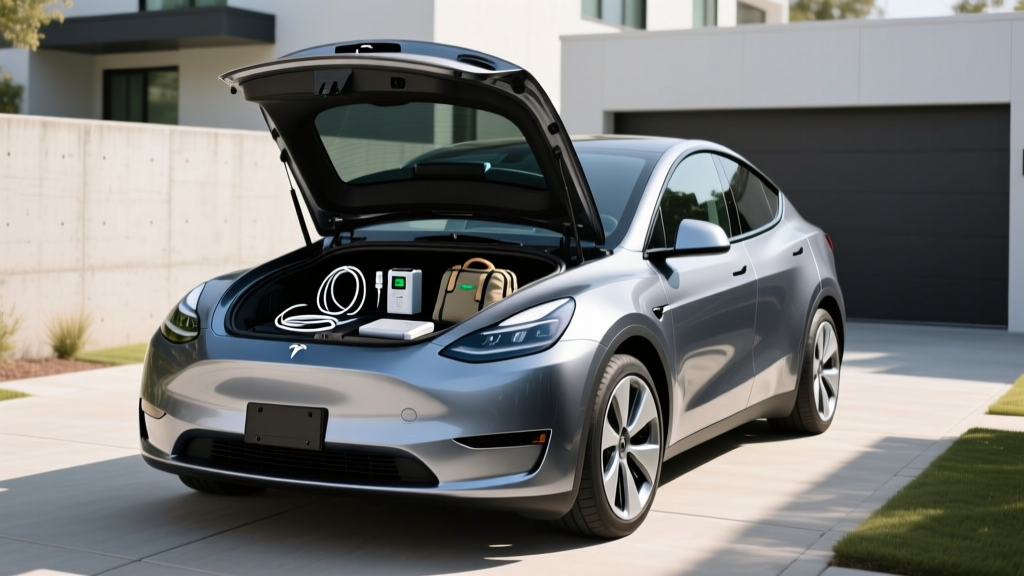
The 2026 Model Y's front trunk is a sealed, drainable compartment beneath the hood, accessed via the touchscreen, the Tesla app, or a manual release. The Juniper refresh expanded its volume to 4.1 cubic feet — roughly a 46% increase over the prior generation. In practice, that translates to:
- Grocery runs: Two to three standard reusable grocery bags, stacked
- Charging cables: Mobile Connector + NACS adapter + a 25-ft J1772 extension, with room to spare
- Travel: One medium duffel bag or a backpack plus a laptop sleeve
- Everyday carry: Tire inflator, first-aid kit, windshield washer fluid, and detailing supplies
The frunk floor sits roughly 18 inches deep and 22 inches wide at its widest point. It's lined with a removable plastic tray — a smart choice for wet or dirty items, and the drain plug at the bottom means hosing it out is viable. Unlike the Rivian R1S (11.0 cu ft frunk) or the Ford F-150 Lightning's Mega Power Frunk (14.1 cu ft), the Model Y's front trunk is modest but optimized for an SUV footprint. You won't fit a full-size cooler or a week's luggage here, but for daily-use separation of clean/dirty or secure-from-passengers cargo, it earns its keep.
One notable drawback: the frunk latch mechanism requires a firm press to close, and some owners report the hood sensor triggering "hood ajar" warnings if not fully seated. It's a minor annoyance but worth knowing before a long trip.
Range, Efficiency, and Real-World Expectations
EPA Estimated Range: 320 miles (Long Range AWD, 19" wheels)
Real-World Expectation: ~280–300 mi on mixed highway/city driving at 70 mph; ~240–260 mi in sub-freezing winter conditions; ~310+ mi in mild city-heavy commuting with regen.
The Model Y Long Range AWD's 111 MPGe combined (30 kWh/100 mi) puts it among the most efficient electric SUVs on the market, trailing only the Hyundai Ioniq 5 RWD (114 MPGe) by a narrow margin. Tesla's heat pump — standard on all Juniper trims — significantly reduces cold-weather cabin energy draw compared to resistive heaters, limiting winter range loss to roughly 18–22% rather than the 30–40% seen on older EVs without thermal management.
On a 300-mile highway run at 75 mph in 45°F weather, expect to arrive with approximately 15–20% State of Charge remaining. Push speeds to 80+ mph or face headwinds and elevation gain, and that buffer shrinks. The in-car trip planner remains one of the most accurate in the industry, typically predicting arrival SoC within 1–2 percentage points when preconditioning is active.
For the Performance trim (21" wheels, stickier tires, sport suspension), the EPA drops to 277 miles, and real-world highway figures settle around 240–255 miles. The trade-off is sharper handling and a 3.5-second 0–60 mph time.
Charging Speed: DC Fast, Level 2, and Home Setup
The 2026 Model Y Long Range charges natively via NACS (North American Charging Standard), giving it direct access to Tesla's Supercharger network — still the most reliable DC fast-charging ecosystem in North America, with over 20,000 V3 and V4 stalls nationwide. With the included NACS-to-CCS adapter (or native CCS port on earlier Juniper builds), Electrify America, EVgo, and ChargePoint DC stalls are accessible, though plug-and-charge reliability varies by network.
| Charging Level | Power (kW) | Speed | Typical Use Case |
|---|---|---|---|
| Level 1 (120V, 12A) | ~1.4 kW | ~4 mi/hr | Emergency / overnight trickle |
| Level 2 (240V, 48A Wall Connector) | 11.5 kW | ~44 mi/hr | Home daily charging |
| Level 2 (240V, 32A Mobile Connector) | 7.7 kW | ~30 mi/hr | Home / destination |
| DC Fast (V3 Supercharger) | 250 kW peak | 10–80% in ~27 min | Road trips |
| DC Fast (CCS adapter, 350-kW stall) | ~170 kW sustained | 10–80% in ~33 min | Non-Tesla networks |
A critical nuance: the 250 kW figure is a peak, not a sustained rate. The Model Y's charge curve is aggressive from 10–40% SoC (holding near 230–250 kW), then tapers progressively. By 70% SoC, you're seeing roughly 80–100 kW, and above 85%, the rate drops below 40 kW. This is why Tesla's navigation system targets 80% for road-trip stops — the time-to-full penalty above 80% is severe. Preconditioning the battery (automatic when a Supercharger is set as your nav destination) is essential to hit peak rates; without it, a cold battery may cap at 100–120 kW for the first several minutes.
For home Level 2 installation, budget $1,200–$2,500 for a licensed electrician to run a 60A circuit (for 48A continuous charging) from a 200A panel. If your home has a 100A panel, a service upgrade to 200A adds $2,000–$4,000. Always defer final specs to a licensed electrician — panel capacity, wire gauge, and local code vary by jurisdiction.
Pricing, Trims, and Federal Tax Credit Eligibility
The 2026 Tesla Model Y is offered in two primary trims in the U.S.:
- Long Range AWD: $44,990 MSRP (before destination)
- Performance AWD: $48,990 MSRP (before destination)
Both trims fall under the $80,000 MSRP cap for SUVs under IRS §30D rules. However, the full $7,500 federal tax credit is not guaranteed. Eligibility depends on three concurrent requirements, and Tesla's battery-sourcing status can shift mid-year as supply chains evolve.
| Trim | MSRP | §30D Credit | Effective Price |
|---|---|---|---|
| Long Range AWD | $44,990 | $3,750–$7,500* | $37,490–$41,240 |
| Performance AWD | $48,990 | $3,750–$7,500* | $41,490–$45,240 |
*Credit amount depends on critical-mineral and battery-component sourcing compliance. Verify current eligibility at fueleconomy.gov before purchase. Point-of-sale transfer available for qualified buyers.
Key §30D eligibility constraints for 2026:
- Buyer income caps: Modified AGI ≤ $150,000 (single), ≤ $225,000 (head of household), ≤ $300,000 (joint)
- MSRP cap: ≤ $80,000 for SUVs (Model Y qualifies)
- Battery sourcing: Critical minerals and battery components must meet phased-in percentages from U.S. or FTA-partner countries; non-compliant vehicles receive $0 or $3,750 (partial)
- Point-of-sale transfer: Eligible buyers can apply the credit as a down-payment reduction at the dealer, rather than waiting for a tax refund
Consult a tax professional and the IRS clean vehicle credits page for your specific situation. State incentives (California's CVRP, Colorado's innovative motor vehicle credit, etc.) may stack on top but vary by jurisdiction.
Tech, Driver Assistance, and Interior
The Juniper refresh brought meaningful interior upgrades: ventilated front seats, ambient lighting, a rear-seat touchscreen, power-folding second row, and acoustic glass that noticeably reduces wind noise above 65 mph. The 15.4-inch center touchscreen runs Tesla's latest UI with a snappier processor and native integration for navigation, media, and vehicle controls.
Autopilot (included): Lane-keeping, adaptive cruise, and Traffic-Aware Cruise Control. Competent for highway use but requires continuous driver engagement.
Full Self-Driving (Supervised) — $8,000 option: Adds automatic lane changes, on/off-ramp navigation, autosteer on city streets, and Smart Summon. Despite the name, this is an SAE Level 2 driver-assistance system. You must remain attentive, hands ready to intervene, and eyes on the road at all times. It is not self-driving.
SAE Automation Level: Tesla Autopilot and FSD (Supervised) are Level 2 — partial automation. The driver is the operator and is legally responsible for the vehicle at all times. Level 4 (true driverless operation in defined areas) is currently offered only by robotaxi services like Waymo in select cities.
Other tech highlights: Sentry Mode (360° dashcam recording), Dog Mode (climate hold for pets), Camp Mode (overnight HVAC), and the Tesla app's remote frunk/trunk release — particularly handy when someone else needs to grab charging cables from the front trunk while you're still inside.
Who the 2026 Model Y Suits Best
The Model Y Long Range AWD is best for:
- Daily commuters with home Level 2 charging who value efficiency and Supercharger network access
- Small families (two adults + two children) who need 72 cu ft of cargo space with seats folded
- Road-trip-capable EV buyers who prioritize charging infrastructure reliability over maximum range
It's less ideal for:
- Three-row seekers: The optional third row is extremely cramped (children only, short trips); the Kia EV9 or Rivian R1S serve larger families better
- Towing-heavy buyers: 3,500-lb towing capacity is modest; the F-150 Lightning or R1T handle heavy trailers
- Button-and-knob loyalists: Nearly all controls live on the touchscreen, including glovebox release and mirror adjustment
Pros
- Class-leading Supercharger network access (native NACS)
- 111 MPGe efficiency — among the best for electric SUVs
- 4.1 cu ft frunk is drainable and weather-sealed
- Accurate in-car trip planner with reliable arrival SoC
- Strong OTA update cadence adds features post-purchase
- Heat pump limits winter range loss vs competitors
Cons
- FSD (Supervised) costs $8,000 and remains Level 2, not autonomous
- Minimalist interior frustrates buyers who prefer physical controls
- Rear visibility is compromised by thick C-pillars and small rear window
- 250 kW peak DCFC trails Hyundai/Kia's 800V architecture (~350 kW)
- Insurance premiums run 15–25% higher than comparable gas SUVs
- Optional third row is impractical for anyone over age 10
Model Y vs. Key Competitors
The Model Y's closest rivals in the midsize electric SUV segment are the Hyundai Ioniq 5, Ford Mustang Mach-E, and Chevrolet Equinox EV. Here's how they compare on the metrics that matter:
| Metric | Tesla Model Y LR | Hyundai Ioniq 5 LR | Ford Mach-E ER | Chevy Equinox EV |
|---|---|---|---|---|
| EPA Range | 320 mi | 305 mi | 312 mi | 319 mi |
| Frunk | 4.1 cu ft | 0.85 cu ft | 4.7 cu ft | None |
| Peak DCFC | 250 kW | 350 kW | 150 kW | 190 kW |
| 10–80% Time | ~27 min | ~18 min | ~39 min | ~33 min |
| MPGe (comb.) | 111 | 114 | 101 | 97 |
| Base MSRP | $44,990 | $46,700 | $43,995 | $33,600 |
| Charging Standard | NACS | NACS (2025+) | NACS (2025+) | NACS (2025+) |
The Ioniq 5's 800V architecture delivers genuinely faster DC charging (~18 min 10–80%), but its frunk is nearly useless at under 1 cu ft. The Mach-E has a slightly larger frunk (4.7 cu ft) but charges noticeably slower. The Equinox EV undercuts on price dramatically but sacrifices efficiency and performance. The Model Y wins on charging-network reliability and software integration — a factor that's hard to quantify on a spec sheet but shows up in ownership satisfaction.
Frequently Asked Questions
What is the real-world range of the 2026 Tesla Model Y?
The EPA rates the Long Range AWD at 320 miles. In real-world mixed driving at highway speeds (70–75 mph), expect 280–300 miles. In sub-freezing winter weather with cabin heat active, plan for 240–260 miles. City driving with regenerative braking can push above 310 miles in mild conditions.
How fast does the Model Y charge at home and on the road?
On a 48A Level 2 Tesla Wall Connector (240V), the Model Y adds roughly 44 miles of range per hour, or a full charge in about 8 hours. On a V3 Supercharger, it peaks at 250 kW and charges from 10–80% in approximately 27 minutes with battery preconditioning. Above 80%, charging slows dramatically — plan to stop at 80% on road trips.
How much does the 2026 Model Y cost after the federal tax credit?
The Long Range AWD starts at $44,990. If you qualify for the full $7,500 §30D credit (subject to income caps, MSRP caps, and battery-sourcing rules), the effective price drops to ~$37,490. Partial credit of $3,750 brings it to ~$41,240. Eligibility shifts as battery supply chains change — verify at fueleconomy.gov before purchasing. Point-of-sale transfer lets you apply the credit as a down-payment reduction.
Does the 2026 Model Y qualify for the federal EV tax credit?
It depends. The Model Y's MSRP is under the $80,000 SUV cap, so it passes that threshold. Your personal eligibility requires income under $150K (single) / $300K (joint). The battery-sourcing requirement is the variable — Tesla's compliance status can change. Always check the IRS clean vehicle credits page and fueleconomy.gov for the most current status before committing to a purchase.
Is the Tesla Model Y worth buying over the Ioniq 5 or Mach-E?
Choose the Model Y if: Supercharger network access, software polish, and frunk practicality are priorities. Choose the Ioniq 5 if: you want the fastest DC charging in the segment (18 min 10–80%) and don't need frunk space. Choose the Mach-E if: you prefer a more traditional interior layout with physical controls and a slightly larger frunk. On pure efficiency and network reliability, the Model Y retains an edge.
What fits in the Tesla Model Y front trunk?
The 4.1-cu-ft frunk holds two to three grocery bags, a full set of charging cables and adapters, a medium duffel bag, or everyday essentials like a tire inflator and first-aid kit. It's drainable and weather-sealed, making it suitable for wet or dirty items. It does not fit a full-size cooler or large luggage.
How long will the Model Y battery last?
Tesla warranties the battery for 8 years or 120,000 miles (whichever comes first), guaranteeing at least 70% capacity retention. Real-world data from Tesla's annual impact report and third-party fleet studies (e.g., Recurrent Auto) suggest NMC batteries in the Model Y retain approximately 88–92% capacity at 100,000 miles under normal use. Avoiding repeated 100% charges and frequent DC fast-charging from very low SoC extends longevity.