Tesla Model Y Frunk: What Actually Fits Up Front?
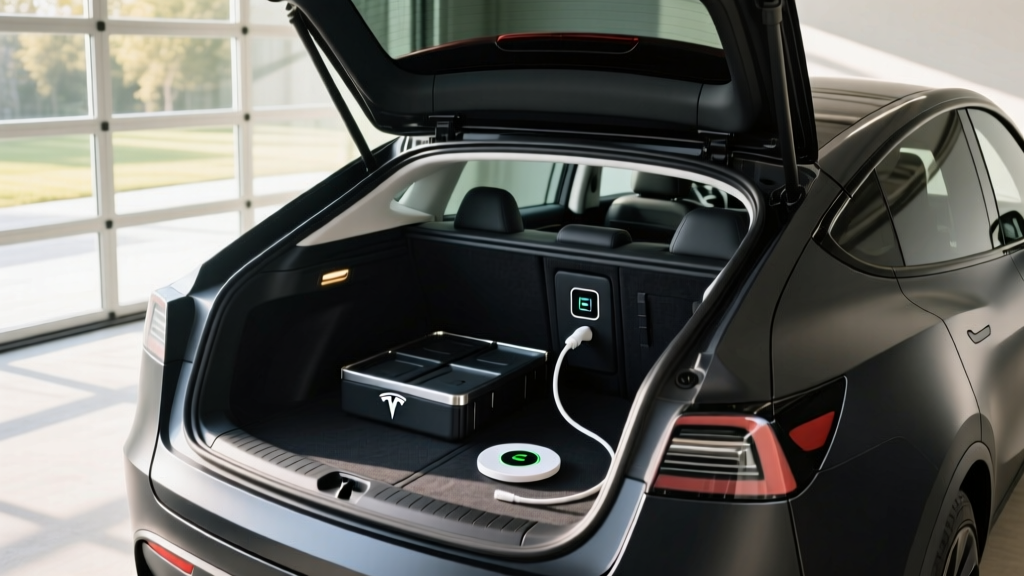
The front trunk of Tesla's Model Y — commonly called the "frunk" — is one of the most searched cargo features among EV shoppers, and for good reason. Without a bulky internal-combustion engine up front, Tesla reclaims that space for storage. In the refreshed 2026 Model Y (the "Juniper" update that debuted in early 2025 and carries into 2026), the frunk offers approximately 4.1 cubic feet of usable volume. That's enough for a standard carry-on suitcase, a laptop bag plus groceries, or a set of charging cables and emergency kit — but it won't swallow a full cooler or large duffel.
The frunk floor sits relatively shallow compared to the Model S (which offers roughly 5.3 cu ft up front), and the 2026 Model Y's frunk is slightly reshaped from pre-refresh models due to revised HVAC and structural components. It features a flat floor with a small lip, a 12V accessory port on some trims, and a manual release latch inside for emergency egress. The power-operated frunk lid — standard on Long Range and Performance trims — opens and closes via the touchscreen, key fob, or Tesla app.
| Spec | Long Range AWD | Performance AWD | Rear-Wheel Drive |
|---|---|---|---|
| EPA Range | 320 mi | 295 mi | 300 mi (est.) |
| Battery (usable) | ~75 kWh (NMC) | ~75 kWh (NMC) | ~60 kWh (LFP) |
| Drivetrain | Dual-Motor AWD | Dual-Motor AWD | Single-Motor RWD |
| Horsepower | 384 hp | 456 hp | 295 hp |
| 0-60 mph | 4.8 sec | 3.5 sec | 6.6 sec (est.) |
| Max DC Fast Charge | 250 kW | 250 kW | 170 kW |
| 10-80% DCFC Time | ~27 min | ~27 min | ~32 min |
| Level 2 (11.5 kW) | ~44 mi/hr | ~44 mi/hr | ~35 mi/hr |
| Frunk Volume | 4.1 cu ft | 4.1 cu ft | 4.1 cu ft |
| Total Cargo (rear seats up) | 30.2 cu ft | 30.2 cu ft | 30.2 cu ft |
| Total Cargo (rear seats folded) | 72.1 cu ft | 72.1 cu ft | 72.1 cu ft |
| Base MSRP | $48,990 | $53,990 | $44,990 |
Sources: fueleconomy.gov, Tesla official specifications.
Real-World Range vs. EPA Sticker
EPA Estimated: 320 miles (Long Range AWD)
Real-World Expectation: Expect ~260-285 miles on sustained highway driving at 70-80 mph. In cold weather (below 30°F), range can drop an additional 15-25%, putting winter highway range closer to 210-240 miles. City driving with regenerative braking recovers more energy and can meet or slightly exceed the EPA figure in mild conditions.
The Model Y Long Range AWD carries an EPA rating of 320 miles, while the Performance trim drops to 295 miles due to stickier tires, sport-tuned suspension, and higher accessory draw. The base RWD variant is estimated around 300 miles with its smaller LFP pack.
Tesla's heat pump — standard across all 2026 trims — significantly reduces cold-weather cabin-heating energy draw compared to resistive heaters, but physics still wins: lithium-ion cells lose efficiency at low temperatures, and denser cold air increases aerodynamic drag. On a 75°F day at 65 mph, you'll see numbers close to the sticker. At 80 mph in January in Chicago, plan your charging stops conservatively.
Efficiency for the Long Range AWD is rated at 122 MPGe combined (28 kWh/100 mi), per fueleconomy.gov. That's among the most efficient in the compact electric SUV segment, trailing only the Hyundai Ioniq 5 RWD and rivaling the BMW iX3.
Charging Speed: DC Fast, Level 2, and the Curve Reality
The 2026 Model Y Long Range and Performance trims peak at 250 kW on a V3 Supercharger or equivalent CCS/NACS DC fast charger. However, peak is not sustained. Here's the real charging story:
| Charging Level | Power | Rate / Time |
|---|---|---|
| Level 1 (120V household) | ~1.4 kW | ~3-5 mi/hr |
| Level 2 (240V, 48A) | 11.5 kW | ~44 mi/hr |
| DC Fast (V3 Supercharger) | Peak 250 kW | 10-80% in ~27 min |
| DC Fast (above 80% SoC) | Tapers to ~40-60 kW | 80-100% adds ~25-35 min |
The charge curve matters: the Model Y holds near 250 kW from roughly 10% to 35% state of charge, then progressively tapers. From 60-80%, you're seeing closer to 100-120 kW. Above 80%, charging slows dramatically to protect the NMC cells — a trait shared by virtually all lithium-ion EVs. If you're road-tripping, plan stops at 10-80% and skip topping to 100% unless it's your final destination.
For home charging, a Level 2 wall connector at 48 amps (11.5 kW) adds roughly 44 miles of range per hour, fully replenishing the 75 kWh pack in about 7-8 hours. The RWD trim with its LFP battery charges at a lower peak DC rate (~170 kW) but can be charged to 100% daily without the degradation concerns of NMC — a meaningful ownership advantage for commuters.
The 2026 Model Y ships with the NACS (North American Charging Standard) connector natively. Tesla's Supercharger network remains the gold standard for reliability, with over 6,500 V3/V4 stalls in North America. Non-Tesla chargers using CCS1 require no adapter on NACS-equipped vehicles at stations that have adopted the NACS standard.
Pricing, Trims, and Federal Tax Credit Eligibility
The 2026 Model Y lineup starts at $44,990 for the RWD, $48,990 for Long Range AWD, and $53,990 for Performance. All trims fall under the IRS §30D MSRP cap of $80,000 for SUVs. However, qualifying for the full $7,500 federal tax credit is not automatic — it depends on multiple factors:
| Trim | MSRP | Max §30D Credit | Effective Price (if eligible) |
|---|---|---|---|
| RWD | $44,990 | $7,500 | $37,490 |
| Long Range AWD | $48,990 | $7,500 | $41,490 |
| Performance AWD | $53,990 | $7,500 | $46,490 |
IRS §30D eligibility requirements for 2026:
- Income caps: Modified AGI ≤ $150,000 (single), ≤ $225,000 (head of household), ≤ $300,000 (joint filers)
- MSRP cap: ≤ $80,000 for SUVs (all Model Y trims qualify)
- Battery sourcing: Critical minerals and battery components must meet escalating domestic/free-trade-agreement thresholds — Tesla has shifted significant supply chain to qualify, but confirm at fueleconomy.gov before purchasing
- Point-of-sale transfer: As of 2024+, you can transfer the credit to the dealer at purchase, reducing your out-of-pocket cost immediately rather than waiting for tax filing
Always verify current eligibility on IRS.gov — battery sourcing rules tighten annually, and a vehicle that qualifies in January may face changes by December.
Performance, Ride, and Daily Drivability
The Model Y's dual-motor AWD powertrain delivers confident all-weather traction and brisk acceleration. The Long Range posts a 4.8-second 0-60 mph time — quick enough to merge onto any freeway without hesitation — while the Performance trim shaves that to 3.5 seconds with its more aggressive rear motor and sport tuning.
The 2026 Juniper refresh brought meaningful improvements: a stiffer body structure, retuned adaptive dampers (on Performance), acoustic glass all around, and a redesigned interior with ventilated front seats, ambient lighting, and a rear touchscreen for passengers. Ride quality is noticeably better than pre-2025 models, which drew criticism for harshness over broken pavement.
Regenerative braking remains strong and configurable. Tesla's one-pedal driving mode lets you decelerate to a near-stop simply by lifting the accelerator — reducing brake wear to the point where friction brakes rarely engage in daily driving. The steer-by-wire system introduced in select markets has not yet reached the US Model Y as of early 2026.
Technology, Driver Assistance, and Interior
Every 2026 Model Y includes Tesla's 15.4-inch center touchscreen running the latest Tesla OS, which handles navigation, media, climate, and vehicle settings through a single interface. There is no traditional instrument cluster — speed and range info appears in the upper-left corner of the main screen.
Autopilot comes standard and includes adaptive cruise control, lane-centering, and automatic emergency braking. This is a SAE Level 2 driver-assist system — it does not drive the car for you. You must keep your hands on the wheel and eyes on the road at all times. Tesla's torque-sensing steering wheel monitors engagement.
Important: Full Self-Driving (Supervised) — Tesla's $8,000 optional upgrade — remains a Level 2 system. Despite the name, it requires continuous driver supervision and does not make the vehicle autonomous. Only Level 4 services like Waymo operate without a human driver, and those are limited to specific geofenced areas.
The infotainment system supports native Spotify, Apple Music, Tidal, and Netflix/YouTube (while parked). There is no Apple CarPlay or Android Auto — Tesla's walled garden is a dealbreaker for some buyers who prefer phone projection. Wireless phone charging and USB-C ports (front and rear) are standard.
Interior passenger space is generous for the segment: 41.6 inches of front legroom and 38.0 inches of rear legroom. The panoramic glass roof creates an airy cabin but does reduce headroom slightly compared to vehicles with conventional roofs. Rear visibility is compromised by the sloping roofline — the standard rear camera partially compensates.
Battery, Warranty, and Long-Term Ownership
The Long Range and Performance trims use an NMC (nickel manganese cobalt) chemistry pack with approximately 75 kWh usable capacity. The RWD trim uses LFP (lithium iron phosphate) with roughly 60 kWh usable.
LFP vs. NMC matters for ownership:
- LFP: Longer cycle life, can be charged to 100% daily without accelerated degradation, lower energy density (less range per pound), performs slightly worse in extreme cold. Ideal for commuters who charge at home nightly.
- NMC: Higher energy density (more range), faster DC charging, but Tesla recommends daily charging to 80% with occasional 100% for trips. Better cold-weather performance. Ideal for road-trippers and those who need maximum range.
Tesla's battery warranty covers 8 years / 120,000 miles (Long Range/Performance) and 8 years / 100,000 miles (RWD), with a guaranteed minimum 70% capacity retention over that period. Real-world degradation data from Tesla's fleet reports approximately 12-15% capacity loss at 150,000 miles for NMC packs, with LFP packs showing slower fade curves. Full pack replacement outside warranty currently runs $12,000-$16,000 at Tesla service centers.
The basic vehicle warranty is 4 years / 50,000 miles, which is average for the segment. Competitors like Hyundai (5yr/60k basic, 10yr/100k battery) offer longer basic coverage.
Pros, Cons, and the Competition
Pros
- Supercharger network — still the most reliable DC fast-charging ecosystem in North America
- Class-leading efficiency at 122 MPGe / 28 kWh/100mi
- Frunk + hatchback cargo versatility (72.1 cu ft total)
- Strong over-the-air update cadence keeps the vehicle improving post-purchase
- LFP option for worry-free daily 100% charging (RWD trim)
- Excellent resale value relative to EV segment average
Cons
- Frunk is modest at 4.1 cu ft — smaller than Model S and some competitors
- No Apple CarPlay / Android Auto
- All-screen interface requires learning curve; no physical climate or volume knobs
- Basic Autopilot is capable but FSD (Supervised) remains expensive at $8,000 for Level 2
- Insurance premiums run 15-25% above segment average in most states
- Visibility compromised by thick rear pillars and sloping roofline
Key competitors to cross-shop:
- Hyundai Ioniq 5 — 800V architecture charges 10-80% in ~18 min (350 kW capable); CarPlay standard; smaller frunk (~0.85 cu ft)
- Ford Mustang Mach-E — comparable range and price; larger frunk (~4.7 cu ft); less efficient
- BMW iX3 — premium interior, slightly less range, no US frunk
- Kia EV6 — shares Ioniq 5's 800V platform; sportier styling; smaller cargo area
Who the 2026 Tesla Model Y Suits Best
Choose the Model Y if: You prioritize charging-network reliability, want strong resale value, need a practical family crossover with decent cargo (frunk + hatch), and value OTA software improvements. The LFP RWD trim is ideal for commuters who charge nightly at home. The Long Range AWD suits road-trippers and cold-climate buyers.
Look elsewhere if: You need maximum frunk space (Ford Mach-E offers more), insist on Apple CarPlay, want the fastest possible DC charging (Hyundai/Kia 800V platforms are quicker), or prefer physical controls and a traditional instrument cluster.
Frequently Asked Questions
What is the real-world range of the 2026 Tesla Model Y?
The EPA rates the Long Range AWD at 320 miles, but expect roughly 260-285 miles on the highway and 210-240 miles in cold winter conditions. City driving with regen braking can approach or slightly exceed the EPA figure.
How fast does the Model Y charge at home and on the road?
At home on a Level 2 (240V/48A) charger, it adds ~44 miles per hour, filling the battery overnight. On a V3 Supercharger, it peaks at 250 kW and charges 10-80% in about 27 minutes, though charging slows significantly above 80%.
Does the 2026 Model Y qualify for the $7,500 federal EV tax credit?
All trims fall under the $80,000 MSRP cap for SUVs, but buyer income limits ($150K single / $300K joint) and battery-sourcing rules apply. Verify current eligibility at fueleconomy.gov and IRS.gov before purchasing. The credit can be transferred at point of sale.
How big is the front trunk (frunk) on the Tesla Model Y?
The 2026 Model Y frunk offers approximately 4.1 cubic feet — enough for a carry-on bag, laptop case, or charging accessories. It's smaller than the Model S frunk but benefits from a power-operated lid on higher trims.
Is the Model Y worth buying over the Hyundai Ioniq 5 or Ford Mach-E?
The Model Y wins on charging network access, efficiency, and resale value. The Ioniq 5 charges faster (800V architecture), and the Mach-E offers a slightly larger frunk. Your priority — network reliability vs. charge speed vs. cargo — determines the best fit.
What's the battery warranty on the 2026 Model Y?
Tesla covers the battery for 8 years / 120,000 miles (Long Range/Performance) or 8 years / 100,000 miles (RWD), guaranteeing at least 70% capacity retention over that period.