The Tesla Model Y Front License Plate Problem — and Everything Else You Need to Know
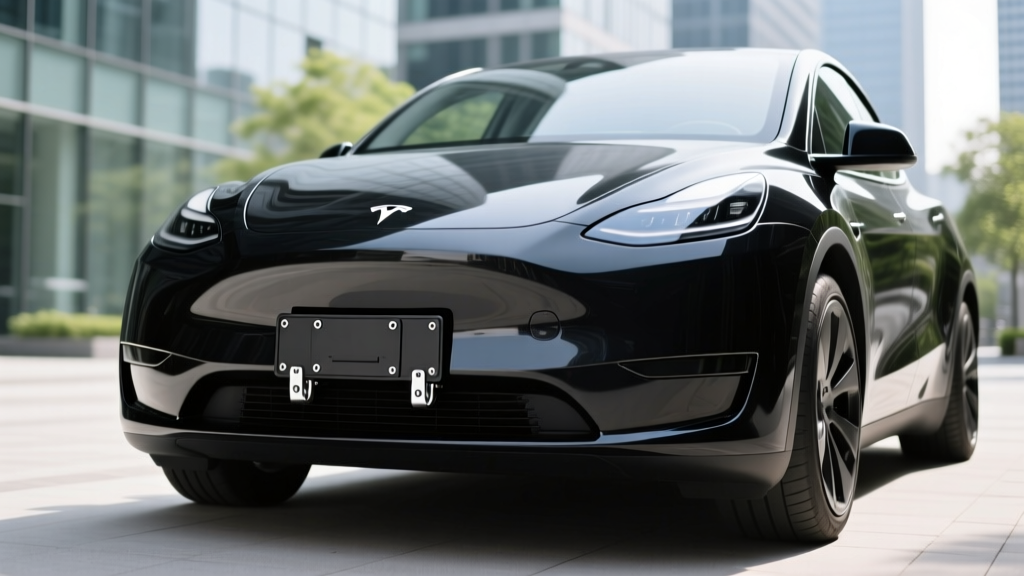
Every Tesla Model Y leaves the Fremont or Austin factory with a bare front bumper. No bracket, no holes, no hardware — just smooth composite. For buyers in the 31 U.S. states (plus D.C.) that legally require a front license plate, that minimalist design creates an immediate post-delivery headache. This review tackles the Tesla Model Y front license plate mounting question head-on, then delivers the comprehensive ownership data — range, charging, pricing, tax credits — that every prospective buyer needs before signing the paperwork.
The 2026 Model Y "Juniper" refresh brought a redesigned front fascia with an integrated light bar, revised interior materials, and a slightly larger battery pack. It remains the best-selling electric vehicle in the United States for good reason, but the front plate issue persists even on the refreshed model. Let's break down the mounting solutions, then get into the numbers.
Front License Plate Mounting: Your Three Options
Option 1: Tesla's Official Bracket Kit ($35–$50)
Tesla sells a front license plate bracket through its online store and service centers. The kit uses adhesive tape (3M VHB) combined with two self-tapping screws that drill into the lower bumper grille area. Installation takes roughly 15 minutes with a power drill. The downside: it leaves permanent holes if removed, which can affect resale value and triggers a cosmetic repair if you move to a front-plate-exempt state.
Option 2: Aftermarket No-Drill Adhesive Mounts ($20–$45)
Brands like StoNado, EV Plate, and various Amazon sellers offer bracket kits that rely exclusively on high-strength adhesive — no drilling required. These work well for lighter plates and moderate climates, but owners in hot-weather states report adhesive softening and bracket detachment after 12–18 months of direct sun exposure. Surface preparation (isopropyl alcohol cleaning, 60°F+ application temperature) is critical.
Option 3: Tow-Hook Mount ($40–$80)
The most secure non-drill solution threads into the Model Y's front tow-hook receiver (located behind a small removable cap on the lower bumper). Brands like Rhino USA and EV-specific fabricators offer tow-hook plate holders that bolt in with a standard wrench. This is the preferred option for owners who want a rock-solid mount without bumper modification. The trade-off: it occupies the tow point and adds slight weight to the front overhang.
2026 Tesla Model Y: Specs, Range, and Efficiency at a Glance
| Specification | Long Range RWD | Long Range AWD | Performance |
|---|---|---|---|
| EPA Range | 320 miles | 300 miles | 280 miles |
| Battery (usable) | ~79 kWh (NMC) | ~79 kWh (NMC) | ~79 kWh (NMC) |
| Efficiency (MPGe) | 123 MPGe combined | 117 MPGe combined | 111 MPGe combined |
| kWh/100 mi | 27 | 29 | 30 |
| 0–60 mph | 5.8 sec | 4.1 sec | 3.5 sec |
| Horsepower | ~300 hp | ~384 hp | ~456 hp |
| Drivetrain | Rear-Wheel Drive | Dual-Motor AWD | Dual-Motor AWD |
| Max DC Charge | 250 kW | 250 kW | 250 kW |
| 10–80% DC Time | ~25 min | ~25 min | ~25 min |
| Base MSRP | $44,990 | $47,990 | $52,490 |
Source: fueleconomy.gov and Tesla's official specifications page. Real-world figures may vary based on driving style, temperature, and terrain.
Real-World Range: What the EPA Sticker Doesn't Tell You
- Mild weather, mixed driving (55/45 city/highway): Expect 270–290 miles on a full charge.
- Sustained highway driving at 75 mph: Range drops to roughly 245–265 miles. The Model Y's crossover profile creates more aerodynamic drag than the Model 3 sedan.
- Cold weather (below 32°F / 0°C): Expect a 20–30% reduction — that 300-mile sticker becomes 210–240 miles. The Juniper refresh's heat pump helps mitigate cabin-heating draw, but battery chemistry still loses efficiency in the cold.
- Hot weather with A/C (above 95°F): Roughly 5–10% loss — less severe than cold, but noticeable on Southwest road trips.
The Model Y Long Range AWD's ~79 kWh usable battery (NMC chemistry) provides a solid buffer, but the crossover's 4,400-lb curb weight and taller frontal area work against highway efficiency. On a 300-mile road trip at 70–75 mph in 40°F weather, plan one charging stop rather than hoping to arrive on fumes. The navigation system's built-in trip planner accounts for elevation, temperature, and speed — trust it over the dashboard percentage guess-o-meter.
Charging Speed: DC Fast Charging and Home Level 2
The 2026 Model Y retains the NACS (North American Charging Standard) connector natively — no adapter needed at Tesla Superchargers, and an increasing number of third-party networks (Electrify America, EVgo) now offer NACS cables as well.
| Charging Level | Power | Miles Added per Hour | Notes |
|---|---|---|---|
| Level 1 (120V outlet) | ~1.4 kW | 3–5 mi/hr | Emergency/trickle only. Not practical for daily use. |
| Level 2 (240V, 48A) | 11.5 kW | ~44 mi/hr | Full overnight charge in ~7–8 hours. Requires NEMA 14-50 or hardwired Wall Connector. |
| DC Fast Charge (V3 Supercharger) | Peak 250 kW | ~1,000 mi/hr (at peak) | 10–80% in ~25 min. Tapers sharply above 80% SoC. |
| DC Fast Charge (V4 Supercharger) | Peak 250 kW (Model Y limited) | ~1,000 mi/hr (at peak) | V4 hardware supports higher rates, but Model Y architecture caps at ~250 kW. |
Charging curve reality: The Model Y's NMC pack peaks near 250 kW between roughly 10–35% State of Charge. From 35–60%, it sustains around 150–180 kW. Above 80%, the rate drops below 50 kW as the battery management system protects cell longevity. If you're road-tripping, plan stops to arrive at chargers around 10–15% SoC and depart at 75–80% — the last 20% takes as long as the first 60%.
For home charging, Tesla's Gen 3 Wall Connector ($420) at 48 amps on a 60A circuit delivers the fastest Level 2 speed the Model Y's onboard charger supports (11.5 kW). A licensed electrician will typically charge $800–$2,500 for installation depending on panel proximity and whether a 200A service upgrade is needed. Reference IRS Form 8911 — the Alternative Fuel Vehicle Refueling Property Credit can cover 30% of home charger installation costs (up to $1,000) if you live in an eligible census tract.
Pricing, Trims, and Federal Tax Credit Eligibility
| Trim | Base MSRP | Destination | Est. Federal Credit | Effective Price |
|---|---|---|---|---|
| Long Range RWD | $44,990 | $1,390 | Up to $7,500 | ~$38,880 |
| Long Range AWD | $47,990 | $1,390 | Up to $7,500 | ~$41,880 |
| Performance | $52,490 | $1,390 | Up to $7,500 | ~$46,380 |
- MSRP Cap: SUVs/crossovers must be ≤$80,000. All Model Y trims qualify.
- Buyer Income Cap: Modified AGI ≤$150,000 (single), ≤$225,000 (head of household), ≤$300,000 (married filing jointly).
- Battery Sourcing: Critical minerals and battery components must meet phased-in percentages from U.S. or FTA-partner countries. Tesla's supply chain has progressively shifted to comply, but verify the specific VIN's eligibility at fueleconomy.gov before purchase.
- Point-of-Sale Transfer: As of 2024, the credit can be transferred to the dealer at purchase, reducing your out-of-pocket cost immediately rather than waiting for a tax refund.
- Assembly: Must be assembled in North America. All U.S.-sold Model Ys are built in Fremont, CA or Austin, TX.
Credit eligibility depends on your specific tax situation and the vehicle's VIN-specific battery sourcing. Consult a tax professional and verify at irs.gov before committing.
Interior, Cargo, and Daily Practicality
The Juniper refresh brought meaningful interior improvements: ventilated front seats (previously a glaring omission), ambient lighting, a rear-seat touchscreen for climate and media control, and upgraded acoustic glass that noticeably reduces wind noise at highway speed.
Cargo volume: 30.2 cu ft behind the rear seats, expanding to 72.1 cu ft with the 60/40 split rear row folded. The front trunk (frunk) adds 4.1 cu ft — useful for charging cables and groceries but smaller than the Ford Mustang Mach-E's frunk.
Passenger space: Front legroom is generous at 41.8 inches. Rear legroom measures 37.0 inches — adequate for adults on shorter trips but tighter than a Hyundai Ioniq 5 or Kia EV6 for six-foot passengers. The panoramic glass roof creates an airy feel, though it does reduce headroom slightly compared to vehicles with a conventional steel roof.
Towing: The Model Y is rated for 3,500 lbs (with the optional tow package, $1,000). That's sufficient for a small utility trailer or a pair of dirt bikes, but it falls well short of the Rivian R1S or Ford F-150 Lightning for serious towing duty. Towing also cuts range roughly in half — plan accordingly.
Technology, Driver Assistance, and What's Missing
The Model Y's 15.4-inch center touchscreen controls virtually everything — climate, mirrors, glovebox, navigation, media. There are no physical buttons beyond the steering wheel stalks and hazard switch. This minimalist approach divides buyers: tech-forward users love it; traditionalists find it distracting.
Autopilot (included): Basic adaptive cruise control and lane-centering. It's competent for highway driving but requires continuous driver supervision.
Full Self-Driving (Supervised) — $8,000 option or $99/month: Adds automatic lane changes, traffic light/stop sign recognition, and Navigate on Autopilot. Despite the name, FSD Supervised is SAE Level 2 — you must remain attentive, hands near the wheel, and ready to intervene at any moment. It is not autonomous driving. Tesla's camera-only vision system occasionally struggles with construction zones, faded lane markings, and heavy rain.
Notable drawbacks: The absence of Apple CarPlay and Android Auto remains a dealbreaker for some buyers — Tesla's native infotainment is capable but doesn't integrate with your phone's ecosystem. The turn-signal buttons on the steering wheel (replacing the traditional stalk in the Juniper refresh) draw consistent complaints. And the panoramic roof, while beautiful, offers no shade — a retractable sunshade is a $150+ aftermarket necessity in sunbelt states.
Pros, Cons, and the Verdict
- Class-leading Supercharger network access (20,000+ U.S. stations)
- Strong efficiency (27–30 kWh/100 mi) for a crossover
- Over-the-air updates continuously add features
- Competitive pricing after federal tax credit
- Spacious cargo area with flat-load floor
- Standard heat pump for cold-climate efficiency
- NACS connector — no adapter needed at most DC chargers
- No front license plate bracket from factory — drilling or aftermarket mount required
- No Apple CarPlay or Android Auto
- Rear-seat legroom tighter than key competitors
- FSD (Supervised) is expensive and still Level 2, not autonomous
- Turn-signal buttons on steering wheel require re-learning
- Service center wait times can stretch weeks in some metro areas
- Insurance premiums above segment average
How It Stacks Up Against Key Competitors
The electric compact crossover segment has grown crowded. Here's how the Model Y Long Range AWD compares against its three most common cross-shops:
| Tesla Model Y LR AWD | Hyundai Ioniq 5 Limited | Ford Mustang Mach-E Premium | Kia EV6 GT-Line | |
|---|---|---|---|---|
| EPA Range | 300 mi | 290 mi | 290 mi | 282 mi |
| Max DC Charge | 250 kW | 240 kW (800V) | 150 kW | 240 kW (800V) |
| 10–80% Time | ~25 min | ~18 min | ~38 min | ~18 min |
| Base MSRP (AWD) | $47,990 | $54,200 | $48,995 | $52,900 |
| CarPlay/Android Auto | No | Yes | Yes | Yes |
| Charging Network | Native Supercharger | NACS adapter + Supercharger | NACS adapter + Supercharger | NACS adapter + Supercharger |
The Ioniq 5 and EV6 charge faster thanks to their 800V architectures, and both offer CarPlay. The Mach-E charges slower but provides a more traditional cockpit layout. The Model Y's decisive advantage remains the Supercharger network — it's the most reliable, most extensive DC fast-charging ecosystem in North America, and Tesla owners never deal with adapter hassles or third-party payment app failures.
Warranty and Long-Term Battery Outlook
Tesla covers the Model Y's battery and drive unit for 8 years or 120,000 miles (Long Range/Performance), whichever comes first, with a minimum 70% capacity retention threshold. The basic vehicle warranty is 4 years or 50,000 miles.
NMC batteries in Teslas have demonstrated strong longevity in real-world fleet data. Most Model Y packs lose roughly 5–8% capacity over the first 50,000 miles, then degradation flattens significantly. Owners who avoid routinely charging to 100% (set the daily limit to 80–90%) and who precondition the battery before DC fast charging will see the slowest degradation curve. A full battery replacement outside warranty currently runs $12,000–$16,000 at a Tesla service center — a figure worth knowing for long-term ownership planning, even though most packs outlast the vehicle itself.
Who the Model Y Is For — and Who Should Look Elsewhere
- You want the most reliable DC fast-charging network for road trips
- You prioritize efficiency and range per dollar over luxury finishes
- You're comfortable with a screen-centric, minimalist interior
- You live in a front-plate state and don't mind an aftermarket bracket solution
- You want continuous OTA improvements and a strong resale value
- You need Apple CarPlay / Android Auto for daily navigation
- You want the fastest possible DC charging (consider Ioniq 5 / EV6 with 800V)
- You need maximum rear-seat room for tall teenagers or car seats (check the Ioniq 5 or Honda Prologue)
- You want a traditional cockpit with physical buttons and stalks
- You plan to tow more than 3,500 lbs regularly
Frequently Asked Questions
Does Tesla install the front license plate bracket at delivery?
No. Tesla ships the Model Y without a front plate bracket. You must purchase and install one yourself (or have a body shop do it). Tesla service centers will install the official bracket for a labor fee if you prefer not to DIY, but it involves drilling into the bumper.
Will drilling for a front license plate void my Tesla warranty?
Drilling holes for the official bracket does not void the overall vehicle warranty, but any damage caused by improper installation (cracked bumper, water intrusion) would not be covered. The tow-hook mount avoids this concern entirely.
What is the real-world range of the Tesla Model Y?
The Long Range AWD is EPA-rated at 300 miles. In real-world mixed driving at moderate temperatures, expect 270–290 miles. Sustained 75-mph highway driving drops that to roughly 245–265 miles, and sub-freezing temperatures can reduce range by 20–30%, yielding 210–240 miles.
How fast does the Model Y charge at home?
On a 48-amp Level 2 home charger (Tesla Wall Connector or equivalent on a 60A circuit), the Model Y charges at 11.5 kW, adding roughly 44 miles of range per hour. A full 10–100% charge takes approximately 7–8 hours — ideal for overnight charging.
Does the Tesla Model Y qualify for the $7,500 federal tax credit?
All Model Y trims fall under the $80,000 SUV MSRP cap and are assembled in North America, so they meet the basic vehicle requirements. However, eligibility depends on your income (≤$150K single / ≤$300K joint), and the specific VIN's battery component and critical mineral sourcing must meet 2026 thresholds. Verify at fueleconomy.gov and consult a tax professional before relying on the credit.
Is FSD (Full Self-Driving) worth the $8,000 cost?
FSD Supervised adds useful highway and city-street features, but it remains an SAE Level 2 driver-assist system — you must stay engaged at all times. Most owners find the included Autopilot sufficient for highway commuting. The $99/month subscription is a lower-risk way to try FSD before committing $8,000 upfront.
How does the Model Y's insurance cost compare to gas crossovers?
Model Y insurance premiums typically run 15–30% higher than comparable gas-powered crossovers, averaging $2,200–$3,000 annually depending on your state, driving record, and coverage level. Tesla's own insurance product (available in most states) uses real-time driving data and can be competitive for safe drivers. Always get quotes before purchasing.
Data sourced from fueleconomy.gov, Tesla's official Model Y configuration page, and irs.gov. Specifications and tax credit rules reflect the 2026 model year and are subject to change. Always verify current figures before purchasing.