Why the Tesla Model Y Front License Plate Bracket Matters
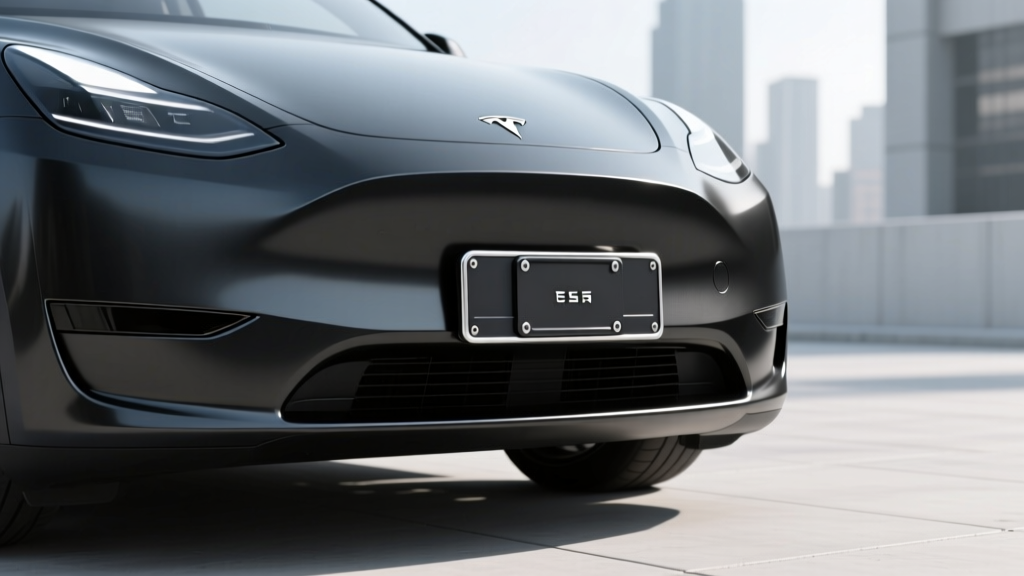
Every Tesla Model Y delivered in the United States ships without a front license plate mounted — and in many cases, without the bracket pre-installed on the bumper. Tesla includes a front plate bracket kit in the glovebox or trunk at delivery, but the automaker leaves the actual installation to the owner. This creates an immediate dilemma for new owners in the roughly 30 states that legally require a front license plate: mount the bracket and drill into your brand-new EV's bumper, or risk a citation.
This guide covers everything you need to know about the Tesla Model Y front license plate bracket — from installation methods and no-drill alternatives to the consequences of skipping it. We also provide a complete 2026 Model Y review with range, charging, pricing, and federal tax credit data so you can evaluate the vehicle end-to-end.
Front License Plate Laws: Which States Require One?
As of 2026, approximately 29 states plus Washington D.C. require a front license plate on passenger vehicles. States like California, New York, Texas, Florida (rear only), Illinois, and Washington enforce front-plate mandates with fines typically ranging from $25 to $200+ per citation. Some jurisdictions, such as Colorado and Nevada, have debated eliminating the front-plate requirement, but as of this writing, enforcement remains active.
If you live in a front-plate state and drive a Model Y without one, you're exposing yourself to repeated fines that quickly exceed the cost and effort of mounting the bracket. Parking enforcement officers in cities like San Francisco, New York, and Seattle are particularly diligent about front-plate compliance on Teslas, since the missing plate is visually obvious.
Tesla Model Y Front License Plate Bracket: Installation Options
Tesla provides a model-specific front plate bracket in the vehicle at delivery. Here are the three primary installation approaches, from most permanent to least invasive:
Option 1: OEM Tesla Bracket with Self-Tapping Screws (Factory Method)
Tesla's included bracket is designed to be screwed directly into the front bumper fascia using self-tapping screws (also included). The process:
- Position the bracket on the lower-center of the front bumper, using the alignment guides molded into the bracket.
- Mark the screw holes with a marker or punch.
- Drill pilot holes (typically 3mm) at the marked locations — or let the self-tapping screws cut their own threads.
- Secure the bracket with the provided screws (usually 4 to 6 depending on model year).
- Attach your state-issued front plate to the bracket with standard plate screws.
Pros: Secure, permanent, OEM-fitted, no rattling. Cons: Drills holes in the bumper, which some owners resist on a new vehicle. Tesla service centers will perform this installation, typically charging 0.5–1.0 hours of labor ($75–$150 depending on location).
Option 2: No-Drill Adhesive Mounts
Aftermarket companies sell adhesive-based front plate mounts designed specifically for the Model Y's bumper contour. Products like the Rykla Model Y No-Drill Mount and TESFAN Front Plate Holder use 3M VHB (Very High Bond) automotive tape to adhere the bracket to the bumper without any drilling.
Pros: No holes, reversible, preserves bumper for resale. Cons: Adhesive can fail in extreme heat (Arizona summers, direct sun), may leave residue on removal, and some car washes (especially touchless high-pressure) can dislodge poorly applied mounts. Expect to spend $25–$50 on an aftermarket no-drill bracket.
Option 3: Tow-Hook-Mounted Plate Relocator
For owners who absolutely will not touch the bumper, aftermarket tow-hook plate relocators (e.g., CravenSpeed or Platypus brand) screw into the front tow-hook receiver point behind the bumper cover. The plate then sits slightly offset from center.
Pros: Zero bumper modification, easily removable. Cons: Off-center plate placement may not satisfy all state inspectors, occupies the tow point, typically $50–$90, and can interfere with the front parking sensors or the lower air dam on some trims.
2026 Tesla Model Y: Range, Battery, and Efficiency
For the 2026 model year, the Tesla Model Y continues with its refreshed "Juniper" design language introduced in early 2025, available in three primary trims. Here are the critical specifications:
| Spec | Long Range AWD | Performance AWD | RWD (Standard) |
|---|---|---|---|
| EPA Range | 320 miles | 298 miles | 280 miles |
| Battery Capacity (usable) | ~75 kWh (NMC) | ~75 kWh (NMC) | ~57.5 kWh (LFP) |
| Efficiency | 122 MPGe / 27 kWh/100mi | 115 MPGe / 29 kWh/100mi | 128 MPGe / 26 kWh/100mi |
| 0–60 mph | 4.8 seconds | 3.5 seconds | 6.6 seconds |
| Drivetrain | Dual-Motor AWD | Dual-Motor AWD | Rear-Wheel Drive |
| Horsepower | 384 hp | 456 hp | 295 hp |
| Max DC Fast Charge | 250 kW | 250 kW | 170 kW |
| 10–80% DCFC Time | ~25 min | ~25 min | ~28 min |
| Level 2 Home Charging | 11.5 kW (~44 mi/hr) | 11.5 kW (~44 mi/hr) | 7.7 kW (~30 mi/hr) |
| Base MSRP | $48,990 | $53,990 | $39,990 |
Sources: EPA fueleconomy.gov, Tesla.com specifications.
Battery Chemistry: LFP vs NMC in the Model Y
The 2026 Model Y RWD uses a lithium iron phosphate (LFP) battery, while the Long Range and Performance trims use nickel manganese cobalt (NMC) chemistry. Here's why it matters:
| Factor | LFP (RWD) | NMC (LR / Performance) |
|---|---|---|
| Energy Density | Lower (heavier pack, less range) | Higher (lighter, more range) |
| Cycle Life | 3,000+ cycles | 1,000–2,000 cycles |
| Recommended Daily Charge | 100% (Tesla recommends) | 80% daily, 100% for trips |
| Cold Performance | Slightly reduced charge speed | Better cold-weather throughput |
| Long-Term Degradation | Slower degradation curve | Moderate; ~10% loss at 150k mi |
If you plan to keep your Model Y for 8–10+ years and charge daily at home, the LFP RWD's longevity advantage is significant. If you need maximum range for road trips or live in a cold climate, the NMC Long Range is the better fit.
Charging: DC Fast Charging and Home Level 2 Speeds
Charging speed is one of the most consequential ownership factors for any EV. The Model Y uses the NACS (North American Charging Standard) connector natively — meaning it plugs directly into Tesla Superchargers without an adapter. Starting in 2025, Tesla opened its Supercharger network to non-Tesla EVs, but Tesla owners retain the simplest plug-and-charge experience.
| Level | Power | Speed (Long Range) | Use Case |
|---|---|---|---|
| Level 1 (120V) | ~1.4 kW | ~4 miles/hour | Emergency / trickle |
| Level 2 (240V, 48A) | 11.5 kW | ~44 miles/hour | Home / workplace daily |
| DC Fast (Supercharger V3) | Up to 250 kW peak | ~175 mi in 15 min | Road trips |
Charging curve reality: The 250 kW peak rate on the Long Range and Performance trims is not sustained across the entire session. Like all EVs, the Model Y's charge rate tapers significantly above 60% SoC and drops sharply past 80%. The 10–80% time of ~25 minutes reflects this taper. Charging from 80–100% on DCFC can add another 20+ minutes — so plan to unplug at 80% during road trips for optimal time efficiency.
Home charging setup: Tesla sells the Wall Connector ($420) which delivers up to 11.5 kW on a 60A circuit (48A continuous). Professional installation of a 240V/60A circuit typically costs $500–$2,000 depending on your electrical panel's capacity and the run distance from panel to garage. If your home has a 200A panel with available capacity, expect the lower end; older 100A panels may require a $1,500–$3,000 panel upgrade.
Interior, Cargo, and Technology
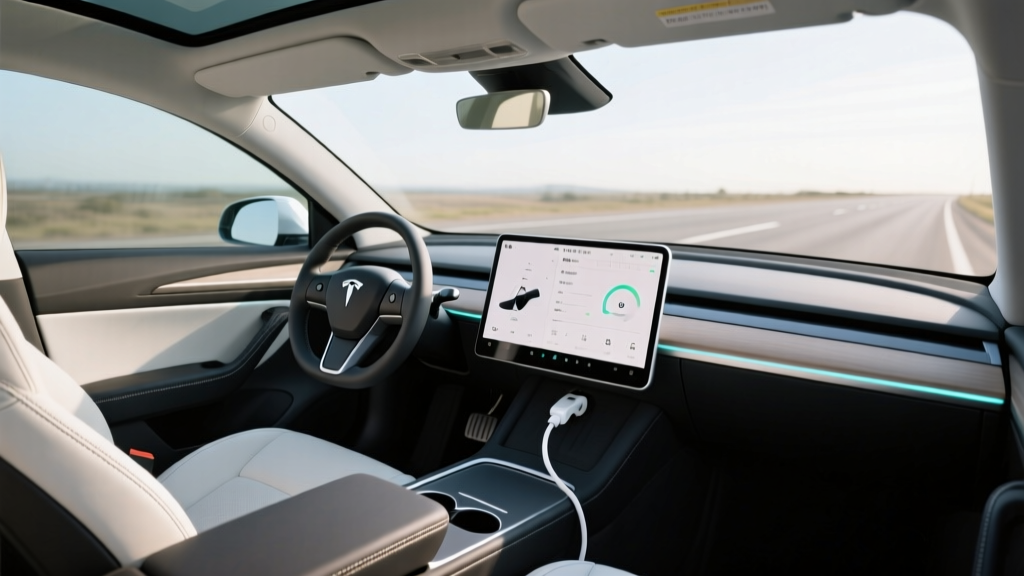
The refreshed Juniper-generation Model Y interior is noticeably quieter and more refined than the pre-2025 model, with acoustic glass, ventilated front seats, a rear-seat touchscreen, and ambient lighting. Here are the key dimensions:
- Cargo volume (rear seats up): 30.2 cu ft
- Cargo volume (rear seats folded): 72.1 cu ft
- Front trunk (frunk): 4.1 cu ft
- Rear legroom: 40.5 inches
- Front headroom: 41.0 inches
- Towing capacity: 3,500 lbs (Long Range / Performance; RWD not rated for towing)
The 15.4-inch center touchscreen runs Tesla's proprietary infotainment OS with native navigation, streaming apps (Netflix, YouTube while parked), and over-the-air updates. There is no Apple CarPlay or Android Auto — a dealbreaker for some buyers accustomed to phone projection.
Driver Assistance: Autopilot and FSD (Supervised)
Standard Autopilot includes Traffic-Aware Cruise Control and Autosteer (lane centering) on highways. FSD adds automatic lane changes, city-street navigation, traffic light and stop sign recognition, and Smart Summon. Real-world FSD performance in 2026 is capable but inconsistent — expect occasional phantom braking, missed turns in complex intersections, and the need for frequent driver takeovers in construction zones or unmapped areas.
Pricing, Trims, and Federal Tax Credit Eligibility
| Trim | Base MSRP | Est. After §30D Credit | Credit Eligible? |
|---|---|---|---|
| RWD (Standard) | $39,990 | ~$32,490 | Yes — if buyer meets income caps and battery sourcing requirements are met |
| Long Range AWD | $48,990 | ~$41,490 | Yes — under $80K SUV MSRP cap |
| Performance AWD | $53,990 | ~$46,490 | Yes — under $80K SUV MSRP cap |
Federal tax credit rules (§30D, 2026): The up-to-$7,500 credit is available as a point-of-sale reduction at the time of purchase (transferred to the dealer/Tesla). However, eligibility depends on several factors per IRS guidelines:
- Buyer income caps: Modified AGI ≤ $150,000 (single), ≤ $225,000 (head of household), ≤ $300,000 (joint).
- MSRP cap: SUVs/vans/pickups must be ≤ $80,000. All Model Y trims qualify.
- Battery sourcing: The credit is split into two halves ($3,750 each) — one for critical minerals sourcing and one for battery component manufacturing. Tesla's supply chain has progressively met more of these requirements, but the exact credit amount ($3,750 or $7,500) depends on the specific vehicle's battery sourcing at time of delivery. Always verify with Tesla at purchase and consult a tax professional.
- Point-of-sale transfer: Since 2024, buyers can transfer the credit to the seller for an immediate price reduction rather than waiting to claim it on their tax return.
Note: Some states offer additional EV rebates or incentives (e.g., California's CVRP, Colorado's state tax credit). Check your state's energy office or AFDC state incentive database for current programs.
Warranty Coverage
- Basic Vehicle Limited Warranty: 4 years / 50,000 miles, whichever comes first
- Battery & Drive Unit Warranty (Long Range / Performance): 8 years / 120,000 miles, with minimum 70% battery capacity retention
- Battery & Drive Unit Warranty (RWD / LFP): 8 years / 100,000 miles, with minimum 70% battery capacity retention
Tesla's battery warranty is competitive with the segment. Hyundai's Ioniq 5 offers 10yr/100,000mi on the battery, while Ford's Mustang Mach-E matches Tesla at 8yr/100,000mi. If the battery degrades below 70% of its original capacity within the warranty period, Tesla will repair or replace it — though real-world data from high-mileage Model Y owners suggests degradation typically plateaus around 8–12% loss at 100,000 miles for NMC packs.
Pros, Cons, and the Competition
Pros
- Best-in-class Supercharger network access
- Excellent efficiency (kWh/100mi) among electric SUVs
- Spacious cargo area with practical frunk
- Strong OTA update cadence adds features post-purchase
- Low center of gravity, composed handling for a crossover
- LFP battery option (RWD) for maximum longevity
Cons
- No Apple CarPlay / Android Auto
- Front plate bracket not pre-installed — owner's job
- FSD remains Level 2 despite the "Full Self-Driving" name
- Firm ride quality on 20-inch wheels
- No physical buttons — all controls via touchscreen
- Insurance costs above segment average
Model Y vs. Key Competitors (2026)
The Model Y competes directly with the Hyundai Ioniq 5, Ford Mustang Mach-E, Chevrolet Equinox EV, and the newer BMW iX3. The Model Y's advantages are Supercharger access, efficiency, and cargo space. The Ioniq 5 counters with 800V ultra-fast charging (10–80% in ~18 min on 350 kW chargers) and CarPlay support. The Equinox EV undercuts on price with a ~$33,000 starting MSRP. The Mach-E offers a more engaging driving experience but trails on range and charging infrastructure.
Who Should Buy the 2026 Tesla Model Y?
Choose the Model Y Long Range AWD if: You take regular road trips, live in a cold climate, need AWD traction, and want the broadest Supercharger coverage. Ideal for families who need cargo space and 300+ mile range confidence.
Choose the Model Y RWD if: You primarily commute under 50 miles daily, want the lowest purchase price, plan to keep the vehicle 10+ years (LFP longevity), and live in a mild climate where AWD isn't essential.
Choose the Model Y Performance if: You prioritize acceleration and handling dynamics and are willing to sacrifice ~22 miles of range and pay a $5,000 premium for it.
Look elsewhere if: You require Apple CarPlay, prefer physical controls, want the fastest possible DC charging (Hyundai/Kia 800V platform), or need a third-row seat (consider the Kia EV9 or Rivian R1S).
Frequently Asked Questions
Does the Tesla Model Y come with a front license plate bracket?
Yes. Tesla includes a front license plate bracket kit in the vehicle at delivery (typically in the glovebox or trunk), along with the necessary self-tapping screws. However, the bracket is not pre-installed on the bumper — the owner must install it or have a Tesla service center do it.
Will drilling holes for the front plate bracket void my Tesla warranty?
No. The front bumper fascia is a non-structural plastic panel. Drilling small pilot holes for the OEM bracket does not void the vehicle's basic or battery warranty. If you ever need the bumper replaced (e.g., after a collision), the new bumper would come undrilled and you'd re-mount the bracket.
What is the real-world range of the 2026 Tesla Model Y?
The EPA rates the Long Range AWD at 320 miles. In real-world highway driving at 70–75 mph, expect 265–285 miles. In cold weather below freezing, plan for 220–250 miles. The RWD (LFP) is EPA-rated at 280 miles with similar proportional reductions.
How fast does the Model Y charge at home and on road trips?
At home on a Level 2 Tesla Wall Connector (11.5 kW / 48A), the Long Range gains ~44 miles per hour of charging — a full overnight charge from 20–80% takes about 5 hours. On a V3 Supercharger (250 kW peak), 10–80% takes approximately 25 minutes. Always precondition the battery by entering a Supercharger as your navigation destination for optimal charge speed.
Does the 2026 Tesla Model Y qualify for the $7,500 federal tax credit?
All Model Y trims fall under the $80,000 SUV MSRP cap. However, the full $7,500 credit depends on the buyer's income (≤ $150K single / $300K joint), the vehicle's battery critical-mineral and component sourcing at time of delivery, and the buyer's tax liability. The credit can be applied as a point-of-sale reduction. Always verify current eligibility on IRS.gov and consult a tax professional before purchase.
Is the Tesla Model Y worth buying over the Hyundai Ioniq 5 or Ford Mach-E?
The Model Y wins on Supercharger network reliability, cargo volume, and overall efficiency. The Ioniq 5 wins on DC charge speed (800V architecture), has Apple CarPlay, and offers a more distinctive design. The Mach-E is more engaging to drive but has less range and a smaller charging network. For buyers who prioritize road-trip convenience and long-term software updates, the Model Y remains the segment benchmark. For those who value rapid charging and phone integration, the Ioniq 5 is a strong alternative.
Can I use a no-drill adhesive bracket for my front plate on a Model Y?
Yes, aftermarket no-drill adhesive brackets (using 3M VHB tape) are available for $25–$50 and work well in moderate climates. However, they can fail in extreme heat or through high-pressure car washes. For long-term reliability, especially in hot states, the OEM screw-mount bracket is the more dependable choice.