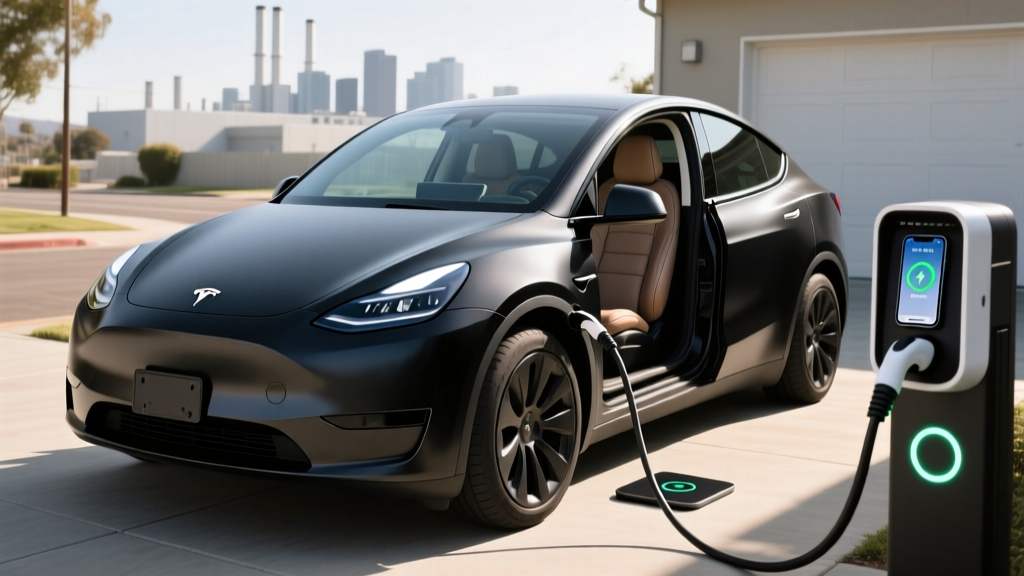
The Tesla Model Y remains America's best-selling electric vehicle, and every unit sold in the western United States traces its origin to the company's original manufacturing hub in Fremont, California. The 2026 Model Y — internally designated the "Juniper" refresh — carries over the redesigned platform introduced in early 2025 with updated styling, a revised interior, improved suspension tuning, and the same NACS-native charging architecture that gives Tesla owners exclusive access to the Supercharger network. This review covers the Long Range AWD and Performance trims assembled at the Fremont, CA facility, with exact specifications, real-world range data, and total ownership costs.
2026 Tesla Model Y: Quick Verdict
The Model Y Long Range AWD delivers an EPA-estimated 320 miles of range, peaks at 250 kW on DC fast chargers, and starts at $44,990 before incentives. It remains the default choice for buyers who want a proven EV SUV with the most reliable public charging network in North America. The Juniper refresh addressed the previous generation's ride-quality complaints with frequency-selective dampers and added ventilated front seats, ambient lighting, and a rear touchscreen. If you prioritize charging infrastructure reliability and software integration over interior material luxury, the Fremont-built Model Y is still the segment benchmark.
| Specification | Long Range AWD | Performance |
|---|---|---|
| EPA Range | 320 mi | 295 mi |
| Battery (usable) | 75 kWh (NMC) | 75 kWh (NMC) |
| Drivetrain | Dual-motor AWD | Dual-motor AWD |
| Horsepower | 384 hp | 456 hp |
| 0–60 mph | 4.8 sec | 3.5 sec |
| Peak DC Charge Rate | 250 kW | 250 kW |
| 10–80% DC Time | ~27 min | ~27 min |
| Level 2 Rate | 11.5 kW (44 mi/hr) | 11.5 kW (44 mi/hr) |
| Efficiency | 122 MPGe / 27 kWh/100mi | 111 MPGe / 30 kWh/100mi |
| Cargo (rear seats up) | 30.2 cu ft | 30.2 cu ft |
| Cargo (rear seats folded) | 72.0 cu ft | 72.0 cu ft |
| Base MSRP | $44,990 | $51,490 |
| Battery Warranty | 8 yr / 120,000 mi | 8 yr / 120,000 mi |
Range and Efficiency: EPA vs Real-World
The 2026 Model Y Long Range AWD carries an EPA-estimated 320 miles of range. That figure is measured on a combined city/highway driving cycle at moderate temperatures. Real-world results diverge based on speed, climate, and terrain.
- City / suburban (55 mph avg): 310–330 mi — regen braking recovers energy; efficiency peaks here.
- Highway (70–75 mph): 265–285 mi — aerodynamic drag dominates at sustained speed.
- Cold weather (30°F, highway): 220–250 mi — battery resistance increases, cabin heating draws 3–5 kW continuously.
- Hot weather (95°F+, AC running): 285–305 mi — thermal management and cabin cooling reduce range modestly.
The Model Y's heat pump (standard since 2021) mitigates cold-weather losses compared to resistive-heater EVs, but expect a 20–30% range reduction in sub-freezing highway driving. Preconditioning the battery via the Tesla app before departure recovers some efficiency.
The 75 kWh usable battery uses nickel-manganese-cobalt (NMC) chemistry, which offers higher energy density than lithium iron phosphate (LFP) but requires keeping daily charge limits around 80% for longevity. Tesla's software enforces this by default; you set 100% only for road trips. Over a typical ownership span of 8 years or 120,000 miles, NMC packs in the Model Y have shown approximately 8–12% degradation based on fleet data aggregated by Tesla's Impact Reports.
Charging Speed: DC Fast, Level 2, and Level 1
Charging speed is where the Model Y's native NACS connector and Supercharger integration provide a tangible advantage. The vehicle peaks at 250 kW on V3 and V4 Superchargers and on third-party networks equipped with NACS cables (Electrify America, EVgo, and ChargePoint have been adding NACS connectors since 2024).
| Level | Power | Rate | Typical Use Case |
|---|---|---|---|
| Level 1 (120V) | ~1.4 kW | ~5 mi/hr | Overnight top-off; emergency |
| Level 2 (240V, 48A) | 11.5 kW | 44 mi/hr | Home Wall Connector; full charge in ~7.5 hr |
| DC Fast (V3 Supercharger) | Peak 250 kW | ~180 mi in 15 min | Road trips; 10–80% in ~27 min |
| DC Fast (V4 Supercharger) | Peak 250 kW | Same as V3 for Model Y | Same capability; newer cabinet design |
Charging curve reality: The 250 kW peak is sustained only between roughly 10% and 35% state of charge. Above 50%, the rate tapers to approximately 150 kW, and above 80%, it drops further to under 60 kW. This is why Tesla (and all EV manufacturers) quote 10–80% times rather than 0–100%. Charging from 80% to 100% on DC fast charging can add another 25–30 minutes — plan accordingly on road trips and charge only to 80% unless you need the full battery.
For home charging, the Tesla Wall Connector ($420) delivers up to 11.5 kW on a 60-amp circuit (48 amps continuous). A licensed electrician will typically charge $800–$2,000 for installation depending on panel proximity and whether a panel upgrade to 200 amps is needed. Most Model Y owners report adding 250–300 miles overnight, more than enough for daily commuting.
Performance and Driving Dynamics
The Long Range AWD pairs a rear induction motor with a front permanent-magnet synchronous motor for a combined 384 horsepower and 360 lb-ft of torque. The 0–60 mph time of 4.8 seconds is brisk for a family SUV and sufficient for confident highway merging. The Performance trim bumps output to 456 hp and drops the sprint to 3.5 seconds — sports-car territory in a vehicle with 72 cubic feet of cargo space.
The Juniper refresh introduced frequency-selective damping that noticeably improves ride quality over the pre-2025 Model Y. Road noise is reduced thanks to acoustic glass on all windows. The steering remains quick and precise, though some drivers will find it artificially weighted at low speeds. Regenerative braking is strong enough for one-pedal driving in most conditions, though Tesla removed the adjustable regen setting years ago — it's max-regen or nothing.
Towing capacity is rated at 3,500 pounds with the factory tow package ($1,000), adequate for a small boat or utility trailer but below the Ford Mustang Mach-E's absence of any tow rating and well below the Rivian R1S. This is a car-based crossover, not a truck substitute.
Interior, Tech, and Driver Assistance
The 2026 Model Y interior is minimalist by design. A single 15.4-inch center touchscreen handles navigation, media, climate, and vehicle settings. The Juniper update added a second 8-inch touchscreen for rear passengers, ventilated front seats, power-folding second-row seats, and a full-width ambient lighting strip. Build quality from the Fremont line has improved measurably since 2022, with tighter panel gaps and more consistent material finishing.
Cargo space measures 30.2 cubic feet behind the second row and 72.0 cubic feet with seats folded — competitive with the Hyundai Ioniq 5 (27.2 / 56.2 cu ft) and slightly less than the Kia EV9's three-row layout. A small front trunk (frunk) adds approximately 4.1 cubic feet for charging cables or a small bag.
Autopilot and FSD (Supervised): Every Model Y ships with Basic Autopilot (lane centering + adaptive cruise). The $8,000 Full Self-Driving (Supervised) option adds automatic lane changes, traffic-light recognition, and city-street navigation. However, FSD remains an SAE Level 2 system — the driver must maintain hands-on-wheel awareness and is legally responsible for all driving decisions at all times. It is not autonomous driving. Tesla's supervised FSD has improved substantially in 2025–2026, but it still requires active monitoring and occasional intervention, particularly in construction zones and unmapped areas.
Autopilot and FSD (Supervised) are SAE Level 2 driver-assistance systems. They do NOT make the vehicle self-driving. The driver must remain fully engaged, eyes on the road, hands on the wheel. Failure to supervise can result in collisions. Only Level 4 services like Waymo operate without a human driver.
Pricing, Trims, and Federal Tax Credit
The 2026 Model Y is offered in two trims. Both are built at the Fremont, CA factory and ship to all 50 states.
| Trim | Base MSRP | Destination | Total Before Credit | Est. After §30D Credit* |
|---|---|---|---|---|
| Long Range AWD | $44,990 | $1,390 | $46,380 | $38,880 |
| Performance | $51,490 | $1,390 | $52,880 | $45,380 |
*Federal tax credit (§30D) eligibility requires meeting ALL of the following conditions:
- MSRP cap: Vehicle MSRP must not exceed $80,000 for SUVs (both trims qualify).
- Buyer income cap: Modified adjusted gross income ≤ $150,000 (single), $225,000 (head of household), or $300,000 (married filing jointly).
- Battery sourcing: A percentage of critical minerals and battery components must be sourced from the U.S. or free-trade-agreement countries. Tesla's Fremont-built Model Y has historically met this threshold, but the IRS updates the eligible vehicle list periodically — verify before purchase.
- Point-of-sale transfer: Since January 2024, buyers can transfer the credit to the dealer at purchase, reducing the out-of-pocket price immediately rather than waiting for a tax refund.
Popular options that increase the as-tested price include FSD Supervised ($8,000), the tow package ($1,000), and premium paint colors ($1,000–$2,500). A fully optioned Long Range AWD with FSD can reach approximately $57,000 before the credit.
Pros, Cons, and Who Should Buy
- Supercharger network — most reliable DC fast-charging in North America
- 320 mi EPA range is competitive in the midsize EV SUV segment
- Strong over-the-air software updates add features post-purchase
- Excellent efficiency (27 kWh/100mi) reduces charging cost per mile
- Improved ride quality post-Juniper refresh
- Class-leading cargo volume (72 cu ft folded)
- No Apple CarPlay or Android Auto — Tesla's proprietary interface only
- FSD ($8,000) is expensive and still requires driver supervision
- NMC battery requires 80% daily charge limit (no LFP option available)
- Minimalist interior lacks physical buttons for climate and mirrors
- Insurance premiums run 15–25% above segment average
- 3,500-lb tow rating trails body-on-frame electric SUVs
- You rely on public DC fast charging and want Supercharger reliability.
- You value software features, OTA updates, and app integration.
- You need a practical family SUV with 300+ miles of range under $50K.
- You want Apple CarPlay (look at Hyundai Ioniq 5 or Kia EV6).
- You need three rows of seating (Kia EV9) or a longer range (Lucid Gravity).
- You prefer a more traditional interior with physical controls.
Warranty and Long-Term Ownership
Tesla covers the Model Y's battery and drive unit for 8 years or 120,000 miles (whichever comes first), with a guaranteed minimum 70% capacity retention during that period. The limited vehicle warranty is 4 years or 50,000 miles. These terms are in line with Hyundai/Kia (10 yr / 100,000 mi battery) and slightly better than Ford's 8 yr / 100,000 mi battery coverage.
Maintenance costs are low — no oil changes, no spark plugs, and brake pad life is extended by regenerative braking. However, tire replacement costs are above average due to the vehicle's weight (~4,400 lbs) and performance-oriented tire sizing (255/45R19 or 255/40R20). Budget $1,200–$1,600 for a set of four premium tires every 25,000–35,000 miles.
Insurance is a known pain point. The IIHS rates the Model Y as a Top Safety Pick+, but collision repair costs for Tesla vehicles remain elevated due to aluminum-intensive construction and proprietary parts. Expect annual premiums of $2,200–$3,000 depending on your state and driving record — get quotes before committing.
Frequently Asked Questions
What is the real-world range of the 2026 Tesla Model Y?
The EPA rates the Long Range AWD at 320 miles. In real-world highway driving at 70–75 mph, expect 265–285 miles. In cold weather (below freezing), highway range drops to approximately 220–250 miles. City driving with regenerative braking can match or slightly exceed the EPA estimate.
How fast does the Model Y charge at home and on the road?
On a Level 2 home charger (Tesla Wall Connector at 11.5 kW), the Model Y adds approximately 44 miles of range per hour, fully charging from empty in about 7.5 hours. On a V3 or V4 Supercharger, it peaks at 250 kW and charges from 10–80% in approximately 27 minutes, adding up to 180 miles in 15 minutes under ideal conditions.
Does the 2026 Model Y qualify for the $7,500 federal EV tax credit?
Both trims fall under the $80,000 SUV MSRP cap. Eligibility depends on your income (≤$150K single / $300K joint), and the vehicle's battery meeting critical-mineral and component sourcing requirements. Tesla's Fremont-built Model Y has consistently qualified, but always verify the current IRS eligible vehicle list before purchasing. The credit can be applied at the point of sale since 2024.
Is the Model Y worth buying over the Hyundai Ioniq 5 or Ford Mustang Mach-E?
The Model Y wins on Supercharger network access, efficiency (27 kWh/100mi vs 30+ for competitors), cargo space (72 cu ft), and software integration. The Ioniq 5 offers faster 800V charging (10–80% in ~18 min), Apple CarPlay, and a more distinctive design. The Mach-E provides a more traditional driving feel but has lower range. If charging reliability on road trips is your top priority, the Model Y's Supercharger advantage is difficult to replicate.
What are the biggest drawbacks of owning a Model Y?
The most common owner complaints are the lack of Apple CarPlay/Android Auto, the touchscreen-dependent climate and mirror controls, higher-than-average insurance premiums, and the $8,000 cost of FSD for a system that still requires full driver attention. The NMC battery chemistry also means you should charge to 80% daily rather than 100%, slightly reducing usable daily range compared to LFP-equipped competitors.
Where is the Tesla Model Y built?
U.S.-market Model Y vehicles are assembled at Tesla's factory in Fremont, CA — the company's first large-scale production facility, formerly a GM/Toyota joint venture (NUMMI). Tesla also produces the Model Y at Gigafactory Texas (Austin) and Gigafactory Shanghai for other markets. Fremont and Austin units are functionally identical in specification.