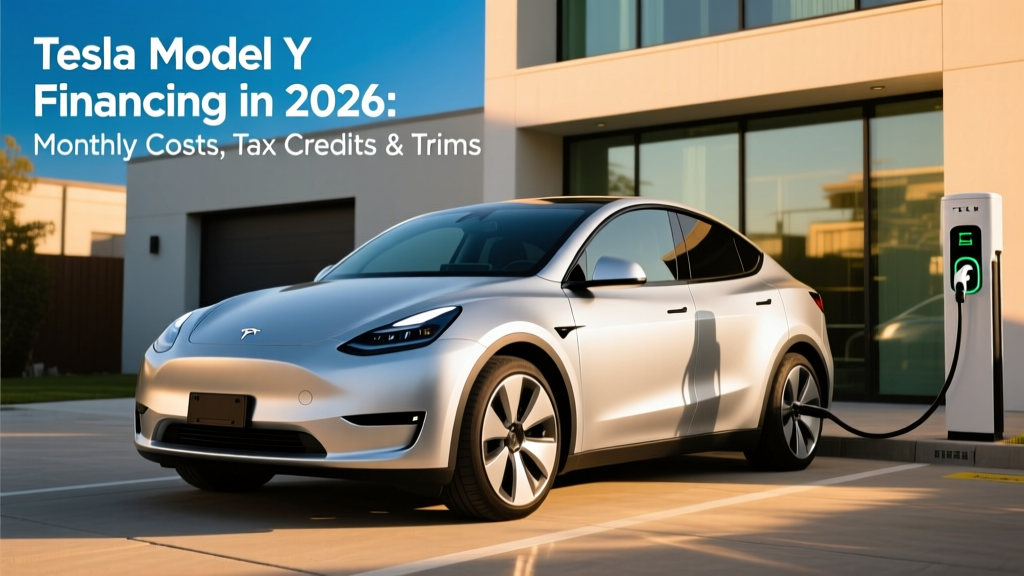
Even as the midsize electric-crossover segment crowds with rivals, the Tesla Model Y remains the sales-volume benchmark every competitor measures against. For 2026, Tesla has trimmed the lineup, updated the interior (the so-called "Juniper" refresh that began rolling out in early 2025), and repriced aggressively to defend share. But the question most shoppers actually type into Google is narrower: what does Tesla Model Y financing actually look like once you factor in the federal tax credit, state rebates, and real-world ownership costs?
This profile pairs the usual EV spec deep-dive — EPA range, charging curve, battery chemistry — with the math buyers need to decide whether to finance, lease, or pay cash. Figures reflect the 2026 model year as of publication; always confirm trim pricing on Tesla's configurator before signing.
2026 Tesla Model Y Specs at a Glance
| Spec | Long Range RWD | Long Range AWD | Performance |
|---|---|---|---|
| EPA range | 320 mi | 308 mi | 280 mi |
| Usable battery | ~75 kWh (NMC) | ~75 kWh (NMC) | ~75 kWh (NMC) |
| Drivetrain | Rear-motor RWD | Dual-motor AWD | Dual-motor AWD |
| Horsepower | ~346 hp | ~384 hp | ~510 hp |
| 0–60 mph | 5.8 sec | 4.8 sec | 3.5 sec |
| Peak DC charge rate | 250 kW | 250 kW | 250 kW |
| 10–80% DCFC time | ~25 min | ~25 min | ~25 min |
| Level 2 (11.5 kW) | ~44 mi/hr | ~44 mi/hr | ~44 mi/hr |
| MPGe (combined) | 122 MPGe | 117 MPGe | 111 MPGe |
| Base MSRP* | $44,990 | $47,990 | $52,490 |
*Destination fee (~$1,390) and any options excluded. Verify current pricing at tesla.com.
Real-World Range: What the EPA Number Doesn't Tell You
EPA sticker: 320 miles (Long Range RWD) / 308 miles (Long Range AWD) / 280 miles (Performance).
Real-world expectation: Plan on 260–285 miles at steady 75-mph highway speeds in mild weather; 210–240 miles in sub-freezing winter conditions with the heat pump running. Around-town driving with regen recovers closer to the EPA number.
The Model Y's efficiency — roughly 27–29 kWh per 100 miles depending on trim — is still among the best in the segment. Tesla's heat pump, introduced on the 2021 refresh, materially improves cold-weather range versus earlier resistive-heater EVs, but physics is physics: a 75 kWh pack simply stores less energy at 20°F, and cabin heating still draws heavily. On a 300-mile winter road trip through the Rockies, I typically plan one 15-minute Supercharger stop to stay comfortable above 15% SoC.
Charging Speed: Supercharger Network Is the Real Asset
| Level | Power | Miles Added | Notes |
|---|---|---|---|
| Level 1 (120V) | ~1.4 kW | ~3–4 mi/hr | Emergency/trickle only |
| Level 2 (240V, 48A) | 11.5 kW | ~44 mi/hr | Overnight full charge in ~8 hr |
| DC Fast (V3 Supercharger) | Peak 250 kW | ~175 mi in 15 min | Tapers hard above 80% SoC |
| DC Fast (V4 Supercharger) | Peak 250 kW (vehicle-limited) | Similar to V3 | CCS cable adapter native on 2026 models |
Tesla quotes 250 kW peak on V3 and V4 Superchargers, but the charge curve matters more than the headline number. The Model Y pulls close to peak rate only between roughly 10–35% SoC, then ramps down through stepped plateaus. Expect a true 10–80% session of about 25 minutes, with 80–100% adding another 20+ minutes — so plan road-trip stops around 80% and move on.
For home charging, a NACS Wall Connector on a 60A circuit delivers the full 11.5 kW (48A continuous). Budget $500–$1,500 for installation depending on panel proximity; older homes may need a $1,500–$3,000 service upgrade to 200A. See our Level 2 install cost guide for the full breakdown.
Financing the Model Y: MSRPs, Tax Credits, and Monthly Payments
This is where Tesla Model Y financing gets interesting — and where most buyers get tripped up by the rules. The 2026 Model Y qualifies for the IRS §30D Clean Vehicle Credit up to $7,500, but only if you clear three hurdles simultaneously:
- MSRP cap: SUVs/vans/pickups must sticker at $80,000 or less. All 2026 Model Y trims clear this easily.
- Buyer income cap: Modified AGI ≤ $150,000 single / $225,000 head of household / $300,000 joint. Exceed this and the credit phases out entirely.
- Battery sourcing: Critical minerals and battery components must meet escalating domestic-content thresholds. Tesla's Austin-built Model Y with CATL/Panasonic cells has generally qualified, but verify VIN eligibility at fueleconomy.gov before signing.
Under the 2026 rules, the credit can be transferred to the dealer at point of sale as an immediate price reduction — you don't have to wait until tax filing. See IRS.gov clean vehicle credits for current-year details.
| Trim | MSRP | After $7,500 Credit | Est. 72-mo Payment @ 5.9% APR* |
|---|---|---|---|
| Long Range RWD | $44,990 | $37,490 | ~$620/mo |
| Long Range AWD | $47,990 | $40,490 | ~$670/mo |
| Performance | $52,490 | $44,990 | ~$745/mo |
*Assumes $0 down, no trade, 72-month term, 5.9% APR, excludes tax/title/registration. Actual rate depends on creditworthiness. Tesla Financial Services rates vary; shop lenders like PenFed and LightStream for comparison.
Two financing wrinkles worth knowing:
- Leasing: The §30D credit technically belongs to the lessor, but most EV leases pass the savings through as a capitalized-cost reduction ("lease cash"). Confirm in writing before signing.
- Used Model Y: The separate §25E used-EV credit offers up to $4,000 (30% of sale price, capped) on vehicles under $25,000 with lower income limits ($75k/$112.5k/$150k). A 2022–2023 Model Y is starting to drift into this territory on the used market.
Performance, Tech, and Daily-Use Practicality
The Juniper-refreshed Model Y keeps Tesla's signature one-pedal driving and minimal dashboard — a 15.4-inch center touchscreen handles nearly every function, including glovebox release and mirror adjustment. Love it or hate it, the interface remains the fastest and most responsive in the segment. Wireless Apple CarPlay and Android Auto are still not offered; Tesla insists on its native UI.
Driver assistance is strong but frequently misunderstood. Basic Autopilot is standard and includes adaptive cruise and lane-centering. Enhanced Autopilot ($6,000) adds auto lane-change and Navigate on Autopilot. Full Self-Driving (Supervised) remains a Level 2 system — the driver must remain engaged, eyes on road, hands ready. It is not autonomous. Only Waymo-style robotaxis operate at SAE Level 4. FSD has improved substantially with the v13 neural-net stack, but treat it as a premium cruise control, not a chauffeur.
Cargo volume is genuinely SUV-class: roughly 30 cu ft behind the second row, 72 cu ft with seats folded, plus a ~4 cu ft front trunk. Rear legroom is about 41 inches — enough for two adults on a long trip, tighter for three across. The 180-degree camera view and ultrasonic-free Tesla Vision parking assist make the compact footprint feel smaller than it is.
Warranty, Ownership Costs, and Who Should Buy
Tesla's warranty is average for the segment:
- Basic vehicle: 4 years / 50,000 miles
- Battery & drive unit: 8 years / 120,000 miles (Long Range) with a 70% minimum capacity retention guarantee
That 70% SoH floor is typical — Hyundai/Kia offer 10yr/100k on the Ioniq 5 and EV6, which matters if you plan to keep the car a decade. Independent data from Recurrent Auto shows most Model Y packs retain ~90% capacity at 100,000 miles under normal use; NMC chemistry degrades primarily from high-SoC storage and DC fast-charging frequency, so daily charging to 80% and occasional 100% before trips is the recommended pattern.
Insurance is the hidden cost. Model Y premiums run 15–30% higher than comparable ICE crossovers due to repair costs and Tesla's aluminum-intensive structure. Get a quote before ordering — in some states Tesla's own insurance product is competitively priced and uses real-time driving data.
Who it suits: Tech-forward commuters and small families who want Supercharger network access for road trips, can charge at home, and value over-the-air feature updates. Who should look elsewhere: Buyers who want Apple CarPlay, physical controls, a longer basic warranty, or who lack reliable home/workplace charging.
Pros, Cons, and Key Competitors
Pros
- Best-in-class Supercharger network reliability
- Segment-leading efficiency (~28 kWh/100 mi)
- Strong §30D credit eligibility on all trims
- Fast OTA updates keep the car current
- Spacious cargo area with frunk
Cons
- No Apple CarPlay / Android Auto
- Touchscreen-only controls frustrate some drivers
- Insurance premiums above segment average
- FSD remains Level 2 despite the name
- 4-year basic warranty shorter than Korean rivals
The Hyundai Ioniq 5, Kia EV6, and Ford Mustang Mach-E all undercut the Model Y Long Range on price and offer CarPlay, but none match Tesla's charging ecosystem or efficiency. The upcoming Rivian R2 (2026) will target the same buyer with more off-road capability at a likely higher price. If road-trip charging reliability is your top priority, Tesla still wins; if interior tactility and dealer service matter more, drive the Ioniq 5 before signing.
Tesla Model Y Financing FAQ
What is the real-world range of the 2026 Tesla Model Y?
EPA rates the Long Range RWD at 320 miles, AWD at 308, and Performance at 280. Real-world highway driving in mild weather yields ~260–285 miles; cold-weather trips drop to ~210–240 miles.
How fast does the Model Y charge at home and on the road?
On a 48A Level 2 home charger it adds about 44 miles per hour (~11.5 kW), filling the pack overnight. On a V3/V4 Supercharger it peaks at 250 kW and hits 10–80% in roughly 25 minutes, tapering sharply above 80%.
Does the 2026 Model Y qualify for the $7,500 federal tax credit?
Yes, provided the buyer's MAGI is under the §30D caps ($150k/$225k/$300k) and the specific VIN clears battery-sourcing rules. Check your VIN at fueleconomy.gov before purchase. The credit can transfer to the dealer at point of sale as an instant discount.
What's a realistic monthly payment on a financed Model Y?
With the $7,500 credit applied, a 72-month loan at ~5.9% APR, and no money down, expect roughly $620/mo for Long Range RWD, $670/mo for Long Range AWD, and $745/mo for Performance. Actual rates and terms vary by lender and credit profile.
Is the Model Y worth buying versus the Ioniq 5 or Mach-E?
For road-trip charging reliability and software, yes — Tesla's Supercharger network remains the most dependable. For interior quality, physical controls, Apple CarPlay, and longer basic warranties, the Hyundai/Kia/Ford alternatives are compelling and often cheaper after incentives.