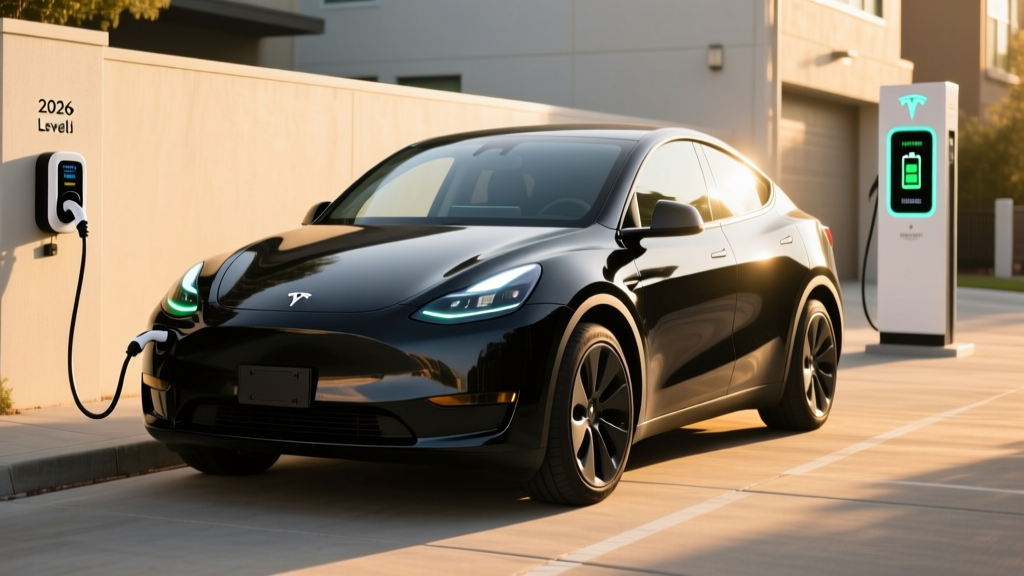
The refreshed "Juniper" Tesla Model Y entered 2026 as the best-selling EV in the world for a reason: it blends SUV practicality with sedan-like efficiency and access to the most reliable DC fast-charging network in North America. But with the Hyundai Ioniq 5, Ford Mustang Mach-E, and Chevrolet Equinox EV all closing the gap on range and price, buyers need hard numbers — not marketing gloss — to decide if the Model Y still earns its segment lead.
This review breaks down every spec that matters to an EV buyer: real-world range versus the EPA sticker, the exact charging curve you'll see at a Supercharger, federal tax credit eligibility under current IRS §30D rules, and the daily-ownership quirks that spec sheets don't mention. All figures reflect the 2026 model year as sold in the United States.
2026 Tesla Model Y Features at a Glance
| Spec | Value |
|---|---|
| EPA Range | 320 miles (Long Range AWD) |
| Battery (usable) | ~75 kWh, NMC (Nickel Manganese Cobalt) |
| Efficiency | 122 MPGe combined / 28 kWh/100 mi |
| Peak DC Fast Charge | 250 kW (CCS via NACS adapter or native NACS) |
| 10–80% DC Charge Time | ~27 minutes (preconditioned) |
| Level 2 Home Charge Rate | 11.5 kW (~44 miles/hour) |
| 0–60 mph | 4.8 seconds (Long Range AWD) |
| Horsepower | 384 hp (dual-motor AWD) |
| Cargo Volume | 30.2 cu ft (rear seats up) / 72.1 cu ft (folded) |
| Battery Warranty | 8 years / 120,000 miles (min 70% retention) |
| Base MSRP | $44,990 (Long Range AWD, before incentives) |
Range and Efficiency: EPA vs. Real World
Real-World Expectation: 270–295 miles in mixed driving at 65–75 mph; 230–260 miles in sustained cold weather (below 32°F) or at sustained 80+ mph highway speeds.
Tesla's NMC pack and heat-pump-equipped thermal management system deliver some of the best efficiency in the midsize electric SUV class. On the EPA cycle, the Long Range AWD posts 122 MPGe combined, translating to roughly 28 kWh per 100 miles — a figure that rivals smaller, lighter EVs.
In real-world highway testing at 70 mph and 65°F ambient, the Model Y typically returns 280–295 miles before the low-SoC warning. Drop the ambient temperature to 20°F and expect that figure to shrink to 240–260 miles, even with the heat pump running. The cabin heater and battery warming draw significant energy in deep cold — a reality all EVs share, though the Model Y's heat pump mitigates it better than resistive-heater competitors.
For the Rear-Wheel-Drive (Standard Range) trim, the EPA figure drops to 302 miles on a smaller ~60 kWh LFP (lithium iron phosphate) battery. LFP chemistry sacrifices some energy density but gains cycle life and allows routine 100% charging without degradation concerns — a major practical advantage for daily commuters who can charge at home every night.
Charging Speed: DC Fast Charge and Home Level 2
Charging speed is where Tesla's vertical integration shows its advantage. The 2026 Model Y supports peak DC charging at 250 kW on V3/V4 Superchargers and compatible third-party CCS stations (via the included NACS-to-CCS adapter on older charge-port vehicles, or natively on NACS-equipped 2026 models).
| Charging Level | Power / Voltage | Miles Added per Hour | Notes |
|---|---|---|---|
| Level 1 (120V household) | ~1.4 kW | ~5 mi/hr | Emergency/trickle only |
| Level 2 (240V, 48A) | 11.5 kW | ~44 mi/hr | Full charge in ~7–8 hours |
| DC Fast (Supercharger V3) | Peak 250 kW | ~1,000 mi/hr (peak) | 10–80% in ~27 min |
| DC Fast (above 80% SoC) | Tapers to <50 kW | Varies | 80–100% adds ~20+ min |
Charging-curve reality check: The 250 kW peak is achieved between roughly 10–35% SoC when the battery is preconditioned (the car automatically does this when you navigate to a Supercharger). Above 50% SoC, the curve tapers significantly — you'll see ~150 kW at 60% and under 75 kW past 80%. Plan road-trip stops around 10–80% charges; sitting to 100% at a DC charger wastes time and money.
For home charging, a Tesla Wall Connector on a 60-amp circuit delivers the full 11.5 kW (48 amps continuous). That translates to roughly 44 miles of range per hour of charging — enough to fully replenish a day's driving overnight. Installation costs typically run $500–$1,500 if your electrical panel has capacity; budget up to $3,000+ if a panel upgrade to 200A service is needed. Always consult a licensed electrician for final specifications.
Performance and Drivetrain
The Long Range AWD pairs dual permanent-magnet motors for 384 combined horsepower and all-wheel-drive traction. The 0–60 mph sprint completes in 4.8 seconds — brisk for a family SUV and more than adequate for highway merging and passing. The Performance trim drops that to 3.5 seconds with 456 hp, though at a ~$3,000 premium and a small range penalty (EPA 293 miles).
The Rear-Wheel-Drive model uses a single motor producing approximately 295 hp and a 5.8-second 0–60 time. For most commuters, this is the value sweet spot: lower price, lighter weight, and the LFP battery's 100% daily-charge tolerance.
Regenerative braking is aggressive and effectively enables one-pedal driving in most conditions. The Juniper refresh added a slightly softer initial regen mapping, making stop-and-go traffic less jerky than prior model years while still recapturing meaningful energy.
Interior, Cargo, and Standout Tech Features
The 2026 Juniper interior is a significant step up in material quality and noise isolation over the pre-2025 Model Y. Key feature highlights:
- Ventilated front seats (new for Juniper refresh) with heated rear seats standard
- Ambient lighting strip across the dashboard and doors
- 15.4-inch center touchscreen with faster processor and redesigned UI
- 8-inch rear passenger touchscreen for climate and entertainment control
- Power-folding second row with cargo release buttons in the trunk
- Acoustic glass on all windows — noticeably quieter at highway speeds
Cargo space remains generous at 30.2 cubic feet behind the second row and 72.1 cubic feet with seats folded. The front trunk (frunk) adds a useful additional compartment for charging cables or a small bag. Rear legroom measures 41.6 inches — comfortable for adults on longer trips.
Driver assistance: Tesla's Basic Autopilot (adaptive cruise + lane centering) is standard and competent for highway use. Full Self-Driving (Supervised) remains a $8,000 option or $99/month subscription. Despite the name, FSD is an SAE Level 2 system — the driver must remain fully engaged, hands on or near the wheel, and eyes on the road at all times. It is not autonomous driving.
Pricing, Trims, and Federal Tax Credit Eligibility
| Trim | Base MSRP | Est. After §30D Credit* | EPA Range |
|---|---|---|---|
| Rear-Wheel Drive (LFP) | $39,990 | ~$32,490 | 302 mi |
| Long Range AWD (NMC) | $44,990 | ~$37,490 | 320 mi |
| Performance AWD | $47,990 | ~$40,490 | 293 mi |
*Federal tax credit estimates assume buyer eligibility. Actual credit amount depends on battery sourcing, critical minerals content, buyer income, and MSRP caps under IRS §30D. The point-of-sale transfer option allows the credit to be applied at purchase rather than at tax filing.
The IRS §30D clean vehicle credit offers up to $7,500, split into two $3,750 halves: one for battery-component manufacturing origin and one for critical-minerals sourcing. Eligibility requirements include:
- MSRP cap: SUVs must be under $80,000 (all Model Y trims qualify)
- Buyer income cap: AGI ≤ $150,000 (single) / $300,000 (joint)
- Battery sourcing: Specific percentages of critical minerals and battery components must be sourced from the U.S. or FTA partners — these thresholds increase annually and can shift mid-year
- Point-of-sale transfer: Buyers can transfer the credit to the dealer at purchase for an immediate price reduction
Tesla's battery supply chain has historically qualified for the full $7,500 on the Model Y, but sourcing rules tighten each year. Always verify current eligibility on fueleconomy.gov before purchasing, as partial credit ($3,750) is possible if only one of the two sourcing requirements is met.
Pros and Cons
- Supercharger network access — most reliable DC charging in North America
- Class-leading efficiency (122 MPGe combined)
- Strong cargo capacity (72.1 cu ft max) with flat load floor
- Over-the-air updates continuously add features post-purchase
- LFP option (RWD) allows daily 100% charging without degradation worry
- Heat pump preserves range in cold weather better than most competitors
- No Apple CarPlay or Android Auto — Tesla's native infotainment only
- FSD (Supervised) is expensive ($8,000) and remains Level 2, not autonomous
- Turn-signal stalks removed in Juniper — signals now on steering wheel buttons (divisive ergonomics)
- No physical instrument cluster — all info on center screen
- Rear visibility is limited; relies heavily on cameras
- Insurance premiums tend to run 15–25% higher than comparable non-Tesla SUVs
Who Should Buy the 2026 Tesla Model Y?
The Model Y Long Range AWD is the strongest pick for families and road-trippers who need 300+ miles of range, fast DC charging for highway travel, and enough cargo space for strollers, luggage, or camping gear. The Supercharger network remains a decisive advantage for anyone who drives beyond their home metro area regularly.
The Rear-Wheel-Drive trim with LFP battery is the best value for daily commuters with home charging access. The ability to charge to 100% every night without battery degradation anxiety, combined with the lower $39,990 MSRP and potential $7,500 credit, makes it one of the most cost-effective electric SUVs on the market.
Buyers who prioritize conventional infotainment (CarPlay, physical buttons, traditional gauge clusters) or who want hands-free Level 2+ driving on mapped highways (GM's Super Cruise, Ford's BlueCruise) should cross-shop the Ioniq 5, Mach-E, or Cadillac Lyriq. The Model Y's minimalist cabin and Tesla-exclusive software ecosystem are strengths for some and dealbreakers for others.
Frequently Asked Questions
What is the real-world range of the 2026 Tesla Model Y?
The EPA rates the Long Range AWD at 320 miles. In real-world mixed driving at highway speeds (65–75 mph) and moderate temperatures, expect 270–295 miles. In cold weather (below 32°F), that drops to 230–260 miles. The RWD (LFP) trim is EPA-rated at 302 miles with similar proportional real-world reductions.
How fast does the Model Y charge at home and on the road?
On a Level 2 home charger (11.5 kW / 48A), the Model Y adds approximately 44 miles of range per hour, fully charging overnight in 7–8 hours. On a V3 Supercharger (250 kW peak), a 10–80% charge takes roughly 27 minutes with battery preconditioning. Charging above 80% slows dramatically — budget an additional 20+ minutes for 80–100% if needed.
Does the 2026 Tesla Model Y qualify for the $7,500 federal EV tax credit?
Historically, yes — the Model Y has qualified for the full $7,500 under IRS §30D. However, eligibility depends on current battery-sourcing rules (critical minerals and component manufacturing), buyer income (≤$150K single / ≤$300K joint), and the SUV MSRP cap ($80,000 — all trims clear this). Always verify on fueleconomy.gov before purchase, as sourcing thresholds change annually. The credit can be transferred at point of sale for an immediate price reduction.
Is the Tesla Model Y worth buying over the Hyundai Ioniq 5 or Ford Mach-E?
The Model Y wins on Supercharger network access, cargo space, and efficiency. The Ioniq 5 offers faster peak charging (up to 350 kW on 800V architecture, though sustained rates are comparable), Apple CarPlay/Android Auto, and a more conventional interior layout. The Mach-E provides a more engaging driving feel and BlueCruise hands-free highway driving. Choose the Model Y if road-trip charging reliability and cargo volume are your top priorities; choose the Ioniq 5 or Mach-E if you prefer traditional infotainment or hands-free Level 2+ driving.
What is the battery warranty on the 2026 Model Y?
Tesla covers the battery and drive unit for 8 years or 120,000 miles (whichever comes first) on the Long Range and Performance trims, with a minimum 70% capacity retention guarantee. The RWD (LFP) trim carries an 8-year/100,000-mile warranty. If capacity drops below 70% within the warranty period, Tesla will repair or replace the battery to restore it above that threshold.
Can the Model Y tow, and how does towing affect range?
The Model Y is rated to tow up to 3,500 pounds when equipped with the factory tow package. Towing a small trailer or boat typically reduces range by 30–50% depending on weight, aerodynamics, and terrain. Plan for roughly 160–200 miles of range when towing near max capacity, and ensure your route includes Supercharger stops.