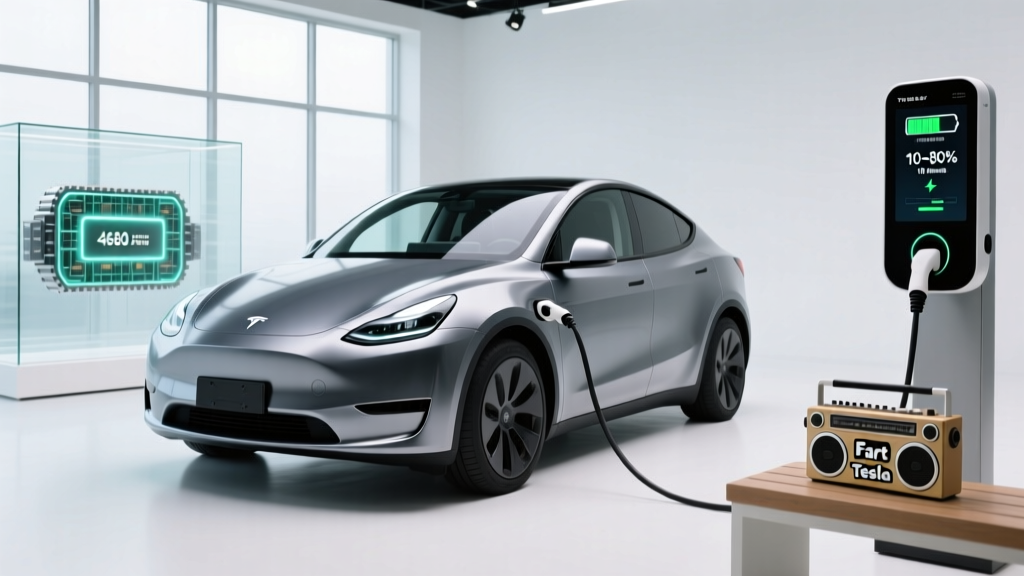
If you've spent any time on EV forums or TikTok, you've probably encountered the search term fart tesla — a phrase that blends Tesla's infamous Boom Box whoopee-cushion sound effect with genuine curiosity about the brand's most popular vehicle. Behind the meme is a serious question: Is the 2026 Tesla Model Y Juniper refresh actually worth your money? This review cuts through the viral noise to deliver exact range figures, charging data, pricing, and tax-credit reality for Tesla's best-selling crossover.
2026 Tesla Model Y at a Glance: Core Specs
| Spec | Long Range RWD | Long Range AWD | Performance |
|---|---|---|---|
| EPA Range | 320 mi | 300 mi | 280 mi |
| Battery (usable) | 75 kWh (est.) NMC | 75 kWh (est.) NMC | 75 kWh (est.) NMC |
| Peak DC Charge Rate | 250 kW | 250 kW | 250 kW |
| 10–80% DCFC Time | ~25 min | ~25 min | ~25 min |
| Level 2 Rate (11.5 kW AC) | ~37 mi/hr | ~37 mi/hr | ~37 mi/hr |
| 0–60 mph | 5.6 sec | 4.1 sec | 3.5 sec |
| Horsepower | 295 hp | 384 hp | 456 hp |
| Drivetrain | RWD (single motor) | AWD (dual motor) | AWD (dual motor) |
| Efficiency | 123 MPGe / 27 kWh/100mi | 117 MPGe / 29 kWh/100mi | 111 MPGe / 30 kWh/100mi |
| Base MSRP | $44,990 | $47,990 | $52,490 |
| Battery Warranty | 8 years / 120,000 miles (min 70% retention) | ||
Real-World Range: What the EPA Number Doesn't Tell You
The Long Range RWD Model Y carries an EPA-estimated 320 miles of range, placing it among the top non-luxury electric crossovers for 2026. But as any experienced EV owner knows, the sticker number is a starting point, not a guarantee.
EPA Estimate: 320 miles (Long Range RWD)
Highway (70–75 mph, mild weather): ~265–285 miles
City/Suburban mixed driving: ~295–315 miles
Cold weather (below 32°F, highway): ~220–250 miles (up to 30% loss without preconditioning)
Towing (with hitch, light trailer): ~180–210 miles
Tesla's thermal management system is among the best in the industry. The heat pump — standard on all 2026 Model Y trims — recovers waste heat from the drivetrain to warm the cabin, reducing winter range loss compared to resistance-heater-equipped competitors. Still, physics wins: at 20°F with no preconditioning, expect roughly 25–30% range reduction on highway trips. Preconditioning the battery while plugged in (via scheduled departure) mitigates this to around 15–20%.
The Juniper refresh improved the Model Y's aerodynamic drag coefficient slightly, and the revised tire compound on the 19-inch Gemini wheels contributes to the 320-mile EPA figure. If you opt for the 21-inch Über Turbine wheels, expect a roughly 5–8% range reduction across all trims due to increased rolling resistance and weight.
Charging Speed: DC Fast Charge and Home Level 2
The 2026 Model Y retains a 250 kW peak DC fast-charge rate on V3 and V4 Superchargers. While some competitors now advertise 300–350 kW peaks (Hyundai Ioniq 5, Porsche Macan Electric), Tesla's sustained charge curve remains competitive thanks to excellent thermal conditioning.
| Charging Level | Power | Speed | Notes |
|---|---|---|---|
| Level 1 (120V household) | ~1.4 kW | ~3–4 mi/hr | Emergency/top-up only |
| Level 2 (240V, 48A) | 11.5 kW | ~37 mi/hr | Full charge in ~8.5 hrs |
| DC Fast Charge (V3 Supercharger) | Peak 250 kW | 10–80% in ~25 min | Sustains ~170 kW avg to 60% |
| DC Fast Charge (CCS adapter, EA/others) | Up to 250 kW | 10–80% in ~27 min | Varies by station capability |
Charging curve reality: The Model Y hits 250 kW only at low state-of-charge (roughly 5–15% SoC). From 20–60%, it sustains approximately 150–180 kW. Above 80%, the rate tapers sharply — typical of NMC chemistry — dropping below 50 kW by 90%. For road trips, plan your stops around 10–80% windows; charging from 80–100% adds 15–20 extra minutes for only ~60 miles of range.
At home, the Model Y's 11.5 kW onboard charger means a full Level 2 session on a 48-amp circuit (60-amp breaker) adds roughly 37 miles per hour. A typical overnight session (8 hours) replenishes about 296 miles — essentially a full battery. Installation of a Tesla Wall Connector or equivalent NACS-compatible Level 2 unit typically costs $800–$2,200 depending on panel proximity and local permitting. Tesla includes the Mobile Connector with NACS and 5-15 adapters in the box.
Performance and Driving Dynamics
The Juniper generation brought revised suspension tuning, improved sound insulation, and a more refined ride compared to the pre-2025 Model Y. The Long Range AWD's 4.1-second 0–60 time is brisk for a family crossover, while the Performance trim's 3.5-second sprint remains genuinely quick.
Tesla's regenerative braking is single-mode (strong, one-pedal-capable), which some buyers love and others find abrupt compared to the adjustable regen in a Hyundai Ioniq 5 or BMW iX. The steering is precise but offers minimal feedback — a characteristic Tesla trait. Ride quality on the 19-inch wheels is compliant; the 21-inch wheels trade comfort for grip.
Interior, Cargo, and Technology
The Juniper interior is noticeably more premium than the outgoing Model Y. Ambient lighting, ventilated front seats, power-folding second-row seats, and a rear-seat entertainment screen are now standard or widely available. The minimalist cabin still relies on the 15.4-inch central touchscreen for virtually all controls, including the glovebox and mirror adjustments.
Cargo volume: 30.2 cubic feet behind the second row, expanding to 72.1 cubic feet with seats folded. The front trunk (frunk) adds 4.1 cubic feet — enough for a charging cable bag and a small duffel. Rear legroom measures 38.5 inches, adequate for adults on longer trips.
Standout tech:
- Autopilot (standard): Adaptive cruise, lane centering, auto emergency braking — SAE Level 2 driver assist, requires active supervision
- Full Self-Driving (Supervised) ($8,000 option or $99/mo): City street navigation, traffic-light recognition, auto lane changes. Still Level 2 — the driver must remain engaged at all times.
- Boom Box / Fart Mode: Yes, the viral feature is real. Tesla's Boom Box allows you to play whoopee-cushion sounds through the external pedestrian warning speaker (PWS) while the car is in Park or via a scheduled prank mode. It's a party trick, not a safety feature — and some municipalities have raised concerns about its use while driving. Use it in Park, at car meets, or to annoy your passengers. This is the feature behind the "fart tesla" search trend.
- Sentry Mode / Dashcam: Records from multiple cameras when parked or driving, with cloud clip saving.
- Over-the-air updates: Tesla pushes feature updates regularly; the 2026 Juniper software includes improved trip planner, battery preconditioning indicators, and enhanced Supercharger routing.
Tesla Autopilot and FSD (Supervised) are SAE Level 2 driver-assistance systems. They do NOT make the Model Y self-driving. You must keep your hands on the wheel (or demonstrate attention via the cabin camera) and remain prepared to take over at any moment. NHTSA continues to investigate Autopilot-related incidents. Treat these features as convenience aids, not autonomous systems.
Pricing, Trims, and Federal Tax Credit Eligibility
| Trim | MSRP | Est. Federal Credit (§30D) | Effective Price (if eligible) |
|---|---|---|---|
| Long Range RWD | $44,990 | Up to $7,500 | ~$37,490 |
| Long Range AWD | $47,990 | Up to $7,500 | ~$40,490 |
| Performance | $52,490 | Up to $7,500 | ~$44,990 |
All three Model Y trims fall under the $80,000 MSRP cap for SUVs under IRS §30D rules. However, eligibility for the full $7,500 credit depends on several factors that change annually:
- Buyer income caps: Modified AGI must not exceed $150,000 (single), $225,000 (head of household), or $300,000 (joint filers).
- Critical minerals & battery component sourcing: As of 2026, 80% of critical minerals and 100% of battery components must meet North American or FTA-partner sourcing requirements. Tesla has progressively shifted Model Y battery cell sourcing, but the exact credit amount ($3,750 or $7,500) depends on the specific battery pack batch and IRS guidance at time of purchase.
- Point-of-sale transfer: Eligible buyers can apply the credit as a down-payment reduction at delivery rather than waiting for a tax refund.
Check the latest eligibility details at IRS.gov §30D and confirm with a tax professional before ordering. Tesla's website also lists current credit estimates per trim at time of configuration.
How It Compares: Model Y vs. Key Rivals
The Model Y Juniper competes directly with the Hyundai Ioniq 5, Ford Mustang Mach-E, Kia EV6, and the refreshed Volkswagen ID.4. Here's how it stacks up on the metrics that matter:
| Metric | Tesla Model Y LR AWD | Hyundai Ioniq 5 (Long Range AWD) | Ford Mach-E (Extended Range AWD) |
|---|---|---|---|
| EPA Range | 300 mi | 290 mi | 290 mi |
| Peak DC Charge | 250 kW | 350 kW (800V) | 150 kW |
| 10–80% DCFC | ~25 min | ~18 min | ~38 min |
| 0–60 mph | 4.1 sec | 5.1 sec | 5.0 sec |
| Cargo (behind 2nd row) | 30.2 cu ft | 27.2 cu ft | 29.7 cu ft |
| Base MSRP (AWD) | $47,990 | $49,500 | $48,995 |
| Supercharger Network | Native NACS | NACS adapter required | NACS adapter required |
The Ioniq 5's 800-volt architecture delivers faster DC charging — a meaningful advantage on road trips. The Mach-E offers a more conventional interior layout with physical buttons. But the Model Y's combination of range, Supercharger access, cargo space, software ecosystem, and resale value remains difficult to beat as a complete package.
Pros and Cons
- 320-mile EPA range (LR RWD) is class-leading
- Native NACS / Supercharger network access — still the most reliable public charging ecosystem
- Spacious cargo area (30.2 cu ft) and comfortable rear seat
- Excellent OTA update cadence and software polish
- Strong resale value relative to EV competitors
- Heat pump standard — better cold-weather efficiency
- Yes, Boom Box / Fart Mode is genuinely funny at car meets
- 250 kW peak charge rate is falling behind 800V competitors (Ioniq 5 at 350 kW)
- Minimalist interior isn't for everyone — no physical buttons or traditional instrument cluster
- FSD (Supervised) is a $8,000 upsell that remains Level 2
- Ride quality on 21-inch wheels is firm
- Service center wait times remain a pain point in many metro areas
- Single-mode regen braking lacks adjustability
Who Should Buy the 2026 Model Y?
Choose the Model Y if:
- You want maximum Supercharger network access without adapters
- You need a practical family crossover with 300+ mile range and strong cargo capacity
- You value software features, OTA updates, and Tesla's ecosystem (Powerwall, Solar Roof integration)
- You want strong projected resale value in a depreciating EV market
- Fastest possible DC charging is your top priority (consider Ioniq 5 / EV6 with 800V)
- You prefer physical controls and a traditional dashboard layout (Mach-E, ID.4)
- You need third-row seating (Kia EV9, upcoming Tesla Model Y 7-seat option is cramped)
Frequently Asked Questions
What is the real-world range of the 2026 Tesla Model Y?
The EPA estimates 320 miles for the Long Range RWD and 300 miles for the Long Range AWD. In real-world highway driving at 70–75 mph in mild weather, expect 265–285 miles. In cold weather (below freezing) without preconditioning, plan for 220–250 miles. City and suburban driving with regenerative braking recovers energy and gets you closer to the EPA figure.
How fast does the Model Y charge at home and on the road?
On a 48-amp Level 2 home charger (11.5 kW), the Model Y adds approximately 37 miles of range per hour, with a full charge taking about 8.5 hours. On a V3 or V4 Tesla Supercharger (250 kW peak), a 10–80% session takes roughly 25 minutes. The charge rate tapers significantly above 80% — don't plan road-trip stops beyond 80% SoC unless necessary.
Does the 2026 Model Y qualify for the $7,500 federal EV tax credit?
All trims fall under the $80,000 MSRP SUV cap. However, the actual credit you receive ($3,750 or $7,500) depends on your income, the battery's critical-mineral and component sourcing at time of manufacture, and current IRS guidance. Check IRS.gov and consult a tax professional. The credit can be transferred at point of sale to reduce your down payment.
What is Tesla's Fart Mode / Boom Box?
Boom Box is a Tesla software feature that plays novelty sounds — including a whoopee cushion ("fart") sound — through the vehicle's external Pedestrian Warning Speaker. It can be triggered manually in Park or set as a prank via the Tesla app. It's the feature behind the viral "fart tesla" trend. Note: using novelty sounds while the vehicle is in motion may violate local noise ordinances and is discouraged by Tesla's own terms.
Is the Model Y worth buying over the Ioniq 5 or Mach-E?
It depends on your priorities. The Model Y wins on Supercharger access, cargo volume, software, and resale value. The Ioniq 5 wins on DC charging speed (18 min vs 25 min, 10–80%). The Mach-E wins on interior ergonomics for buyers who prefer physical controls. For most buyers who road-trip regularly and want a single-vehicle solution, the Model Y's Supercharger advantage remains decisive in 2026.
What is the battery warranty?
Tesla covers the Model Y battery and drive unit for 8 years or 120,000 miles (whichever comes first), with a minimum 70% capacity retention guarantee. If the battery degrades below 70% State of Health within that window, Tesla will repair or replace it at no cost. The NMC chemistry used in the Long Range and Performance trims typically shows 8–12% degradation over the first 100,000 miles based on fleet data, well within the warranty threshold.
Sources: EPA Fueleconomy.gov, Tesla Model Y Specifications, IRS §30D Clean Vehicle Credits