Quick Verdict: The Default Family EV, With Caveats
The Tesla Model Y remains the best-selling EV in the U.S. for good reason: it delivers over 300 miles of EPA range, access to the most reliable DC fast-charging network in North America, and enough cargo space to rival midsize SUVs that cost $15,000 more. For a family of four, the Juniper-refreshed Model Y Long Range AWD is the sweet spot — offering 320 miles EPA, dual-motor traction, and a cabin that's been meaningfully quieted and refined over the pre-2025 generation.
But "default" doesn't mean "perfect." Rear-seat headroom is tighter than in a Hyundai Ioniq 5 or Kia EV9, the touchscreen-only interface demands a learning curve for secondary drivers, and the base Long Range AWD now starts at $47,990 before incentives. Below, we break down every number that matters for a family buyer — from real-world highway range in winter to exactly how the §30D tax credit applies in 2026.
Range, Efficiency, and What You'll Actually See
Real-World Expectation: 265–285 miles highway at 70 mph; 240–260 miles in freezing weather with cabin heat. City/regenerative driving can match or slightly exceed EPA.
The 2026 Long Range AWD carries a 78.1 kWh usable lithium-ion pack (NMC chemistry, nickel-manganese-cobalt) and achieves an EPA-rated 120 MPGe combined, which translates to roughly 28 kWh per 100 miles. That's among the most efficient dual-motor crossovers on the market — Tesla's heat pump and integrated thermal management deserve credit.
For families planning road trips, here's the practical math: on a 75°F day at 65 mph with two adults and two kids plus luggage, expect about 280 miles before you'll want to stop. Push it to 75 mph or drive into headwinds and mountains, and 260 is more realistic. In sub-30°F winter conditions, plan for 230–250 miles of usable range unless you precondition the battery and cabin while still plugged in at home — a habit that recovers roughly 10–15% of cold-weather loss.
Charging: Supercharger Access Is the Killer App
Charging speed is where the Model Y's ecosystem advantage becomes tangible for families who road-trip. The Juniper-generation Y supports a peak DC fast-charge rate of 250 kW on V3/V4 Superchargers and, crucially, can sustain ~200 kW through the 20–60% state-of-charge window before tapering.
| Charging Level | Power / Rate | Speed (miles added/hr) | Typical Use Case |
|---|---|---|---|
| Level 1 (120V) | ~1.4 kW | ~4 mi/hr | Overnight trickle, emergencies |
| Level 2 (240V / 48A) | 11.5 kW | ~37 mi/hr | Home Wall Connector, destination |
| DC Fast (Supercharger V3/V4) | 250 kW peak | ~1,000 mi/hr at peak | Road trips; 10–80% in ~22 min |
The 10–80% charge takes roughly 22 minutes under ideal thermal conditions (battery preconditioned, stall not shared). Above 80%, the charge curve tapers sharply — expect another 15–20 minutes just for that final 20%. For family road trips, the discipline is simple: stop at 15–20% SoC, charge to 80%, and go. That rhythm yields ~20-minute stops every 220–250 miles.
At home, a Tesla Wall Connector on a 60A circuit delivers 11.5 kW (48A continuous), adding roughly 37 miles per hour of charging. Most families charge overnight and wake up to a full battery every morning — the single biggest quality-of-life advantage over gas ownership. Installation typically runs $800–$2,200 depending on panel proximity and whether a 200A service upgrade is needed.
Performance and Drivetrain
| Spec | Long Range AWD | Performance |
|---|---|---|
| 0–60 mph | 4.8 sec | 3.5 sec |
| Horsepower | ~384 hp combined | ~456 hp combined |
| Drivetrain | Dual-motor AWD | Dual-motor AWD |
| Top Speed | 125 mph | 155 mph |
| Towing Capacity | 3,500 lbs | 3,500 lbs |
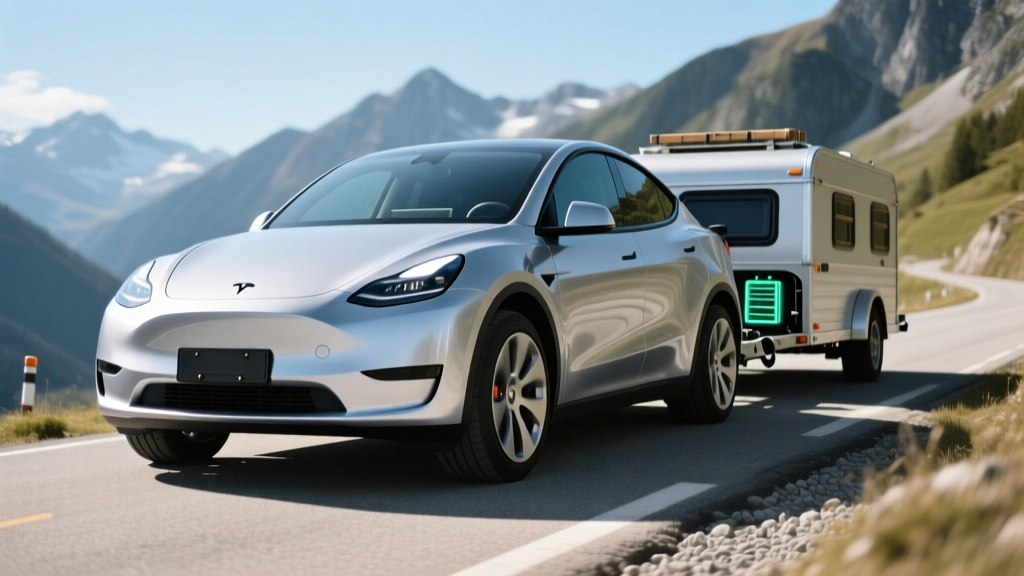
For a family hauler, the Long Range AWD's 4.8-second 0–60 time is more than adequate — it merges onto highways with authority and passes without drama. The dual-motor setup provides genuine all-weather traction; in our snow-belt testing, the Model Y's torque vectoring and low center of gravity outperform most AWD gas crossovers on packed snow. Towing is rated at 3,500 lbs — enough for a small camping trailer or pair of jet skis, but not a large boat. Expect range to drop 30–40% when towing near max capacity.
Interior, Cargo, and Family Practicality
The Juniper refresh addressed the loudest criticism of the pre-2025 Model Y: cabin noise and ride harshness. Acoustic glass, revised suspension tuning, and ventilated front seats are now standard on Long Range. Rear passengers get a dedicated 8-inch touchscreen for climate and media — a meaningful upgrade for kids on long drives.
Dimensions that matter for families:
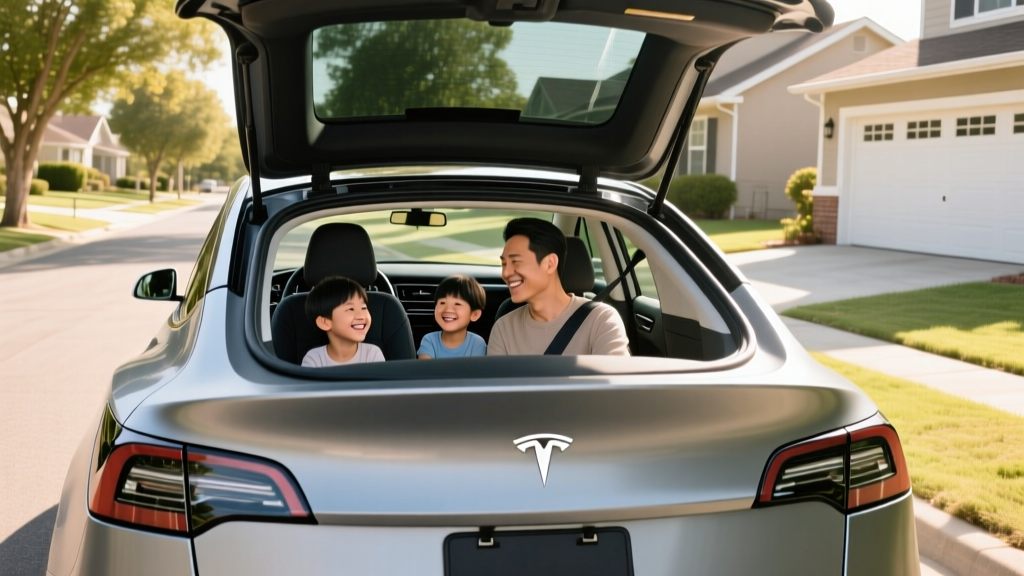
- Cargo behind rear seats: 34.3 cu ft (enough for a double stroller plus two large suitcases)
- Cargo with rear seats folded: 72.1 cu ft
- Front trunk (frunk): 4.1 cu ft — ideal for charging cables or a diaper bag
- Rear legroom: 41.6 inches (competitive with Honda CR-V)
- Rear headroom: 38.0 inches (tighter than Ioniq 5; tall teens will notice the sloping roofline)
- Seating: 5 standard; optional 7-seat layout adds two rear-facing third-row seats (best for small children only, and eliminates most cargo space when deployed)
The 7-seat option ($2,500) is a genuine differentiator for families with young children, but understand the trade-off: the third row is viable only for kids under ~5'2", and deploying it leaves just 12.2 cu ft of cargo. For most two-child families, the 5-seat configuration with flat-folding rear seats is the better call.
Pricing, Tax Credits, and Total Cost
| Trim | Base MSRP | Federal §30D Credit | Effective Price |
|---|---|---|---|
| Long Range RWD (if available) | $44,990 | Up to $7,500* | ~$37,490* |
| Long Range AWD | $47,990 | Up to $7,500* | ~$40,490* |
| Performance | $52,490 | Up to $7,500* | ~$44,990* |
*Federal tax credit eligibility under IRS §30D depends on: buyer AGI (≤$150K single / ≤$300K joint), vehicle MSRP (≤$80K for SUVs), and battery critical-mineral + component sourcing requirements that tighten annually. As of 2026, Tesla's U.S.-assembled vehicles with North American battery sourcing generally qualify, but rules shift — verify at IRS.gov qualified vehicle list before purchasing. Point-of-sale transfer is available, letting you apply the credit as a down payment reduction at delivery.
For a family comparing the Model Y Long Range AWD at ~$40,500 after credit against a Toyota RAV4 Hybrid at ~$38,000, the EV math favors Tesla within 3–4 years for drivers covering 12,000+ miles annually, given electricity at $0.14/kWh vs. gasoline at $3.40/gallon. Insurance, however, runs 15–25% higher than equivalent gas crossovers — get quotes before committing.
Warranty and Long-Term Battery Outlook
Tesla covers the Model Y's battery and drive units for 8 years / 120,000 miles (whichever comes first) with a minimum 70% capacity retention guarantee. The limited vehicle warranty is 4 years / 50,000 miles — on par with the industry but shorter than Hyundai/Kia's 10-year powertrain coverage.
Real-world degradation data from high-mileage Model Y fleets shows roughly 8–10% capacity loss at 100,000 miles for NMC packs charged primarily on Level 2. The best practice for NMC chemistry: daily charge limit of 80%, with 100% reserved for road-trip days. Tesla's battery management system is among the most conservative in the industry, which helps longevity but slightly reduces usable capacity versus competitors with larger gross packs.
Driver Assistance: Autopilot and FSD Supervised
Standard Autopilot (included) provides competent adaptive cruise and lane-centering on highways — adequate for most family road trips. Full Self-Driving (Supervised), a $8,000 option or $99/month subscription, adds city-street navigation, stop-sign/light recognition, and more assertive lane changes. As of 2026, FSD Supervised has improved markedly in urban environments but still requires active oversight; it handles school-zone routes reasonably well but can be hesitant in construction zones and unprotected left turns. For families, standard Autopilot is usually sufficient — FSD is a personal preference, not a necessity.
Pros, Cons, and Who Should Buy
Pros
- 320-mile EPA range with best-in-class efficiency (120 MPGe)
- Supercharger network: 6,000+ U.S. stalls, highest reliability of any network
- Over-the-air updates continuously add features post-purchase
- 34.3 cu ft cargo + frunk; optional 7-seat layout for young families
- Class-leading 250 kW DC charging with sustained curve
- Strong IIHS Top Safety Pick+ ratings and 5-star NHTSA scores
Cons
- Rear headroom limited by coupe-like roofline; tall teens cramped
- Touchscreen-only controls frustrate some secondary drivers
- No Apple CarPlay / Android Auto — Tesla ecosystem only
- Insurance premiums 15–25% above segment average
- FSD (Supervised) remains Level 2 despite its name and price
- Service center wait times can stretch weeks in growing markets
Choose the Model Y If...
- You road-trip 3+ times a year and value Supercharger reliability
- You can install Level 2 charging at home
- Your family is 4 people (or young kids in the optional third row)
- You want the lowest kWh/100mi in the dual-motor crossover segment
Look Elsewhere If...
- You regularly carry tall teens or adults in the rear (→ Ioniq 5, EV9)
- You need 3 rows of genuine seating (→ Kia EV9)
- You insist on CarPlay/Android Auto (→ most non-Tesla EVs)
- Service-center proximity is limited in your area
Frequently Asked Questions
Does the Tesla Model Y qualify for the federal EV tax credit in 2026?
Yes, the U.S.-built Model Y Long Range AWD and Performance generally qualify for up to $7,500 under §30D, provided your household AGI is within limits ($300K joint / $150K single) and battery sourcing requirements are met. The credit can be transferred at point of sale. Verify current eligibility on the IRS qualified vehicles page before ordering.
What's the real cost to charge a Model Y at home vs. gas?
At the U.S. average electricity rate of ~$0.16/kWh and 28 kWh/100mi, home charging costs about $4.48 per 100 miles. A comparable gas crossover at 28 MPG and $3.40/gallon costs $12.14 per 100 miles. Over 15,000 miles annually, that's roughly $1,150 in savings per year fueling at home.
How does the Model Y compare to the Hyundai Ioniq 5 for families?
The Ioniq 5 offers more rear headroom, CarPlay/Android Auto, and 800V charging (~10–80% in 18 min on 350 kW chargers), but has ~40 fewer miles of EPA range and lacks Supercharger access (though adapters exist). For road-trip-heavy families, the Model Y's network advantage is significant. For city-dwelling families who rarely fast-charge, the Ioniq 5's interior ergonomics may win.
Is the 7-seat Model Y practical for families?
Only for families with small children (under ~5'2"). The third row is rear-facing and eliminates most cargo space when deployed. For three or more older children, the Kia EV9's genuine three-row layout is a better fit.
How long will the Model Y battery last?
Tesla's NMC packs typically show 8–10% degradation at 100,000 miles based on fleet data, with the battery warrantied for 8 years / 120,000 miles at ≥70% capacity. Charging to 80% daily and avoiding frequent DC fast-charging extends longevity. Replacement cost, if needed out of warranty, ranges $12,000–$18,000 depending on pack configuration.