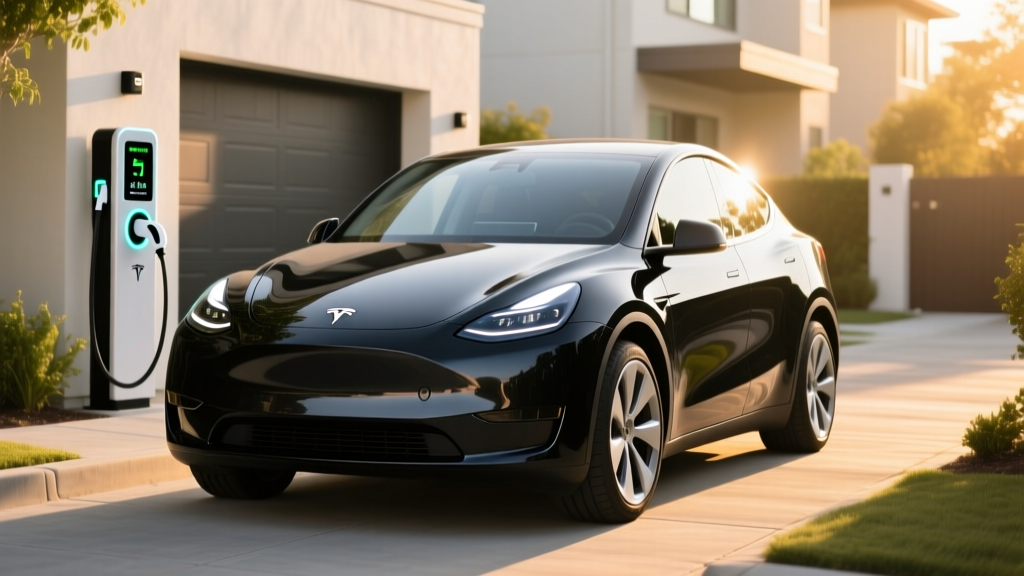
The Tesla Model Y remains one of the best-selling electric vehicles in the United States, but for buyers eyeing federal incentives, the question isn't just "how far does it go?" — it's whether the Tesla Model Y EV tax credit actually applies to their purchase. With IRS §30D rules tightening around battery sourcing, MSRP caps, and buyer income limits, eligibility is far from guaranteed.
This guide walks through the real 5-year cost of owning a 2026 Tesla Model Y, including whether you can claim the federal credit at the point of sale, what you'll actually spend on electricity versus gas, and the insurance and depreciation realities that catch many first-time EV buyers off guard.
2026 Tesla Model Y: Specs That Affect Your Wallet
Before calculating ownership costs, here are the numbers that matter for the current-generation Model Y (Long Range AWD, the volume seller):
| Spec | 2026 Model Y Long Range AWD |
|---|---|
| EPA Range | 320 miles (real-world highway ~275–290 mi; cold weather ~240–260 mi) |
| Battery | ~75 kWh usable, NMC chemistry |
| Peak DC Fast Charge | 250 kW (10–80% in ~22 min on V3 Supercharger) |
| Level 2 Charge Rate | 11.5 kW (~44 mi/hr) |
| Efficiency | 122 MPGe combined / 27 kWh/100 mi |
| 0–60 mph | 4.8 seconds |
| Horsepower | 384 hp (dual motor) |
| Base MSRP | $44,990 (Long Range AWD) |
| Battery Warranty | 8 years / 120,000 miles (≥70% retention) |
Real-World Range Note: The EPA rates the Model Y Long Range at 320 miles, but sustained highway driving at 75+ mph typically yields 275–290 miles. In freezing temperatures with cabin heat running, expect 240–260 miles. The heat pump on the current Model Y mitigates some cold-weather loss compared to older EVs, but physics still applies.
Federal Tax Credit: Does the Model Y Qualify in 2026?
The IRS §30D Clean Vehicle Credit offers up to $7,500 for qualifying new EVs, split into two halves: $3,750 for meeting critical-minerals sourcing requirements and $3,750 for battery-component sourcing. The Tesla Model Y's eligibility has fluctuated as Tesla adjusts its supply chain. As of early 2026, certain Model Y trims built with North American-sourced battery components and qualifying critical minerals remain eligible for the full $7,500 — but this can change with model-year production shifts.
§30D Eligibility Checklist (2026 Rules):
- MSRP Cap: Vehicle must be under $55,000 for sedans or $80,000 for SUVs/pickups/vans. The Model Y is classified as an SUV, so the $80,000 cap applies. Most trims qualify.
- Buyer Income Cap (Modified AGI): $150,000 single filer / $225,000 head of household / $300,000 married filing jointly. Exceed these and you're ineligible regardless of the vehicle.
- Battery Sourcing: Critical minerals must be extracted or processed in the U.S. or a free-trade-agreement country; battery components must be manufactured or assembled in North America. Foreign Entity of Concern (FEOC) restrictions apply and tighten annually.
- Final Assembly: Must occur in North America (the Fremont and Austin factories qualify).
- Point-of-Sale Transfer: You can transfer the credit to the dealer at purchase, reducing your out-of-pocket cost immediately — even if you have no federal tax liability that year.
- One Credit Per VIN: The vehicle must be new and not previously credited.
Key caveat: Always verify current eligibility on IRS.gov's qualifying vehicle list before purchasing. Battery sourcing rules tighten each year under the FEOC provisions, and a vehicle eligible in January may lose eligibility by mid-year if its supply chain shifts. Consult a tax professional for your specific situation.
State, Local, and Utility Incentives
Beyond the federal credit, incentives vary dramatically by location:
- California: Up to $2,000–$7,000 via the Clean Fuel Rebate and local air-district programs (income-dependent).
- Colorado: State tax credit of up to $5,000 for new EVs (stacks with federal).
- New York: Drive Clean Rebate up to $2,000 at point of sale.
- Utility Rebates: Many utilities (PG&E, ConEdison, Xcel Energy, etc.) offer $500–$1,500 rebates for home Level 2 charger installation or off-peak charging credits.
Check your state energy office and local utility for current programs — these change frequently and often have funding caps.
5-Year Total Cost of Ownership: Model Y vs. Gas SUV
To answer the central question — how much does it really cost to own an EV over 5 years? — here's a side-by-side comparison of the 2026 Model Y Long Range AWD against a similarly priced gas compact SUV (e.g., Toyota RAV4 AWD, ~$35,000 MSRP, 30 MPG combined).
Assumptions: 15,000 miles/year (75,000 total), home charging at $0.14/kWh national average, gas at $3.50/gallon, 5-year loan at 6.5% APR with 10% down.
| Cost Category | Tesla Model Y LR AWD | Gas Compact SUV (30 MPG) |
|---|---|---|
| Purchase Price (MSRP) | $44,990 | $35,000 |
| Federal Tax Credit | −$7,500 (if eligible) | $0 |
| Net Purchase | $37,490 | $35,000 |
| Fuel/Energy (75k miles) | $2,835 (20,250 kWh) | $8,750 (2,500 gal) |
| Maintenance (5 years) | ~$1,200 | ~$3,500 |
| Insurance (5 years) | ~$12,500 | ~$8,500 |
| Estimated Depreciation | ~$17,000 | ~$14,000 |
| Total 5-Year Cost | ~$71,025 | ~$69,750 |
What this shows: With the full $7,500 federal credit applied, the Model Y's 5-year cost is competitive with a gas SUV — essentially breaking even. Without the credit, the Model Y costs roughly $8,500 more over 5 years, driven largely by higher insurance premiums and steeper depreciation. The fuel and maintenance savings are real but don't fully offset the higher purchase price on their own.
Charging vs. Gas: The Per-Mile Math
| Metric | Model Y (Home Charging) | Model Y (DC Fast Charging) | Gas SUV (30 MPG) |
|---|---|---|---|
| Energy Source Cost | $0.14/kWh | $0.40/kWh | $3.50/gallon |
| Efficiency | 27 kWh/100 mi | 27 kWh/100 mi | 3.33 gal/100 mi |
| Cost per Mile | $0.038 | $0.108 | $0.117 |
| Annual Fuel Cost (15k mi) | $567 | $1,620 | $1,750 |
The economics are clear: home charging saves roughly $1,183 per year versus gas. But if you rely primarily on DC fast charging at public stations (at $0.35–$0.48/kWh on networks like Electrify America or Tesla Superchargers), your per-mile cost nearly triples and approaches gas-equivalent pricing. Home Level 2 charging access is the single biggest variable in EV ownership economics.
For a full breakdown of home charging setup costs, see our Level 2 installation guide.
Maintenance Savings: Where EVs Actually Win
| Maintenance Item | Model Y (5-Year Cost) | Gas SUV (5-Year Cost) |
|---|---|---|
| Oil Changes | $0 | $600–$900 |
| Brake Pads/Rotors | $0–$200 (regen extends life) | $600–$1,200 |
| Transmission Fluid | $0 | $150–$300 |
| Air Filters/Spark Plugs | $0 | $200–$400 |
| Cabin Air Filter | $150 | $150 |
| Tire Rotation/Replacement | $800–$1,000 (EV tires wear faster due to weight/torque) | $600–$800 |
| Coolant/Misc | $50 | $200 |
| Total Estimated | ~$1,200 | ~$3,500 |
The Model Y eliminates oil changes, spark plugs, transmission fluid, and most brake wear (regenerative braking handles the majority of deceleration, preserving friction brakes for years). However, EVs are heavier and produce instant torque, which accelerates tire wear — budget for tire replacement sooner than you would on a gas vehicle. Net maintenance savings over 5 years: approximately $2,300.
Insurance: The Hidden EV Cost
EV insurance premiums are typically 15–30% higher than equivalent gas vehicles. For the Model Y, national average premiums run $2,300–$2,700/year depending on your driving record, location, and coverage level — compared to roughly $1,600–$1,800/year for a gas compact SUV.
Why EVs cost more to insure:
- Higher repair costs: EV battery packs and specialized powertrain components are expensive to replace after a collision. Body shops need EV-specific training and equipment.
- Total-loss thresholds: Even minor battery damage can trigger a total-loss declaration, increasing insurer payouts.
- Higher vehicle MSRP: Insurers factor in replacement cost; the Model Y's higher sticker price translates to higher premiums.
- Limited repair network: Fewer certified EV collision centers mean higher labor rates and longer rental-car periods during repairs.
Some insurers now offer EV-specific policies with discounts for safe charging behavior or bundled home-charger coverage. Shop at least three quotes before purchasing — premiums for the same Model Y can vary by $800+/year between carriers.
Depreciation and Resale Value Trends
EV depreciation has been a moving target. Early EVs lost value rapidly due to battery-degradation fears and rapid price cuts on new models. The Model Y has held value better than most EVs, but the landscape shifted in 2023–2025 when Tesla aggressively cut prices, which immediately dragged down used-model values across the board.
Current 5-year depreciation estimates:
- Tesla Model Y: ~38–45% over 5 years (estimating ~$17,000–$20,000 loss on a $44,990 purchase)
- Gas compact SUV (RAV4-class): ~35–40% over 5 years (~$14,000 loss on a $35,000 purchase)
The gap is narrowing as EV adoption matures and battery longevity data reassures used buyers. The Model Y's 8-year/120,000-mile battery warranty (guaranteeing ≥70% capacity retention) provides a floor for resale confidence. However, Tesla's history of unpredictable price cuts remains a depreciation wildcard — a new-model price drop instantly reduces your used vehicle's market value.
According to fueleconomy.gov, EVs with strong efficiency ratings and established charging networks (like Tesla's Supercharger ecosystem) tend to retain value better than EVs from brands with limited infrastructure.
Decision Framework: Is the Model Y Worth It in 2026?
Choose the Model Y if:
- You qualify for the full $7,500 federal credit (check income caps and current IRS sourcing rules)
- You can install a Level 2 home charger (this is non-negotiable for the economics to work)
- You drive 12,000–20,000 miles/year (higher mileage amplifies fuel savings)
- You value Supercharger network access for road trips — still the most reliable DC fast-charging network in the U.S.
Consider a gas SUV or PHEV instead if:
- You exceed the income caps ($300k MFJ / $150k single) and can't claim the credit
- You live in an apartment or lack home-charging access
- Your local electricity rates exceed $0.25/kWh and you'd rely on expensive public charging
- You want to minimize upfront cost and insurance premiums
Frequently Asked Questions
How much does it really cost to own a Tesla Model Y over 5 years?
Approximately $68,000–$71,000 over 5 years (75,000 miles) with the federal tax credit applied, or $75,000–$78,500 without it. This includes purchase price, energy, maintenance, insurance, and depreciation. It's competitive with a gas compact SUV only when you capture the full $7,500 credit and charge primarily at home.
Do I qualify for the Tesla Model Y EV tax credit?
You likely qualify if: (1) your modified AGI is under $300,000 (married filing jointly) or $150,000 (single), (2) the specific Model Y trim you buy has MSRP under $80,000 (SUV cap), and (3) the vehicle's battery meets current-year critical-mineral and component sourcing rules. Verify on the IRS qualifying vehicles page before purchasing — eligibility can change mid-year.
How much do I save on fuel and maintenance?
Home-charging the Model Y saves approximately $1,183/year in fuel costs versus a 30 MPG gas SUV. Maintenance savings add another ~$460/year. Combined, that's roughly $8,200 in operational savings over 5 years — significant, but not enough alone to offset the higher purchase price without the tax credit.
Are EVs more expensive to insure than gas cars?
Yes, typically 15–30% more. Model Y insurance averages $2,300–$2,700/year nationally versus ~$1,700 for a gas compact SUV. Higher repair costs, specialized parts, and the vehicle's MSRP drive the premium gap. Always get quotes before committing to a purchase.
How well does the Tesla Model Y hold its value?
The Model Y depreciates roughly 38–45% over 5 years, slightly more than top-selling gas SUVs. Tesla's unpredictable new-vehicle pricing can cause sudden drops in used values. However, the strong Supercharger network, over-the-air updates, and battery warranty help support resale relative to other EVs.
Can I get the tax credit as a point-of-sale discount?
Yes. Under current §30D rules, you can transfer the credit to the dealer at the time of purchase, reducing your out-of-pocket cost immediately — even if your tax liability for the year is less than $7,500. The dealer handles the IRS paperwork. Confirm with your Tesla advisor that the specific VIN qualifies before finalizing.
Sources: IRS §30D Qualifying Vehicles, fueleconomy.gov, Tesla official specifications. Tax credit rules are subject to change — always verify current eligibility before purchase.